Friday, December 06, 2013

Europe 2005

Part 6: Paris


For reasons that I'll go into at a later time, I'm keen to wrap-up various series that I've started here at The Wild Reed. A few weeks ago, for instance, I concluded Pahá Sápa Adventure, my series of posts documenting time spent in the Black Hills of South Dakota earlier this year.

This evening I conclude a series started back in August of 2010, and which highlights the two weeks that my parents and I spent traveling in Europe in the summer of 2005. The main focus of this final installment is on our time in Paris. However, the first couple of photos are actually of Lucerne, Switzerland, which we visited while traveling to Paris from Florence, Italy.


Above: In this picture can be seen part of one of Lucerne's most famous landmarks, the Chapel Bridge (Kapellbrücke), a wooden bridge first erected in the 14th century.

About Lucerne Wikipedia notes:

Lucerne is a city in north-central Switzerland, in the German-speaking portion of that country. It is the capital of the Canton of Lucerne and the capital of the district of the same name. With a population of about 76,200 people, Lucerne is the most populous city in Central Switzerland, and a nexus of transportation, telecommunications, and government of this region. The city's urban area consists of 17 cities and towns located in three different cantons with an overall population of about 250,000 people.


Above: During our time in Lucerne we visited a Swiss village on the outskirts of the city. Part of the journey involved traveling in a horse-drawn wagon. It was while we were enjoying the warm Swiss sun and the beautiful alpine vistas that we heard about the terrible event that had taken place in the U.S.


Thursday, September 1, 2005 (11:57 p.m.)

I was in the picturesque and peaceful Swiss countryside this morning, enjoying a horse and carriage ride, when I was informed of the events in New Orleans. Tonight I've been watching CNN International in my Lucerne hotel room. As many as 1,000 people could be dead in New Orleans and elsewhere in the region as the result of Hurricane Katrina. Elsewhere, close to 1,000 people have been killed in Baghdad as a result of a stampede of people on a bridge. I've also just finished viewing a special commemorative program on the first anniversary of the Beslam massacre in Russia. So much suffering, chaos and destruction in the world. I pray for all affected by such realities – pray that they may know God's transforming love, strength and peace in their lives.

The U.S. officials, including President Bush, all seem totally inept. They also sound incredibly pompous and uncaring – more concerned about their reputations than the harsh truth that their response to this disaster has been totally inadequate. I pray that there will be justice and accountability in the weeks and months ahead.


Above: Paris!

Following is another excerpt from my journal.


Sunday, September 4, 2005

Paris was very beautiful and interesting – though, as with London, it's unfortunate that so many of its monuments and buildings honor military exploits and the conquests of empire.

At the Louvre on Friday night I located three statues of Antinous – one original piece from Roman times and two that were made in later times. I'm getting quite good at recognizing Antinous, which is just as well as the museum guides were hopeless.

After the Lourve we went on a night cruise on the Seine. Yesterday we visited the Eiffel Tower and Napolean's tomb.

Afterwards, Mum, Dad and I did our own thing by catching a city sightseeing bus and visiting the Arc de Triomphe. We then went in search of the last home of Maria Callas – which we found easily enough as the bus dropped us off quite close to Georges Mandel Avenue.

Last night we enjoyed a night of entertainment at a Parisian cabaret – complete with can-can dancers, acrobats and jugglers.


Above: A view of the base of the Eiffel Tower – Saturday, September 3, 2005.

Notes Wikipedia:

The Eiffel Tower (La Tour Eiffel) is an iron lattice tower located on the Champ de Mars in Paris. It was named after the engineer Gustave Eiffel, whose company designed and built the tower. Erected in 1889 as the entrance arch to the 1889 World's Fair, it has become both a global cultural icon of France and one of the most recognizable structures in the world. The tower is the tallest structure in Paris and the most-visited paid monument in the world; 7.1 million people ascended it in 2011. The tower received its 250 millionth visitor in 2010.

The tower stands 324 metres (1,063 ft) tall, about the same height as an 81-storey building. During its construction, the Eiffel Tower surpassed the Washington Monument to assume the title of the tallest man-made structure in the world, a title it held for 41 years, until the Chrysler Building in New York City was built in 1930. Because of the addition of the antenna atop the Eiffel Tower in 1957, it is now taller than the Chrysler Building by 5.2 metres (17 ft). Not including broadcast antennas, it is the second-tallest structure in France, after the Millau Viaduct.

The tower has three levels for visitors. The third level observatory's upper platform is at 279.11 m (915.7 ft) the highest accessible to the public in the European Union. Tickets can be purchased to ascend, by stairs or lift (elevator), to the first and second levels. The walk from ground level to the first level is over 300 steps, as is the walk from the first to the second level. Although there are stairs to the third and highest level, these are usually closed to the public and it is usually accessible only by lift. The first and second levels have restaurants.


Above: Mum and Dad on a night cruise on the River Seine – Friday, September 2, 2005.


Above: The Arc de Triomphe – Saturday, September 3, 2005.

About this impressive structure Wikipedia notes the following:

The Arc de Triomphe de l'Étoile is one of the most famous monuments in Paris. It stands in the centre of the Place Charles de Gaulle (originally named Place de l'Étoile), at the western end of the Champs-Élysées. The Arc de Triomphe (in English: "Triumphal Arch") honours those who fought and died for France in the French Revolutionary and the Napoleonic Wars, with the names of all French victories and generals inscribed on its inner and outer surfaces. Beneath its vault lies the Tomb of the Unknown Soldier from World War I.

The Arc de Triomphe is the linchpin of the historic axis (Axe historique) – a sequence of monuments and grand thoroughfares on a route which goes from the courtyard of the Louvre, to the Grande Arche de la Défense. The monument was designed by Jean Chalgrin in 1806, and its iconographic program pitted heroically nude French youths against bearded Germanic warriors in chain mail. It set the tone for public monuments, with triumphant patriotic messages.

The monument stands 50 metres (164 ft) in height, 45 m (148 ft) wide and 22 m (72 ft) deep. The large vault is 29.19 m (95.8 ft) high and 14.62 m (48.0 ft) wide. The small vault is 18.68 m (61.3 ft) high and 8.44 m (27.7 ft) wide. It was the largest triumphal arch in existence until the construction of the Arch of Triumph in Pyongyang, in 1982. Its design was inspired by the Roman Arch of Titus. The Arc de Triomphe is so colossal that three weeks after the Paris victory parade in 1919 (marking the end of hostilities in World War I), Charles Godefroy flew his Nieuport biplane through it, with the event captured on newsreel.


Above: The Louvre.

Notes Wikipedia:

The Louvre or Louvre Museum is one of the world's largest museums and a historic monument. A central landmark of Paris, France, it is located on the Right Bank of the Seine in the 1st arrondissement (district). Nearly 35,000 objects from prehistory to the 21st century are exhibited over an area of 60,600 square metres (652,300 square feet). With more than 8 million visitors each year, the Louvre is the world's most visited museum.

The museum is housed in the Louvre Palace (Palais du Louvre), originally built as a fortress in the late 12th century under Philip II. Remnants of the fortress are visible in the basement of the museum. The building was extended many times to form the present Louvre Palace.


Above: With the Antinous Mondragone in the Louvre – Friday, September 2, 2005.

Notes Wikipedia:

The Antinous Mondragone is a unique colossal 0.95 metre high marble example of the iconographic type of the deified Antinous, of c. 130 CE. It can be identified as him from the striated eyebrows, full lips, sombre expression and the head's twist down and to the right (reminiscent of that of the Lemnian Athena), whilst its smooth skin and elaborate, centre-parted hair mirror those of Hellenistic images of Dionysus and Apollo.

It formed part of a colossal acrolithic cult statue for the worship of Antinous as a god. Thirty-one holes in three different sizes have been drilled for the attachment of a head-dress (possibly a lotus flower or uraeus) in metal; the sculpture has also lost eyes in metal, ivory or coloured stone.

It is said to have been found at Frascati between 1713 and 1729 - it was certainly displayed as part of the Borghese collection at their Villa Mondragone there. The German art historian Johann Joachim Winckelmann made it better known by praising it in his History of Ancient Art, calling it "the glory and crown of art in this age as well as in others" and "so immaculate that it appears to have come fresh out of the hands of the artist." This was since, though Roman in date, it echoed the 5th century BC Greek style which Winckelmann preferred over Roman art.

In 1807 it was bought with a large part of the Borghese collections for Napoleon. Sometime since a brown layer of wax was added to give an opaque finish, along with plaster round the base of the neck to make the statue look more complete - these were both removed in recent cleaning. It is now held at the Louvre Museum, though it toured to the Henry Moore Institute, Leeds in 2006 for the exhibition "Antinous: The Face of the Antique."


Writes Vittorio Lingiardi of Antinous (or Antinoos) in Men in Love: Male Homosexualities from Ganymede to Batman:

Like Ganymede, Antinoos for centuries stood as a symbol of same-sex love, and also as a platonic ideal of spiritual love. Like Ganymede, Antinoos was transformed into a star: wanting his lover to be remembered for all eternity, [the emperor] Hadrian named a constellation after him. In the Almagest, Ptolemy’s first great compendium of Greek astronomy, the stars of Antinoos are mentioned as part of the Aqila (Eagle) group; in various ancient maps of the heavens.


The best book about Antinous and Hadrian is undoubtedly Royston Lambert's Beloved and God. It's a book that is not only scholarly but also eloquently written and entertaining.


Above: The façade of the Palais Garnier – Saturday, September 3, 2005.

According to Wikipedia:

The Palais Garnier is a 1,979-seat opera house, which was built from 1861 to 1875 for the Paris Opera. It was originally called the Salle des Capucines because of its location on the Boulevard des Capucines in the ninth arrondissement of Paris, but soon became known as the Palais Garnier in recognition of its opulence and its architect, Charles Garnier. The theatre is also often referred to as the Opéra Garnier, and historically was known as the Opéra de Paris or simply the Opéra, as it was the primary home of the Paris Opera and its associated Paris Opera Ballet until 1989, when the Opéra Bastille opened at the Place de la Bastille. The Paris Opera now mainly uses the Palais Garnier for ballet.

The Palais Garnier has been described as "probably the most famous opera house in the world, a symbol of Paris like Notre Dame Cathedral, the Louvre, or the Sacré Coeur Basilica." This is at least partly due to its use as the setting for Gaston Leroux's 1910 novel The Phantom of the Opera and, especially, the novel's subsequent adaptations in film and on stage.


Speaking of opera . . . One of the places my parents and I visited in Paris was the former home of opera legend Maria Callas, located at 36 Georges Mandel Avenue. Callas lived at this address from the late 1960s until her death on September 16, 1977.

In 2000, Georges Mandel Avenue was dedicated to Maria Callas (above).


Above: 36 Georges Mandel Avenue, Paris – the former home of Maria Callas.


Right: Dad snapped this photo of me standing at the front gates of 36 Georges Mandel Avenue – Saturday, September 3, 2005.


Above: A 1968 photograph showing Maria Callas in her Paris apartment at 36 Georges Mandel Avenue.

For a short video of pianist Robert Sutherland revisiting Callas' former apartment many years after her death, click here.

For more about Maria Callas, see the previous Wild Reed posts Remembering Maria . . . Celebrating Callas and Callas Remembered.


See also the previous Wild Reed posts:
Europe 2005 - Part 1: London
Europe 2005 - Part 2: Bruges and Brussels
Europe 2005 - Part 3: Germany and Austria
Europe 2005 - Part 4: Ah, Venezia!
Europe 2005 - Part 5: Rome and Florence

Images: Michael Bayly and Gordon Bayly.


Wednesday, December 04, 2013

Happy Birthday, Mum!

In Australia today my mother celebrates her 75th birthday. Happy Birthday, Mum!

Left: With Mum and my friend Garth in Sydney in May 2012, which was when I last saw my parents. (For more images and commentary on this time in Australia, see here, here & here).

I've said it before and I'll happily and truthfully say it again: My two brothers and I are incredibly fortunate to have Margaret Anne Bayly (nee Sparkes) as our mother. She’s a beautiful, wise and strong woman who extends care, kindness, and love to everyone she encounters.

I love you, Mum, and can’t thank you enough for who you are and for all you continue to be and give to me, my brothers, our family, and so many others whose lives are fortunate enough to be touched by yours!

In celebrating Mum's birthday at The Wild Reed in 2009, 2010 and 2011, I shared quite a number of photos from the Bayly family archives. I share this evening a few more. Enjoy!


Above: Mum with her younger sister Ruth, photographed sometime in the early 1940s.


Left: Mum and Dad, early in their courtship, in Gunnedah in the mid-1950s. Dad is in his band uniform.


Above: Mum on her wedding day – November 7, 1959. That's Mum's sister Ruth at left and their father, Valentine Sparkes, at far left.


Above: Mum with Aunty Phyllis (Dad's aunt), standing in front of Phyllis' Newtown terrace house on Union Street in 1960. Newtown is an inner city suburb (or neighborhood) of Sydney. For more recent images of Newtown, click here.


Above: Mum (left) in the early 1960s in our hometown of Gunnedah with her friend and neighbor Heather Sills.


Right: Mum doing her Shirley Bassey routine at Aunty Phyllis' apartment in Ashfield, Sydney, in 1976.


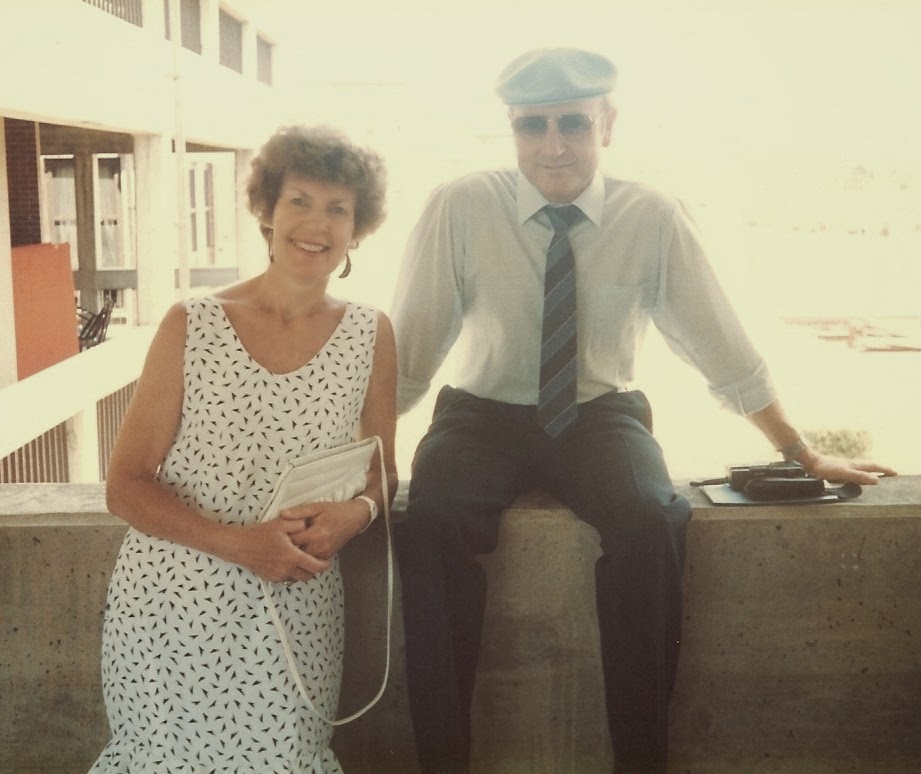
Above: Mum and Dad, December 1987.


Above: Mum in 1989 with her mother, Olive Sparkes (1906-1997).


Left: Mum with her younger sister Ruth in 1996.


Above: Celebrating Mum's birthday in Gunnedah in December 2000. From left: Mum, Aunty Val (Mum's sister-in-law), me, and Aunty Fay (Mum's older half-sister).


Right: Mum and I in January 2001.


Above: Mum in Melbourne with her daughter-in-law Cathie and two of her grandsons, Mitch (left) and Ryan – April 2003.


Above: Mum at Hanging Rock, Victoria, Australia – April 7, 2003.

For more images of our day at Hanging Rock, click here.


See also the previous Wild Reed posts:
Happy Birthday, Mum (2011)
Happy Birthday, Mum (2010)
Happy Birthday, Mum (2009)
Thanks, Mum!
Catholic Rainbow (Australian) Parents
Congratulations, Mum and Dad!
My "Bone Country"
This Corner of the Earth
Journey to Gunnedah
Gunnedah (Part 1)
Gunnedah (Part 2)
Gunnedah (Part 3)
Gunnedah (Part 4)
A Visit from the Hometown Relatives
An Afternoon at the Gunnedah Convent of Mercy


Tuesday, December 03, 2013

To Be Gay in the Vatican

Writes Michael Joseph Gross in his recent Vanity Fair exposé, "The Vatican's Secret Life":

To be gay in the Vatican is no guarantee of success, mark of belonging, or shortcut to erotic intrigue. Most basically it is a sentence of isolation. Gays in the Vatican are creatures of a cutthroat bureaucracy whose dogmatic worldview denies or denigrates their own existence. They live in a closet that has no door. Among recent Popes, Benedict made the most concerted effort to sharpen Church doctrine on homosexuality, which he once called “a more or less strong tendency ordered toward an intrinsic moral evil.” He tried to cull gays from clerical ranks, most notably in 2005, when men with known “deep-seated homosexual tendencies” were prohibited from being ordained, even if they were celibate.

Denunciation and exposure have made gay priests figures of fascination—though less as people than as symbols—especially to the secular far left and the religious far right. Both sides find these clerics to be politically useful. The left uses them to level charges of hypocrisy. The right sees them as a stain in need of removal. They all got a shock late last July when Francis made his first direct public statement about gay clerics since becoming Pope.

During an impromptu press conference aboard the papal jet, en route from Rio de Janeiro to Rome after his first overseas trip, Francis was asked about the so-called gay lobby. His response, delivered with casual humor and punctuated by shrugs and smiles, was as follows: “So much has been written about the gay lobby. I still haven’t run into anyone in the Vatican who has shown me an identity card with ‘gay’ on it.” He pantomimed holding up such a card in his left hand and then went on: “When you find yourself with a person like that, you have to distinguish between the fact of a person being gay and the fact of somebody forming a lobby. . . . If a person is gay and is searching for the Lord and has goodwill, who am I to judge him?”

He spoke these words with a palpable warmth, unlike the embattled, wary tone that other Popes have adopted. This may well have been the first time in history that a Pope has publicly uttered the term “gay”—the word that most men who feel romantic love for other men use to describe themselves—instead of the pathologizing 19th-century medical term “homosexual.” Then, in a lengthy interview with a Jesuit journal, the Pope went further, stating that the Church’s ministry should not be “obsessed” with a few divisive moral issues such as abortion and gay marriage. “When God looks at a gay person, does he endorse the existence of this person with love, or reject and condemn this person?” the Pope asked rhetorically. “We must always consider the person.”

– Michael Joseph Gross
"The Vatican's Secret Life"
Vanity Fair
December 2013


See also the previous Wild Reed posts:
Gay Men in the Vatican Are Giving the Rest of Us a Bad Name
Why I Take Hope in Pope Francis' Statement on Gay Priests
Astounded
Homosexuality in the Priesthood
A Fact That Should Be Neither Surprising Nor Derogatory
Officially Homophobic, Intensely Homoerotic
Blaming the Gays
Report: Homosexuality No Factor in Abusive Priests
Donohue's "Blame the Gays" Tactic Refuted by John Jay Study Researcher
Bill Donohue's Homophobic Claims Refuted by Bishops' Study
In a Right Gay Tizzy: The Catholic Hierarchy's War on Gays
Let's Face It: The Catholic Church is a Gay Institution
Keeping All the Queens Under One Roof
Vatican Stance on Gay Priests Signals Urgent Need for Renewal & Reform
Catholic Church Can Overcome Fear of LGBT People
Quote of the Day – November 21, 2010


Monday, December 02, 2013

Remembering Maria . . . Celebrating Callas


If you were online today you no doubt saw that the Google logo honors opera great Maria Callas on what would have been her 90th birthday. The animation (pictured below) shows the legendary soprano performing on stage and channeling through her expressive arm and hand movements what fellow singer George London called her unique "energy of mind and spirit."


Here at The Wild Reed I honor Maria Callas on this special day by sharing an excerpt from John Ardoin's insightful essay "The Art and the Life" in the now out-of-print 1974 book Callas (which I was fortunate to have found at Magers and Quinn's used books store in Uptown earlier this year!). Enjoy!

Three things come to mind when I summon a mental image of Callas: her eyes, her hands, her walk. Callas' face was not beautiful in the conventional sense, but it was better than beautiful for the needs of the theater. Offstage, her eyes, mouth, and nose have a quality of exaggeration. But these very proportions were what made it possible for her face to speak so eloquently from the stage of even the largest opera house. People who saw her from the upper reaches of La Scala or the Metropolitan Opera are still able to describe details – a spark of a tear in her eyes – with the accuracy of one sitting downstairs. This facial projection had all the immediacy of a cinematic close-up.

. . . Oddly enough, one noticed Callas' mouth most when she was not singing. Then, it so often shaped itself into a peculiar half-smile, a bemused look as though she sensed an irony which had escaped the rest of us. This look had about it all the enigmatic beauty writers have long ascribed to Leonardo's La Gioconda. It was easier to digest those snarled, black looks that accompanied the rages of Medea or Norma than this simpler, infinitely more mysterious glance.

When one wasn't mesmerized by her face, one was held by her arms and hands. They too sang with a range of mood and accent comparable to those in her voice. When she spread her arms full, and usually with a slight arch in her wrists, her long, slim fingers seemed to extend from stage left to stage right, so powerful was the gesture. She usually kept the fingers of her open hand tightly together, so that the line of her arm came to a single, fine point rather than a diffused or blunted one. Yet she could also contract her arms and hands to the most intimate of gestures and frequently wrapped herself in them, cradling her body as she sang. Except in moments of extreme urgency, Callas moved almost as in slow motion. When she moved more forcefully, it was not so much a walk as a lanky stride of strong, decisive steps (a "Gary Cooper lope," one writer termed it). But more often she stood still, knowing full well the effectiveness of making the drama come to her.


Through director Sandro Sequi did not work with Callas in a production, he watch her performances with the trained eye of a man who thinks music in terms of movement. To him, "she was never in a hurry. Everything was very paced, proportioned, classical, precise. Probably this was her Greek origin, I mean the history behind her which came out. When one has seen Callas only in photographs and not on stage, you might think she was like a crazy woman in Medea, for example, running around the stage and shouting. Not at all. She was extremely powerful but extremely stylized. Her gestures were not many, if you consider the whole interpretation of a role. I don't think she did more than twenty gestures in a performance. But she was capable of standing ten minutes without moving a hand or finger, compelling everyone to look at her."

This gift of acting without movement, of commanding a stage while immobile, belonged to George London as well, Callas' Scarpia in Tosca at the Metropolitan in 1956. He has explained the force as "an inner spiritual and artistic motor, something which is always running and is part of an internal identification with character. That kind of energy, which is an energy of mind and spirit, has an irresistible thrust into an audience. But to work, it requires an innate dramatic personality. You can't teach it to someone. It's like a talent. How do you teach that? You can teach the superficial aspects of what must be enacted, but you cannot create a Callas out of Miss X, even if she were to do in every detail what Callas did in a given situation onstage, because it came from Callas' inner strength and that cannot be fabricated."

Franco Zeffirelli, who directed Callas in five productions, felt Herbert von Karajan (stage director and conductor for her at Scala Lucias) most successfully capitalized on this quality. "Karajin didn't even try to direct," Zeffirelli remembers. "He just arranged everything around her. She did the best Mad Scene with a follow-spot like a ballerina against black. Nothing else. He let her be music, absolute music. It was the best you could do with Callas. I think he was the only one who really got it. . . . You could spend hours looking at [Callas]. It was tremendous, that half-smile of hers, the mouth, the eyes. She was enchanting, living music, the perfect illumination of the music. No director taught her this, she was born with it, she found this way of trusting herself, the right gesture, the right moment, not one motion more or less than was necessary, She somehow knew the incredible trick of achieving the maximum with a minimum of effort. . . . For me, Maria is always a miracle. You cannot understand or explain her. . . . What is it this woman has? I don't know, but when that miracle happens, she is a new soul, a new entity."


Below is footage of Maria Callas performing the duet "Miserere"/"Lord, thy mercy on this soul" from Il trovatore at a recital in Paris in 1958. About this performance John Ardoin writes the following in The Callas Legacy: The Complete Guide to Her Recordings on Compact Disc:

The year 1958 came to a close for Callas with her debut in Paris, her future home, at a gala Legion of Honor concert carried live throughout Europe on television. . . . The Il trovatore sequence, minus cabaletta, lacks the full sense of night and mystery Callas usually wove into the music, nor are her top notes too steady. The cadenza is pushed and the final note held more by Callas' throat than her breath. The chorus is wretched in the "Miserere," and Callas' voice takes flight only in the second verse. But, as was frequently the case with Callas, seeing her makes hearing her more exciting, and the [footage] of the "Miserere" is riveting.


Related Off-site Links:
Maria Callas: Google Gives Singer a Solo – The Guardian (December 2, 2013).
Maria Callas Gets a Google Logo to Celebrate the Opera Singer's 90th Birthday – Amy Gesenhues (SearchEngineLand.com, December 2, 2013).
Viva Maria! No Wonder Google Wants Some Callas Stardust – Tom Service (The Guardian, December 2, 2013).
Maria Callas: The Truth is She Was Far from Perfect – Terrence McNally (The Guardian, December 2, 2013).
Icon: Maria Callas
Re-Visioning Callas
Callas as Medea

For more of Maria Callas at The Wild Reed, see:
• Remembering Callas
• Re-Visioning Callas
• Callas Went Away
• Maria Callas – "Ava Maria"
• Callas Remembered
• Here's to the "Crazy Ones"

Opening image: Gary S. Bralow.

Advent: The Season of Blessed Paradox

Yesterday marked the beginning of Advent, that season of the liturgical year full of paradox.

Why do I say this? Well, think about it: Advent is all about waiting while journeying; being centered while engaged in preparations; and retreating inwards in anticipation of revolutionary transformation!

Now that Thanksgiving has past it's also that time of year for putting up Christmas decorations, which is exactly what my friend and housemate Tim and I did on Saturday afternoon when we set up and decorated our Christmas tree!

I therefore share in this post today some of the Advent thoughts I heard articulated yesterday at the Spirit of St. Stephen's Catholic Community . . . and some images of the Christmas tree that Tim and I decorated.

I start with the following reflection by Sr. Joan Chittister.

God is not in the whirlwind, not in blustering and show, Scripture teaches us. God is in the breeze, in the very atmosphere around us, in the little things that shape our lives.

God is in the contradictions that assail us, in the circumstances that challenge us . . . in the life goals that demonstrate our real aspirations, in the burdens that wear us down, in the actions that give witness to the values in our hearts.

God is in the stuff of life . . . God is where we are, including in the very weaknesses that vie for our souls.

God is not a mystery to be sought in strange places and arcane ways.

God is a mystery to be discovered within us and around us.

And savored.


Also shared yesterday at the Spirit of St. Stephen's was a wonderfully insightful and inspiring homily by one of our community members. Here's part of what was shared:


There are multiple references to the image of a thief breaking into a home throughout Scripture. It must have been a big problem and a bigger worry. Just the thought of it can bring an apprehensive shiver—that feeling of invasion, vulnerability and eroded trust. We who are blessed with wealth know that things can be replaced but feeling safe is harder to come by.

So, is God a thief, wanting to break in and startle us? Does God want us to be afraid? Of course not. God wants us to pay attention, to prepare, to be ready and awake.

Is God a thief? Of course. God is the thief who wants to break into our barricaded hearts and souls to shine the light of day on the treasures there. God is the thief who wants to steal our economy of war and death and dazzle us with the light of peace with justice. God is the thief who can wait no longer for an invitation but must be an intimate part of our lives—right now.

Joan Chittister says God is in the contradictions, the challenges, the burdens and the actions that give witness to the values in our heart. Simply put: God is where we are.

. . . Megan McKenna calls Advent the “guard dog” rousing us from our sound sleep. There is an intruder in our midst—wake up!

And do what?—Grab a weapon to defend ourselves, our loved ones? Run and hide? Melt into a puddle of fear?

No, the revolutionary call is to fling open all of the doors and the windows, light the lanterns and roll out the red carpet in welcome.

The intruder is the One we have been waiting for.

We would have missed it without the barking of Advent and our prophets and those who beg us to raise our voices with them for living wages and dignified working conditions, for just immigration processes, for housing that feels like home.

Come . . . let us walk in the light of hope and promise. Let us open the home of our heart willingly, putting thieves out of business. Let us be the evidence of peace for pilgrims climbing the holy mountain. Let us be always ready—more than ready, let us be longing—to approach the burning bush of God’s inviting presence.

Better still, let us light the fire of God’s glory and wisdom so that others are drawn to the Holy One’s warm love through our prayers and actions, through our lives of peace with justice.

Welcome to the revolution, fellow pilgrims! Blessed Advent to you.


See also the previous Wild Reed posts:
Something to Cherish
Rejoice? (Advent 2012)
Advent 2011: Thoughts and Reflections (Part 1)
Advent 2011: Thoughts and Reflections (Part 2)
Advent 2011: Thoughts and Reflections (Part 3)
Advent 2011: Thoughts and Reflections (Part 4)
Thoughts on Waiting . . . and a Resolution
Advent: Renewing Our Connection with the Sacred
The Centered Life as an Advent Life
My Advent Prayer for the Church
Advent Thoughts
Letting God Loose
Mystics Full of God
Thoughts on Transformation (Part 1)
Thoughts on Transformation (Part 2)
Thoughts on Transformation (Part 3)
Christmas Baubles


Sunday, December 01, 2013

Hans Matheson in The Christmas Candle


12/22/13 Update: Excerpts from Helen Earnshaw's December 10, 2013 interview with Hans Matheson have been incorporated into this post and credited to Earnshaw.


Hans Matheson is an actor whose body of work and approach to acting I've long admired. Or, as someone who knows me well has more succinctly put it, "He's your movie boyfriend, Michael!"

Okay, okay. . . . I admit I find the guy (incredibly) good-looking. But seriously, Hans Matheson is also a dedicated and gifted actor who is building (albeit a little too slowly for my liking) an impressive body of work in both film and TV. His latest venture sees him in the lead role in The Christmas Candle.

In this film Hans plays the Rev. David Richmond, a progressive minister who is undergoing something of a crisis of faith due to the recent death of both his wife and daughter. The setting is the fictional English village of Gladbury in 1890. Legend has it that every twenty-five years an angel visits the local candlemaker and bestows a miracle upon whomever lights the Christmas Candle. However, shortly after the arrival of the new pastor (Hans' character), the Christmas Candle goes missing. For anything more of the plot you're just going to have to either see the film or read Max Lucado's novel upon which it is based.

The Christmas Candle is an Impact and Big Book Media production presented by Britain's Pinewood Pictures. In the U.S. it's being distributed by Rick Santorum's film production company EchoLight Studios. Yes, that Rick Santorum.

Yet, thankfully, Hans appears not to share what I consider Santorum's rabid social conservative Christian views. Indeed, according to Hans in an interview with Helen Earnshaw, the message of The Christmas Candle is "not just a Christian thing." Following is more of what he says about the film and the character he plays in it.


I take on the role of David Richmond, the reverend, and he has formed this anger towards God, because he lost his wife and his child tragically. Before that, he had a firm belief and a faith in God and miracles. But [this tragedy] made him a little bit cynical and doubting of what he once believed.

He forms this anger towards God and, in some ways, he believes through good works and proving to others and getting them to follow his way of thinking, he will somehow get closer to God; it is almost like a competition. If anyone stands in opposition to that, they almost become a target for his anger. What this anger does is it imprisons him, I think.

It keeps him from seeing the miracle of the universe and he is left with only his limited perception. . . . What is wonderful is that there is redemption in the end, in which he sees that all the times he thought good works would lead somewhere, providence was at work the whole time. The miracle of life is the unknown.

That is not just a Christian thing because if you watch Brian Cox and his science programmes, it is the wonder of the universe and just sitting back and thinking ‘goodness me, I thought I was in control.’ There is just a miracle of being alive in this world.

. . . For me, [The Christmas Candle] is a romantic comedy and it is not necessarily a message from the Christian faith; I just don’t see it like that - maybe some people do. I think that there is a message in everything and in all paths towards, apparently, God: whether it is physics or whatever. It is just whether or not it lights you up or not and if there’s a resonance in you about certain things.


Although I'm definitely happy to see Hans in the leading role in a film, it's unfortunate that the film in question is one that has not been getting very good reviews. Following is The Guardian's overview of the film's reception.


The Christmas Candle, set in the fictional English village of Gladbury and billed as "a timeless holiday film for the entire family," attracted widespread critical scorn as well as dismal box-office results, having grossed just over $1.6m (£988,000) after two weeks on release.

The bad reviews were perhaps predictable, with the New York Daily News saying: "This odd Dickens-meets-Sunday-school movie is as artless as the setup is muddled", while the New York Post judged: "This throwback, made-for-TV-style film takes the easy way out in a cheesy climax, but its resolute quaintness may appeal to the kind of viewers who regard electricity as disturbingly newfangled." The Arizona Republic called it "resolutely stiff and hollow."

Former presidential candidate Santorum, who took to the media shortly before the film's release to lambast Hollywood as "the devil's playground" will presumably find it easy to shrug off critical brickbats; less easy to swallow will be the ignominious box office results. Its opening weekend, on a small "platform" release on just five screens, took a respectable $68,000; but in its second week, when it expanded to over 390, it took less than $1m. The crucial screen average was an extremely moderate $2,500, putting it below the likes of The Best Man Holiday, Narco Cultura, and bodybuilding doco Generation Iron - and far beneath Catching Fire and Philomena.


Oh, dear!

Well, as my friend Rick wryly remarked to me the other day, At least Hans still would have been paid.

Also, it should be noted that the criticisms have been leveled at the film's storytelling (described as hammy by one reviewer), and not at its cast. Roger Moore, for instance, observes that "the performances — save for Susan Boyle, a better singer than actress — are uniformly fine."

In his perceptive and insightful review for Christianity Today, Kenneth R. Morefield notes that "the cast is quite good, with Matheson and [Samantha] Barks both giving restrained performances that suit the mood of the film and keep it from going over the top."

Mary Houlihan, writing for the Chicago-Sun Times, acknowledges the "smart casting of a range of British stage and screen actors," and says the film's main character is "nicely played by Scottish actor Hans Matheson."

Reviewer Michael Smith goes a step further, noting that Hans "is often quite affecting as the Rev. David Richmond."

Mmmm . . . now why doesn't that surprise me?


Above: Hans with his Christmas Candle co-star Samantha Barks.


In early 2008 I did a post about Hans as Thomas Cranmer, the Archbishop of Canterbury, in the TV series The Tudors. At the end of that post I shared something of a retrospective of Hans' career. Since that time Hans has completed only a few projects. These are highlighted below.


Above: Hans as the dastardly Alec D'Urberville in the 2008 BBC television adaptation of Thomas Hardy's Tess of the D'Urberville. For more about this production, see the previous Wild Reed post, A Devilish Turn.


Left: Hans as Lord Coward in the 2009 film Sherlock Holmes.


Above: Hans as Ixas, meeting Medusa in the 2010 film Clash of the Titans. And, no, Ixas doesn't appear in the sequel!


Next year Hans will feature in another sword and scandal epic when he stars as Aeskylos in 300: Rise of An Empire (right), a film which in pretty much every way imaginable is as far removed from The Christmas Candle as you can get!

And let's just be open to that as serving to indicate Hans Matheson's versatility as an actor!


About his involvement in 300: Rise of An Empire (above), Hans told Helen Earnshaw of FemaleFirst.com:

It was just a great experience for me because I had to get fit – really fit – in about ten weeks; it was hard-core training. It was fantastic and I had a great time making it. Visually it is going to be a real spectacle. I was really lucky to get the part and deliver it to the best of my ability. I haven’t seen it yet, so I can’t really tell you, but I think it is going to be pretty good.


Related off-site Links:
Christmas Candle Beams with Holiday Spirit – Martin Tsai (Los Angeles Times, November 21, 2013).
Review of The Christmas Candle – Frank Scheck (The Hollywood Reporter, November 21, 2013).
Flipping the Holiday Switch – Nicolas Rapold (New York Times, November 21, 2013).
The Christmas Candle Review – Peter Sobczynski (RogerEbert.com, November 23, 2013).
The Christmas Candle Has Trouble Keeping Faith Burning Consistently – Chris Foran (The Journal Sentinel, November 21, 2013).
Hammy Storytelling Douses Christmas Candle – Sean P. Means (Salt Lake Tribune, November 21, 2013).
Hans Matheson Online

For more of Hans Matheson at The Wild Reed, see:
• To the Lighthouse . . .
• Hans Matheson in The Tudors
• A Devilish Turn
• Stealing Away


Three Excellent Responses to Cardinal Dolan's Remarks on "the Church" Being "Out-Marketed" on the Issue of Marriage Equality

In an NBC-TV Meet the Press interview recorded Friday and scheduled for broadcast later this morning, Cardinal Timothy Dolan, the Roman Catholic archbishop of New York, laments the continued expansion of same-sex marriage in the United States and says that “the church” is being “caricatured as being anti-gay.” Cardinal Dolan also states that the church has been “out-marketed” on the issue of same-sex marriage by Hollywood, by some politicians, and by “opinion-molders” who have tried to paint the church in a negative light.

I think what needs to be pointed out first and foremost is that Cardinal Dolan in his statements is erroneously equating “the church” with the hierarchy. Yet the church is far more than its clerical caste. Indeed, unlike the bishops, U.S. Catholics recognize and respect that in a pluralistic society such as ours, the Roman Catholic hierarchy should not be expending time and resources imposing its understanding of sexuality and marriage onto wider society. And now we have a pope who's basically saying the same thing! Astounding, I know.

Of course, it's very much self-evident that the bishops’ understanding of a range of issues relating to sexuality is out-of-step with the collective wisdom of the Catholic people. On issues relating to the intimate lives of heterosexuals (such as contraception) and homosexuals (civil marriage rights) the Catholic faithful have clearly moved beyond the hierarchy’s limited understanding of sexuality.

Why are the bishops so out-of-step? Well, I think much of it is to do with the fact that they have forgotten that truth (including the truth of human sexuality) is discovered through time, and that tradition (including the tradition of marriage) evolves. Thankfully, the Catholic people have not forgotten these liberating hallmarks of our living Catholic faith. Accordingly, we not only respectfully listen to and consider what the hierarchy says, but also seek out the wisdom of theologians and our own and others’ lived experiences so as to inform our unfolding understanding of the complex reality of sexuality.

But back now to Cardinal Dolan's remarks that the church (i.e., the hierarchy) is being “caricatured as being anti-gay” and that it's been “out-marketed” on the issue of same-sex marriage. Following are a number of excellent responses to these remarks that I've come across online. The first is a particularly eloquent response by Francis DeBernardo, executive director of New Ways Ministry. You may recall that in July I had the honor of hosting a gathering at my home in Minneapolis at which Frank and New Ways Ministry's co-founder Jeannine Gramick were special guests. (For more about this gathering, click here).


. . . Dolan’s comments are filled with many errors in characterization. First, “the church” is not against same-gender marriage. The church hierarchy is defending heterosexual-only marriage. We know that poll after poll keeps showing that Catholics support marriage equality–and “the church” is rightly defined as ALL the people of God, not just the hierarchy.

Second, people, especially Catholics, are not being swayed by external forces to support marriage equality. Catholics are supporting these measures not in spite of their faith, but because of their faith. Catholic principles of justice, equality, human dignity, protection and support of all families are what are motivating them to support marriage for lesbian and gay couples. The more that the hierarchy continues to view this argument as a battle between forces inside and outside the church, the more that these leaders will miss the fact that the Holy Spirit is moving among the laity on this issue.

Third, it is not because of opposition to marriage equality that people characterize Catholic leadership as anti-gay. It is because they oppose a whole variety of equality issues–immigration, employment non-discrimination, adoption, as well as marriage–that people view the hierarchy as anti-gay. It’s because they deny sacraments to lesbian and gay people and their supporters, because they expel children of lesbian and gay people from Catholic schools, because they fire openly LGBT people from church employment, because they hold exorcisms when marriage equality is enacted, because they compare the gay equality movement to the Ku Klux Klan–and so many other actions and statements–that people perceive the church hierarchy as anti-gay. And it’s because they miss every opportunity to do or say anything positive that people develop this characterization.

Just look at how people have responded to the few positive things that Pope Francis has said in regard to lesbian and gay people. While he has not challenged church doctrine, he has found many ways of being affirmative, and people are responding in a wildly positive way.

Cardinal Dolan, and all the U.S. bishops, should stop blaming others and do a thorough examination of their own statements, behaviors, and attitudes in regard to LGBT people and issues.

– Francis DeBernardo
"Cardinal Dolan’s Complaints Are Not Warranted"
Bonding 2.0
November 30, 2013


While Dolan and his brother bishops continue an out-of-touch culture war that the Pope has instructed them to cease, the voice of the church is no longer viable on issues such as poverty, immigration and health care reform. The Roman Catholic Church is viewed by the public as anti-gay because it is. It is viewed as being on the wrong side of history because it is. And as a result of the spiritual violence that has been waged from pulpits and chanceries from New York to Saint Paul to Los Angeles, real lives have been ruined, destroyed or lost altogether. The Cardinal can chuckle and wink all he wants, but to say that this is a matter of being out-marketed is like saying that the Titanic would have made it to shore if they had only served better champagne.


The Church is perceived as anti-gay not because it teaches that marriage is between a man and a woman but because its bishops have lied about gay people and our lives, have demonized us and have persecuted priests, Sisters and parishes that minister authentically to gay people and our families. In addition, some bishops have threatened and tried to intimidate Catholic legislators who support equality and justice for all.

There are people of good will who do not support same-sex marriage on religious grounds but they do not try to force their personal religious ideology on the nation nor do they attack lesbian and gay people and their families.

The Catholic bishops have spent millions of dollars fighting hate crimes legislation and laws banning housing and employment discrimination on the basis of sexual orientation,. Most egregious, the bishops have threatened to not support the immigration reform bill if it includes same-sex couples.

The bishops consistently reduce gay people to their genitals and what they do or do not do with them and a number of bishops have supported and promoted dangers programs that seek to change gay people's sexual orientation. The bishops have opposed any legislation or policy changes that would affirm gay people's right to be treated equitably under the law. That is why the Church is perceived as anti-gay. It is not a caricature it is a sad reality.

– Rick Garcia
"Catholic Church's Perception as Anti-Gay is Reality, Not Caricature"
ChicagoPride.com
November 30, 2013


12/16/13 UPDATE: A fourth excellent response! The editors of the National Catholic Reporter have published a response to Cardinal Dolan's recent remarks. Following is an excerpt.

. . . If the church faces a marketing failure on issues of sexuality, the failure is in listening to its people. In recent years, the U.S. bishops have been deaf to the people of the church – and the American voters – on the issue of same-sex marriage. When it comes to contraception and divorce and remarriage, the church has tuned out what the faithful have been saying for 50 years. The church's teaching on sexuality is unpersuasive because the church advances teachings that actually reduce human sexuality and sexual activity to its most banal, utilitarian and mechanistic level, detaching it from the deepest possibilities of genuine human intimacy.

They've detached it from human experience, and according to sociologist William D'Antonio, whose life's career has been studying Catholics, "Lived experience is trumping abstract teaching. Wins it all the time."

Official teaching on contraception has been so widely dismissed in practice, one wonders it even comes up in conversation. The same is true for divorce and remarriage.

The same is quickly coming true on the topic of homosexuality, because among Catholic parents who know their children as all manner of things – curious, funny, loving, mischievous, talented, gracious, annoying, musical, athletic – all the things that parents revel in and come to love, some are also coming to know their children as gay. Thank God that today most parents are not cowering before a catechism characterization of their children and sending them off in a panic to a Courage meeting to be remade into something more acceptable.

We dare suggest that some of the Catholic faithful, particularly the family and friends of gay, lesbian, bisexual or transgender persons, might be a bit further down the road in loving as God would have us love, that they might understand Pope Francis' teaching about encounter to a greater degree than many of us.

. . . Dismissing the lack of acceptance of church teaching as a marketing failure is an insult to the very idea of teaching and certainly to gays and lesbians. It walks, in search of a sound bite, right past the mystery of the human being.

– Editorial Staff
"The Church Was Not 'Out-Marketed' on Gay Marriage"
National Catholic Reporter
December 16, 2013


Related Off-site Links:
Dolan Says Church is “Caricatured” as Anti-Gay – Michael Schwirtz (New York Times, November 29, 2013).
Majority of Catholics – But Not the Bishops – Support Passing ENDA Today – Jamie Manson (National Catholic Reporter, November 7, 2013).
Pope's Blunt Remarks Pose Challenge for Bishops – Rachel Zoll (Associated Press via Yahoo! News, September 21, 2013).
Cardinal Dolan: Please Don't Call It Love – Jamie L. Manson (The Huffington Post, April 8, 2013).


See also the previous Wild Reed posts:
Responding to Whiny Catholic Bishops Who Cry Victim
A Head and Heart Response to the Catholic Hierarchy's Opposition to Marriage Equality
Quote of the Day – November 8, 2013
Responding to Bishop Tobin's Remarks on Gay Marriage
Progressive Perspectives of Archbishop Nienstedt's Anti-Gay Activism
What Part of Jesus' Invitation to "Be Not Afraid" Don't the Bishops Get?
National LGBTQ Catholic Organization Honors Role Played by Catholics and Other Faith Groups in Securing Marriage Equality in Minnesota