Thursday, April 25, 2013

Quote of the Day

. . . I believe that using Communion as . . . a manipulative [and coercive] tool surely profanes the sacrament. Perhaps [those] Catholic leaders [who threaten to deny Communion to pro-marriage equality Catholics] should revisit their church’s theology of the Eucharist. Reception of the body and blood of Christ at Communion is God’s gift to God’s people, not a reward for right behavior. We receive Communion not because we are worthy of it, but because God’s offers us the body and blood of Christ despite our unworthiness.

While some are seeking to withhold Communion from pro-choice and pro-marriage-equality Catholics, I have heard no call to withhold Communion from priests and bishops who have engaged in horrific sexual abuse against vulnerable children, nor their enablers. Bernard Cardinal Law, whose administration actively facilitated the moving around of known pedophile priests to other unsuspecting parishes, has not been denied Communion, but instead been rewarded with a prestigious church in Rome.

It seems that the church hierarchy is sending the following message: two gay men or lesbians (not to mention their supporters) who want to vow a lifetime of commitment, monogamy and love should be denied Communion, but those who exploit vulnerable children (and those who facilitate their abuse) for their own sexual gratification are still welcome.

. . . The good news message of Jesus Christ is that despite our failure to be all that God would want us to be, we are all welcome at the Lord’s Table anyway. Until the Roman Catholic hierarchy gets that right, they might prayerfully consider quieting their judgmental rhetoric and contemplating the humility Jesus suggested as a value to be lived by all.

– Gene Robinson
Retired Episcopal Bishop of New Hampshire
"Catholic Leaders Using Communion as a Weapon in the Culture War"
The Washington Post
April 24, 2013


Related Off-site Links:
Detroit-area Catholic Leaders Urge Gay Marriage Supporters to Skip Communion – Niraj Warikoo (Detroit Free Press, April 9, 2013).
Bishop Gumbleton to Pro-Marriage Equality Catholics: "Don't Stop Going to Communion" – Francis DeBernardo (Bonding 2.0, April 12, 2013).
Bishop Gumbleton Preaches on Christ’s Radical Welcome for All – Bob Shine (Bondings 2.0, April 19, 2013).

See also the previous Wild Reed posts:
"Receive What You Are, the Body of Christ"
Trusting God's Generous Invitation
My Rainbow Sash Experience
"Take, All of You, and Eat": Communion and the Rainbow Sash (Part 1)
"Take, All of You, and Eat": Communion and the Rainbow Sash (Part 2)
"Take, All of You, and Eat": Communion and the Rainbow Sash (Part 3)
Reflections on the Primacy of Conscience


Monday, April 22, 2013

Photo of the Day


I snapped this photo of my housemate Tim yesterday afternoon as we walked to our neighborhood hardware store.

It's quite something when you think about it. I mean, how many people living in a major metro area get to walk through the woods to go shopping?

All I can say is that I feel very fortunate to live in a city like Minneapolis which has some really beautiful areas of urban wilderness – like the area in this picture, situated near my home along the Minnehaha Creek Parkway.

With today being Earth Day, it seems a good time to share this particular picture and the 'recommended links' below!


Recommended Off-site Links:
Seven Quick Ways to Save the World on Earth Day 2013 – Janey Street Thornton (Gay Star News, April 22, 2013).
Earth Day 2013: Land for Food Under Attack Worldwide – Sally Miller (Common Dreams, April 21, 2013).
Entering a Resource-Shock World – Michael T. Klare (TomDispatch.com via TruthDig.com, April 22, 2013).
How Monstanto Went from Selling Aspirin to Controlling Our Food Supply – Jill Richardson (AlterNet, April 18. 2013).
Tim DeChristopher Speaks Out After 21 Months in Prison for Disrupting Oil Bid – Democracy Now! (April 22, 2013).
Newly Released Tim DeChristopher Finds a Movement Transformed by His Courage – Melanie Jae Martin (Yes!, April 22, 2013).
What Would a Down-to-Earth Economy Look Like? – David Korten (Yes! January 17, 2013).

See also the previous Wild Reed posts:
Spring Snow
Thomas Berry (1914-2009)
"Something Sacred Dwells There"

Image: Michael J. Bayly.


Sunday, April 21, 2013

Happy Birthday, Dad!

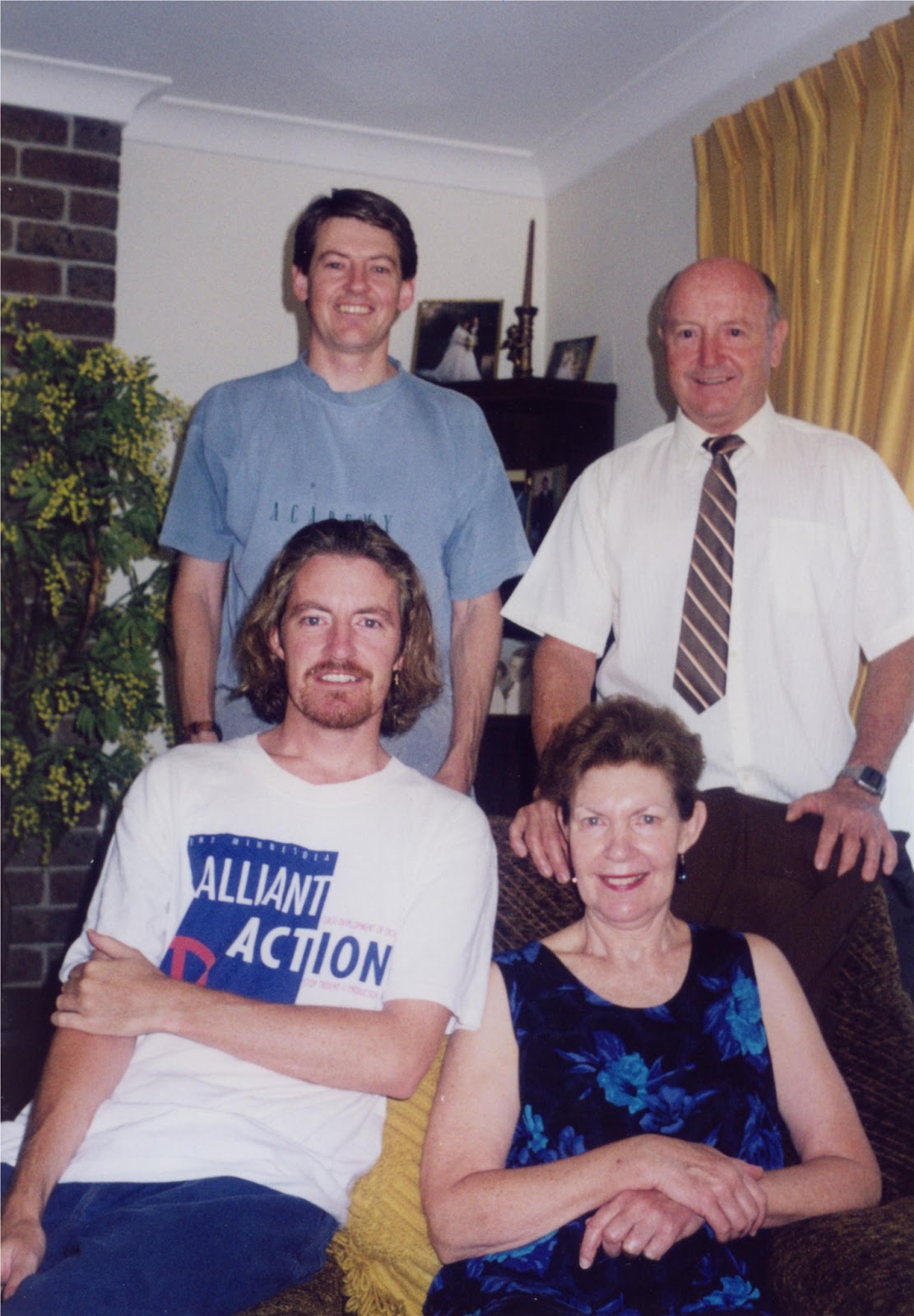
In Australia today my Dad, Gordon James Bayly, celebrates his 76th birthday! Happy Birthday, Dad!

I find that one of the hardest aspects of living away from family and friends in Australia is that I don't get to celebrate with them special events like birthdays, anniversaries, and graduations. You'd think that after living in the U.S. for almost 20 years, I'd be used to this by now. But, in all honesty, I don't think I'll ever get used to it, which I guess says something about my Australian family and friends and the love we share.

The photo above was taken in Sydney last May, which was when I last saw my parents. (For more images and commentary on this particular visit back to Australia, see here, here, and here).

I've shared images of my Dad through the years in a number of previous birthday posts (see for example, here, here, and here.) Here are a few more pics from the Bayly family archives . . .


Above: At Swallows' Ledge, Port Macquarie, Australia, with (from left) Aunty Fay, Mum, my niece Layne, and Dad – December 2009.


Above: Mum and Dad during their July 2005 visit to the Twin Cities.


Above: With my parents and elder brother Chris and his family in London – August 2005. From left: Chris, Cathie, Brenden, Ryan, Mitch, Mum, Liam, Dad, and me.

For more images and commentary on my visit with my parents to Europe in the summer of 2005, click here.


Above: Mum and Dad with my younger brother Tim and his family in Queanbeyan, Australia – March 2003. From left: Layne, Dad, Ros, Mum, Sami, and Tim.


Above: Sitting next to Mum with Dad and my elder brother Chris behind us – Christmas 1998 in Australia. The work tie Dad's wearing reminds me that at this time he was still two years from retiring from work in our hometown of Gunnedah. (See here, here, and here.)


Above: Dad and my younger brother Tim, partnered up for a game of table tennis – Christmas 1986.


Above: Mum and Dad at my 21st birthday party in Armidale, New South Wales, Australia – October 1986.

As you can see, my 21st party had a Prince Valiant theme! And I have my Dad to thank for introducing me to the heroic Prince of Thule and to what is undoubtedly the greatest work ever produced in the adventure strip medium.

For more images of my 21st, click here.

For my 2010 interview with my Dad about Prince Valiant, see this post on my blog A Prince Named Valiant.


Above: Mum and Dad and my younger brother Tim with the Dignam family. Although I know this photo was taken in Gunnedah, I'm not exactly sure when it was taken. I'm thinking, though, that it was probably some time around 1980.


Above: Dad pictured during one of our family holidays at Coffs Harbour in the late-1970s.


Above: Dad holding me as an infant. This photo was probably taken during a family holiday at The Entrance in the Australian summer of 1966/67.


Above: My parents on their wedding day – November 7, 1959.


Above: Dad (left), pictured in the mid-1950s with his good friend John Sills. John and his wife Heather married shortly after my parents and raised their family next door to us in Gunnedah.


Above: Dad as a schoolboy in the 1940s.


Above: Dad as a young boy. He's pictured riding his tricycle at “Flodden,” Dad's mother’s family farm in the Purlewaugh district of northwestern New South Wales, Australia.


See also the previous Wild Reed posts:
Happy Birthday, Dad (2009)
Happy Birthday, Dad (2010)
Happy Birthday, Dad (2011)
Congratulations, Mum and Dad!
Commemorating My Grandfather, Aub Bayly, and the Loss of AHS Centaur


Friday, April 19, 2013

Spring Snow


It may be spring in Minnesota according to the calendar but, weather-wise, conditions remain decidedly wintry! So much so that my friend Daniel posted the following yesterday on Facebook:

How do you spell "spring" in Minnesota? "B-L-I-Z-Z-A-R-D."


I guess it's all to make up for last year when we experienced a very early spring.

Here's how the Minneapolis Star Tribune is reporting yesterday's spring snowfall:

Minnesota’s relentless winter is poised to reassert itself Thursday afternoon into Friday, bringing about 6 inches of snow to the Twin Cities metro area and as much as a foot to Duluth.

. . . Rain on Thursday is expected to turn to all snow by the afternoon, then come down at the rate of 1 to 2 inches per hour Thursday night — hard enough to accumulate even on warm roads, National Weather Service meteorologist Bill Berghoff said.

Friday traffic, however, is usually lighter than that on other days of the workweek, and the snow should not hang around long with highs in the mid-30s, said T.K. Kramascz, spokesman for the Minnesota Department of Transportation’s metro district.

The amount forecast for the Twin Cities would push this April into the five snowiest. Duluth, meanwhile, is enduring its snowiest February-through-April on record and had 17 inches of snow on the ground through Tuesday.

International Falls residents are trudging through 21 inches, the most at this late date, assistant state climatologist Pete Boulay said.

While April snows, even deep ones, are not extraordinary across Minnesota, nature watchers say the combination of snow and cold appears to have set back some bird ­arrivals by about two weeks. . . . Pete Harris, naturalist at Wolf Ridge Environmental Learning Center near Isabella, said the first day when the temperature remains above freezing is usually March 18, but it hasn’t happened yet this year. Likewise, April 13 usually brings the first mosquito sighting; this year, none yet.

National Weather Service hydrologist Greg Gust said the continuing cold has cast the agency’s flood-predicting models into “uncharted territory,” with wintry conditions unprecedented for this late.

While rivers have usually flooded by now, they remain frozen across the Red River Valley, and the late date has increased the risk of a sudden warm-up and thaw across the region, Gust said. The Red could crest at Fargo-Moorhead the week after next, one of its latest spring melt floods ever.


See also the previous Wild Reed posts:
Shadows and Light
A Winter Walk Along Minnehaha Creek (March 2013)
A Springtime Walk Along Minnehaha Creek (March 2012)
Winter Storm (December 2012)
Waiting in Repose for Spring's Awakening Kiss
A Springtime Prayer

Images: Michael J. Bayly.


Wednesday, April 17, 2013

Quote of the Day

. . . I expect a good deal more from [Pope] Francis than the friendly but still largely cosmetic changes he has instituted. Gradualists will disagree with me, but I think it is time for Catholics to grow up and realize that royalty does not become us. The Church is a service organization whose primary stakeholders are people who are poor. Their needs, and not the whims of pampered prelates, are the priority. Nothing less is acceptable. Raise the bar for heaven’s sake.

. . . [O]n things that enthusiasts say are different in the months since the new pope took office: they are not all that different. Take, for example, the washing of two women’s feet at the Holy Thursday celebration. Granted, one of them was Muslim, and granted, the current pope may not be one for grand gestures (in which case they all would have been women in retribution), but is the liturgical act of washing two women out of 12 in 2000 years really the sign of the ‘feministization’ of the Roman Catholic Church? Not by my lights.

Rather than washing feet, I suggest looking Catholic women in the eye and saying, “You are my sister, equal in every way to me,” and then changing structures accordingly. To atone for centuries of discrimination against women will take more than four clean female feet. I despair of those who say, “It is a start,” to which I respond, “Obviously, but how pitifully inadequate.” . . .

– Mary E. Hunt
"Pope Francis and the American Sisters"
Religion Dispatches
April 17, 2013


Image: Michael J. Bayly.

Tuesday, April 16, 2013

Something to Think About . . .


Writes Lucia Brawley:

This is Martin, 8. He died in the Boston bombing yesterday. He was at the finish line with his family, waiting for his dad to cross. His mother and little sister were catastrophically injured. He was the student of our dear friend, Rachel Moo. His message resonates powerfully today. My prayer is that we all live by Martin's words, paying tribute to his too-brief, but immeasurably valuable life by following his example.


Related Off-site Links:
Boston Marathon a "Horrifying Scene" After Twin Blasts Kill 3 and Leave Scores Maimed, Wounded – Democracy Now! (April 16, 2012).
Martin Richard Dead: Boy, 8, Dies in Explosion at Boston Marathon – The Huffington Post (April 16, 2013).
8-Year-Old Marathon Victim’s Mother, Sister Severely Injured – Holly Bailey (Yahoo! News, April 16, 2013).
Carlos Arredondo, Cowboy Hat-Wearing Hero of Boston Bombings, is Famed Peace Activist – Taylor Berman (Gawker, April 16, 2013).
Jeff Bauman Jr., Injured Man in Associated Press Photo, Got Both Legs Amputated: Dad – Huffington Post (April 16, 2013).
Boston Marathon Explosion Video Footage (Warning: Graphic Images) – The Huffington Post (April 15, 2013).
"Like a War Scene": From the Streets to Hospitals, Witnesses and Medics Rushed to Help Bombing Victims – Democracy Now! (April 16, 2013).
Gay Bostonians React to Bombing – Michelle Garcia (The Advocate, April 16, 2013).
The Boston Bombing Produces Familiar and Revealing Reactions – Glenn Greenwald (The Guardian, April 16, 2013).
How I Hope to Remember My First Boston Marathon – Brian Keaney (Millennial, April 16, 2013).
The Boston Marathon Bombings and U.S. Drone Attacks: A Tale of Two Terrorisms – Earth First News (April 16, 2013).

UPDATES:
Officials: Bomb Suspect Identified, But No Arrest – Liz Goodwin and Jason Sickles (Yahoo! News, April 17, 2013).
The Saudi Marathon Man – Amy Davidson (The New Yorker, April 17, 2013).
Let’s Hope the Boston Marathon Bomber is a White American – David Sirota (Salon, April 17, 2013).
The Orwellian Warfare State of Carnage and Doublethink – Norman Solomon (Common Dreams, April 17, 2013).
How the Gun Lobby Has Already Blocked Boston’s Bombing Investigators – Frank Smyth (MSNBC, April 17, 2013).
Grief Without Borders – Robert C. Koehler (Common Dreams, April 18, 2013).
Boston Bombing Suspects? Authorities Seek IDs of Two Men Seen on Video – Peter Grier (Christian Science Monitor, April 18, 2013).
FBI Releases Photos of Two Men Considered Suspects in Marathon Bombings – Jason Sickles (Yahoo! News, April 18, 2013).
Boston Bombing Suspect Killed in Shootout – Evan Perez, Jennifer Smith and Pervaiz Shallwani (The Wall Street Journal, April 19, 2013).
Boston Marathon Bomber Manhunt: One Suspect Dead, Second on the Run – Jason Sickles and Dylan Stableford (Yahoo! News, April 19, 2013).
Boston Bombing Suspects' Muslim Identity Provides No Clues to Motivation for Bombing – Jaweed Kaleem (Huffington Post, April 19, 2013).
Tamerlan Tsarnaev and Dzhokhar Tsarnaev Were Refugees from Brutal Chechen Conflict – Peter Finn, Carol D. Leonnig and Will Englund (The Washington Post, April 19, 2013).
BREAKING NEWS: Boston Bombing Suspect Dzhokhar Tsarnaev Captured Alive – Jason Sickles and Liz Goodwin (Yahoo! News, April 19, 2013).


Celebrating Dusty

Today is the 74th anniversary of the birthday of Dusty Springfield (1939-1999), widely considered one of the greatest female vocalists of the twentieth century.

In celebrating Dusty's life and music on this special day, I share images and videos of Dusty, along with excerpts from two of the most engaging and insightful books about her – Dusty!: Queen of the Postmods by Annie J. Randall, Associate Professor of Musicology at Bucknell University, and Dusty Springfield: In the Middle of Nowhere by teacher, author and psychotherapist Laurence Cole.

My own interest in and admiration for Dusty is well documented here at The Wild Reed, most notably in Soul Deep, one of my very first posts. Other previous posts worth investigating, especially if you're new to Dusty, are Dusty Springfield: Queer Icon and Remembering Dusty, my 2009 tribute to Dusty on the tenth anniversary of her death. And, of course, off-site there's my website dedicated to Dusty, Woman of Repute, the name of which is derived from Dusty's 1990 album Reputation.

As I explain in Soul Deep, Reputation introduced me not only to Dusty's music but also to her life and journey – much of which resonated deeply with me. Indeed, my identification with aspects of Dusty's journey played an important role in my coming out as a gay man. I begin today's celebration of Dusty, therefore, with a video from the time of Reputation. It's a clip of Dusty being interviewed in 1990 by Gloria Hunniford on the British morning chat show Sunday, Sunday. The interview is preceded by a snippet of the music video for "Arrested By You," the third and final single release from Reputation.


The above exchange is one of the many "safe" interviews that, according to author Annie J. Randall, Dusty and the mainstream media engaged in during the singer's late '80s comeback. Following is an excerpt from Randall's 2008 book Dusty!: Queen of the Postmods in which she explores further this idea and its connection to Dusty's 1960s look, and the way that both this look and her music ensured a "spectacular [though commercially problematic] collision of . . . elements at the intersection of gender, race, and sexuality."


By the time Dusty Springfield died [from breast cancer] in 1999, she had already been anointed by the music press and music industry as an icon of the swinging 1960s, if not the fab icon among Britpop solo singers of the era. Rising phoenix-like from the ashes of bygone pop celebrity, Dusty's late 1980s revival seemed to ameliorate the bitterness associated with the public relations debacles that had plagued her for the preceding twenty years. Indeed, her aptly named hit of 1989, "Nothing Has Been Proved," neutralized the singer's unmarketable sexual ambiguities and rebranded her as a commercially viable "survivor": one who had triumphed over press incursions into her personal life regarding "drink, drugs, and lesbian sex" and claimed a place in pop's pantheon of stars.

While the hit-induced lovefest between Dusty and the press ran its course through the 1990s, the only safe interview topics seemed to be Dusty's over-the-top 1960s look – the trademark hairstyles and dark eye makeup – and her often-repeated love of "black music." Rarely treated with depth, these topics were mined instead for jokes and nostalgia – a consequence of the press's usual avoidance of complexity (unless, of course, it involves scandal, in which case no detail is too small to report) and the singer's own apparent decision to stay firmly on neutral ground. Yet, the interviews and newspaper articles of Dusty's final years hint at a much larger and more interesting story than journalistic fixations on hair, makeup, and Motown would suggest. It is a story in which the singer's unique sound and look were key factors in at least three important cultural phenomena of the 1960s: a distinctly camp sensibility in British pop culture; British and European fans' participation in black American music, which had, heretofore, been the near-exclusive preserve of jazz aficionados; and a "mod revolution" among teenagers, especially girls. Indeed, during the years of her greatest celebrity, 1964 to 1969, Dusty's look and sound seemed to embody her fans' experience of profoundly changing gender roles and race relations and to give voice to emerging new perspectives.

. . . Dusty borrowed elements of her look from blond glamour queens of the 1950s and 1960s – Brigitte Bardot, Kim Novak, Monica Vitti, Catherine Deneuve – and pasted them together according to her own taste. The result was unlike that envisioned by record producer Svengalis such as Berry Gordy and Phil Spector, who were largely responsible for the uniform appearance and projection of wholesome femininity of American girl groups; rather, it was a camp version of feminine display that drew attention to its artificiality and communicated with delicious theatricality its own obvious fakeness. Tapping into the emerging camp wellspring of the early 1960s British arts scene and, indeed, helping to create it, Dusty was able to participate in pop music's dance of teenage sexual attraction while at the same time parodying it. Too brazen for some (mothers, for instance, who refused to allow their daughters to leave the house if they did not wash off their Dusty-clone makeup) and intoxicatingly liberating for others (the first wielders of "girl power" according to Lulu), Dusty's outre look seems now, in retrospect, to have been a stroke of genius that served at least two purposes: It satisfied the record company's demand for sex appeal but allowed the singer to express her own ambivalent relationship to such calculated allure. Dusty herself later acknowledged that her look was a form of drag and repeatedly pointed up its extreme contrivance on her public self-referential remarks.

If camp is defined as "the lie that tells the truth," then Dusty's highly artificial look speaks volume about the material, constructed, and highly constricted nature of mid-sixties white, middle-class femininity. . . . There was, clearly, no pretense of authenticity attached to Dusty's look . . . Her real name [Mary O'Brien], along with images and testimonies of her pre-Dusty appearance, had always been a staple of articles and interviews. Yet, musical authenticity was, nevertheless, thought to emit from the elaborately prepared mask in the form of her soul sound. Discourses of authenticity were reserved for Dusty's voice, even though, as was perfectly obvious to her fans across the globe, its characteristic features originated in cultural and historical traditions far removed from her own. While this seemingly glaring contradiction was blithely perceived as but another colorful strand in the fabric of swinging London, it was just one of a veritable postmodern pileup of disjunctures that came together in the figure of Dusty Springfield. Fans took in stride the apparent contradictions between Mary and Dusty, Britpop and U.S. pop, a blond singer with a black sound, colonial privilege and black Americans' commensurate lack of privilege, and after 1970, Dusty's allegedly "bent" sexuality and her songs' straight lyrics.

The spectacular collision of these elements at the intersection of gender, race, nation, and sexuality and its constant presence in Dusty's music makes Springfield one of the most fascinating pop phenomena of her era.


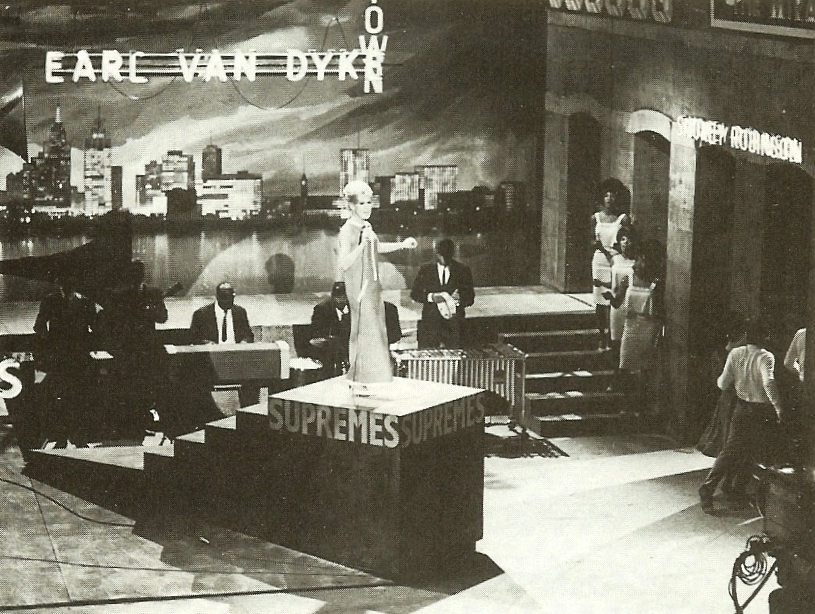
Above: Dusty singing with Martha and the Vandellas on the April 1965 Ready, Steady, Go! Motown special. Dusty not only hosted this British TV special but was instrumental in devising it. (For Martha's recollections of her friend Dusty Springfield, click here.)

In the following excerpt from Dusty!: Queen of the Postmods, author Annie J. Randall explores Dusty's role in the successful introduction of black American music to Britain via The Sounds of Motown television special, and her desire "to be perceived, first, as a promoter, even proselytizer, of soul music, and second, as a contributor to it."


Putting the Motown acts together struck Dusty as precisely the way to market the new sound on British television. They had been toured this way in the United States for years, thus executing Berry Gordy's strategy to present the singers collectively to a race-wary white public (who, he judged correctly, would accept an all-black show more readily than individual black acts integrated with white ones). Some months after Dusty's appearance at the Brooklyn Fox [September 4-13, 1964], the Ready Steady, Go! production team – Elkan Allan, Francis Hitching, and Vicki Wickham – decided to book the entire Motown Revue for their television show – with Dusty as host – when they next came to Britain. Individual Motown singers and groups had already appeared individually on Ready, Steady, Go! – Stevie Wonder and The Supremes, for example – but this would be their first appearance together as representatives of the Motown label and the soul sound. It could not escape anyone's notice, especially Dusty's and Vicki's, that such an appearance would convey the impression of a musical movement, exactly representative of the social and political sea change that was well under way in the United States and, of course, in countries like South Africa, where this music's representations could not be clearer.

Indeed, only a few weeks after Brooklyn, Dusty had traveled to South Africa (December 9-18, 1964) and refused complicity in the spectacle of hypocrisy that her performance of black-influenced music for white-only audiences would have been. Her experiences in Brooklyn and South Africa, separated by only a few months and preceded by her new friendships with Martha Reeves and other Motown musicians, may have caused a crisis of conscience. Nina Simone had not yet thrown a drink in Dusty's "honky" face, though this was the kind of reaction she wished to preempt. Even though "all British bands did it," Dusty did not want to be perceived as someone who simply appropriated black music and denied, either directly or indirectly, the originating artists from profiting in Britain and Europe; rather, she wished to be perceived, first, as a promoter, even proselytizer, of soul music, and second, as a contributor to it. Not content to be described as a "good thief," she fulfilled the first with her role in [Ready, Steady, Go!'s] Sounds of Motown (one she maintained throughout her life) and made a bid for the second, with Dusty in Memphis, two and a half years later.

. . . Martha Reeve remembers: When [Dusty] invited us all it helped open not only my career up here, it got The Supremes introduced, it got The Temptations their number one spot for a moment, and the tour went all over the UK after the show. A lot of things were booked after Ready, Steady, Go! was taped."

. . . [During the The Sounds of Motown] Dusty was onstage with her guests as if welcoming friends into her home and introduced each act to the audience less as a compere type of intermediary between audience and performers than as a gleeful party host introducing one set of friends to another. She also performed three times during the course of the show: once by herself ("You Lost the Sweetest Boy"), then with the Vandellas ("Wishin' and Hopin'" and "I Can't Hear You No More"), and last in the show's finale. There she took part in the improvised "Mickey's Monkey" with all of the Motown singers and Earl Van Dyke's instrumentalists assembled onstage in a free-for-all song-and-dance-number reminiscent of a ring show. The camaraderie between Dusty and the Motown groups, especially evident when she was onstage with the Vandellas, underscored the fact that she was introducing not only musicians she revered but also individuals who were her personal friends. Interwoven thus among the acts, Dusty achieved the image she hoped to create – as promoter rather than thief of soul music – and strengthened the perception, in Britain at least, that she could perform soul legitimately and could, indeed, contribute something credible of her own to the new style.


Following is a clip from the February 7, 1970 broadcast of The Andy Williams Show. It features Dusty performing a medley of her songs, accompanied by a troupe of groovy looking (and moving) dancers who wouldn't be out of place in Godspell or Jesus Christ Superstar! Enjoy!


Next up is Dusty performing "Knowing When To Leave" and "Up On The Roof" on The Rolf Harris Show, January 2, 1971. I have to say that I find the latter performance to be simply exquisite in its fragility. Indeed, Dusty's performance of "Up On the Roof" brings to mind author Laurence Cole's musings on a number of other Dusty tracks which convey "the sense of a woman on the edge of mental disorder – neither sane nor deranged but somewhere in between." Such tracks include "Soft Core," "In the Winter," "Exclusively for Me," and the haunting "Beautiful Soul," where she could be addressing either a female lover or herself.

Writes Cole in Dusty Springfield: In the Middle of Nowhere:

Those who only know Dusty Springfield via the hits know a truncated version of her 40-year public persona, for she sometimes took herself to dark and dangerous places in her recordings, when she was probably just about holding herself together as a person. . . . [F]ew singers have provided such access to private hurts and vulnerabilities, or sent postcards from so close to the edge of breakdown.


Okay, next is Dusty in one of her last television appearances, sharing her song "Roll Away" on the British morning chat show Pebble Mill. "Roll Away" was released as a single on October 23, 1995 (my 30th birthday!) and is the opening track on what would be Dusty's last album, A Very Fine Love. (For more about this beautiful song, see the previous Wild Reed post Time and the River.)


Every day when I look in the mirror,
I try to see where my soul’s at now.
Happy day, is it further or nearer?
On the way, will I find it somehow?
Yesterday’s gone, love lead me on.
I won’t ask why.

Roll away – it’s only time and the river.
Roll away – to the endless sea.
Roll away – it can all change tomorrow.
This is life in its glory,
And the river runs free.
Oh, roll away. . .


I conclude this special 'celebrating Dusty' post with a second excerpt from Dusty Springfield: In the Middle of Nowhere, one in which author Laurence Cole explores why many gay men and lesbians consider Dusty the "quintessential pop icon."

Commentators have agreed that Dusty's glamour, drama, hurt, survival instinct, bloody-mindedness, anguish and sheer emotionality held up a mirror in which gay men and lesbians could see themselves. The landscape of cracks, potholes and jagged edges she attempted to negotiate reflected the one they inhabited themselves. . . . However, Dusty's appeal for lesbian and gay consumers is broader than this . . . Because of her own sexual ambiguity, she was – is – about the only performer amongst the several women of gay iconic status assumed to have shared her fans' outsider sexuality. Her star atmosphere thus uniquely reflects her followers' feelings of 'not belonging' to the general culture and viewing it from a skewed angle; the knowledge that her lifestyle was neither straightforwardly heterosexual nor family-centered adds a dimension to the attraction missing from other fan-gay icon relationships. Gay-sympathetic songs like "Closet Man," "Beautiful Soul," and "Born This Way," recorded in the Seventies and Eighties at the height of her 'cult' attraction for gay men and lesbians, strengthened the connection. The suggestion . . . that alternative viewpoints and marginalised perspectives could be detected in the voice itself, and contributed to Dusty being heard as not-like-anyone-else, further enhanced her appeal for sexual outlaws and social non-conformists.

Shared, too, and probably because of this complicity, was the mocking sense of playfulness which star and fans adopted towards the idea of gay iconicity, with Dusty becoming one of the first to treat the matter of her iconic status as a bit of a laugh. This 'knowing sense of camp' and 'being in on the joke' . . . further boosted her appeal, and set the trend for subsequent tongue-in-cheek send-ups by Madonna and Kylie Minogue. What gave Dusty Springfield her singularity as a gay icon was this combination of drama-queen wallowing and in-on-the-joke camp parody. No-one else so skillfully and elegantly walked a tightrope between the two modes, or got such mileage from their conceptual possibilities. For Barry Walters, the 'mix of public exuberance and personal anguish' make Dusty Springfield 'the quintessential pop icon' for gay men and lesbians who experience similar vicissitudes of feelings and attitudes in their own lives.


For more of Dusty at The Wild Reed, see:
Soul Deep
Dusty Springfield: Queer Icon
Remembering Dusty
Remembering Dusty – 11 Years On
Remembering Dusty – 14 Years On
Classic Dusty
Classic Dusty II
Classic Dusty III
Classic Dusty IV
Classic Dusty V
Something In Your Eyes
The Other "Born This Way"
Heat Wave
No Stranger Am I
Time and the River
Remembering a Great Soul Singer
A Song and Challenge for 2012
The Sound of Two Decades Colliding
Dusty Springfield: "Wasn't Born to Follow"

Related Off-site Links:
Woman of Repute – My (archived) website dedicated to the life and music of Dusty Springfield.
Let's Talk Dusty
Forever Dusty: "A New Musical About the Legendary Dusty Springfield"
Dusty Springfield Tribute Site
The Definitive Dusty Springfield Collection
Portraying Dusty on Stage and in Film – Annie Randall (Oxford University Press Blog, April 16, 2013).


Saturday, April 13, 2013

Good News on the Road to Emmaus


When it comes to recognizing Christ in the lives
and relationships of LGBT people, the Catholic hierarchy
and the Catholic laity are at different points on the journey.
But Christ, the 'good news' of presence and transformation,
remains always beside us.


Last Sunday's gospel reading was the Road to Emmaus story. It's a story that, for a number of reasons, I've always been drawn to. One reason for this is that I very much resonate with its theme of journeying – an important metaphor within numerous spiritual traditions, and a particularly meaningful one in my own spiritual life as a gay man.

In light of this, I'm heartened by how on the Road to Emmaus answers and realizations and transformations unfold. I also like how the friends of Jesus are changed, once they awaken to his presence in their midst. And it's not only their thinking that is transformed, but also their actions. For instance, these once sad and fearful individuals are now so intent on sharing their encounter with Jesus that they embark on the dangerous nighttime journey back to their friends in Jerusalem, their hearts aflame with joy, hope and purpose.

And what does it mean that Jesus vanished from sight once his friends came to recognize his presence? Is it possible that in this part of the narrative we're being challenged to contemplate the idea that Jesus may never had been physically present to his friends at all?

Could it be that the risen Christ 'appeared' in the travelers hearts and minds as they shared their memories, thoughts and actions of their friend Jesus?

Could it be that this sharing brought to consciousness Jesus' wisdom and, yes, presence? Put another way, did such awareness ensure that they became Christ for one another?

Does such a reading diminish the power of this story? I'm sure for some people it does, and perhaps there was a time when it would have done so for me. But not anymore. For regardless of how one interprets the Road to Emmaus story, the truth remains: Jesus was truly present to his friends, and awareness of this presence transformed them.

I've been thinking a lot recently about these two key components of the Road to Emmaus story – presence and transformation. I've also been thinking about how they relate to the church today. Aren't we all, as church, on a journey whereby we're seeking to recognize, experience and embody God's transforming presence? And how does all of this happen?

It seems to me that when we're truly present to one another; when we listen, empathize, and honestly open ourselves to our own and others' experiences and insights, we experience the presence of the sacred. And this presence is transformative. We're not the same. We become living embodiments of God's transforming love; our hearts are aflame, and we find ourselves thinking and doing things we'd perhaps never have dreamed of thinking or doing before! Yes, it can be quite unsettling, to say the least!

After all, it is unsettling to realize that we can indeed recognize and experience Christ – one of many names for God's transforming love – whenever we're truly present to our deepest self and to the deepest reality of others. I know that it has been these 'being present' moments that have helped me grow and mature emotionally, intellectually, and spiritually. I'm sure many of my readers can relate to this experience – one that is ongoing, ever unfolding. And of course, because individuals are offered the opportunity to grow and change as the result of encountering and responding to God present in others, so too are the groups and institutions we as individuals comprise.

I find this to be a source of hope – especially within the context of the institutional Roman Catholic Church. And we're seeing this hope unfold within the institutional church around a number of issues, including many relating to gay people and their lives and relationships. The ancient catholic principle that 'matter channels spirit while remaining matter' lives on in Catholic sacramental theology (and in what Jamie Manson calls the "Catholic imagination"). I believe this means that Catholics are intuitively open and responsive to God's presence in, as I like to say, "unexpected faces and places." Yet, tragically, for reasons that I won't go into here (but have explored here, here, and here), the majority of men who comprise the clerical caste of the Catholic Church have abandoned this sacramental understanding when it comes to issues of gender and sexuality. They are thus neither open nor responsive to God's presence in the lives and relationships of lesbian, gay, bisexual and transgender (LGBT) people. Yet as the Road to Emmaus story reminds us, the potential for transformation is always with us, as Christ – God's transforming love – is always in our midst.


And who knows, maybe the growing number of bishops and cardinals (one of whom is now pope!) who have expressed support for legal recognition of same-sex relationships is a sign that Christ's presence in the lives and loving relationships of gay people is beginning to break through within the collective consciousness of the hierarchy.

Regardless of whether this is indeed the case or if civil unions are being used by the bishops as a desperate stopgap measure against marriage equality, those of us who have encountered and been changed by Christ's presence in our own and/or others' gay lives, must be like the disciples in the Road to Emmaus story. We must joyfully and fearlessly tell of our experiences. Indeed, I like to think that being a follower of Jesus is not about changing other people but about sharing our 'good news' stories of God's presence and transformation. Such stories obviously have the power to change hearts and minds, but how others choose to respond to them is ultimately beyond our control. The main thing is that we keep joyfully sharing – through both word and action – how our lives as LGBT and allied people have been transformed by God's love. Through such sharing we embody Christ in our church and our world – an embodiment that has the power to transform both.

Now how's that for good news!


See also the previous Wild Reed posts:
• The Passion of Christ (Part 12): Jesus Appears to His Friends
• The Many Manifestations of God's Loving Embrace
• LGBT Catholics Celebrate Being 'Wonderfully Made'
• Trusting God's Generous Invitation
• The Triumph of Love: An Easter Reflection
• Celebrating Our Sanctifying Truth
• Be Not Afraid, You Can Be Happy and Gay!
• Joy: The Most Infallible Sign of God's Presence
• Jesus: Path-Blazer of Radical Transformation
• Thoughts on Archbishop Nichols' Support for Civil Unions
• The "Gay Civil Unions" Approach of Some Within the Catholic Hierarchy: Too Little, Too Late

Recommended Off-site Links:

Why Do So Many Catholics Support Marriage Equality? Blame the Catholic Imagination – Jamie L. Manson (National Catholic Reporter, October 10, 2012).
Catholic Cardinals, Bishops Evolving on Civil Unions, Gay Relationships – Terence Weldon (Queering the Church, April 12, 2013).
Two More Cardinals on the Record Endorsing Civil Unions – Francis DeBernardo (Bondings 2.0, April 12, 2013).
"Records Show Pope Francis Supported Gay Unions" – Terence Weldon (Queering the Church, March 19, 2013).
Bishop Gumbleton to Pro-Marriage Equality Catholics: "Don't Stop Going to Communion" – Francis DeBernardo (Bondings 2.0, April 12, 2013).
The Appearance on the Road to Emmaus – Sacred Art Meditations.

Image 1: "Emmaus' Door" (1992) by Janet Brooks-Gerloff.
Image 2: Albert Decaris.
Image 3: Sadao Watanabe.
Image 4: "Jesus Appears at Emmaus" by Doug Blanchard.
Image 5: "The Supper at Emmaus" by Edward Knippers.