Friday, July 06, 2012

A Spirit of Defiance


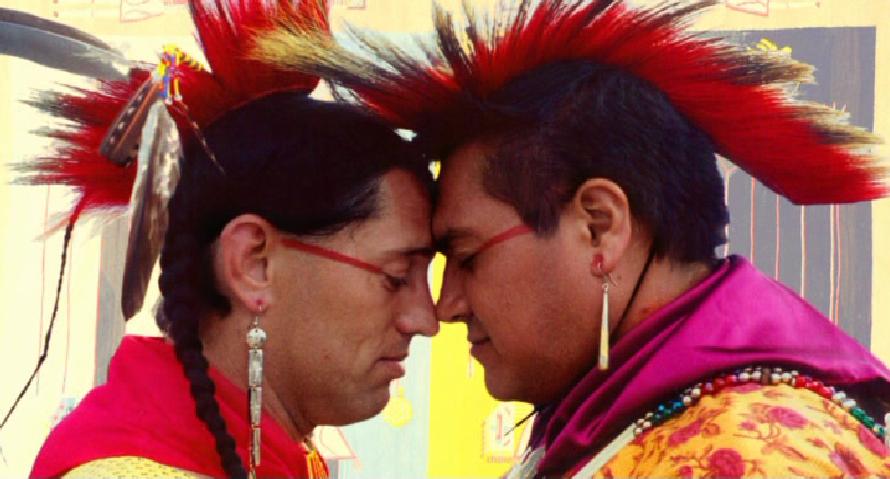
The Wild Reed's 2012 Queer Appreciation series concludes with an excerpt from Donald L. Boisvert's Out on Holy Ground: Meditations on Gay Men's Spirituality.


Gay men have always had a peculiar love-hate relationship with religion. It is important, therefore, to understand the very intimate connection between the oppression an exclusion of gay men and the emergence of a distinctly gay spirituality.

Gays are intensely conscious, personally and collectively, of the disdain in which they have been held by organized religion, most notably Christianity, throughout history. One need only consider in this regard the statements of condemnation that continue to be issued by the Roman Catholic hierarchy. The political and social ostracism of gay men has its source in the oppression of Scripture. The blossoming of a gay spirituality can therefore be seen as a classic example of the positive recuperation, by the victim and the outsider, of the religious discourse of rejection and intolerance – in much the same way that gays and lesbians, for example, may opt to call themselves "faggot," "dyke," or "queer," or wear the pink triangle with pride.

In choosing to define themselves as persons with a spiritual life and a language with which to express it, gay men are staking claim to one of the most powerful and persuasive instruments of social, cultural, and political legitimacy, that of religion. In doing so, not only do they attempt to neutralize the sharp sting of religious righteousness, they also create a parallel religious discourse of inclusion and acceptance: sites of defiance and resistance, as it were. Such a parallel discourse, in turn, can become a significant source of personal and collective empowerment. The similarities with the field of liberation theology are striking, and it could be argued that these are more deliberate than accidental. Gay theology came into its own at the same time that several Latin American theologians were confidently redefining traditional Christian teaching with respect to the meaning of human salvation.

Gay spirituality is characterized by a spirit of defiance. In asserting the truth and viability of the gay religious experience, and in creating the conditions that allow it to assume meaningful and treasured place in the lives of gay men, gay spirituality situates itself squarely in opposition to the orthodox religious norm. Though some forms of gay spiritual life may be very much tied in with more established churches, gay spirituality, as a whole is transnormative. It may burrow blatantly and deliberately from a universal storeroom of religious symbols and rituals, but it posits a radically different understanding of the human body and of human sexuality, on the one hand, and of human relationships with the holy or with the sacred, on the other. This subversive element – vis-a-vis both the transcendent and the immanent – gives gay spirituality its force and dynamism, and makes it an essential constituent of the contemporary gay identity.


For previous posts in The Wild Reed's 2012 Queer Appreciation series, see:
The Theology of Gay Pride
Bi God, Somebody Listen
North America: Perhaps Once the "Queerest Continent on the Planet"
Gay Men and Modern Dance

For The Wild Reed's 2011 Gay Pride/Queer Appreciation series, see:
Gay Pride: A Celebration of True Humility
Dusty Springfield: Queer Icon
Gay Pioneer Malcolm Boyd on Survival – and Victory – with Grace
Senator Scott Dibble's Message of Hope and Optimism
Parvez Sharma on Islam and Homosexuality
A Catholic Presence at Gay Pride
Worldwide Gay Pride

For The Wild Reed’s 2010 Gay Pride series, see:
Standing Strong
Growing Strong
Jesus and Homosexuality
It Is Not Good To Be Alone
The Bisexual: “Living Consciously In the Place Where the Twain Meet”
Spirituality and the Gay Experience
Recovering the Queer Artistic Heritage
A Catholic Presence at Gay Pride
Worldwide Gay Pride

For The Wild Reed's 2009 Gay Pride series, see:
A Mother’s Request to President Obama: Full Equality for My Gay Son
Marriage Equality in Massachusetts: Five Years On
It Shouldn’t Matter. Except It Does
Gay Pride as a Christian Event
Not Just Another Political Special Interest Group
Can You Hear Me, Yet, My Friend?
A Catholic Presence at Gay Pride
Worldwide Gay Pride

See also the related Wild Reed posts:
Spirituality and the Gay Experience
In the Garden of Spirituality – Toby Johnson
Gay People and the Spiritual Life
The Challenge to Become Ourselves
The Gifts of Homosexuality
The Bible and Homosexuality
The Roman Catholic Church: Officially Homophobic, Intensely Homoerotic
Sons of the Church: The Witnessing of Gay Catholic Men – A Discussion Guide

Image: Subject and photographer unknown.


Sunday, July 01, 2012

Sufism: A Call to Awaken


My interest in universal Sufism recently led me to Fazal Inayat-Khan’s 1973 book Old Thinking, New Thinking: The Sufi Prism.

The grandson of Sufi master Hazrat Inayat Khan, founder of The Sufi Order in the West in 1914, Fazal Inayat-Khan (1942-1990) was a psychotherapist and poet who led the International Sufi Movement from 1968 to 1982. Because he sought to incorporate the insights of modern psychology and dissociate from the traditional religious approaches of the past, Fazal's approach to Sufism was labeled “revolutionary and contemporary.” For Fazal, “sex, the family, children, education, the question of worship and devotion all take on new nuances and meanings when focused through the lens of mystical realism.” Accordingly, Old Thinking, New Thinking is described by its publishers, Harper and Row, as follows:

Old thinking explains, new thinking demonstrates. Old thinking puzzles things out, new thinking flashes with intuition. Old thinking is the tortoise, new thinking the hare. Rather than reject one for the other, the truly happy person dances between them. This is the message of Fazal Inayat-Khan’s piercing look at contemporary life through the Sufi prism. . . . Far from being buried in the scriptures and teachings of another culture, the creative Sufism explored in Old Thinking, New Thinking is a living, viable path for today. No magical formulas, fantastic techniques, or tricks will be found in these pages. But for those interested in becoming newly alive and who have the courage to travel deep within, this book reveals a way of seeing life that can sweep one toward final liberation from the world of illusion.

It should be emphasized that Fazal Inayat-Khan wrote his book in 1973. Accordingly, its language is non-inclusive, even as the book’s overall message is all about inclusion. Also, the book's chapters that deal with the unique challenges faced by the male and female genders contain, to my mind, a number of stereotypes that would puzzle and offend many people today. The excerpts I share this evening from Old Thinking, New Thinking are not drawn from those parts of the book. Rather, they explore the overall, the universal message of Sufism.

_________________________


Sufism has always tried to be an answer to humanity in the time of its need, realizing full well that as the need of humanity changes, the answer has to change. If someone is hungry you can bring him water, but it will not satisfy the hunger. If someone is thirsty you can bring him food, but he might not be able to digest it through lack of water. As one delves deeper and deeper into Sufism, one will find that on the surface it is culturally colored to give the immediate answer to man at a particular time in his humanity.; however, as it leads you along further and further, it tries to bring you to a more balanced approach to life; not strictly water to the hungry or food to the thirsty or vice versa, but maybe water to the thirsty to begin with and then food afterwards, maybe food to the hungry to begin with and then water. It tries to be an answer which leads man to a greater, a more balanced understanding, and thereby an acceptance of his humanity, his real self.

. . . Sufism is something which must help you to see life as a permanent transition. It is something which must bring you to a realization of dynamic peace: peace, not with what is, but with what will be. It is not, of course, possible to explain exactly what is meant by these terms. It is not possible because first, every general statement is in part invalid, and that part of it which is invalid begins to lose its validity as soon as it has been expressed; and second, because we must be aware that to each and every one of us everything means something different. . . . [T]here is nothing we know that we can be sure about, because all that we know is unique, exclusive to our own little consciousness. This may, in fact, be man’s greatest basic insecurity, the fear of having to face the fact that we know, for sure, nothing.

Think of of it another way: many people in the world are sure of what they know, yet there is nothing that can be known which is not subject to change, and impermanent. Very few people are sure of what they know not, and yet all those things which are not to be known are, in the end, the only things we can be sure of, the only things of which we are certain. Sufism begins by giving man that security, which could also be labeled freedom, to approach the experience of what appears as life without hesitation, without prejudice, without fear, especially without this incredible plague of our mind which conceives that things ought to be in a particular way. . . . Sufism brings a freedom to function in the known without fear, to function in the unknown without certainty, and to approach the apparent realiy of life with a mystical insight into its unreality.

. . . [T]he meaning, the value, the worth, the reason of life [is] not in what we do, nor even in how or why we do it, since all these are forever changing – but in becoming the experience. Some may say this is not clear, how can it be understood? Others may grasp the concept but feel that it is not sufficiently stable, how can one build one’s life? How does it help me to live? Here [another] important aspect of Sufism must be brought out, an aspect which may be as shocking as, if not more shocking than, the previous ones. That is that if one really begins to live, consciously, one can never live in the same way again. . . . Although you will still function as a human being, you will still be able to calculate, add and divide, you will still be able to laugh and cry, to break and to destroy, to create, to wonder, to hurt, to love, to disdain, to reject, to accept, you will be able to do all these things like any other human being, yet the coloring of their meanings, the reasons for why you will do, how you will do, what you will experience of what you will do, all will have changed, because the driving power behind your consciousness will have changed. This is the transformation of the personality, of the character, the real transformation, separating – and this may by cynically put, but it is still valid – the human sheep from the human beings.

Sufism is not something which one can define in form, it is not a grouping which one can understand in structure, it is not a teaching which one can communicate in words. It is an approach to life, a way of life, helping you at the speed at which you are able to unload the weight, the gravity of fear and attachment, bringing you to a transcendent freedom, the freedom of experience.

All these are big words, and maybe in their size you have become lost, but they are also very simple words and one usually becomes lost in their simplicity. In the spiritual search, in the cultural search, in whatever search for meaning that mankind is engaged in, we usually look for something magical, something sensational, something fantastic. . . . And yet, when Sufism is presented to your mind, you are totally estranged from it because it is not at all the kind of answer you are looking for. It is not something to sell, it is not another gimmick to help you, another wine to dull the senses into believing that everything is all right.

It is a way to awaken. Sufism is a call, a cry to awaken, to the minds who are ready, to the human beings who have slept enough, but to those who still want to sleep it is merely a lullaby along in their dreams. It is a cry to awake to life, to integration, to meaning, to honesty, to honesty with ourselves. It is a cry to drop all sorts of holy trips, flat earths, ancestor worships, sentimental attachments to souls and spirits and other trickery which exist or not, neither their existence nor their non-existence being that meaningful in the end. It is a cry to the genes of your consciousness, to the chromosomal activity of your mind, of your being, to awake, and live. . . .


See also the previous Wild Reed posts:
The Sufi Way
A Living, Twenty-First Century Tradition
Clarity, Hope and Courage
As the Last Walls Dissolve . . . Everything is Possible
The Winged Heart
Bismillah
It Happens All the Time in Heaven
A Dance of Divine Light
Never Say It is Not God
Rumi and Shams: A Love of Another Kind
In the Garden of Spirituality – Doris Lessing
Keeping the Spark Alive: Conversing with “Modern Mystic” Chuck Lofy

Opening image: Michael J. Bayly.


Thursday, June 28, 2012

Wednesday, June 27, 2012

What a Man!

Last April I started highlighting well-known straight men who, regardless of the risks to their careers or popularity, are taking very public stands for LGBT people and their civil rights. To date, The Wild Reed's "What a Man!" series has spotlighted four sportsmen (Ben Cohen, Sean Avery, Hudson Taylor and Nick Youngquest) and one U.S. Republican politician (John Kriesel).

Tonight the spotlight's on Minnesota Viking's punter Chris Kluwe, who recently recorded a series of radio spots for Minnesotans for Equality, one of a number of groups working to defeat November's proposed amendment to the state constitution which would limit the freedom to marry.

Following is an excerpt from an OutSports.com interview with Kluwe.

______________________


OutSports: How did you get involved in the fight in Minnesota against the marriage amendment?

Kluwe: Someone contacted me on Twitter [from Minnesotans for Equality] and asked if I’d be interested. I said yes. I’ve always believed that people are inherently the same and should have the same rights and equal protection under the law. It really doesn’t matter what you do with who or whom as long as you’re not infringing on someone else’s rights. Everyone should be free to live their own life however it makes them happy.


Above: Kluwe and his wife Isabel with their
two daughters Remy and Olivia.


OutSports: In the 30-second ad, you referenced families a lot. Families are the thing thrown at supporters of gay marriage because we’re told we have to protect the traditional family. Was that a conscious decision on your part to mention family several times?


Kluwe: I had some input in writing it and I wanted to make sure it was something that would resonate with people. I don’t think a lot of people realize that family is family. It doesn’t matter who you are; the people you grow up with, that’s your family. If you find out your kid is gay, are you going to love him any less? Because if you do, then you’re probably not doing parenting for the right reasons.

One of my wife’s brothers is gay and I know him and his partner [who live in California] would love to get married but they can’t.


OutSports: Do you have close friends who are gay?

Kluwe: None that I know of. Honestly, I’ve never really asked anyone. I’m more interested in if you’re going to play video games with me! Honestly, I don’t care. People don’t ask me what goes on in my bedroom and I try and give them the same privilege . . .


OutSports: Do you still think you’d be involved in this issue if you didn’t have a relation who was gay?


Kluwe: I would definitely still be signing up for it. One of the things my parents [Ron and Sandy] brought me up with is that you should have equality for everyone. I would like to think I have a pretty strong sense of justice and right and wrong. [The proposed marriage amendment] is just blatant discrimination and that’s not right, that’s wrong.

One of the best things parents can teach their children is to have the courage to go out and find your own answers in life. While we can give you a framework, it’s up to you to live your own life.


To read OutSports.com's interview with Chris Kluwe in its entirety, click here.


For a Chris Kluwe update, click here.


See also the previous Wild Reed posts:
What a Man! – Ben Cohen
What a Man! – Sean Avery
What a Man! – Hudson Taylor
What a Man! – John Kriesel
What a Man! – Nick Youngquest
Rockin' With Maxwell
Ian Thorpe's "Difficult Decision"
The New Superman: Not Necessarily Gay, but Definitely Queer
A Fresh Take on Masculinity


Monday, June 25, 2012

Gay Men and Modern Dance


The Wild Reed's 2012 Queer Appreciation series continues with a post that also fits well into this blog's ongoing series, The Dancer and the Dance. That's because I'm sharing this evening an excerpt from Julia L. Foulkes' 2002 book Modern Bodies: Dance and American Modernism from Martha Graham to Alvin Ailey. As you'll see, this particular excerpt explores how from its earliest days, modern dance was "distinct from other artistic genres in the groups of people it attracted," including gay men. "Modern dance began and remains a place where people on the edges of society congregate and express themselves," writes Foulkes.

(Note: To start at the beginning of The Wild Reed's 2012 Queer Appreciation series, click here.)

____________________________


Like Picasso, Matisse, and other modernist painters, modern dancers created new ways for people to see themselves, from disjointed, angular composites of body parts to colorful, rounded, fluid outlines. New images came out of new roles. Modern dance was distinct from other artistic genres in the groups of people it attracted: white women (many of whom were Jewish), gay men, and some African American men and women. Women held leading roles on stage and off, replacing the common stage image of the sexual ingenue with that of the pioneering individual who moved her own body with disquieting, abrupt force. Gay men, too, recast the effeminate image of the sissy into a hardened, heroic, dancing American athlete. African American dancers, however, did not find an easy place within this new American art form, even though the theme of African Americans' rise from oppression dominated many of the stories of white modern dancers' choreography, such as Tamiris's Negro Spirituals. In their slighted role, African American dancers and choreographers defined the limits of modern dancers' communal visions, and in their own productions they explored other conceptions of dance, of modern times, and of the United States by thrusting Africa and the Caribbean onto American stages.

This vital new force in the arts inevitably evoked questions about how America could be portrayed in dance, what was American in the arts, and what it meant to be an American. In many ways, modern dance productions portrayed the United States as a society composed of heroic individuals, a theme also found in post office murals and Federal Theatre productions created out of the government-sponsored Works Progress Administration (WPA). One of the most celebrated plays of the era was Thornton Wilder's Our Town (1938), which eulogized Americans' ability to group together quirky individuals in both life and death. But modern dancers enacted a more radical concept. Marginalized groups of gay men, Jewish women, and African American men and women flocked to a fledgling art form that was based on physical expression. Defined by external physical characteristics or so-called deviant sexual practices, the social identities of these dancers shaped the means by which they contributed to defining America. And their physical differences and exploration of body movement showed the limits of pluralism and assimilation in the 1930s and, particularly, the depth and endurance of racial fracture.

Modern dance began and remains a place where people on the edges of society congregate and express themselves. . . . The evolution of modern dance into an esoteric art form illustrates the course of modernism in the United States where social roles reinforced a marginal path. White women, African American men and women, and gay men created in modern dance a malleable art form within which they might re-imagine conventional social roles. But that very malleability and radical re-visioning have kept modern dance on the fringe of the arts and the rim of society.


Modern dance's liminal place, though, lends it importance in offering an original perspective on how the arts reflect and contribute to the struggles and composition of our world. The instructiveness of dance begins with its elusiveness – the active embodiment of idea, practice, or historical era and its fleetingness. The inability to fix or stop the moment of dance allows for continual transformation of our finite bodies. James Baldwin elegantly described the power of performance as "the unmistakable silence in which [the performer] and the audience re-create each other." Dance resides within that hope of re-creation. It offers the possibility that our bodies are not always a prison of flesh and that we can change our physical presentation to the world and alter the way we see ourselves and others.

. . . In the 1930s white gay men succeeded in modern dance due to the strategy Ted Shawn devised to heighten virility and thereby diminish the perceived threat of homosexuality. . . . Shawn and other gay men found in modern dance a way to both display and conceal their circumscribed lives and, in doing so, further substantiated the coded association of the arts with male homosexuality. . . . In general, artists tolerated difference, and once gay men filtered into the arts, other gay men followed. In a society that criminalized homosexual acts, the arts provided a place of relative comfort, acceptance, and community.


NEXT: A Spirit of Defiance


See also the previous Wild Reed posts:
Reclaiming the Queer Artistic Heritage
The Trouble with the Male Dancer (Part 1: Challenging Notions of Masculinity)
The Trouble with the Male Dancer (Part 2: Homophobia and the Male Dancer)
The Trouble with the Male Dancer (Part 3: Homosexuality and the Male Dancer)
The Dancer and the Dance
The Premise of All Forms of Dance
The Church and Dance
The Soul of a Dancer
A Dance of Divine Light
Seeking Balance

Image 1: "Decades of Dance" – Foster Fiz-Simons of Ted Shawn's Men Dancers (John Lindquist, Harvard Theatre Collection) and Garrett Ammon of Trey McIntyre Project (Jonas Lunqvist).
Image 2: From Men in Motion: The Art and Passion of the Male Dancer by François Rousseau.
Image 3: Ted Shawn Dancers.
Image 4: Some of Ted Shawn's dancers at Jacob's Pillow, Massachusetts.


Something to Think About . . .


Recommended Off-site Links:
Supreme Court Decision On Arizona’s Immigration Law Provides Strong Support for Obama’s Immigration Order – Judd Legum (ThinkProgress.org, June 25, 2012).
Latinos and Immigration – Eduardo Peñalver (Commonweal, June 25, 2012).
Immigrant Solidarity Network

See also the previous Wild Reed posts:
Something to Think About – May 19, 2012
Fasting, Praying and Walking for Immigration Reform
May Day 2007

Image: Subjects and photographer unknown.


Sunday, June 24, 2012

North America: Perhaps Once the "Queerest Continent on the Planet"


The Wild Reed’s 2012 Queer Appreciation series continues with an excerpt from Will Roscoe’s enlightening 1998 book Changing One: Third and Fourth Genders in Native North America. Historian Martin Duberman describes Changing Ones as a “magisterial summation – and extension – of [Roscoe’s] earlier studies on alternative genders in Native American culture” (The Zuni Man-Woman).

Changing One is grounded in the reality that 150 tribes across America have members who engage in some form of gender identification beyond "male" and "female." Amazon.com notes that “Roscoe's study reveals how integral these third and fourth genders, and same-sex marriage, have been to the tribes' societies, in contrast to the intolerance demonstrated by the Judeo-Christian culture of the descendants of European invaders. His analysis of these tribes, rooted in the empirical evidence of their histories, also provides a fascinating counterpoint to theories about homosexual identity rooted solely in modern, Western preconceptions.”

(Note: To stat at the beginning of this series, click here.

_________________________________________


In 1986, when the U.S. Supreme Court upheld Georgia’s sodomy law, the majority opinion cited “millennia of moral teaching” against homosexuality in support of its decision. Ten years later, when legislation called the Defense of Marriage Act was proposed by a twice divorced congressman and signed into law by anadmitted adulterer, it was said that no society that allowed people of the same sex to marry has or could survive, that American values were grounded in Judeo-Christian principles that precluded tolerance of same-sex love and gender difference.

In truth, the ground American society occupies once may have been the queerest continent on the planet. The original peoples of North America, whose principles are just as ancient as those of Judeo-Christian culture, saw no threat in homosexuality or gender variance. Indeed, they believed individuals with these traits made unique contributions to their communities. As a Crow tribal elder said in 1982, “We don’t waste people the way white society does. Every person has their gift.”

In this land, the original America, men who wore women’s clothes and did women’s work became artists, innovators, ambassadors, and religious leaders. And women sometimes became warriors, hunters, and chiefs. Same-sex marriages flourished and no tribe was the worse for it – until Europeans arrived. In this “strange land,” people who were different in terms of gender identity or sexuality were respected, integrated, and sometimes revered.

[Changing Ones documents] one of the most distinctive, widespread, and least known aspects of native North America. The result is a strikingly different view of the American frontier. Instead of hyper-masculine braves and submissive squaws we find personalities of surprising diversity and complexity. . . .


NEXT: Gay Men and Modern Dance


See also the previous Wild Reed posts:
Quote of the Day – November 12, 2011
John Corvino on the "Always and Everywhere" Argument Against Gay Marriage

Recommended Off-site Links:
Gay Marriage Has Been in America for Hundreds Of Years – Cacy Forgenie (Global Grind, June 15, 2011).
Gay Native Americans Reclaim Two-Spirit Culture – Adam Amel Rogers (Change.org, November 24, 2009).
Two-Spirits: The Film

Image 1: Source.
Image 2: A same-sex Navajo couple in 1866.
Image 3: Two spirit Crow members in 1928.


Friday, June 22, 2012

Quote of the Day

In some ways it feels like the society we're living in has a better view of how all of us can get along than the church. By trying to protect marriage, the church is becoming an enemy of human beings, causing divisiveness.... I think the dangerous thing that [Archbishop] Nienstedt did is that he decided to step out politically, and crossed the boundary of being a teacher of the faithful to trying to influence the political background of the state.

Rev. Michael Anderson
Quoted in Casey Michels' article
"Tilting at Rainbows: Archbishop John Nienstedt
Crusades Against Gay Marriage
"
City Pages
June 20 2012

Thursday, June 21, 2012

Out and About – Spring 2012 (Part 3)

.


With today being the first day of summer, I realize I'd better finish up my spring 'Out and About' series!

It's been quite an eventful past four months, as the previous installments in this series attest (see here and here). Much of my time and energy have been focused on my work as executive coordinator for Catholics for Marriage Equality MN, and this group's efforts to spread the message that Catholics can in good conscience support marriage equality and vote 'no' on the proposed state constitutional amendment that would deny same-sex couples the freedom to marry. These efforts were mentioned in a recent City Pages cover story about Catholic opposition to Archbishop Nienstedt's anti-gay and pro-'marriage amendment' activism. Also, my friend and fellow C4ME-MN board member Jim Smith was featured earlier this week in a CNN story entitled "Can 'Good Catholics' Support Same-Sex Marriage?"

My part-time job as a site coordinator for a local meals-on-wheels program also keeps me busy, as does my maintaining of a number of blogs other than The Wild Reed. These include The Progressive Catholic Voice, Sensus Fidelium and A Prince Named Valiant. An unfortunate result of all this activity is that I find I have considerably less time to write original material for The Wild Reed. From the earliest days of this blog there has been basically two types of posts: my own writings and my sharing of others' writings that I find interesting and insightful, and that I hope my readers will too. Lately, however, it seems that I've mainly been sharing the latter type of posts, including a lot of "Quote of the Day" and "Something to Think About" posts. I miss the days when I could spend hours, sometimes even days, working creatively on a piece of writing like this or this or this. Still, I guess there's not a lot I can do about this current situation, but it does make me wonder about the direction and overall future of this blog.

These concerns aside, I have to say that I do find replenishment by intentionally spending time outdoors and with the many wonderful friends that I'm very fortunate to have in my life. Some of these friends you'll see in this post . . .


For instance, pictured above are my friends Barb and Greg. I took this photo in late May when the three of us went out walking along Minnehaha Creek, which is close to my home in South Minneapolis.


Above: My house-mate Tim, putting up a rabbit-proof fence! Tim's planted all sorts of vegetables and herbs in our backyard garden. Just last night we had fresh radish with our evening meal!

Right: Home, sweet, home! I moved from St. Paul to South Minneapolis at the end of January. The transition has been remarkable smooth, and my new home very welcoming and restful. I know I owe much of this to my friend, house-mate, and work-out buddy Tim! Thanks, Tim!


Above: In late May Tim and I hosted our first cook-out in the backyard. Pictured above from left: John, Brian, Rick and Tim.


Left: With my good friends Noelle and Phil.

Phil was recently a guest writer here at The Wild Reed. To read his piece, click here.


Above: Curtis and Liana! What a lovely couple!


Above: And here's another lovely couple . . . John and Bob!

This photo was taken at the beautiful Kordiak Park in Columbia Heights, MN, on June 5, 2012.


Above: Hello, boys! Standing at left with my good friends Brian, John and Bob – Kordiak Park, June 5, 2012.


Opening image and above: I so wanted to strip down to my skivvies and take a swim! Paddling around in a canoe would also have been fun.


Above: With my dear friend Joan at an outdoor concert in Minnehaha Park.


On Sunday, June 10, more than 200 Catholics came together at a church in Edina to discuss how Catholics can vote 'no' on the proposed constitutional amendment that would limit the freedom to marry. Speaking at the podium in the picture above is Sen. Scott Dibble, who along with his husband Richard, feature in C4ME-MN's video series, Catholics for Marriage Equality.

In the aforementioned City Pages article, Scott talks about C4ME-MN's video series: "It just [has] really beautiful vignettes, putting language and context to values people already hold. [And] you contrast the archbishop's threats and edicts with the generosity and warmth and adherence to ideals of justice that are coming from the pews, and it's striking."


Above: The display table of Catholics for Marriage Equality MN, one of the four Catholic organizations that partnered with Minnesotans United for All Families to present the June 10 "Catholics Vote No" event.

For the video and transcript of "Why Catholics Can Vote No," Fr. Bob Pierson's presentation on June 10, click here.


Above: with my friends Kathleen and Joey outside the famous Blue Room jazz bar in Kansas City, Missouri. For more images of our recent weekend in KC, click here.


See also the previous Wild Reed posts:
Out and About – Spring 2012 (Part 1)
Out and About – Spring 2012 (Part 2)


Bi God, Somebody Listen

By Guest Writer
Philip Jacquet-Morrison


Note: The Wild Reed's 2012 Queer Appreciation series continues with a thoughtful reflection on bisexuality by my good friend Phil. (To start at the beginning of this series, click here.)


A little over a year ago I dated a man who joked that bisexuality is “gay-layaway”, e.g., “bi now, gay later.” Normally, I would be able to brush this off, but as I reflected upon it, I realized this “joke” bothered me. Even little remarks like that hint at a subtle prejudice that exists within the GLBT community. There are times when I wonder if there's an invisible line separating the BT in GLBT. (Transgender people may feel the same way, but as I'm not transgender, I cannot speak on the topic.) Bisexual people don't seem to get much attention in mainstream queer media. I can't remember the last time Lavender or Equality reported on someone who's openly bisexual, or a film or TV show portrayed bisexuals as something other than psychopaths, sex-maniacs, or the butt of jokes.

In a way, I'm not surprised. Truthfully, there isn't an easy way in which bisexual people can be visible since we tend to make assumptions about people's relationships based on the sex of their partner. When we see a heterosexual couple we tend to assume they're both heterosexual, just as we assume both partners in a homosexual relationship are homosexual. I do realize that the majority of people in the queer community identify as gay or lesbian, but that doesn't mean everyone is, and if we don't correct people, that assumption persists. People have tried to tell me I'm overreacting, usually dressing it up in language akin to “What does it matter? Gay, lesbian, bisexual, it's all the same essentially.” Therein lies the problem, because bisexuality is not the same thing.

I once tried to explain to someone what it's like being bisexual, but found myself stymied to come up with a better analogy than “some people like the opposite sex, some like the same sex, and I like both.” I feel that promotes a tendency among people to approximate bisexuality as being “half-gay” or “partially straight”, and neither of those is accurate. The best I could come up with was to say that I don't understand what it's like to not be attracted to someone because of his or her sex. If I personally find someone attractive, his or her sex simply doesn't factor in. Bisexuality is not a variation of homosexuality or heterosexuality; it is an entirely unique identity and cannot be abrogated due to the nature of a single relationship. All too often we are fearful of that which cannot easily fit into prescribed categories. It's this fear that ultimately leads to biphobic sentiments, which is a shame since there's a valuable lesson bisexual people can teach.

Sexual orientation is equally a matter of who we're not attracted to as it is who we are attracted to. A person who identifies as heterosexual is expressing both a consistent interest in the opposite sex, as well as a consistent lack of interest in the same sex. Likewise, a person who identifies as homosexual is expressing an interest in the same sex as well as lack of interest in the opposite sex. That being said, why should a single exception to the rule cause people to worry? There's no reason a person cannot identify as heterosexual because he or she had a single, perhaps fleeting, interest in someone of the same sex. Likewise a person who identifies homosexual can still be homosexual even if he or she had an attraction to someone of the opposite sex.

There are good number of people (probably more than are willing to admit) who have had curiosities about members of the sex they thought they weren't attracted to. All too often, people live in fear of these curiosities because of what they feel are the broader implications of having them. Heterosexuals may face anxiety over being perceived as gay, while homosexuals may fear being ostracized from a community they have stridently identified with. The lesson here is that when it comes to matters of sexuality, we should stop worrying what other people think and focus on what things mean to us as individuals. As a bisexual person, I don't worry about the significance of a person's sex, only about the significance of the person to me. Instead of running from these curiosities, we should try understanding them, and perhaps even embracing and exploring them. It may help to remove, or at least lessen, the burden of sexual repression we are so often compelled to carry in our society. In so doing, we can open our minds to the beauty and richness of human sexuality, embracing it for its wondrous ability to uplift and ennoble the human spirit.


NEXT: North America: Perhaps Once the "Queerest Continent on the Planet"


See also the previous Wild Reed posts:
The Bisexual: "Living Consciously and Continually in the Place Where the Twain Meet"
Alexander's Great Love


Wednesday, June 20, 2012

Casey Michel on Archbishop Nienstedt's "Crusade Against Gay Marriage"


About two months ago I was interviewed by City Pages writer Casey Michel for a feature article he was writing about Archbishop John Nienstedt's anti-gay and pro-'marriage amendment' activism. Michel's article came out today, and it's quite an extensive piece. Others interviewed for it include Catholic theologian Leonard Swidler, my friends Paula Ruddy and Bob Beutel of the Twin Cities-based Catholic Coalition for Church Reform, Bob Pierson, "an openly gay priest in the St. Cloud diocese," and Mike Tegeder, who, along with Pierson, is "one of the few Minnesota priests to publicly oppose Nienstedt's stance on gay marriage."

Michel's article does, however, have its shortcomings, and they stem from the tendency of many people – including, it seems, reporters – to peg credit for an entire organization or movement onto a single person. It's very uncomfortable being set up as that person when you, not to mention those you work with, are fully aware that a given group's achievements are the result of many people's efforts and dedication, not just one individual's. I find myself in that uncomfortable position when reading Casey's piece, as at one point he has me single-handedly founding Catholics for Marriage Equality MN (C4ME-MN) and producing the group's DVD Catholics for Marriage Equality! Believe me, many people were involved in the formation of C4ME-MN, and our DVD was the work of a creative and dedicated group of people. Casey also erroneously states that the Catholic Pastoral Committee on Sexual Minorities (CPCSM) folded two years ago. It's actually still in existence and is serving as C4ME-MN's fiscal agent.

These overstatements and errors aside, Michel's article is definitely worth looking into. It can be read in its entirety here, while following, with added links, are excerpts.

__________________________________


Excerpts from
Archbishop John Nienstedt Crusades
Against Gay Marriage
But increasingly, his flock of Minnesota Catholics isn't following

By Casey Michel
City Pages
June 20, 2012


. . . "The greatest threats to marriage are the economy, joblessness, alcoholism, drug abuse — there are a lot of threats to marriage, but it has very little to do with homosexuals having a committed relationship," says [Fr Mike] Tegeder . . . "I know committed same-sex people who are doing God's work."

Tegeder knows what the Bible dictates on homosexuality — along with what it dictates about shellfish, and mixed-cloth clothing, and all those other Bronze Age concerns. And he knows there's no single person responsible for the shame his church lifts from these passages.

But there is one person who could single-handedly end it all in the Twin Cities: His Excellency, the Most Reverend Archbishop of St. Paul and Minneapolis John C. Nienstedt.

"Nienstedt is just so rigid about these things," Tegeder continues, growing animated. "But, you know — just let go of it. What are we trying to defend? Marriage? Has the Catholic Church protected marriage? I mean, [Nienstedt] has a priest who impregnated one of his staff members, broke up their marriage, and the guy's still functioning! ... Why don't we take care of our own issues before we start imposing views onto other people who don't have the same religious beliefs?"

It wasn't always this way. Archbishop John Roach and his successor, Harry Flynn, led a notably progressive, inclusive, post-Vatican II archdiocese, one balanced on even-handed discussion. They understood the church's line on certain social issues — reproductive rights, welfare reform — but always kept their doors, and their minds, open.

But in the mid-'80s, with AIDS and "moral relativism" coming to the fore, the church began sidelining priests who'd championed gay parishioners. Pope John Paul II closed rank, and his successor followed suit.

"I'm afraid these men have sex on the brain, and between you and me that's not the best place to have sex," says Leonard Swidler, a prominent Catholic theologian and professor of Catholic Thought and Interreligious Dialogue at Temple University. "Issues of birth control, marriage, divorce, married priests, female priests, same-sex marriage — it's all sex, sex, sex. They're sex maniacs."

Few fit Swidler's caricature of the current episcopacy more naturally than Nienstedt. Born in Detroit in 1947, Nienstedt took to the church early. His parents were devout Catholics, and it took little time for Nienstedt to find his calling, claiming from an early age that he'd someday become a priest.

Patrick Halfpenny, now a monseigneur in the Detroit archdiocese, first met Nienstedt when they were freshmen at seminary school in Detroit. Bonded by a common affinity for hockey, the two formed a fast friendship, one that has continued 47 years to this day.

"From the start, he was a very bright man, with a very good sense of himself," Halfpenny recalls. "We both come from families that were very devout and serious in the practice of their faith — the church is the place we were first nourished."

After finishing seminary school, Nienstedt headed to Rome to complete his theological studies. He skipped pastoral experience and instead spent most of his days buried in books in Pontifical Gregorian University's extensive library, studying in vitro fertilization and embryonic morality.

He didn't display any overwhelming conservatism while in theological studies, and he didn't take any strong public stance in opposition to homosexuality.

But then he returned to the States. And same-sex attraction, which he's lately described as a "disorder," suddenly struck him as the issue to preempt all others. . . . Nienstedt is, of course, parroting the Vatican's party line, and was recently burnished by Pope Benedict in a March visit to Rome. Still, few bishops have taken such public, vocal stands on the matter — and none have employed the panoply of methods the archbishop has utilized to get out the anti-gay message.

. . . Speaking to a collection of elderly Catholics last October, Jason Adkins, the executive coordinator for Minnesota Catholic Conference and vice chairman for [the pro-'marriage amendment' group] Minnesota for Marriage, spent 30 minutes discussing the [Catholic hierarchy's] stance.

"Marriage is under attack. It's under attack in the law, it's under attack in our courts, it's under attack in our culture," he says in the video. "We should recognize that it's not just marriage that's under attack, but civilization is really under attack."

Adkins claims that the church has made the "defense of marriage" a number-one priority.

"Love and commitment are necessary for a marriage, but love and commitment are not sufficient," Adkins says. "I'm in a loving and committed relationship with a lot of people, but I'm not married to all of them."

Specious logic aside, Adkins's main thrust rests on the well-being of children. He cites the government's favorable outlook on male-female marriage, and subsequent ability to have children, as a guarantor of its future. (He says nothing about barring the elderly, the infirm, or the infertile from marriage.)

But it's more than that, he explains. It's not simply that the Bible bars homosexual activity. Instead, the church's stance, and his own group's obduracy, is based in one eternal, intractable goal.

"This is why the Catholic Church is so hated in our society: because it dares to say 'No' to so many things," Adkins says. "We don't say 'No' for the sake of saying 'No.' We say 'No' so that people in the world can say 'Yes.' 'Yes' to Christ."

. . . Minnesotans United's [anti-'marriage amendment'] coalition has representatives from dozens of Christian denominations across the state. But even though Catholicism is the largest single Christian contingency in the United States, only two Catholic organizations have attached their names to the push for marriage equality.

Michael Bayly, a sandy-haired Australian, [co-]founded Catholics for Marriage Equality-Minnesota (C4ME-MN) two years ago in response to Nienstedt's DVD campaign, in the hopes of providing a platform within the church for voices opposing Nienstedt's anti-gay ideology.

"[Nienstedt has] this idea that the truth is already complete, that he's got it, that he's the keeper of it, and that you have to make sure that your experiences match this truth," says Bayly. "Such hubris. It makes him and the system they've built into what I consider to be a clerical caste. And it's the antithesis of what Jesus was about."

Bayly's story is prototypically American: foreign national arriving in the U.S. to escape past privations. But Bayly's hardships in Australia weren't economic — they stemmed from a thicket of lies about his sexuality.

Coming out in America was his only option. Fortunately, as he opened up as a gay man, he latched onto the Catholic Pastoral Committee on Sexual Minorities, a small group tasked with aiding and integrating same-sex Catholics into the church.

Not long after Bayly arrived, however, the St. Paul archdiocese began disowning CPCSM's work. Without its primary patron, CPCSM slowly lost steam, and eventually disbanded a few years ago. [Actually, CPCSM is still very much in operation! It serves, for instance, as the fiscal agent for Catholics for Marriage Equality MN. Also, the Archdiocese was never CPCSM's "primary patron." For a history of the relationship between CPCSM and the Archdiocese of St. Paul-Minneapolis, click here, here, here and here.]

"There's a fear that the bishops utilize: If gays get the right to civil marriage, then the church will be sued if we don't marry them," Bayly says. "That's a crock."

. . . C4ME-MN is still a small operation, and it has been repeatedly disavowed by the archdiocese, which said it was composed of people "masquerading as Catholics." But it's managed to gather hundreds in vigils across the city, with the most prominent happening outside the Cathedral of St. Paul over Lent. Signs citing tolerance, people offering hugs and grins and two-finger signs of peace — all Catholics, all coming out against an episcopacy that, as Bayly says, "is very much a feudal system, [an] absolute monarchy."

"The church isn't going back to the 1960s — it's going back to the 600s," says Tom Murr, a Catholic colleague of Bayly, who says he was banned from sharing his gay son's story in church. "They're moving almost militantly against our LGBT brothers and sisters. If you have problem with gays, blame God, not the people."

C4ME-MN's high-water moment came last fall, when [the group] decided to respond to Nienstedt's DVD campaign with a film of [its] own.

Released at the Riverview Theater last September, C4ME-MN's 20-minute offering contained a series of five testimonials, ranging from same-sex couples to parents and family members of gay individuals. All were bound by their Catholic faith.

"I didn't want to speak out as Big Gay Senator. People know who I am," says Sen. Scott Dibble (DFL-Minneapolis), who appears in the film along with his husband, Richard Leyva (the couple wed in California while gay marriage was legal there). "But that DVD, it just had really beautiful vignettes, putting language and context to values people already hold. [And] you contrast the archbishop's threats and edicts with the generosity and warmth and adherence to ideals of justice that are coming from the pews, and it's striking."

The video, as with most things put forth by C4ME-MN, was received with thundering silence by the church's hierarchy. But the premiere drew an audience of nearly 300, and allowed people to connect with like-minded Catholics.

"Look at some of the statements [the church] made at DeLaSalle, where they're comparing gay marriage to bestiality," Bayly says. "It's just so over the top. I think people are hungry for a grounded, reasonable, calm, compassionate Catholic voice. And that's our aim, to be that voice."

C4ME-MN isn't the lone Catholic organization working in the Twin Cities to combat the bishop's recalcitrance. Four years ago, in light of the ballooning sexual abuse scandal, a dozen parishioners formed Concerned Catholics for Church Reform. [Actually, it's the Catholic Coalition for Church Reform, and those who founded it did so in response to a number of issues, not just the clergy sex abuse crisis.]

Paula Ruddy, a 77-year-old member of St. Boniface, noted that CCCR's impetus was to open a dialogue between parishioners and clergy. All they wanted was a chance to discuss the direction their church was taking.

"That our archbishop is leading a campaign to change the Constitution on the issue of equality is very hard to imagine," Ruddy says. "And we want to be able to talk with him, to reason it out. Because he's got to have some very good reasons for doing that, and we haven't heard them yet."

Nienstedt has maintained his distance, unwilling to attend any meeting or discussion. He has written letters to individual members, but has been loath to entertain dissent.

"We used to have consultative bodies under prior archbishops, but Nienstedt has not continued that," says Bob Beutel, a member of CCCR and a parishioner at St. Joan of Arc. "He's told us only that he thought we held positions that were a threat to our eternal salvation."

CCCR has approximately 2,500 members, with about 90 percent coming from the St. Paul-Minneapolis Archdiocese. They're mailing and organizing, preparing for the upcoming November vote, their entire focus in 2012.

Meanwhile, Bayly is planning more gatherings, more vigils. He's planning to write more op-eds, and will be trying, against the odds, to finally discuss with Nienstedt why the archbishop carries such a preoccupation, such an obsession, with the idea of same-sex attraction.

"I think this whole issue of homosexuality is the last one the bishops still have any sort of control over, and they see that going," Bayly says. "And that's why they're putting up such a huge fight. Because after that's gone, there's nothing left in the realm of sexuality that people will listen to them about."


See also the previous Wild Reed posts:
A Catholic Rationale for Opposing the Marriage Amendment
In Minnesota, Catholics Sing Their Support for Marriage Equality
A Catholic Statement of Support for Marriage Equality
Palm Sunday at the Chancery
People of Faith Are on Both Sides of the "Marriage Amendment"
Tips on Speaking as a Catholic in Support of Marriage Equality
Media Matters
PCV Publishes Archbishop Nienstedt's Marriage Amendment Directives to Priests
Quote of the Day – January 3, 2012
A Head and Heart Response to the Catholic Hierarchy's Opposition to Marriage Equality
Progressive Perspectives on Archbishop Nienstedt's Anti-Gay Activism
Quote of the Day – October 22, 2010
Pastor Mike Tegeder Challenges Archbishop Nienstedt's "Bullying Behavior"
It's a Scandal
Archbishop Nienstedt Calls (Again) for a Marriage Amendment to Minnesota's Constitution
Dialoguing with Archbishop Nienstedt on Natural Law
Same-Sex Marriage: Still Very Much on the Archbishop's Mind
Thoughts on Archbishop Nienstedt
The Talk of the Archdiocese
300+ People Vigil at the Cathedral in Solidarity with LGBT Catholics
Nienstedt's "Trauma of His Own"
An Open Letter to Archbishop Nienstedt
Monitoring Nienstedt
Interesting Times Ahead
Coadjutor Archbishop Nienstedt's "Learning Curve": A Suggested Trajectory