Saturday, August 10, 2013

Pahá Sápa Adventure

.
Part 5: "I Will Return to You in the Stone"

In early June I traveled to Pahá Sápa, which is the Lakota (or Sioux) name for that area of North America also known as the Black Hills of South Dakota. Accompanying me on this journey were my friends Kathleen, Joey and Will.

As I mentioned previously, one of the things I was particularly looking forward to on this trip was the experiencing of places and landscapes associated with the Oglala Lakota warrior and mystic Tȟašúŋke Witkó ('His-Horse-Is-Crazy' or 'His-Horse-Is-Spirited,' generally known as Crazy Horse), someone for whom I have much respect, and in whose life and times I am greatly interested.

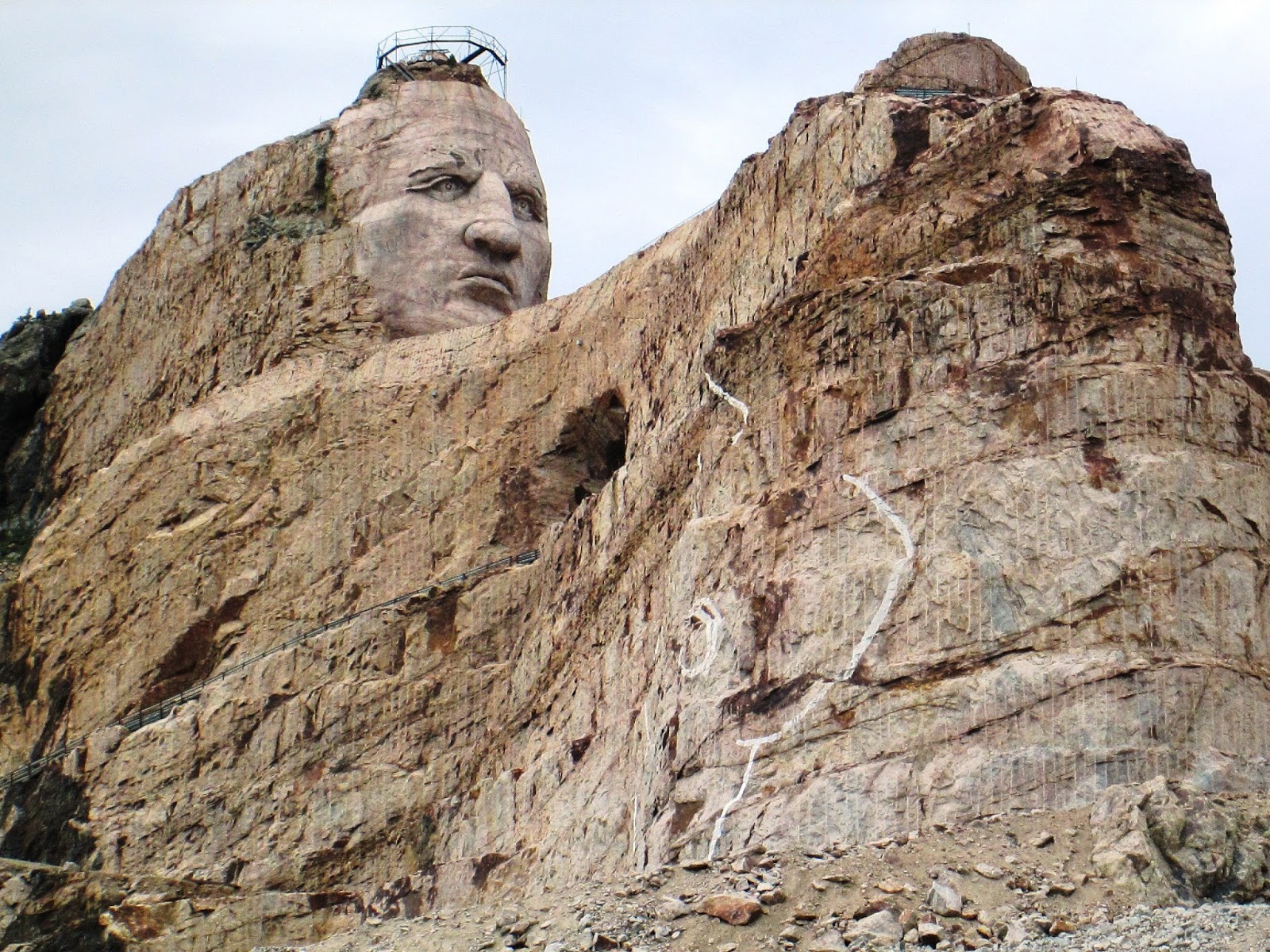
Accordingly, a real highlight of my time in the Black Hills was my June 10 visit to the memorial being built in honor of 'the spirit of Crazy Horse' and all Native Americans.


Here's part of what Wikipedia says about this massive monument-in-progress:

The Crazy Horse Memorial is a mountain monument complex that is under construction on privately held land in the Black Hills, in Custer County, South Dakota. It depicts Crazy Horse, an Oglala Lakota warrior, riding a horse and pointing into the distance. The memorial was commissioned by Henry Standing Bear, a Lakota elder, to be sculpted by Korczak Ziolkowski. It is operated by the Crazy Horse Memorial Foundation, a private non-profit organization.

Right: Korczak Ziolkowski with Henry Standing Bear.

The memorial consists of the mountain carving (monument), the Indian Museum of North America, and the Native American Cultural Center. The monument is being carved out of Thunderhead Mountain on land considered sacred by some Oglala Lakota, between Custer and Hill City, roughly 17 miles from Mount Rushmore. The sculpture's final dimensions are planned to be 641 feet (195 m) wide and 563 feet (172 m) high. The head of Crazy Horse will be 87 feet (27 m) high; by comparison, the heads of the four U.S. Presidents at Mount Rushmore are each 60 feet (18 m) high.

The monument has been in progress since 1948 and is far from completion. If completed, it may become the world's largest sculpture, as well as the first non-religious statue to hold this record since 1967 (when it was held by the Soviet monument The Motherland Calls.)


Here's an interesting fact: Crazy Horse died on September 6, 1877. Thirty-one years later Korczak Ziolkowski was born on the same day, September 6.

Ziolkowski began blasting the stone of Thunderhead Mountain on June 3, 1948. He labored 34 years on the mountain, right up to the very last day of his life. His work is continued by his wife Ruth and their seven children.

As a warrior, Crazy Horse always wore an "Inyan creature," a stone, under his left arm and behind his ear. These stones came from Maka Sica, the White River Badlands, and it was said that they provided powers that made him invincible in battle. When questioned about the stones by his people, Crazy Horse is said to have replied: "I will return to you in the stone."


The Crazy Horse Memorial project is not without its detractors. Elaine Quiver, a descendant of Crazy Horse, said in 2003 that Standing Bear should not have independently petitioned Ziolkowski to create the memorial. She believes that Lakota culture is based on getting a consensus from family members for such a decision, and no one asked the opinions of the descendants of Crazy Horse before the work on the memorial began in 1948.

Others also oppose the monument. John Fire Lame Deer, a Lakota holy man, said in 1972: "The whole idea of making a beautiful wild mountain into a statue of [Crazy Horse] is a pollution of the landscape. It is against the spirit of Crazy Horse."

I must admit I have concerns about the project. For one thing, the sheer size, some might say grandiosity, of the Crazy Horse Monument is the antithesis of Crazy Horse's life of simplicity and humility. Also, carving up the landscape to build an imposing sculpture seems to be a very European way of paying homage to a historical figure.

Another issue I have is that Crazy Horse in the sculpture appears unnaturally rigid. I picture Crazy Horse galloping across the plains, his body loose and fluid, his head down low to that of his horse's. I would have loved to have seen a sense of this energy and movement reflected in the sculpture. And of course the monument's depiction of Crazy Horse pointing his finger towards his ancestral home of the Great Plains is problematic. Why? Well, many Native American cultures prohibit using the index finger to point at people or objects. It's considered rude. Perhaps this issue will be addressed when that particular part of the sculpture is completed.

Having said all this, I realize and accept that the Crazy Horse Memorial is here to stay, and that it was started and is continued with good and noble intentions. Thus, although I have my own 'issues' with aspects of it, I choose to support the Crazy Horse Memorial.


I conclude this installment of "Pahá Sápa Adventure" by sharing (with added images and links) an excerpt from Larry McMurtry's book Crazy Horse: A Life. In this excerpt, McMurtry reflects on the life of Crazy Horse and recalls the first time he saw the Crazy Horse Monument, one which he refers to as "an American Sphinx."


Crazy Horse, a Sioux [or Lakota] warrior dead more than one hundred and twenty years, buried no one knows where, is rising again over Pa Sapa, the Black Hills of South Dakota, holy to the Sioux. Today, as in life, his horse is with him. Fifty years of effort on the part of the sculptor Korczak Ziolkowski and his wife and children have just begun to nudge the man and his horse out of what was once Thunderhead Mountain. In the half-century that the Ziolkowski family has worked, millions of tons of rock have been moved, as they attempt to create what will be the world's largest sculpture; but the man that is emerging from stone and dirt is as yet only a suggestion, a shape, which those who journey to Custer, South Dakota, to see must complete in their own imaginations.

It is a nice irony that the little town Crazy Horse has come to brood over is named for his old adversary George Armstrong Custer – Long Hair, whose hair, however, had been cut short on the day of his last battle, so that it is not certain that the Sioux or Cheyenne who killed him really recognized him until after he was dead. Crazy Horse had one good look at Custer, in a skirmish on the Yellowstone River in 1873, but Custer probably never saw Crazy Horse clearly enough to have identified him, either on the Yellowstone or at the Little Bighorn, three years later. The thousands who come to the Crazy Horse Monument each year see him as yet only vaguely; but that too, will change. One day his arm will stretch out almost the length of a football field; statistics will accumulate around his mountain just as legends, rumors, true tales and tall tales, accumulated around the living man.

What should be stressed at the outset is that Crazy Horse was loved and valued by his people as much for his charity as for his courage. Ian Frazier, in his fine book Great Plains, reports correctly that the Crazy Horse Monument is one of the few places on the Great Plains where one will see a lot of Indians smiling. The knowledge of his charity is still a balm to his people, the Sioux people, most of whom are poor and all of whom are oppressed. Peter Matthiessen was right to call his bitterly trenchant report on the troubles the Pine Ridge Sioux had with the U.S. government in the 1970s In the Spirit of Crazy Horse, because the spirit of Crazy Horse was a spirit unbroken, though it was certainly raked raw by the difficulties of his last few months.

[Above right: Detail of a depiction of Crazy Horse by Kenneth Ferguson (2006)]

George E. Hyde, the great (if cranky) historian of the Oglala and Brulé Sioux, a man not easily swept off his feet by even the most potent myth, confessed his puzzlement with the Crazy Horse legend in words that are neither unfair nor inaccurate: "They depict Crazy Horse as a kind of being never seen on earth: a genius at war yet a lover of peace; a statesman who apparently never thought of the interest of any human being outside his own camp; a dreamer, a mystic, a kind of Sioux Christ, who was betrayed in the end by his own disciples – Little Big Man, Touch-the-Clouds and the rest. One is inclined to ask, what is it all about?"

A Sioux Christ? That touches on his charity and on his betrayal, but he was a determined warrior too, one of the great Resisters, men who do not compromise, do not negotiate, do not administer, who exist in a realm beyond the give-and-take of conventional politics and who stumble and are defeated only when hard circumstances force them to live in that realm.

I saw the Crazy Horse Monument one day while traveling north to visit the grave of that sad, boastful woman Martha Jane Canary (Calamity Jane), who lies in the Deadwood cemetery next to James Butler Hickok (Wild Bill), a proximity he could not protest, since Calamity outlived him by a quarter of a century. I was easing through the Black Hills buffalo heard – many of the buffalo stood in the road, dull and incurious, as indifferent to the traffic as they had been to the buffalo hunters who slaughtered some fifty million of them in a short space of time in the [nineteenth] century – when I slowly became aware of something: something large. I looked up and saw Crazy Horse mountain, just to the northeast. Great hundred-yard swirls of white paint streaked the mountain, representing his hair; below him more swirls of the same white paint formed a Picassoesque horse head.


Like most travelers who come unexpectedly onto the monument, I was stunned, too stunned even to go up to the gift shop. I stopped the car, sat on the hood, and looked, as buffalo ambled by. What loomed above me, framed by the blue Dakota sky, was an American Sphinx. He was there, but as a force, an indefiniteness, a form made more powerful by his very abstractness.

I suppose, someday, the Ziolkowski family will finish this statue. It may take another generation or two, and when it's finished, if I'm alive, I'd like to see it. But I'm glad that I saw the mountain in the years when Crazy Horse was still only a form and a mystery. Now that I've read what there is to read about him, I think this indefiniteness was also an aspect of the man. His own people experienced him as a mystery while he was alive: they called him Our Strange Man. In his life he would have three names: Curly, His Horses Looking, Crazy Horse (Ta-Shunka-Witco). We know him as Crazy Horse, but in life few knew him well; in truth it is only in a certain limited way that we who are living now can know him at all.

– Larry McMurtry
Crazy Horse: A Life
pp. 1-4


See also the previous Wild Reed posts:
Pahá Sápa Bound
Pahá Sápa Adventure – Part 1: The Journey Begins
Pahá Sápa Adventure – Part 2: The Badlands
Pahá Sápa Adventure – Part 3: Camp Life
Pahá Sápa Adventure – Part 4: "The Heart of Everything That Is"
Crazy Horse: "Strange Man" of the Great Plains

Related Off-site Links:
Crazy Horse Memorial Official Website
Dreamers of Crazy Horse: Korczak and Standing Bear – The Black Hills Travel Blog (November 5, 2012).
Crazy Horse Memorial Turns 60 with No End in Sight – Carson Walker (Associated Press via USA Today, June 2, 2008).
Mistake on the Mountain – David B. Conrad (Manataka.org, November 9, 2006).

5/23/14 UPDATES: Crazy Horse Sculpture Widow Dies, Project Ongoing – Carson Walker (Associated Press, May 22, 2014).
"Mother" of Crazy Horse Monument Dies – Bob Collins (Minnesota Public Radio, May 22, 2014).
Widow's Death Won't Slow Crazy Horse Memorial – Associated Press via Minnesota Public Radio (May 23, 2014).

Images of Crazy Horse Memorial: Michael J. Bayly (June 10, 2013).


Quote of the Day

.
[Bayard] Rustin was a radical visionary – a Black gay activist for freedom and peace during a time when the conditions of both of these identities were perilous. The fact that he lived at the intersection of these identities while fighting for the freedoms of all oppressed people is even more revolutionary. Rustin owned his power as a Black, openly gay man to fiercely challenge the status quo and fight on behalf of the oppressed and marginalized, while at the same time refusing to be defined by any single aspect of his identity. Rusting was as unapologetically Black as he was gay, and by his very presence challenged the evils of homophobia and racism throughout his life. His legacy leaves a salient lesson for us on the power of living authentically.

– Sharon J. Lettman-Hicks
Executive Director & CEO, National Black Justice Coalition
NBJC Statement on Bayard Rustin Receiving the Presidential Medal of Freedom
August 9, 2013


Related Off-site Links:
Obama Awards Bayard Rustin – the 'Man Behind the March' – the Presidential Medal of Freedom – Peter Dreier (The Huffington Post, August 9, 2013).
Gay Quaker Civil Rights Leader Earns White House Honor for Work Largely Hidden from History – Colby Itkowitz (The Morning Call, August 9, 2013).
National Black Justice Coalition Applauds Bayard Rustin Recognition by ObamaTheGrio.com (August 9, 2013).
Bayard Rustin Awarded Presidential Medal of Freedom: Continuing Pertinence of "Time on Two Crosses" – William D. Lindsey (Bilgrimage, August 10, 2013).
Remembering a Forgotten Gay Civil Rights HeroImpactProgram.org (January 22, 2013).
A Closer Look at Bayard Rustin – Walter Naegle (Rustin.org).
Brother Outsider: The Life of Bayard Rustin

UPDATES: Bayard Rustin: The Man Homophobia Almost Erased From History – Steven Thrasher (Buzz Feed, August 27, 2013).
Meet Bayard Rustin, the Gay Socialist Pacifist Who Planned the 1963 March on Washington – Dylan Matthews (Washington Post, August 28, 2013).
March on Washington Can Teach Catholic Hierarchy About Equality – Bob Shine (Bondings 2.0, August 30, 2013).

See also the previous Wild Reed posts:
The Same Premise: Making the Connection Between the Black and Gay Struggles for Civil Rights
The Response of One Gay Black Man to the Charge that King's Dream Has Been "Hijacked" by the Gay Movement
Why Civil Rights Leader Julian Bond Will Be Marching for Gay Rights


Thursday, August 08, 2013

Worldwide Gay Pride – 2013


Here at The Wild Reed it's become somewhat of a tradition to share, at this time of year, images of gay pride celebrations from around the world. Most of these celebrations are joyous events, though some, because of where they take place, trigger negative reactions from individuals and governments that actually jeopardize the safety of LGBT people and those who support them.

I start this year's Worldwide Gay Pride post with the image above from the August 3 Gay Pride festival in Amsterdam, one place that is clearly not negative toward LGBT people.

Many of this year's Pride events celebrated specific gay rights victories, as Samantha Stainburn notes in her June 30 article for GlobalPost.com.

Large and enthusiastic crowds turned out for this weekend’s gay pride parades, held in cities around the world, reflecting that fact that gay rights advocates have racked up a striking number of victories over the past year.

London’s Gay Pride parade on Saturday drew about half a million revelers just weeks after parliament passed legislation that will allow gay people to get married, not just enter into civil unions. "By making this change…parliament believes their love is the same as anyone else's love and that we believe in equality," Britain's Prime Minister David Cameron wrote in the official guide to the event, Reuters reported.

In Paris, marchers celebrated last month’s legalization of same-sex marriage in France.

And in the United States, record crowds were expected at Sunday parades given that the US Supreme Court recently struck down the anti-gay Defense of Marriage Act and restored same-sex marriages in California.

This year’s grand marshal for the New York parade is Edith Windsor, the 84-year-old widow who challenged DOMA after she was forced to pay $363,053 on her late wife’s estate.

In San Francisco, the four plaintiffs in the case that ended California’s gay marriage ban – newlyweds Kris Perry and Sandy Stier of Berkeley and Paul Katami and Jeff Zarrillo of Burbank – were scheduled to ride in a float organized by the city attorney.

Unfortunately, not all of this weekend’s marches have been celebratory. In Russia, police detained dozens of people who demonstrated against new anti-gay legislation in Saint Petersburg on Saturday, The Guardian reported. "We staged the rally to support our rights and express our protest against the homophobic law," gay activist Natalya Tsymbalova told Reuters, according to The Guardian.


Above: Two men kiss each other during the Gay Pride parade in the coastal Israeli city of Tel Aviv on June 7, 2013. Thousands of people gathered in Tel Aviv for the parade, which attracts visitors from all over the world, including this year the first French married gay couple. (Photo: David Buimovitch/AFP/Getty Images)

For more images of Tel Aviv's Gay Parade celebrations, click here.


Above: Gay Pride in Mexico City. (Photo: Getty Images)


Notes The Huffington Post:

With an enormous display of colorful outfits, flashy costumes, and rainbow flags, millions from the LGBT community, as well as its supporters, gathered in various Latin American cities to ask for equal rights, tolerance, acceptance and to fight against homophobia and hate crimes.


Above: A participant in a Gay Pride event in Venezuela. (Photo: Getty Images)


Above: A colorful couple celebrating Gay Pride in Mexico. (Photo: Associated Press/Ivan Pierre Aguirre)


Above: An even more colorful couple in São Paulo, Brazil. (Photo: Getty Images)


Above: Well, hello! A participant in a Gay Pride celebration in El Salvador. (Photo: Getty Images)


Above: Two women kiss during the Gay Pride march in Medellín, Columbia. (Photo: Getty Images)


Above: Happy spectators of New York City's Gay Pride Parade. (Photo: Jeffrey James Keyes)

Notes Queerty.com:

New Yorkers have a lot to celebrate this year and roughly two million people came out for NYC Pride 2013. DOMA champion Edie Windsor kicked off the parade with her fellow Grand Marshalls, legendary entertainer Harry Belafonte and Center for Black Equity President Earl Fowlkes. Over 13,000 marchers and sixty-eight floats made their way from midtown to the end of Christopher Street.


Above: Members of Dignity New York participate in the NYC 2013 Gay Pride parade. (Photo: Jeffrey James Keyes)


Above: Angels in America . . . New York, to be precise.


Above: LGBT African activists take to the streets of Cape Town, South Africa – June 2013. (Photographer unknown)

For an insightful article about LGBT activists in Africa and the challenges they are facing, click here.


Above: Supporters of the LGBT community at a Gay Pride parade in Hyderabad, India – February 3, 2013. (Photo: Mahesh Kumar/Associated Press)


Above: Gay rights activists at a demonstration near Taksim Square in Istanbul on June 23, 2013. (Photo: Petr David Josek/AP)

To read about the situation in Turkey for LGBT people, click here.


Above: A screen capture of a video of what is believed to be China’s first Gay Pride parade.

Notes blogger Paul Turner:

A video has been released by the Queer Comrades website, China's LGBT TV Channel about last month's pride march in Changsha, in which hundreds of LGBT supporters and allies attended from Beijing, Hong Kong, Guangdong, Chongqing, Hubei and Zhejiang.

The parade coincided with this year's International Day Against Homophobia and Transphobia (IDAHO).

Shanghai does have a yearly pride event, however there is no parade or march, as all demonstrations are heavily supressed in China.

A statement on the Queer Comrades website said: "That night, event organizer Xiang Xiaohan and three others were taken away by the local Changsha police. The next day, 3 of them were released, but Xiang Xiaohan was administratively detained for 12 days. While we need to think on how to do better next time, we also have to celebrate the courage of Xiaohan and his team and congratulate them on a very successful event."

. . . Xiang said, "Next time they might detain me for 15 days. If that's what it takes to hold another event, then that's fine by me."

Adult, consensual and non-commercial homosexuality has been legal in the mainland of People's Republic of China since 1997 and homosexuality was removed from the Ministry of Health's list of mental illnesses in 2001. Currently no civil rights laws exist to address discrimination against China's LGBT community.


Above: Police detain a gay rights activist during a Gay Pride event in St. Petersburg, Russia – June 29, 2013. Dozens of gay and lesbian rights activists and their supporters gathered for the event but were attacked by anti-gay protesters and later dispersed by the police. (Photo: Reuters)

About the situation in Russia, Wayne Besen of TruthWinsOut.org writes:

Recently, a totalitarian law passed in Russia that prohibits words or actions considered remotely positive about gay, lesbian, bisexual or transgender individuals. It labels any accurate information or support for the LGBT community “propaganda.” Conservative legislators realized that open and free discussions about LGBT people inevitably lead to equality. So, this draconian measure was intended to preemptively hijack the discussion, silence the more persuasive argument, and indoctrinate the population without opposition. These actions — along with abundant and shocking racist attacks –make it clear that Russia should no longer be considered a free country that respects the rights of minorities.

History informs us that scapegoating vulnerable minorities is a risky proposition that can easily spin out of control. A book about the Black Plague by John Kelly, The Great Mortality, reveals some disturbing parallels between anti-Semitism in Middle Age Europe and the current Russian crackdown on LGBT people. While the plight and circumstances experienced by diverse groups in radically different eras of human history makes comparisons tricky, there are undoubtedly commonalities worth exploring.

To read Besen's commentary in its entirety, click here.


Above: Participants in Brighton's Gay Pride event show their support for LGBT people in Russia. (Photo: Nigel Fletcher)

For more about Russia's deplorable treatment of its LGBT citizens, and for updates on global responses to the situation on Russia, including calls to boycott or move the Winter Olympics from Russia, see this previous Wild Reed post.


Recommended Off-site Link:
A Global Look at Gay Rights: "The Fight Against Discrimination Must Go On" – Daryl Lindsey's interview with Boris Dittrich (SPIEGEL, April 5, 2013).

See also the previous Wild Reed posts:
Worldwide Gay Pride – 2012
Worldwide Gay Pride – 2011
Worldwide Gay Pride – 2010
Worldwide Gay Pride – 2009
Worldwide Gay Pride – 2008
Worldwide Gay Pride – 2007

For The Wild Reed's 2013 Queer Appreciation series, see:
Doin' Papa Proud
Jesse Bering: "It’s Time to Throw 'Sexual Preference' into the Vernacular Trash"
Dan Savage on How Leather Guys, Dykes on Bikes, Go-Go Boys, and Drag Queens Have Helped the LGBT Movement
On Brokeback Mountain: Remembering Queer Lives and Loves Never Fully Realized
Manly Love
A Catholic Presence at Pride – 2013

See also:
Dan Furmansky: "Why We Have Pride"
Gay Pride: A Celebration of True Humility
Gay Pride as a Christian Event
The Theology of Gay Pride
Something to Think About – July 13, 2013


Wednesday, August 07, 2013

Quote of the Day

For more than three decades, the Vatican of Popes John Paul II and Benedict XVI operated on a version of the conservative maxim, “No enemies to the right.”

While left-wing theologians were silenced and liberal-to-moderate bishops were shunted aside in favor of hard-liners, liturgical traditionalists and cultural conservatives were diligently courted and given direct access to the apostolic palace.

But in a few short months, Pope Francis has upended that dynamic, alienating many on the Catholic right by refusing to play favorites and ignoring their preferred agenda items even as he stressed the kind of social justice issues that are near and dear to progressives.

. . . Since Francis’ election, the anxiety on the right has only mounted as he has continued to model a radically different pontificate — preaching about the evils of the globalized economy while repeatedly reminding his followers to care for the poor and marginalized.

Indeed, he barely mentioned abortion directly or even gay rights until he was asked about gay priests during an impromptu press conference on the flight back from Brazil and, in a line heard round the world, he said, “Who am I to judge?” . . .

– David Gibson
"Pope Francis is Unsettling – and Dividing – the Catholic Right"
Religion News Service
August 6, 2013


Related Off-site Links:
Jesuit Head: Pope a "Brother Among Brothers" – Joshua J. McElwee (National Catholic Reporter, August 7, 2013).
Touch the Poor and Needy, Pope Tells Argentineans – David Uebbing (Catholic News Service, August 7, 2013).
Pope Francis' Ecclesiology Rooted in the Emmaus Story – Thomas Reese, SJ (National Catholic Reporter, August 6, 2013).
A Revolution Underway with Pope Francis – John Allen Jr. (National Catholic Reporter, August 5, 2013).
Pope Francis the Merciful – James Martin, SJ (The Washington Post, August 2, 2013).
Reformist Priest Helmut Schüller Praises Pope's New Tone But Wants More – Mary Wisniewski (Reuters, August 1, 2013).
Pope Franics is Not All That Evolved on Issues of Sex and Gender – Colleen Kochivar-Baker (Enlightened Catholicism, August 1, 2013).
"When Does Our Hope for Francis Become Denial? – Jamie Manson (National Catholic Reporter, July 31, 2013).
Pope Francis Asks "Who Am I to Judge?" But Real-Life Gay Catholics Continue to Experience Marginalization – William D. Lindsey (Bilgrimage, July 30, 2013).
Will Francis' Statements on Women and Gays "Make a Mess" Inside the Church? – Mary E. Hunt (Religion Dispatches, July 29, 2013).

See also the previous Wild Reed posts:
Why I Take Hope in Pope Francis' Statement on Gay Priests
Quote of the Day – August 1, 2013
Quote of the Day – July 30, 2013

Image: Kristen Solberg.


Monday, August 05, 2013

Prayer of the Week


The Love of God
(based on Psalm 36)

Your love, O God, breaks the small boundaries
of our understanding.
Your faithfulness is not constrained
by etiquette and protocol.
Your righteousness is as firm, yet as fluid
as the ever-changing face of the mountains.
Your justice can plumb the depths of our humanity
and raise us up to new heights.

You, O God, have created both the Gay and the Straight.
You love and nurture us all.
You preserve and honor our lives.
In you we find refuge and strength,
inspiration and courage.
From the abundance of your spirit, without partiality,
you give of yourself to us all.
For with you is the fountain of life,
in you we find acceptance and renewal.

– Liz Styan


Taken from Courage To Love: Liturgies for the Lesbian, Gay, Bisexual, and Transgender Community (compiled by Geoffrey Duncan, Pilgrim Press, 2002).

Image: "Night Holds No Terror" (detail) by Michael O'Neill McGrath, OSFS.


Saturday, August 03, 2013

Ramesh Bjonnes on Rumi and Shams as Gay Lovers


There is some kiss we want
with our whole lives,
the touch of Spirit on the body.

Seawater begs the pearl
to break its shell.

And the lily, how passionately
it needs some wild Darling!

At night, I open the window
and ask the moon to come
and press its face into mine.
Breathe into me.

Close the language-door,
and open the love-window.

The moon won't use the door,
only the window.

– Rumi


It's well known that the renowned Sufi poet Jelaluddin Rumi had an intense relationship with fellow mystic Shams of Tabriz. A number of modern thinkers, writers, gay rights activists, and artists have mused on the possibility that the two men were lovers in the physical, sexual sense.

Author, yogi, and Prama Institute co-founder Ramesh Bjonnes has written one of the best responses I've come across to the idea of Rumi and Shams as gay lovers. For one thing, he offers an informed skepticism of this idea without being disparaging of either homosexuality or same-sex relationships. I also appreciate Bjonnes' highlighting of some of the significant differences between Eastern and Western spirituality in terms of non-sexual expression of intimacy. "We just do not hug, hold hands with and gaze into the eyes of our priests in the West the way ecstatic Easterners have done for centuries," he writes. "Nor do men walk the streets holding hands the way people do in India and Iran where Rumi lived."

For these reasons and others, I continue The Wild Reed's series of posts on Sufism by sharing (with added images and links) an excerpt from Bjonnes' 2011 Elephant Journal article "Were the Poet Rumi and Shams Gay Lovers? (Or Was It Simply Bhakti Love?)."


Personally, I think the idea of Rumi and Shams being gay is one big contemporary projection. Not, of course, that being gay itself is a problem, but in this case I think it is unlikely. In the West, we don’t really have a tradition of the guru/disciple relationship we see in Sufism, Tantra and other ecstatic traditions of the East. Hence we tend to be overly skeptical and distrustful.

We often equate this kind of intimacy in sexual terms, even though it may not be there at all. That some contemporary gurus indeed had sexual relationships with their disciples just compounds the confusion.

The use of terms like Beloved and Lover toward one’s teacher is not common in the West. There is no Bhakti tradition to speak of in Western mysticism (except, perhaps, in some black Baptist churches!) that parallels the ones found in Sufism and Yoga. We just do not hug, hold hands with and gaze into the eyes of our priests in the West the way these ecstatic Easterners have done for centuries. Nor do men walk the streets holding hands the way people do in India and Iran where Rumi lived.

There is also no tradition of sexual imagery in the spiritual poetry of the West. In the East, sexual union also signifies inner ecstasies, Tantric kundalini energies. We have no deep tradition in which words like “wine” and “drunkard” and “tavern” signify spiritual states of whirling drunkenness.

We just don’t have a tradition for getting high on God in the West the way they do it in the East. Those wild yoga rhythms are coming to us slowly, but they are not yet in our bones and in our blood. We are still way too spiritually timid for those rhythms.

The only time we Westerners truly leave or enter our bodies in wild abandon is during drugs, sex and rock & roll. Hardly do we ever whirl with and make love to God or our teacher the way Rumi or Kabir or Mirabai did. When was the last time you fell on the floor in trance during kirtan the way they do it in India?

In other words, we distrust people who claim that they are talking to God the way that Ramakrishna talked to Mother Kali, the way that Mirabai talked to and made love to her Beloved Krishna. We put people like that in institutions over here. In India, they are sometimes declared saints.

In India, sadhus can dance naked in the streets and still be considered holy. In our Calvinist piety, we Westerners have been sitting on our hands too long in church. We distrust people who are both sane and talking to inner images at the same time.

By saying that hearing voices only happens to crazy people, or that sexual imagery in poetry only represents sex, we neglect a whole tradition of spirituality that expressed itself even in the mystical West, in people like St John, St Francis and Teresa of Avila.

Truth is, sometimes these people are truly crazy, but sometimes they are not. Sometimes they are called mystics.

I have seen plenty of people roll on the floor, cry in ecstasy and talk to inner visions; hell I’ve done it myself. And none of us have been institutionalized; not yet.

So to conflate Rumi’s love for his Beloved teacher Shams to a gay relationship is probably as mistaken as to conflate Ramakrishna’s spiritual genius, who is considered the Einstein of consciousness by many Indian scholars today, to a babbling lunatic. That, I think, is reductionism at its worst.

That, I think, is like mistaking a mild kundalini awakening with an insect crawling up your back. Or, conversely, to mistake the crawling insect for kundalini. Nothing but a projection. The inner world is both real and unreal. It all depends, and sometimes, only those who have taken the journey can tell the difference.

So, in a strange way, I suggest that those who reduce the rich inner world of the spiritual mystic of the stature of Rumi to simply being gay (in reality, it does not matter whether he was gay or heterosexual, of course) is doing the opposite of what they think they are doing; they sanitize his image; they block the view of the full spectrum of the mystic consciousness by reducing it to the realm of the flesh only.

The spirit lives in the body and it lives in the heart of love. It lives in the earth and it lives in the sky. It is subtle and it is gross. In the case of Rumi, the spirit freely crosses all boundaries. It lived in the body and it lived in the mind. But when he made love to Shams, he did so with his aching spiritual heart, just the same way that Mirabai made love to her inner Krishna.

Why? Most of Rumi’s love poetry was written during the years after Shams’ death. And Mirabai’s love poetry was written nearly two thousands years after Krishna supposedly walked the fields of Vrindavan.

While looking for Shams after his mysterious disappearance, Rumi finally realized:

“Why should I seek? I am the same as He. His essence speaks through me. I have been looking for myself!”

While looking for ourselves, we sometimes need guides, gurus, mystics who have walked the path before us. Love, said Krishna, in the form of Bhakti Yoga, can quicken and intensify that road considerably.

But ultimately, love for the teacher, the Beloved, Rumi understood, is simply love for our own inner Self. So, ultimately, the spiritual journey is not about finding a gay (or heterosexual) lover, but simply about loving ourselves. About finding ourselves.

– Ramesh Bjonnes


See also the previous Wild Reed posts:
Rumi and Shams: A Love of Another Kind
It Happens All the Time in Heaven
A Dance of Divine Love
Love as Exploring Vulnerability
"More Lovely Than the Dawn": God as Divine Lover
The Many Manifestations of God's Loving Embrace
The Holy Pleasure of Intimacy
Beyond Limited Ideas of "Real" Gay Sex
Never Say It Is Not God

Opening image: Source.


Friday, August 02, 2013

Quote of the Day

The opponents of same-sex marriage have thrown out many arguments against it, most of them without a rational basis or designed simply to obscure their real reason for opposition: They simply don't think homosexuals deserve the same legal rights that they do.

These arguments are mostly falling on deaf ears, apparently, since public opinion continues to change in favor of marriage equality, but that doesn't stop opponents from using half truths, misrepresentations, or even outright lies to advance their agenda.

One of their favorite arguments of late is that legalizing same-sex marriage will somehow lead to restrictions on religious liberty, even "criminalization" of religious opposition to homosexuality, and many conservative religious leaders and pundits are now making this argument the centerpiece of their campaign against gay marriage.

. . . [But] it's not true.

. . . [O]pponents of same-sex marriage point to the 2003 case of a Swedish Pentecostal minister named Aake Green, who was taken to court for comparing homosexuality to cancer, as the perfect example of the slippery slope gay marriage will put us on. His 2004 conviction, however, had nothing to do with gay marriage, which didn't even exist at the time. Aake was charged under Sweden's hate crimes statute. Unlike America, many European countries lack the free speech guarantees we take for granted. Even in Sweden, however, his conviction was ultimately overturned. Apparently, facts rarely get in the way of a politician or a preacher on a mission.

The same is true here in the United States. Opponents of same sex marriage cannot point to a single case where a church or religious institution in America has been forced to conduct or sanction a same sex wedding.

– David Lampo
"The Right’s Bait and Switch on Same-Sex Marriage
The Blaze via Yahoo! News
August 1, 2013


See also the previous Wild Reed posts:
Marriage Equality: Simple Answers to NOM's Complicated Lies
Lisa Cressman's Concise, Reasonable Answers to Marriage Equality Questions
Doug Mataconis on the Bishops, Religious Freedom, and Living in a Civil Society
Distinguishing Between Roman Catholic Theology and Civil Law in the Struggle for Marriage Equality
Quote of the Day – November 19, 2012
A Head and Heart Response to the Catholic Hierarchy's Opposition to Marriage Equality
Joseph O'Leary Responds to Carson Holloway's Arguments Against Gay Marriage
Marianne Duddy-Burke on Religious Liberty vs. Same-Sex Marriage
Joseph Palacios: "The Church is Not the Victim"


Thursday, August 01, 2013

Into the Greenwood


Earlier this evening my friend and housemate Tim and I walked to our neighborhood library. Tim was returning a book and I was picking up The Loving Cup, the tenth novel in Winston Graham's acclaimed Poldark series.


I've mentioned before how fortunate I am to be living so close to Minnehaha Parkway in south Minneapolis and thus the beautiful Minnehaha Creek and an area of urban wilderness.

For Tim and I, a walk to our neighborhood grocery store, library, and coffee shop involves traversing the pathways alongside the picturesque Minnehaha Creek and, if we choose, a trek through what I've come to call 'the greenwood.'


It truly is a beautiful part of Minneapolis, and any amount of time spent there always renews my spirit.

I share in this post some images from earlier this evening in the greenwood and along the creek. I also continue highlighting the Poldark series and the wonderful writing of Winston Graham by sharing an excerpt from The Miller's Dance, the ninth Poldark novel, which I finished reading this past weekend.


This particular excerpt takes place at the Truro horse races, "on the last Tuesday in September," 1812. It focuses on Jeremy Poldark, the eldest son of Ross and Demelza, and Cuby Trevanion, the young woman he loves but whose family expects her to marry a far wealthier man than Jeremy so as to ensure the retaining of Caerhays, the family's extravagant castle-like home.

As you'll read, Graham offers a gentle exploration and evocative depiction of young love, the setting of which is a wooded area, close to the Truro River.


They had picnicked and wined excellently in the wagonette, with a lot of chatter and laughter, much of it contributed by . . . Jeremy who, released temporarily from the glooms of his passion, sparked in front of the object of that gloom and made her laugh. . . . About 3.15, with three more races still to go, an auction of some of the winning horses was held behind the first stand, and most of the party, having no interest in the next race, drifted across to watch the bidding.

Although clouds were building up again in the west, the sun was still brilliant and the heat that of high summer.

Jeremy said to Cuby: "Do you want to buy a horse?"

"I don't think so."

"Nor do I. Are you interested?"

"Oh, yes. I love horses.

"It will be very hot in the crowd. One will be jostled. Your frock might be trodden on. And the mud is not yet dry."

She lifted an eyebrow. "Why are we all going, then?"

"We need not. We could just walk."

She considered this. It was a challenge. "Where to?"

"You know, I suppose, we are near the river here."

"Fairly. But the ground must slope sharply. Here we are on top of the hill."

"Those woods lead down. About a mile perhaps. Even if we didn't go far, we could stroll. It would be pleasanter."

"And muddier."

"Oh no."

"Not muddier?"

"The tracks will be soft, perhaps. Damp leaves, perhaps. But mud is here only because of the carts and the horses."

Cuby glanced across at [her brother] Augustus who was talking flirtatiously with Elizabeth Boscawen. [Her sister] Clemency was with Nicholas Carveth.

"Well," she said, "then let us go for a stroll."

At the edge of the field a gate led into the wood. Jeremy unlatched the gate and they went in. The ground was damp and he glanced anxiously at his capture but she did not complain. His light-hearted approach of today had succeeded beyond all his expectations. Aware that this was a holiday occasion, and particularly aware that at the moment they had both drunk numerous glasses of canary wine, he was not at all sure that this apparent progress really was advancing his suit – not when it came down to the cold light of day. Yet merely to be with her gave him new life and hope. And, whatever the softening circumstances, it was very unlikely she would have agreed to come with him in this way if she did not find pleasure in it too.

She lowered her sunshade as they went further in and down. "When is your sister to marry?"

"At the end of next month. Would you come to the wedding?"

"I think not. That would be too formal an acknowledgement that I was going against my brother's wishes. Jeremy –"

"I know. I'm sorry. I was breaking our agreement. Nothing serious shall henceforth be said."

She stopped to examine one of her boots, pulled three large damp leaves off the heel. "I wish nothing serious ever had to be said. How agreeable if we could just meet people in so unserious a manner!"

"Perhaps we can."

"How?" she replied. "It is impossible! In any event pleasantries would soon wear thin. It was beginning just then. Let us enjoy today."

They walked on. There was an empty quiet in the wood, except for the thin rilling of water in a ditch. All the birds seemed to have fallen silent.

She said: "Tell me about your experiments with the steam engine."

"Oh, those. They are not prospering." He spoke of his meeting with Trevithick, his semi-abandonment of the project.

"But you should not!" she said. "If every inventor despaired when something went amiss, how little would ever be discovered."

"I'm not an inventor. I am a user and perhaps developer of other people's inventions."

"Even so."

"Well, yes, I suppose you are right, I should continue. Of course recently I have lacked –"

"Go on."

"You may guess what I have lacked, which proves again how right you are that pleasantries soon wear thin."

There were giant cow parsnips here, flowered and gone to seed, a thicket of gaunt stalks holding up Japanese heads. She flicked at one and broke the stem with her parasol.

He said: "Let me tell you of our new mine. It is open now and the engine I designed is working and working well. I have never told you of this?"

"No. Last year it was projected."

"But are you interested?"

"Of course I am interested! Just because . . ."

He told her. After a while she began to chat of her own life, of Augustus' holiday with them from his work in London, of Clemency's misunderstanding with her music teacher, of a visit from her aunt and of a spaniel that nipped her ankle. Jeremy told her of [his sister] Clowance and about [her fiancee] Stephen. The most ordinary information, the lightest of communication between them, assumed instant importance.

They went down and down, unheeding. Then Cuby slipped on a fallen branch half buried in the ground and damp with lichen. He caught her arm and she steadied herself. She looked at the slanting light and said: "Mercy, we must go back!"

"You can see the river from here."

"I know, but we must turn back nevertheless. I would not wish [my brother] John to join our party and find me wanting."

They began to retrace their steps. Jeremy retained her arm in a light, un-familiar fashion and did not find himself rebuffed. They climbed back along the rill of water, pushing among sycamore saplings whose huge damp leaves glowed in the shafts of sun.

After a bit they paused for breath and Cuby leaned back against a tree behind her. He put a hand on her other arm, smiled at her cheerfully. They stood for some seconds before he kissed her, and then it seemed as if her mouth came up to meet his own. The heightened sensation of face to face and lip to lip created emotions that made the rest of the day trivial and without point.

– Excerpted from The Miller's Dance: A Novel of Cornwall: 1812-1813 (1982)
by Winston Graham
pp. 263-266


For previous Poldark-related posts, see:
Passion, Time and Tide
A "Useful Marriage" for Morwenna
A Sea Dragon of an Emotion . . . "Causing Half the Trouble of the World, and Half the Joy"
"Hers Would Be the Perpetual Ache of Loss and Loneliness"

See also:
Springtime by the Creek
The End of a Very Long Winter
A Winter Walk Along Minnehaha Creek
An Autumn Walk Along Minnehaha Creek
A Springtime Walk Along Minnehaha Creek

Related Off-site Link:
Winston Graham’s The Miller's Dance: Alive with History – Ellen Moody (Ellen and Jim Have a Blog, Two, February 25, 2011).

Images: Michael Bayly and Tim Lynch.


Quote of the Day

. . . Francis locked the deadbolt on John Paul II's closed door to women, and he reaffirmed the church's woefully inadequate teaching on gays and lesbians as well as its ban on marriage equality. Yet we still hear that many progressive Catholics "cannot get enough" of the new pope.

I have even heard Catholic women who have been fierce fighters for the full inclusion of women in the church claim that they still feel hope and are excited about this pope and his proposed deeper theology of women.

Yes, Pope Francis is a warm pope of the people with a deep passion for many marginalized communities. But he is still advocating some very unjust, harmful doctrinal positions. So why do Catholics, especially many progressive Catholics, continue to give him a pass?

Francis is changing the tone in the hope that the church will be perceived in a better light, but there is little evidence to suggest he will or wants to make doctrinal changes on women's equality, same-sex relationships or contraception, and his response to the issue of clergy sex abuse has been underwhelming at best.

Have we gotten to the point where our desire to realize the church of our dreams and our insistence that Francis will be the man to make our dreams come true is clouding our perception of what Francis is really saying?

– Jamie Manson
"When Does Our Hope for Francis Become Denial?"
National Catholic Reporter
July 31, 2013


See also the previous Wild Reed posts:
Quote of the Day – July 30, 2013
Why I Take Hope in Pope Francis' Statement on Gay Priests

Related Off-site Link:
Pope Francis's Gay Remarks as Something New Under Papal Sun: Commentators Who Say Nay – William D. Lindsey (Bilgrimage, August 1, 2013).
Reformist Priest Helmut Schüller Praises Pope's New Tone But Wants More – Mary Wisniewski (Reuters, August 1, 2013).
Pope Franics is Not All That Evolved on Issues of Sex and Gender – Colleen Kochivar-Baker (Enlightened Catholicism, August 1, 2013).


Let the Weddings Commence!

I write this a little after midnight, Thursday, August 1 – a truly historic day for Minnesota.

Explains the Minneapolis Star Tribune:

Gay and lesbian couples from around the state gathered at city halls, courthouses and even the Mall of America shortly before midnight on Wednesday, poised for a historic round of midnight ceremonies that would mark the first legal same-sex weddings in Minnesota.

Couples who kept their love and relationships secret for years — even decades — were preparing to proclaim what they say will be their new status as full-fledged newlyweds.

“Our wedding will be about celebration and commitment, but will also be about sharing our lives to help people better understand how much the same we all are,” said Phil Oxman, who on Wednesday evening was hours away from marrying his partner of 38 years during a jam-packed procession of same-sex marriages at Minneapolis City Hall.

Earlier this year Minnesota became the 13th state to legalize same-sex marriage, a law that was to take effect at the stroke of midnight after more than two years of fighting over the issue.


Also just after midnight, same-sex couples who were previously married in other states became legally recognized in Minnesota.


Just hours ago, some friends and I gathered at the Wilde Roast Cafe in Minneapolis for "Married at Midnight: Minnesota's Largest Wedding Reception"!


Left: The view of downtown Minneapolis from the St. Anthony Main area of Northeast Minneapolis, where the Wilde Roost Cafe is located.


Organized by Minnesotans United PAC, the evening featured appetizers, wedding cake, and a champagne toast at midnight, along with music and "honeymoon" giveaways every hour. A wedding guestbook was available in which people were invited to write a 'thank you' note to Governor Dayton and to those state legislators who helped make Minnesota the 13th state to grant the 'freedom to marry.'


Above: Standing second from right with friends (from left) Tim,
Brent & Lisa, and Robin.


Above: Rebecca, Maggie, Christine, and Cristy.


Following is another excerpt from the Star Tribune's coverage of this historic day for marriage equality in Minnesota.


The path to marriage equality, after simmering in the state for decades, took an unlikely and circuitous route.

Two years ago, Republican legislative leaders put a measure on the ballot that would have taken an existing ban on same-sex marriage and etched it in the state constitution, making it virtually impossible to overturn. Thirty other states had already passed a similar same-sex marriage ban, and most political watchers saw no reason Minnesota wouldn’t follow suit.

But after an unprecedented campaign that mobilized thousands of volunteers and drew millions of dollars in donations, Minnesota became the first state to reject such a measure. But that still left in place a statute banning gay marriage. Shortly after, the supporters that engineered the constitutional win harnessed their enormous political machine to persuade legislators to move ahead with full-scale legalization.

On May 14, Gov. Mark Dayton signed the legalization bill into law. Leading up to the first weddings, Dayton issued a proclamation declaring Thursday “Freedom to Marry Day” in Minnesota.


That's today, folks! So, Happy Freedom to Marry Day to all my readers!

And if where you're at you can't celebrate fully what this day means in Minnesota, I hope one day very soon you will be able to.


Related Off-site Links:
Tonight's the Night for First Gay Marriages – Brian Lambert (MinnPost, July 31, 2013).
Gay Couples Rush to Wed Under New Minnesota Law – Patrick Condon (Associated Press via Yahoo! News, August 1, 2013).
Minnesota Weddings Start a New Day for Same-Sex Couples – Baird Helgeson, Jim Ragsdale, and Jennifer Brooks (Star Tribune, August 1, 2013).
Some Minnesotans Are More Sad Than Bitter Over Gay Marriage – Kim Ode (Star Tribune, July 31, 2013).
Gays Marry in Minnesota (Photo Gallery)Star Tribune (August 1, 2013).
A Timeline of Minnesota's Gay Marriage Debate – Tom Nehil (MinnPost, May 14, 2013).
Scott Dibble Says Anti-Gay Republicans Are Helping Create Marriage Equality – Graham Gremore (Queerty, June 30, 2013).
Gay Couples Wed At Midnight As Two More States Legalize Same-Sex Marriage – Patrick Condon (Associated Press via The Huffington Post, August 1, 2013).

UPDATES: Couples Celebrate Legal Same-Sex Marriage in Minnesota in Midnight Ceremonies – Jon Collins and Sasha Aslanian (Minnesota Public Radio, August 1, 2013).
Meet the First Same-Sex Couple to Be Legally Married in Minnesota – Chris Geidner (BuzzFeed, August 1, 2013).
Legality of Same-Sex Marriage Still Issue for Minnesota Border Residents – Dan Gunderson (Minnesota Public Radio, August 1, 2013).
Gay Weddings Begin in Minnesota Churches – Terence Weldon (Queering the Church, August 1, 2013).
Same-Sex Wedding Photos from Minnesota and Rhode Island That Will Make Your DayThe Huffington Post (August 1, 2013).
75 Unforgettable Moments from Minnesota’s First Day of Marriage Equality – Matt Stopera (BuzzFeed, August 1, 2013).
'Making History in the Name of Love' as Night Turns to Morning in Minnesota – Beth Hawkins (MinnPost, August 1, 2013).
Culture/History Underlies Freedom to Marry – Alfred Walking Bull (The Circle News: Native American News and Arts, August 1, 2013).
Minnesota Sees Rush to Gay Marriage – Brian Bakst and Patrick Condon (Associated Press via Star Tribune, September 2, 2013).

See also the previous Wild Reed posts:
National LGBTQ Catholic Organization Honors Role Played by Catholics and Other Faith Groups in Securing Marriage Equality in Minnesota
Rediscovering What Has Been Written on Our Hearts from the Very Beginning
Tongues and Souls on Fire
Marriage Equality Comes to Minnesota
Karen Clark's Revolutionary Act: "Daring to Believe That People Can Change Their Hearts and Minds"
Marriage: "Part of What is Best in Human Nature"
"It'll Be Legal August 1st"
The Minneapolis (and Online) Premiere of Catholics for Marriage Equality