Showing posts with label Literature. Show all posts

Wednesday, June 17, 2026

Eric Karl Anderson on the Secret Story Behind Mrs Dalloway

As I noted a few days ago, today, June 17, is Dalloway Day, an annual celebration of author Virginia Woolf’s 1925 modernist masterpiece, Mrs. Dalloway.

To mark this international day of celebration I share a wonderful video by Eric Karl Anderson, who on his YouTube channel describes himself as a “bearded book fan and blogger also known as LonesomeReader chatting about new fiction, book prizes, what I’m reading and what I want to read next.”

In the following 15-minute video, Eric not only talks about the published 1925 version of Woolf’s Mrs Dalloway but also the manuscript version published by SP Books in 2019. “[The manuscript version has] shown me how [Woolf’s] original version of the story was very different from the finished novel,” says Eric.


Related Off-site Links:
Mrs. Dalloway at 100 – Daphne Merkin (Air Mail, September 13, 2025).
Significance of Clarissa’s Parties in Mrs Dalloway – Riya Payal (TJBlogsBlog, August 10, 2018).
The Character of Septimus Warren Smith in Mrs Dalloway – Riya Payal (TJBlogsBlog, July 28, 2020).
The Relationship Between Clarissa and Septimus in Mrs Dalloway – Riya Payal (TJBlogsBlog, April 13, 2021).
Mrs Dalloway’s War Wounds – Lizzie Hibbert (Engelsberg Ideas, May 22, 2025).
Mrs. Dalloway: Secularism and Its Enchantments – Jared Marcel Pollen (Quillette, September 2, 2021).
Clarissa Dalloway’s and Septimus Smith’s Routes Through London – British Literature Wiki.

See also the previous Wild Reed post:
• Something We Dare Call Hope


Saturday, June 13, 2026

Dalloway Day


This Wednesday (June 17) is Dalloway Day, an annual celebration of author Virginia Woolf’s 1925 modernist masterpiece, Mrs. Dalloway.

Dalloway Day takes place globally on the third Wednesday in June, commemorating the fictional day in mid-June 1923 when the protagonist of Woolf’s novel, Clarissa Dalloway, walks through London to buy flowers for a party she’s hosting that night at her Westminster residence.

Through a stream-of-consciousness style that interweaves Clarissa’s experiences with those of other characters, most notably the shell-shocked veteran Septimus Warren Smith, the novel explores not only Clarissa’s inner life, memories, and reflections on life, love, and death, but the social mores and structure of post-World War One England.


Ahead of Dalloway Day, here’s a fascinating 30-minute documentary by award-winning writer and academic Alexandra Harris that explores how Virginia Woolf's Mrs Dalloway “completely re-imagined what a novel might be.”


NEXT: Eric Karl Anderson on the
Secret Story Behind Mrs Dalloway


Related Off-site Links:
Mrs. Dalloway at 100 – Daphne Merkin (Air Mail, September 13, 2025).
Significance of Clarissa’s Parties in Mrs Dalloway – Riya Payal (TJBlogsBlog, August 10, 2018).
The Character of Septimus Warren Smith in Mrs Dalloway – Riya Payal (TJBlogsBlog, July 28, 2020).
The Relationship Between Clarissa and Septimus in Mrs Dalloway – Riya Payal (TJBlogsBlog, April 13, 2021).
Mrs Dalloway’s War Wounds – Lizzie Hibbert (Engelsberg Ideas, May 22, 2025).
Mrs. Dalloway: Secularism and Its Enchantments – Jared Marcel Pollen (Quillette, September 2, 2021).
Clarissa Dalloway’s and Septimus Smith’s Routes Through London – British Literature Wiki.

See also the previous Wild Reed posts:
• Vanessa Redgrave: “Almost a Kind of Jungian Actress”
• Something We Dare Call Hope

Opening image: Vanessa Redgrave as the title character in the 1997 film adaptation of Mrs. Dalloway.


Saturday, November 08, 2025

Like Trees in November


They’re very nice and kind . . . but I’ll tell you how they strike me. They all seem terribly sad. I can’t think why. . . . But they put me in mind of trees in November.

– The character of Fiver in
Chapter 14 of Richard Adam’s
Watership Down: A Novel
Rex Collings Ltd, 1972


Related Off-site Links:
A New Graphic Novel Version of Watership Down Aims to Temper Darkness With Hope – Matthew Schuerman (NPR News, October 22, 2023).
What Watership Down Can Still Teach Us About Politics – Graham Hillard (National Review, September 18, 2025).
Scary Stories for Kids: Watership Down Made Me Aware of My Mortality at Age Four – Aislinn Clarke (The Conversation, October 17, 2025).


See also the previous Wild Reed posts:
• November Musings
• November Vignettes (2024)
• November Vignettes (2023)
• Photo of the Day – November 9, 2023
• Autumn . . . Within and Beyond (2021)
• Time to Go Inwards
• Holding the Moment
• Autumn Branches

Image: Michael J. Bayly


Friday, January 06, 2023

Kahlil Gibran on Self-Knowledge


It’s the birthday today of Lebanese-American writer, poet and visual artist Kahlil Gibran (1883-1931).

Born in what is now modern-day Lebanon, Gibran emigrated with his family to the United States at the age of twelve. The family settled in Boston, where they had relatives, and it was there that a charity worker noticed that Gibran appeared to be artistically gifted. He began studying art, in addition to his regular schooling. His mother also wanted him to learn about his Lebanese heritage, and so Gibran went to a prep school and college in Beirut when he was fifteen. He started a literary magazine with a classmate, and was voted “College Poet.” Upon returning to Boston in 1902, at age nineteen, he soon began being invited to social gatherings, where people enjoyed hearing him discuss philosophy and poetry. He continued to show talent as an artist during this time, and first exhibited his drawings in 1904 at the studio of photographer Fred Holland Day, one of his earliest patrons.

On one occasion a man named Alfred A. Knopf was invited to a gathering at Gibran’s apartment. Knopf was starting a publishing company, and when he saw how fascinated people were with Gibran, he decided to offer him a publishing contract. Gibran’s first two books with Knopf weren’t very successful, but his third, a collection of poetic essays called The Prophet (1923), would eventually be translated into more than 50 languages and sell millions of copies worldwide.

Gibran was raised as a Maronite Christian but embraced a variety of beliefs, including Islam and Theosophy. These influences informed the writing of his masterwork, The Prophet, a compilation of 28 inspirational essays composed as prose poems and illustrated with his own drawings. Although it didn’t sell well at first, The Prophet would become the most renowned of the fifteen books of Gibran’s work published in his lifetime and establish him as both a leading figure in Arabic literature as well as one of the bestselling poets of all time. Indeed, Gibran is now the third-best-selling poet in history, after William Shakespeare and Lao-Tzu.

Writes Antonia Pont, Senior Lecturer in Writing and Literature at Deakin University:

[The Prophet], which presents advice on a number of core aspects of being human – such as love, parenting, friendship, Good and Evil, and so on – employs a simple narrative device. An exiled man, Almustafa, who has been living abroad for twelve years, sees the ship that will carry him back “to the isle of his birth” approaching. Filled with grief at his imminent departure, the townspeople gather and beseech him to give them words of wisdom to ease their sorrow. . . . Gibran himself had been in the U.S. for twelve years at the time of writing and, it could be argued, was in a kind of exile from Lebanon, the country of his own birth.

. . . Gibran has been criticised for his style of playing confoundingly but reassuringly on opposites, which, some argue, can mean anything. (One must note, however, that this unsettling of binary structures is a feature of enduring wisdom texts such as the Tao Te Ching, as well as recalling writings of Sufism and other traditions.)

. . . For someone who undoubtedly “made it” (according to the grim criteria of the New World), Gibran may well have had more than a kernel of wisdom and know-how for those trying to survive its heartless, capricious climes. The fact is that millions of people have found momentary respite in his shifting, evocative words.

In a century where authority figures – whether political or representing various spiritual traditions – have seemed not only to fail their flocks, but to have actively betrayed them, Gibran’s perhaps fuzzy but lyrical advice has come to fill a vacuum of integrity and leadership. We need not badger readers of this work (who included, incidentally, the likes of John Lennon and David Bowie) who might use it to express their love, notate their grief, or ease their existential terrors.

The Prophet has worked as a widespread balm, as effectively as anything quick and concise can. Cheaper than an ongoing tithe to pharmaceutical companies, at $8.55, the going rate at Book Depository, it neither incites hatred, nor violence, nor religious divisiveness.

It says the kinds of things that we sometimes wish a trusted other might say to us, to calm us down. In these aggravated times, perhaps we can appreciate its sheer benignity and leave its boggling success be.


In celebrating Kahlil Gibran’s birthday at The Wild Reed, I share one of my favorite poems from The Prophet, “On Self-Knowledge.”

_________________


On Self-Knowledge

By Kahlil Gibran
And a man said, Speak to us of Self-Knowledge.
And he answered, saying:
Your hearts know in silence the secrets of the days and the nights.
But your ears thirst for the sound of your heart’s knowledge.
You would know in words that which you have always known in thought.
You would touch with your fingers the naked body of your dreams.

And it is well you should.
The hidden well-spring of your soul must needs rise and run murmuring to the sea;
And the treasure of your infinite depths would be revealed to your eyes.
But let there be no scales ot weigh your unknown treasure;
And seek not the depths of your knowledge with staff or sounding line.
For self is a sea boundless and measureless.

Say not, “I have found the truth,” but rather, “I have found a truth.”
Say not, "I have found the path of the soul.” Say rather, “I have met the soul walking upon my path.”
For the soul walks upon all paths.
The soul walks not upon a line, neither does it grow like a reed.
The soul unfolds itself, like a lotus of countless petals.


Related Off-site Links:
Kahlil Gibran on Silence, Solitude, and the Courage to Know Yourself – Maria Popova (The Marginalian, November 21, 2019).
Guide to the Classics: The Prophet by Kahlil Gibran – Antonia Pont (The Conversation, November 27, 2018).
Kahlil Gibran’s The Prophet: Why Is It So Loved? – Shoku Amirani and Stephanie Hegarty (BBC News, May 12, 2012).
Prophet Motive: The Kahlil Gibran Phenomenon – Joan Acocella (The New Yorker, December 30, 2007).

For more writings of (or about) Kahlil Gibran at The Wild Reed, see:
• Fall Round-Up (2014)
• Out and About – Summer 2015
• Blue Yonder
• Spring . . . Within and Beyond (2022)
• Photo of the Day – March 7, 2020
• Yahia Lababidi: “Poetry Is How We Pray Now”

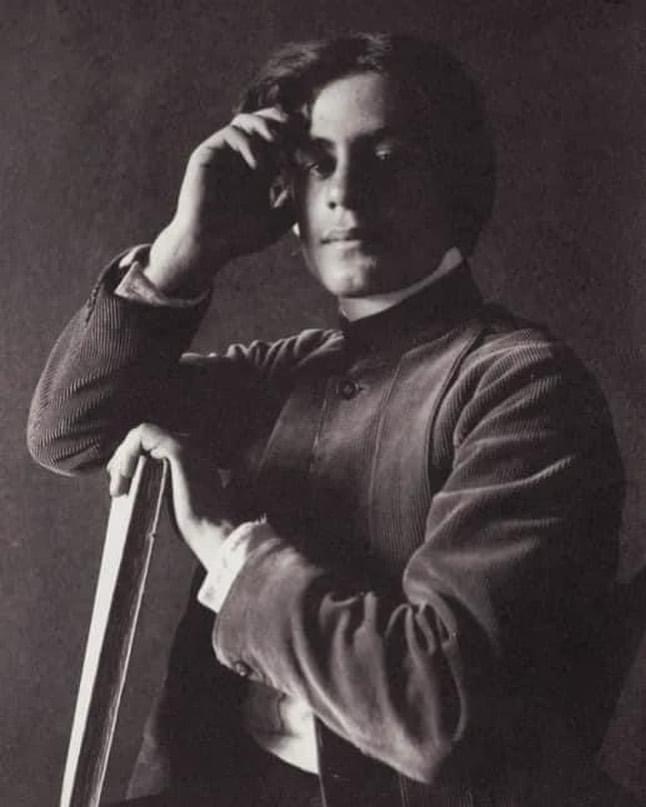
Opening image: Kahlil Gibran in 1897, photographed by Fred Holland Day.


Tuesday, December 27, 2022

“Our Knowledge of Others Is Always Partial”: Garth Greenwell on the Morality of Fiction

I can’t remember how I recently came across To a Green Thought, the substack of novelist, poet, literary critic, and educator Garth Greenwell, but I’m sure glad I did. He is an exceptional writer – insightful, erudite, humorous.

Greenwell’s latest pieces in entitled “I Hated The Hours (et d’autres tristesses),” in which he muses on “the morality of fiction, writing like a pianist, and freedom in art.” Following are excerpts relating to the “morality of fiction” part, the one I found most compelling.

_______________________


I’m not sure [that “aestheticizing a quagmire”] is . . . what great novels do. Please don’t quiz me on this – it’s been a few years since I read it – but I’m not sure that Anna Karenina, say, forces me to permanently suspend judgment and hold everyone blameless. I don’t think that’s true of any of the books I love, which actually I think are constantly inviting me to exercise my judgment. But they also constantly remind me that human beings are not monovalent, that no judgment can be final, that any life is more ample than any judgment I could draw. That’s what annoys us, I think, in our age of ideological bubbles, of blocking and ostracization: the insistence that judgment does not exhaust our knowledge of a person; or rather, to put it more strongly, that judgment does not exhaust our duty to know a person.

To be sure, there are situations whose moral valence is clear: there are crimes, and there should be punishments. But if that’s all you want to know about a situation – that there’s a villain and they should be punished – then I don’t think we need art to think about it. This was part of my annoyance with Tár, which I really don’t want to write about very much, since I think it’s best forgotten. But that’s an example of a film that always already knows the answer, in which everyone is held up for our derision and condemnation, in which dumb horror-movie atmospherics (which never add up to anything or lead anywhere) try to fill up the void where characters should be. There’s no complexity: Tár is a monster from the start, threatening schoolchildren and tyrannizing her family, not to mention talking about music in the dumbest, most cartoonish way possible; and her victims are nothing but victims. (The most interesting character in the film is Tár’s assistant, whose story it should have been: she adores Tár and hates her, is betrayed by her and engineers her destruction. Make that movie, you cowards.) Anyway, I didn’t need a movie about Tár, or not this movie, since it doesn’t convincingly portray her brilliance or her hungers, or even, with any depth or penetration, her cruelty. For the story the movie apparently wants to tell, an article in the Times would have been plenty. I want more from a novel or a film: call it a moral quagmire if you want, or call it depthlessness, an awareness that our knowledge of others is always partial; an awareness that the value of others’ lives is not exhausted by their bad acts, that such value can never be exhausted. This doesn’t mean permanently suspending judgment, or suggesting that “nobody is at fault”; it means seeing that no one is reducible to fault.

. . . [S]ome people might argue that art is nothing but manipulation: that all art intends for us to have an emotional response, and performs certain maneuvers to elicit it. I guess I just don’t think this is true, finally; good art doesn’t treat us like mechanisms. This is something mysterious to me, the way that great art refrains from dictating our response, the way it respects our freedom – presenting us with something too complex to coerce an uncomplicated response. The greatest art, I sometimes think, has a kind of terrifying, sublime indifference to our response. I feel this about certain poems by Bishop or Geoffrey Hill, say. This isn’t coldness or a rejection of emotion; it’s emotion profoundly felt, emotion that has wrestled with itself.

Or maybe that’s not quite right. Maybe it’s emotion in which something is genuinely at risk. In the great operas, which so often are all about flooding us with emotion – Tristan, or the Inquisitor scene in Don Carlo, or Grimes’s madness – there’s a danger, a wildness, a teetering up to the abyss, that has something in it beyond manipulation because there is something in it beyond control. Call it the duende, maybe.


To read Garth Greenwell’s “I Hated The Hours (et d’autres tristesses)” in its entirety, click here.


Related Off-site Links:
Garth Greenwell’s Official Website.
Review: Garth Greenwell’s Cleanness Thrums With Life’s Questions – Nellie Hermann (Los Angeles Times, January 10, 2020).
James Baldwin’s Giovanni’s Room: An Antidote to Shame – Garth Greenwell (The Guardian, November 19, 2016).

See also the previous Wild Reed posts:
• The Distinguished Rhone Fraser: Cultural Critic, Bibliophile, and Dramatist
• Yahia Lababidi: “Poetry Is How We Pray Now”
• Boseman on Wilson
• James Baldwin’s Potent Interweavings of Race, Homoeroticism, and the Spiritual
• Austen and Australia
• Return of the (Cornish) Native
• On Brokeback Mountain: Remembering Queer Lives and Loves Never Fully Realized
• Passion, Tide and Time
• As the Last Walls Dissolve . . . Everything is Possible
• E. M. Forster’s “Elusive Ideal”
• Love at Love’s Brightest
• Don Gorton on the Significance of Maurice (Part I)
• Don Gorton on the Significance of Maurice (Part II)
• Conversing and Arguing with the Theology of Philip Pullman
• At Swim, Two Boys: A Beautiful Novel
• My Travels With Doris
• Tariq Ali Discusses Rudyard Kipling
• John le Carré’s Dark Suspicions

Image: Oriette D’Angelo.


Thursday, May 12, 2022

Yahia Lababidi: “Poetry Is How We Pray Now”


Write me a book
of lamentations
passionate and profound
pure expressions

of loss and longing
and you will discover
true sorrow is sacred
and your songs are psalms

– Yahia Lababidi
“Lamentations”
(from Learning to Pray:
A Book of Longing
)


Yahia Lababidi’s Learning to Pray: A Book of Longing is a beautiful collection of poems and aphorisms.

It also includes an insightful preface by Lababidi entitled “Poetry Is How We Pray Now.” Following is an excerpt.

________________________


The human heart abhors a vacuum. With organized religion losing ground, all sorts of substitutes rush in to fill the God-shaped hole. One particularly effective and time honored balm for the aching human heart is literature. For some, poetry is how we pray now.

In these skeptical times, there still exists an Absolute Literature, in the coinage of Italian writer Roberto Calasso, where we might discern the Divine Voice. Such pre- and post-religious literature share aims and concerns similar to belief systems: sharpening our attention, cultivating a sense of awe, offering us examples of how to better live and die – even granting us a chance at transcendence.

Mysteriously, certain strains of literary art are capable of using words to lose words – ushering us to the threshold of that quiet capital of riches: Silence. After all, it is in silent contemplation that difficulties patiently unfurl and entrust us with their secrets.

By deepening our silences, such literature allows us to overhear ourselves and can lend us a third (metaphysical) eye. We are able not only to bear witness to the here and now but, past that, calmly gaze at eternal things . . . over the head of our troubled times in order to try and understand our spiritual condition (where we’ve come from and where we’re heading).

In our fractured world, beset by so much physical suffering and political turmoil, as a kind of (unconscious?) corrective, more people are reading and writing literature that addresses the life of the spirit, overtly or otherwise.

One manifestion of this renewed spiritual hunger that is being met by literature was the publication of a major anthology, The Poet’s Quest for God: 21st Century Poems of Faith, Doubt, and Wonder (Eyewear, 2016), featuring over three hundred contemporary poets from around the world and of great value (as the jacket blurb indicates) “to those for whom poetry has become a resource or replacement for faith-bound spirituality.” This ambitious book of collective soul-searching was followed by another similar anthology, Without a Doubt: Poems Illustrating Faith (New York Quarterly, 2021).

Likewise, more spiritual oases are appearing in the desert of popular culture to slake the great thirst of seekers. Among the ones that I admire, and turn to for sustenance and inspiration, are edifying podcasts such as Krista Tippett’s On Being and Godspeed Institute or questing, interfaith journals such as The Sun, Parabola, Tikkun, Tiferet, Sufi, as well as many others.

Yet, since we cannot step into the same river twice, what does a return to religion look like? There remain, of course, poets, writers, and artists who pursue direct paths to God through their art. Similarly, there are readers, myself included, who study the lives and utterances of traditional saints and mystics for moral guidance and uplift.

Brad Gooch’s biography, Rumi’s Secret (Harper, 2017) is a fine example of this genre. In his “Secret,” the celebrated mystical poet and the world he lived in (around eight hundred years ago) come to life, and we develop a deeper appreciation of why this Muslim saint matters to us so much at our historical moment. Gooch, in conversation with respected Rumi translator Jawid Mojaddedi, quotes Mojaddedi as saying to him: “Rumi resonates today because people are thinking post-religion. He came to see mysticism as the divine origin of every religion.”

Nowadays, there is also a more ambiguous literature (as well as audience) that finds it needless to define their nameless yearning and sees no contradiction in drawing on different traditions to make a patchwork quilt of their inchoate longing. This peculiarly modern pilgrim, unencumbered by dogma, is unembarrassed to treat organized religion as an archaeological site to be excavated for durable ruins – unearthing fragments of Beauty, Grace, Wisdom wherever they might find them and leaving behind what does not resonate, spiritually.

In such literature that is not directly religious, all sorts of spirits are invited, random relics were thrown into the spiritual pot to prepare a nourishing bone broth. Amid the clamor of the culture wars dominating the headlines and airwaves, prayerful prose or poetry and mystic art grant us the opportunity to share Good News and make a joyful sound.

One way of doing so is by giving thanks, even in the midst of suffering. [. . .] Belief, in the midst of chaos [. . .] teaches us to deeply trust, in spite of appearances, in the innate and inexhaustible goodness of life and how we might contribute to it by caring for our souls. Instinctively, out of self-preservation in the encroaching darkness, we seek out the light with greater urgency – recognizing the necessity for transformation, re-evaluation of values, evolution . . .

We are called to sancify our days, in the phrasing of Kahlil Gibran: “Your daily life is your temple, and your religion. Whenever you enter into it take with you your all.”

Thus, literature in the service of belief, though mindful of other disciplines, is also shrewdly aware of their inadequacies – how the consolations of psychology, philosophy, science, even language cannot quite address the mysteries of the human heart. Mystical art addresses a profound, mute center in us, initiating us into hardly communicable secrets, numinous states of being, and a knowing (gnosis) at the very limits of our self or ego. Our metaphysical eyes are expert at collapsing distances, that way, seeing through the apparent to the Infinite.

Increasingly, I’m intrigued by the idea of artists as mystics and the worship of beauty as a form of prayer. How, for instance, in Omar Khayyam’s deceptively simple utterance, “I pray by admiring a rose,” one finds the connection among the visible, invisible, and indivisible laid bare. Theologian and Sufi mystic Al Ghazali put it thus: “This visible world is a trace of that invisible one, and the former follows the latter like a shadow.”

One year before his death, we find the great poet of longing, Rilke, meditating upon the inseparability of the material and spiritual worlds in these memorable, numinous words:

It was within the power of the creative artist to build a bridge between two worlds, even though the task was almost too great for a man. . . . Everywhere transience is plunging into the depths of Being. It is our task to imprint this temporary, perishable earth into ourselves, so deeply, so painfully and passionately, that its essence can rise again, invisible, inside of us. We are the bees of the invisible. We wildly collect the honey of the visible, to store it in the great golden hive of the invisible.


Reverence for the visible world is not in opposition to the invisible one; in the same way that it is through the body, we access the life of the spirit. Remembering that we are “bees of the invisible” sweetens the suffering and even cheats death of its ultimate sting. We are saved by the very idea of a back and forth, between a here and There.

Through myth and parable, the defiant muse instructs us in the art of being present and then how to vanish without a trace. Poetry explores these variations on the time-honored themes: loss, ecstasy, home, negotiaing how best to live with our unquenchable thirst, using odes to joy and manuals of love. Yes, the essence of this art of living is, always, Love. . . .


See also the previous Wild Reed posts:
• A Return to Spirit
• Come, Spirit . . .
• “Window, Mind, Thought, Air and Love”
• As the Last Walls Dissolve . . . Everything is Possible
• Guidelines for the Advent of a Universal Mysticism
• New Horizons
• “Joined at the Heart”: Robert Thompson on Christianity and Sufism
• The Sufi Way
• Sufism: A Call to Awaken
• In the Garden of Spirituality – Doris Lessing
• My Travels With Doris
• Blue Yonder
• The Landscape Is a Mirror
• November Musings
• “This Autumn Land is Dreaming”
• James Baldwin’s Potent Interweavings of Race, Homoeroticism, and the Spiritual
• Recovering the Queer Artistic Heritage
• What We Mean By Love
• Passion, Tide and Time
• Love At Love’s Brightest
• At Swim, Two Boys: A Beautiful Novel
• Remembering Mary Oliver’s Queer Pagan Spirit
• Reading About Keats on the Spring Equinox
• Under the Blossoming Pear Tree

Opening image: Michael J. Bayly.


Saturday, March 20, 2021

Reading About Keats on the Spring Equinox


Here in Minneapolis, the last two Saturday mornings (March 13 and today, March 20) have been just beautiful – warm, sunny, and . . . well, spring-like!

True, we had a mid-week snowfall (right), but there’s now only the smallest remnant of that. So I think it’s safe to say that we’ve seen winter’s last hurrah, especially with today being the spring equinox, a day “both holy and magical.”

I’ve been taking advantage of the return of spring by taking a chair outside and sitting in the backyard to read a book, and the book I’ve been reading is Darkling I Listen: The Last Days and Death of John Keats by John Evangelist Walsh.

Yes, I know, some might consider it a rather odd book to be reading at the time of year understood to be all about new life, but human experience is always a profound blending of life and death, beginnings and endings, loss and promise. My work as a spiritual health provider (or chaplain) in the field of palliative care has certainly brought the mysterious gravity of this blending to my awareness, and yet I’m not unsettled by acknowledging and sitting with it.

Speaking of sitting, I should say that my sitting outside under the pear tree and reading a book about the romantic poet John Keats was very much inspired by a scene from Bright Star, when Ben Whishaw, playing Keats, similarly sits in a garden under a tree.

Oh, and trust me; if I had his outfit, I’d be wearing it. For as I’ve noted previously. I could quite happily go through each and every day dressed in the attire of a nineteenth-century gentleman. There’s just something about the style and deportment of such a figure that appeals to me – a reserved veneer masking a sea of passion! At least that’s what I project onto this particular figure, and it’s a projection prompted by a number of characters I’m drawn to in various films and TV shows – Dick Dewy (James Murray) in Under the Greenwood Tree, Alexander Hartdegen (Guy Pearce) in The Time Machine, Jean Valjean (Hugh Jackman) in Les Misérables, Arthur Kipps (Daniel Radcliffe) in The Woman in Black, John Mornay (Emun Elliott) in The Paradise, Dr. Alexander Sweet (Christian Camargo) in Penny Dreadful, Ross Poldark, that “renegade of principle” (Aidan Turner) in Poldark . . . and, of course, Whishaw as Keats.

Above: Abbie Cornish as Fanny Brawne and Ben Whishaw as John Keats in Jane Campion’s 2009 film Bright Star.


Which is a good segue into my sharing of the following from John Evangelist Walsh’s excellent Darkling I Listen: The Last Days and Death of John Keats.

As April [1819] drew to a close, suddenly, stunningly, from the scribbling of casual love verse [Keats] was swept to an entirely new level of inspiration, lofty past anything he’d known before – beyond his years, beyond his knowledge and experience of life, beyond even the technical artistry he’d shown in his previous writings. In rapid succession he produced four new poems, a ballad and three odes, that have long since found a place among those very few utterances that reach to the very pinnacle of lyric poetry. All four were directly inspired, if on different levels, by his consuming love for Fanny [Brawne].

The remarkable change that overtook Keats at this time was actually signaled in January, in a lesser way, by his writing of The Eve of St. Agnes (not inspired by Fanny yet surely written as his mind was aglow with her image). A long verse-narrative telling a simple love story, it offers little thought or action but much apt description of a sort that has earned it a special place in the hearts of many readers. Some weeks later came the ballad, “La Belle Dame Sans Merci,” a short but haunting portrayal of a knight whose heart is mysteriously entrammeled by a beautiful, enigmatic woman he meets in the woods (Fanny again). Almost immediately there followed the first of the three odes, “On a Grecian Urn,” then within another few days came the “To a Nightingale,” then “On Melancholy,” all finished by late May.

As with all great art, the three supreme odes have prompted any number of different, even contradictory interpretations – of course, as it should be. It is the special genius of poets to say many things at once, as life itself exhibits not one or two but many interwoven strands intricately patterned. Yet in pursuing the abstruser meanings of these three poems, critics seem often to overlook what is surely their true import and original, underlying inspiration. Each of the three great odes is a muffled cry from the very depths of the the heart over what appears the cruel transience and shortness of life, and the heartbreak of its close. Here is a lover – newly minted – in mortal anguish and despair over the harrowing thought that he, and by extension the woman he loves, will sometime have to die. Momentarily he dreams of alternatives – the seeming permanence to be found in art (“Grecian Urn”), and the soothing absence of individuality among lesser creatures (“Nightingale”). But neither of these ideas, static and lifeless as they are, he finds will serve (“Melancholy”). If being human means eventually to suffer death, it is still far, far better to possess life in all its glorious complexity, freedom, and capacity to feel.

Tragically, after completing the three great odes, Keats was given only another eight months in which to write before illness put a virtual end to his career a full year before his death. In those eight months, still riding the wave of his first inspiration, he wrote many fine things, wonderfully advanced and evocative things, adding to and securing his later fame. But never again, while several times coming close indeed, was he able to attain quite to the lofty height of the three odes. Whatever happened later between him and Fanny Brawne, this must always be remembered in her favor. Keats’ love for her, when it was new and vibrant that spring of 1819, gave him the one thing he so greatly craved and in the end was sure he had lost – literary immortality.

– John Evangelist Walsh
From Darkling I Listen:
The Last Days and Death of John Keats

St. Martin's Pess, 1999
pp. 36-37


Above: Frodo, my downstairs neighbors’ dog.


Related Off-site Links:
Ode to My Hero, John Keats – Simon Armitage (The Times, February 20, 2021).
John Keats: Five Poets on His Best Poems, 200 Years Since His Death – Ruth Padel, Will Harris, Mary Jean Chan, Rachel Long and Seán Hewitt (The Guardian, February 23, 2021).
Bringing Keats Back to Life – Anna Russell (The New Yorker, March 24, 2021).
How a Generation of Consumptives Defined 19th-century Romanticism – Michael Barrett (Aeon, April 10, 2017).

See also the previous Wild Reed posts:
• In This In-Between Time
• A Prayer for the Moment Between
• O Dancer of Creation
• The Landscape Is a Mirror
• Imbolc: Celebrating the Freshness of New Beginnings
• Spring: “Truly the Season for Joy and Hope”
• A Day Both Holy and Magical
• Welcoming the Return of Spring (2018)
• Celebrating the Return of Spring (2017)
• In the Footsteps of Spring: Introduction | Part I | II | III | IV | V


Sunday, February 21, 2021

That Quality of Awe


I recently shared an excerpt from Katherine May’s Wintering: The Power of Rest and Retreat in Difficult Times. This evening I share another one, a sharing inspired by today’s light dusting of snow.

________________________


Try as I might, I can’t produce the adult hardness towards a snowfall, full of resentment at the inconvenience. I love the inconvenience the same way that I sneakingly love a bad cold: the irresistible disruption to mundane life, forcing you to stop for a while and step outside your normal habits. I love the visual transformation it brings about, that recolouring of the world into sparkling white, the way that the rules change so that everybody says hello as they pass. I love what it does to the light, the purplish clouds that loom before it descends, and the way it announces itself from behind your curtains in the morning, glowing a diffuse whiteness that can only mean snow. Heading out in a snowstorm to catch the flakes on my gloves, I love the feeling of it fresh underfoot. I am rarely childlike and playful except in snow. It swings me into reverse gear.

Snow creates that quality of awe in the face of a power greater than ours. It epitomizes the aesthetic notion of the sublime, in which greatness and beauty couple to overcome you – a small, frail human – entirely.

– Katherine May
Excerpted from Wintering: The Power
of Rest and Retreat in Difficult Times

Riverhead Books
pp. 164-165


See also the previous Wild Reed posts:
• Photo of the Day – December 7, 2019
• In Minneapolis, A Snowy February Friday
• After the Season's First Snowstorm, a Walk Through the Neighborhood
• First Snowfall
• Winter of Content
• Brigit Anna McNeill on “Winter’s Way”
• Winter Beauty
• Winter . . . Within and Beyond (2020)
• Winter . . . Within and Beyond (2019)
• Winter . . . Within and Beyond (2017)
• Winter Light
• A Winter Walk Along Minnehaha Creek
• Winter Storm (2016)
• Winter Storm (2012)
• Winter’s Return
• Three Winter Gatherings
• In Wintry Minnesota, An Australian Afternoon Tea

Image: “Skylight View” by Michael J. Bayly.


Sunday, February 14, 2021

Wolfish


One of the books I’m currently reading is Katherine May’s Wintering: The Power of Rest and Retreat in Difficult Times.

The following excerpt is one that speaks deeply to me. Perhaps it will speak similarly to you.

________________________


In the depths of our winters, we are all wolfish. We want in the archaic sense of the word, as if we are lacking something and need to absorb it in order to be whole again. These wants are often astonishingly inaccurate: drugs and alcohol, which poison instead of reintegrate; relationships with people who do not make us feel safe or loved; objects that we do not need, cannot afford, which hang around our necks like albatrosses of debt long after the yearning for them has passed. Underneath this chaos and clutter lies a longing for more elemental things – love, beauty, comfort, a short spell of oblivion once in a while. Everyday life is so often isolated, dreary, and lonely. A little craving is understandable. A little craving might actually be the rallying cry of survival.

In Of Wolves and Men, Barry Lopez examines the mystery of why wolves seem to kill more than they can eat. “Wolves do not get hungry in the way we normally understand hunger,” he says. “Their feeding habits and digestive systems are adapted to a feast-or-famine existence, and to procuring and processing massive amounts of food in a relatively short time. They are more or less always hungry.” Not knowing when they will find their next meal, they must ensure that their cubs and dependents have all they need. Failure to do this could mean starvation at an unspecified future point.

Perhaps the wolf is such an enduring motif of hunger because we see in them a reflection of our own selves in lean times. In winter, those hungers become especially fierce. [Yet] we can learn to respect our wolves. Despite centuries of human effort, they endure.

– Katherine May
Excerpted from Wintering: The Power
of Rest and Retreat in Difficult Times

Riverhead Books
pp. 158-159


See also the previous Wild Reed posts:
• Michael Greyeyes on Temperance as a Philosophy for Surviving
• Brigit Anna McNeill on “Winter’s Way”
• Meeting Truth
• Winter . . . Within and Beyond (2019)
• Winter . . . Within and Beyond (2017)
• Intimate Soliloquies
• Shards of Summer
• The Empty Beach

Image: Photographer unknown.


Friday, December 18, 2020

Boseman on Wilson


Today Netflix premieres Ma Rainey’s Black Bottom, director George C. Wolfe and writer Ruben Santiago-Hudson’s adaptation of the play of the same name by August Wilson (1945-2005). It’s a film I’m definitely looking forward to watching sometime this weekend.

The film stars Viola Davis as the real-life Ma Rainey and Chadwick Boseman as the fictional trumpeter Levee.


The title of both the play and the film was the name of a song by Ma Rainey, one that makes obvious allusions to the Black Bottom dance which was a national craze in the 1920s. Ma Rainy’s song, however, is not itself dance music. She was after all, the “Mother of the Blues.”

Wolfe’s film adaptation of Ma Rainey’s Black Bottom, which opened in select theaters in October, is being acclaimed by critics, with Boseman’s performance (his last before his tragic death from colon cancer earlier this year) being described as “glorious,” “virtuosic,” “exhilarating,” “heartbreaking,” “pitch-perfect,” “invigorating,” “Oscar-worthy,” and “an emotional testament to a singular talent gone far too soon.”

When it comes to Boseman’s connection with playwright August Wilson’s words, Shannon Miller writes:

This is undoubtedly Boseman’s show and will likely live on as his greatest work. . . . What makes the movie unbearably heartbreaking is just how well the star fits among the greats, delivering Wilson’s heady words with the electrifying verve of someone you’d think had decades of credits to his name. By the end, we’re left to wonder just how much Boseman and Levee had left to give the world. Here, reality and fiction blend in a way that’s nearly impossible to overlook.


Peter Rainer similarly notes:

Wilson is a champion at fashioning monologues that have the force of operatic arias, and Boseman takes flight with them. . . . The greatness of Boseman’s performance is that he simultaneously shows us Levee’s youthful brashness and the pain and rage smoldering beneath it. As young as he is, Levee has a full history of racist family horrors to unfold, and when he finally does so, the screen all but trembles in the telling.


Back in 2013, Boseman penned an op-ed for the Los Angeles Times in which he shared how he first became aware of – and later encountered – Wilson. “Within five seconds of hearing him voicing his notes,” wrote Boseman, “it became clear to me that he hadn’t just written these words, he had heard them. He was the type of writer who listened to his characters speak rather than manipulate the story as he sees fit. He was a scribe of his soul.”

Following, with added images and links, is Chadwick Boseman’s 2013 piece on August Wilson.

_________________________


Stage and film legend James Earl Jones once said, “It’s hard for an actor to go wrong if he’s true to the words that August has written.”

As an actor and writer, I have found that statement to be true of only a few playwrights. There is usually at least a grunt or two to be added or taken away when attacking most text. The notion that the writer is God and the script is more like scripture is reserved only for our most sacred of playwrights. One thinks of Tennessee Williams, Amiri Baraka, Arthur Miller, Shakespeare.

The first time I was overcome with August Wilson’s words I was about 10 years old. I was an athlete, not a thespian. My older brother was the dancer and actor in the family, and I had been dragged to his practices and rehearsals since I was a baby. In this instance he was doing a dramatic interpretation of a scene in “Fences”: Troy Maxson bashing his soul against the dreams of his son Cory.

My brother was given a taped excerpt from the Broadway production of “Fences,” for which James Earl Jones won a Tony. A hurt Cory asked his father, “How come you ain’t never liked me?” and Troy answered, “Like you? Who in the hell say I got to like you? What law is there say I got to like you? Do you want to stand in my face asking some damn fool ass question like that. Talking ‘bout liking somebody. Come over here when I talk to you.”

I was instantly captivated by the familiarity of the harsh sternness of this father. I knew well what it was to have a strong male figure in my household. And although Troy Maxson’s railings exceeded the real-life version I knew, this was what tough love from a man’s man felt like. I was familiar with how the weight of worry on big blue-collar hands felt when scolding and protecting.

Although I did not have a trained ear or an understanding of aesthetic to fully appreciate the poetry and the analysis of script, it was the first time I had seen something written that captured the richness of how people I knew spoke. As Jones also said about Wilson, “You don’t always hear people talk like that in real life, but you wish you could.”

By the time I actually met Wilson, I’d been bitten by the writing bug. I studied as a director and was smitten by the energy exchange that you get from acting on stage.

Wilson had only two plays to finish in his 10-play cycle, his decade by decade exploration of the African American experience over the course of a century.

It was November 2004, during the last week of rehearsals for Wilson’s “Gem of the Ocean.” Being fortunate enough to have a friendship with the assistant director, I found myself spying on the process from the back of Broadway’s Walter Kerr Theatre while the cast smoothed out the kinks at a dress rehearsal.

What an unforgettable experience for a burgeoning artist. Renowned stage director Kenny Leon assembled a cast that made the stage heavy with legends. The open and honest John Jelks was Citizen Barlow. The intimidatingly precise Ruben Santiago-Hudson was Caesar. The masterfully raw and raspy Anthony Chisholm was Solly Two Kings. The dynamic Lisa Gay Hamilton was Black Mary. The majestic Phylicia Rashad was so fittingly Aunt Esther, the 285-year-old keeper and transmitter of African wisdom.

What was more incredible than spying on these actors at this delicate and intimate stage in their processes was watching how August engaged the director and cast. Within five seconds of hearing him voicing his notes it became clear to me that he hadn’t just written these words, he had heard them. He was the type of writer who listened to his characters speak rather than manipulate the story as he sees fit. He was a scribe of his soul. He endured the double agony of bearing that soul on the page and performing it to test how it might play on stage. He had performed these roles before, lived these lives before, which is not often the case with playwrights. He cried over it, laughed over it as an actor, so he had the actors’ respect. Wilson was known for saying that when he wrote he left a little blood on the page. “You can’t get that stuff out of yourself without hurt.”

No one else was in the theater but staff and some tech crew, and the actors stopped only a few times to make adjustments, so I watched in awe and amazement a performance that was meant for the shadowed empty seats.

The musicality and sensibility of Wilson’s work are the blues, filled with parables, folklore and mother’s wit. It is the type of poetry that any actor worth his salt craves. The trained actor’s tongue savors the complexities of such speeches, taking note of what spices and hints have been distilled in it. Filling one’s nostrils with the emotionally charged breath to recite an August Wilson monologue can be transformative. The blood spilled by Wilson’s quill made living words that have the power to inhabit the devoted actor and light a spark inside his breast so that inhalations taken for their utterance make the soul of the character blaze up and take shape in the actor’s body and face when he/she exhales them in speech.

Wilson mastered the ability of consistently reaching such hypnotic incantations in his writing that, in my opinion no other playwright rivals him, including Shakespeare. Although it was just rehearsal, some of these actors were already in that place, that coveted zone of inspired performance, “their mouths on fire with song,” particularly Rashad. Others had been to that place before in Wilson’s work, “that city made of bones,” and I could tell they were making their maps, marking the steps to get back there again.

When the rehearsal was done, I emerged from the shadows and assistant director Derrick Sanders found the appropriate moment for me to meet the man, the great August Wilson. I was introduced as a playwright and director, not an actor. At the time I had written a couple of plays that had been produced and had been recently commissioned to write a third. In the similar way that Wilson’s work was influenced by the blues of Bessie Smith, Muddy Waters and W.C. Handy, my plays were infused with Tupac, Biggie and Black Star.

Derrick had previously spoken of me to Wilson, which was embarrassing and humbling. Like Wilson, I was a poet turned playwright, but there was a lump forming in my throat and I had no words, memorable or profound, to offer except compliments for what I’d seen on that day and adoration for all his previous work.

Strangely, he became shy from my flattery, and I felt stupid for not knowing how to engage him better. So this man who had gifted the theater with so much poetry had only these words for me, “Keep your hands moving. Writing is rewriting.” And that was it. First impressions can be everything, and I wished I had this mark to make again.

“Gem of the Ocean” would run until February 2005. I attended three performances; opening week, in the middle of its run and closing night, where I met with Wilson again at the closing-night party. I caught him outside when he slipped away from the throngs to smoke a cigarette in peace. I felt bad about interrupting his quiet moment, but I might not have another chance to sit up under him.

What surprised me was that he remembered me, and instead of being annoyed by my presence he was intent on having a moment with me as well. He mostly uttered the same message, expounding only a little more than his first offering. But his intent was more deliberate, more focused. He seemed to partially look at me and partially look back over his experience, over his body of work. “Keep your hands moving. Writing is rewriting. Trust me and see.” But this time I could hear the blues in his repetitions. I could feel a monologue bubbling from beneath that he wished he could say.

What I noticed more was that he was noticeably slimmer and slightly more fragile than how I had remembered him just a few months before.

After “Gem” closed, August finished the 10th and final play in the cycle, “Radio Golf.” Meanwhile I spent the next six months developing the commissioned play, keeping my hands moving, rewriting, and in doing so I began to understand August’s words, the power of repetition, doing a thing again, and then again and again 10 times and over. The commissioned work opened in September 2005 and would eventually go on to earn a prestigious Jeff nomination in Chicago. The next month, August Wilson passed on to the other side and took his place in the constellation with the greatest of deceased authors.

What can be said about an artist who makes it his life’s work to complete a project and then passes when that work is done? Wilson’s body of plays revisits a history that an oppressive culture hid, altered, distorted and defamed. He rewrote it with a love for the salvaged African mystical tradition, Christian sermon and the history of slavery. He made a Romare Bearden-like collage out of those blues, cherishing what many failed to see value in and made masterpieces that are nothing short of epic and classical.

For the songs, rituals and folklore that were lost in slavery’s middle passage, his plays are those forgotten songs remixed for the struggles of adapting to these shores – what Herald Loomis of “Joe Turner’s Come and Gone” describes as “the bones rising up out of the water taking on flesh and walking on land.”

Wilson’s text has outlined a passion, a ceremony of sorts, in which the actor, if he digs deep enough to make a connection, can move the audience to a catharsis.

The character of Bynum speaks of the “shiny man” – a guide who becomes transfigured and disappears after he leads Bynum on the road to the secret of life – in “Joe Turner’s Come and Gone.” The ancestral spirit of his father, Bynum says, told him “there was lots of Shiny Men, and if I ever saw one again before I died, I would know my song had been accepted and worked its full power in the world and I could die a happy man.”

Certainly Wilson’s song has been accepted, and his living words still make Shiny Men of those of us who dare to excavate the text he’s left us. He gave us a “shiny city of bones” we can return to.

More personal, he helped me to realize “I have these great big old hands” and “showed me how to get back to the road . . . to find my song.”

– Chadwick Boseman
“August Wilson’s Words Came Straight From His Soul”
Los Angeles Times
May, 2020

________________________


Seven years after penning his tribute to August Wilson, Chadwick Boseman would garner immense praise for his portrayal of Levee in the film adaptation of Wilson's “Ma Rainey’s Black Bottom.”

Sadly, it would be his last film, but one that may well become his most celebrated.


NEXT: Chadwick Boseman and That “Heavenly Light”


Related Off-site Links:
Ma Rainey’s Black Bottom Gives Viola Davis and the Late Chadwick Boseman a Stunning Showcase – Alissa Wilkinson (Vox, December 18, 2020).
Chadwick Boseman and the Weight of the Final Role – Zeba Blay (The Huffington Post, December 18, 2020).
Chadwick Boseman’s Final Ma Rainey's Black Bottom Role Could Put Him in Select Oscar Company – Brian Lowry (CNN Entertainment, December 18, 2020).
Sweet Misery: Viola Davis and Chadwick Boseman’s Love Letter to the Blues Is a Must-See – Karen Good Marable (Essense, December 18, 2020).
Reclaiming Black Culture in Ma Rainey's Black Bottom – Aisha Harris (NPR News, December 18, 2020).
Why Viola Davis Hopes Ma Rainey’s Black Bottom Sparks Important Discussions About Faith in the Black Community – Trey Mangum (Shadow and Act, December 18, 2020).
Ma Rainey a Triumph for Viola Davis and the Late Chadwick Boseman – Peter Rainer (Christian Science Monitor, December 17, 2020).
Chadwick Boseman’s Career-Best Performance in Ma Rainey’s Black Bottom Will Break Your Heart – Kevin Fallon (The Daily Beast, December 17, 2020).
Viola Davis on Chadwick Boseman’s Final Oscar-Tipped Role – Claire Gregory (Sky News, December 16, 2020).
Legendary and Terrifying: Ma Rainey Cast Recall Chadwick Boseman’s Final Role – Reuters (December 16, 2020).
Jazz Icon Branford Marsalis on Work With “Perfectionist” Chadwick Boseman for Ma Rainey – Alex Biese (Asbury Park Press, December 15, 2020).
Why Chadwick Boseman’s Final Performance, in Ma Rainey’s Black Bottom, Is His Greatest – Bill Goodykoontz (Arizona Republic, December 14, 2020).
Viola Davis Discusses Her Approach to Ma Rainey’s Black Bottom and Chadwick Boseman’s "Powerful" Final Performance – Peter Sblendorio (New York Daily News, December 14, 2020).
Heartbreak and Transcendence: Bringing Ma Rainey's Black Bottom to the Screen – John D'Amelio and Steven Tyler (CBS News: Sunday Morning, December 13, 2020).
Viola Davis Reflects on Chadwick Boseman’s Death: “Something in My Spirit Feels Like He Was Ready” – Yahoo! Entertainment (December 9, 2020).
What Chadwick Boseman Taught Us About Black History – Taryn Finley (The Huffington Post, September 1, 2020).

UPDATES: Chadwick Boseman Takes a Final, Flawless Bow in Ma Rainey’s Black Bottom – Cortney Wills (The Grio, September 19, 2020).
Chadwick Boseman Fans Want Him to Win an Oscar for Netflix’s Ma Rainey’s Black Bottom – Jeremy Dick (MovieWeb.com, September 19, 2020).

See also the previous Wild Reed posts:
• Chadwick Boseman’s Final Film Role: “A Reed Instrument for Every Painful Emotion”
• Remembering Chadwick Boseman
• Honoring An Icon
• Chadwick Boseman’s Timeless Message to Young Voters: “You Can Turn Our Nation Around”
• The Important Cultural Moment That Is Black Panther
• Celebrating Black Panther – Then and Now
• “Avengers Assemble!”
• Jason Johnson on Stan Lee's Revolutionary Legacy
• Another First for Black Panther
• “Something Special,” Indeed!
• Queer Black Panther