I’ve long respected and appreciated the informed perspective of Phyllis Bennis – author, scholar, and director of the New Internationalism Project at the Institute for Policy Studies (IPS). Indeed, she’s one of my “go-to” people for information and insights on both U.S. foreign policy and its implications both here and abroad and issues pertaining to the Middle East.
Following is an excerpt from a piece that Bennis and her IPS colleague Khury Petersen-Smith had published today on the IPS website.
___________________
Israel’s attack on Iran last week has opened a stark danger – a predictable pattern of escalation ushering in a new phase of the long-standing crises roiling the Middle East region. Certainly Israel has a long history of attacking Iran – including bombing raids; assassinations of political and military leaders as well as nuclear scientists; cyberattacks; assaults on Iranian allies in Syria, Iraq, Lebanon, Yemen, and beyond – and Iran has on occasion struck back. But while it is too soon to know exactly how this latest assault will fully play out, it now holds the prospect of full-scale war between the two strongest military forces in the region, one of them backed by the strongest military power in the world. . . . While a full report of casualties – military, civilian, scientific, children and more – is not yet available, we know there were explosions across Tehran and in other Iranian cities. The Israeli strikes killed at least six nuclear scientists, unknown numbers of ordinary civilians including children, and important military leaders, including the chief of staff of Iran’s army and Ali Shakhani, who served as the main liaison between Iran’s top leader, Ali Khamenei, and the diplomatic team meeting with U.S. negotiators. Israeli officials bragged of having had agents of the Mossad, Israel’s international intelligence force, on the ground setting drone targets long before the attack began. While Iran’s initial response involved 100 drones that were all reportedly destroyed by Israel’s anti-aircraft systems, subsequent Iranian attacks have caused damage and injuries in Israeli cities, including Tel-Aviv.
We know that there is only one state that has nuclear weapons in the Middle East region. Israel maintains an arsenal that reportedly includes at least 90 nuclear weapons, and while it is widely known as one of the nine nuclear weapons states in the world, it is the only one that refuses to confirm or deny its arsenal. Iran has no nuclear weapons, and does not have a program to create such a weapon.
We also know that while President Donald Trump abandoned the 2015 Iran nuclear deal, known as the JCPOA, in 2018, he has shown an eagerness to return to some version of a deal based on the same principles – the U.S. ending sanctions in exchange for Iran not getting a nuclear bomb. The long-standing obstacle to such an agreement was always Israel – which insisted that Iran be denied not just a nuclear weapon but any nuclear enrichment capacity, including civilian uses. Until just a few weeks ago, Trump had maintained the demand that Iran be denied a nuclear weapon in return for lifting sanctions, which Israel continued to reject as insufficient. In the last two weeks, Trump and others in the White House began to switch back and forth between the long-standing U.S. position and the Israeli demand, something they knew would be impossible for Iran to accept.
. . . Before the June 12 attack, Israeli Prime Minister Benjamin Netanyahu was near the nadir of his popularity. He was close to facing the collapse of his government – and we know that citing Iran as an ostensibly “existential threat” to Israel, and claiming to be the only one capable of dealing with it, has always been at the core of his political career. . . . We know Netanyahu strengthens his domestic political position by attacking Iran, and that some Israeli officials believe a provocative attack leading to Iranian retaliation might bring the U.S. into the war. Those are likely both part of Netanyahu’s calculus. . . . [We also know] that Israel remains the main destabilizing force in the Middle East. Just in the last 20 months it has attacked and occupied new swathes of territory in Lebanon, Syria, the West Bank, and is carrying out a genocide in Gaza. It has bombed Iraq and Yemen. And now it is raising the level of instability to a qualitatively new level, directly confronting the other most powerful military and political force in the region. As is true with the assault on Gaza, we in the United States bear a particular responsibility to work to stop it – because, whatever the president or the secretary of state or any other official says or refuses to say, Washington is supplying the weapons and preventing accountability for Israel’s wars. To advance peace, we have a lot of work to do.
I’ve long respected and appreciated the informed perspective of Phyllis Bennis – author, scholar, and director of the New Internationalism Project at the Institute for Policy Studies. Indeed, she’s one of my “go-to” people for information and insights on both U.S. foreign policy and its implications both here and abroad and issues pertaining to the Middle East.
This past Monday, Bennis was interviewed by Janine Jackson of FAIR’s CounterSpin program on Israel's war on Palestinians. Following are excerpts.
___________________
We are now looking at almost 10 months of genocide . .. [with] a ceasefire remain[ing] out of reach. . . . We hear President Biden now saying, “We need a ceasefire. We want a ceasefire.” But he keeps on transferring weapons [to Israel], including the 500-pound bombs. . . . [H]e is sending the weapons. And then he says, “I’m the guy that did more for the Palestinian community than anybody.” What kind of hypocrisy are we hearing here?
. . . The international community, as it likes to be called – meaning the United Nations, the international courts, all of those institutions – have failed. In the main, they haven’t failed primarily for lack of trying. They certainly have not tried hard enough. But they have tried.
The problem is they have been undermined every step of the way by their most powerful member, which happens to be the government of the United States. We should not forget what Dr. King taught us, that the greatest purveyor of violence in the world is our own government. He said that in 1967 at Riverside Church. I will say it again, today, so many years later. That has not changed.
We do see, in the International Court of Justice, in the Hague, the extraordinary impact of South Africa’s initiative to challenge Israel directly, state to state, to say that Israel is violating the international convention against genocide. And after several weeks, on an expedited basis, the court came out and said, yes, this is plausibly genocide. And while it will take some time, usually months or years to make a complete and final determination, we are hereby ordering a set of things, that they ordered Israel to do, to make sure that the potential for genocide – or the actual genocide, they were leaving themselves that little wiggle room – but to make sure that that stopped, and they gave explicit orders, which Israel, again, simply ignored.
And what’s different this time . . . is that the international covenant against genocide, unlike most parts of international law that are very complicated, very hard to understand and really only apply very narrowly, the Genocide Convention specifically holds accountable every country that is a signatory, a party, to that convention. That includes the United States, ironically enough, includes Israel. But it says that every country who has signed on to that treaty has the obligation to make sure that it doesn’t get violated.
That was the basis for South Africa charging Israel with violating the covenant. But it also goes to every other country, including our own. So the Biden administration, aside from its active enabling of the genocide, is doubly responsible here, because it has an explicit, affirmative obligation to do everything in its power to stop the possibility of these attacks turning into genocide, or to stop them if they are indeed already genocide.
And the U.S. answer to that requirement is to keep sending the weapons: 14,000 of these giant 2,000-pound bombs, 6,500 of the smaller 500-pound bombs, 3,000 Hellfire precision-guided air-to-ground missiles, a thousand bunker-buster bombs, 2,600 airdropped, small-diameter bombs, and more and more and more.
. . . [Recently] there was an [Israeli] attack on, supposedly, one of the military leaders of Hamas, Mohamed Deif – that attack killed more than 90 Palestinian civilians, wounded more than 300. It doesn’t matter whether or not it’s true that Israel thought that Muhammad Deif was there. It is illegal to deliberately, knowingly, kill 90 civilians and injure 300 more because you think a military leader might be present. They don’t even allege that he was fighting at the time. That is completely illegal.
It’s illegal to attack hospitals. The fact that there may have been a command center in a tunnel below does not make it legal to destroy a hospital. It does not make it legal to destroy the headquarters of UNRWA, the only humanitarian organization with the capacity to actually get desperately needed humanitarian aid to the people of Gaza.
None of these Israeli claims about “well, we have no choice” – the Gaza Strip is one of the most densely populated areas of the world, and it has been fenced off, walled off, and surrounded by soldiers. It’s the definition of a siege.
I think that many people believe, there’s this claim, that the occupation of Gaza ended in 2005, when the settlers and the soldiers were pulled out. That’s not true, because the definition of occupation in international law is not the presence of settler colonies, physically, or the presence of soldiers on the territory. It’s about control. And by building the wall, and having that wall surrounded by soldiers, Israel remains occupying the Gaza Strip. So you have an entire generation of people who have grown up in the Gaza Strip, because it has been besieged now for 17 years, who have never been outside that tiny strip of land, have been physically walled off like a siege of ancient times, and that was the condition in which this war is being fought.
Hamas has violated international law in a number of ways, in terms of its attacks using missiles that cannot be targeted against military targets. But the notion that there somehow is this choice of Hamas fighters to fight in the open, as if there is massive open space inside the Gaza Strip, this most crowded strip of territory in the world, it boggles the imagination. To anybody who’s ever seen Gaza, this notion that this is somehow a legitimate excuse, that, “Oh, well, it’s too crowded. We had no choice but to destroy all the infrastructure, all the buildings, the water treatment, the hospitals, all the universities, every museum, 70% of the schools.” This is a constant violation of international law, in which our own government and our tax money and our Congress and our president are directly and deeply implicated.
. . . [W]e can never give up hope. What has been extraordinary in this 10 months has been to see the rising of an incredible, powerful, broad movement of human solidarity with the Palestinian population of Gaza. People who never really gave much thought to the Israel/Palestine question, to Palestinian lives, to Israeli occupation, suddenly – and, certainly, part of it is because of the media, social media and mainstream media, have had no choice, as you said earlier, Janine, but to portray the horror of this genocide. And people have responded as human beings, which is an amazing thing. It doesn’t happen all the time.
So we have to have hope in that. We have to know that we have managed to rebuild the definition of ceasefire, so that when we call for a ceasefire, and I’ve got to say the message discipline of this broad and largely unaccountable movement has been pretty extraordinary. Everybody is sticking to the demand: We need a ceasefire now. At the same time, we have managed to transform the understanding of, what does a ceasefire mean? It’s not just, stop firing for a few minutes while you exchange some hostages and then go back to war. It means a permanent stop to the firing. It means access, real access, to massive amounts of immediate humanitarian aid. And it means stop sending weapons.
So when we demand a ceasefire of the Biden administration, we’re demanding all those things. Unfortunately, when President Biden says, “We need a ceasefire,” he’s only talking about part of one of those three things. And he’s undermining the others by continuing to send the weapons. So that’s what we have to focus on. The hope is, we have more people supporting the rights of Palestinians to life, among other things; it’s huge, and the responsibility that comes with that hope is to keep up the demand for an immediate ceasefire, with all that that requires.
Image: A dove flies over the debris of houses destroyed by Israeli strikes in Khan Younis in the southern Gaza Strip – October 11, 2023. (Photo: Reuters)
Israel has a long history of weaponizing false charges of anti-semitism to attack and undermine those fighting for human rights for Palestinians – and U.N. officials and experts have been among the most consistent victims of those attacks.
Almost 15 years ago Richard Falk, an internationally respected Princeton professor of international law who had just been appointed the U.N.’s Special Rapporteur on the occupied Palestinian territories, was not only denied access to the occupied Palestinian territory to carry out the terms of his U.N. mandate, but was also arrested and jailed by Israeli authorities.
Since then every Special Rapporteur has been similarly excluded, their mandate and their work undermined, and their commitment to international law and human rights attacked as anti-semitic. Francesca Albanese[pictured at left] has been among the bravest of these Special Rapporteurs, maintaining her commitment to calling out all violations of international law relevant to her mandate – including when Israel has violated international covenants against apartheid and now, against genocide.
UPDATE: On Friday, March 29, 2024, Francesca Albanese was interviewed by Leila Fadel for NPR’s Morning Edition program. Following is the audio of this interview.
Today I share a compilation of perspectives and voices on the ongoing crisis in Israel and Gaza. I consider all of these voices to be ones of both reason and compassion. I hope you do too.
I start with Democracy Now!’s October 17 interview with Daniel Levy, president of the U.S./Middle East Project and a former Israeli peace negotiator.
[T]his choir of incitement . . . is the road to hell for everyone. If Israel is going to exist in that part of the world, then it has tied its fate to the Palestinians in that part of the world. And it cannot be zero-sum, because what we are doing is just creating more and more hatred. And [we need to] step back from that; not propel [ourselves] further into it.
. . . [We need to] step back from the brink in the immediate term, and then get to grips with the fact that Palestinians, who live without hope, rights, the ability to plan a future, are not going to succumb to that. It doesn’t justify anything, but we have been warning for years that this will explode, and it has. And now we need a different approach.
The violence in Gaza and Israel is bringing horrifying new levels of human suffering to both Israelis and Palestinians.
Both sides have committed heinous violations of international law, and all attacks on civilians must be condemned. But if we’re serious about preventing such horrors in the future, we have to go beyond condemnation.
A lesson we ignore at our peril is that oppression undermines not only the rights, dignity, and lives of the oppressed, but eventually the security of the oppressors as well. The apartheid system that’s been suffocating Palestinians for so long is now also undermining the safety of ordinary Israeli civilians. They’ve become victims of the same system.
We can’t understand how we got here – or how to end the crisis – until we grapple with the immensity of Palestinian suffering. And for us in the United States, it means confronting the role our government and tax dollars play in enabling that oppression to continue.
Explosions of violence never just happen. Since 2007, Gazans have lived under siege, prohibited from leaving their open air prison by a high-security militarized wall and platoons of Israeli soldiers.
Well before the latest escalation, the transit of most goods was banned. Gazans couldn’t get construction materials to repair the apartment blocks, power plants, water treatment facilities, hospitals, school, mosques, and churches that Israel bombed repeatedly – in 2008, 2012, 2014, 2018, and 2021.
Emergency medical permits were often denied, leaving many Gazans to die without care.
Electricity was already limited. A 72-year-old woman in Gaza told a reporter last January, “It is hard to imagine, but we used to experience 24 hours of electricity each day in Gaza; now we are lucky if we get six.”
On October 9, Israeli Defense Minister Yoav Gallant called for a “total siege” of Gaza. “No electricity, no food, no water, no gas – it’s all closed,” he said. For Gaza’s already impoverished and malnourished population, that’s not just collective punishment – it’s genocide.
. . . For decades, Palestinian resistance has taken overwhelmingly non-violent forms. But the world didn’t hear – or if it heard, it didn’t answer. When the UN warned in 2012 and 2015 that by 2020 Gaza would be “unlivable” without a “herculean effort” by the international community, the world didn’t respond.
This time the resistance took a violent form, including Hamas targeting civilians in horrifying and illegal ways. Those illegitimate acts must be condemned. But if we’re serious about preventing violence – all violence – we need to remember they didn’t come out of nowhere.
We need to change the conditions from which this brutality sprang.
The most immediate need right now is for a deescalation. World leaders, and specifically the U.S. and the Biden administration, need to understand that this is not a retaliation by Israel towards Hamas. What we are seeing now is the effort by Israel to pursue an ethnic cleansing campaign and to continue the Nakba, which began in 1948 and which has been ongoing since, in fits and starts, here and there. What we’re seeing is a massive rupture in the daily ethnic cleansing that Israeli authorities are going – are implementing against the Palestinians in the West Bank and in East Jerusalem, as well as in the Gaza Strip. And now we’re seeing that rupture take the ethnic cleansing campaign from a daily continual basis into a significantly more focused attempt at getting rid of millions of Palestinians. We need to deescalate, and we need to ensure that humanitarian aid comes into the Gaza Strip, because this is impacting Gaza’s civilian population. This is a starting step.
The next step needs to be an acknowledgment that Israel is an apartheid regime that is maintaining a system of domination against millions of Palestinians. It’s the only sovereign power in the land of historic Palestine, and it allows rights only to Israeli Jewish citizens, not to Palestinians. What happened on October 7th is a testament to the fact that that reality cannot go on. And that overturned the assumption that the U.S. administration as well as regional powers have always had, which is that Israel can continue to act with impunity, without any cost to its citizens. And I believe we cannot go back to that paradigm anymore.
Marc Lamont Hill recently interviewed former Israeli Deputy Foreign Minister Danny Ayalon. During this interview, Ayalon told Hill that Israel will stop blockading vital resources to Gaza only if and when Hamas surrenders. As Michael Walker of Novara Media points out in the video below, Hill responded by noting that what Ayalon outlined constitutes collective punishment, a violation of international law.
Humanitarian corridors must be established immediately. The siege must end, and power be restored immediately so hospitals can be more than graveyards. Gazan civilians and foreign nationals must be given safe passage. There are surely phone calls going back and forth among world leaders today – including Europeans and Arabs – seeking desperately to broker some kind of humanitarian solution, to create a ceasefire and restore delivery of water, food and medical supplies.
Hamas is not the Palestinian people; in fact, Hamas displays dictatorial power over their own people in Gaza. Yet innocent Palestinians as well as Israelis are already paying a terrible price for what has happened, and their safety must be as high a priority for the world as should the safety of innocent Israelis.
Hamas has announced it will start executing the 150 hostages one by one if Israel takes military action against Gaza, leaving the hostage’s loved ones and the entire nation of Israel in a state of horrifying trauma. No person of good will anywhere in the world wants those hostages executed. The hatred spawned by such insanity would only increase the hostility that already exists between far too many Israelis and Palestinians – two peoples who we should remember lived in peace for centuries, and hopefully will live in peace together again someday. One of the tragic consequences of this situation is how many Palestinians and Israelis have worked for years to forge a better way – only to see their dreams of peace be shattered by what has occurred.
As President, in the years leading up to this I would have been far more active on behalf of an effort to broker peace between Israel and the Palestinians. Supporting Israel militarily yet not playing an active role in emphasizing the need for Palestinian justice was a failure of American leadership and a transgression against our own values. Once Trump was out of office, I would have moved the U.S. Embassy back to Tel Aviv. I would not have allowed the Abraham Accords to minimize the cause of justice for Palestinians. I would have demanded justice for Shireen Abu Akleh. I would have demanded that no military assistance provided to Israel – created by a Congressional Memorandum of Understanding that extends until 2028 – be used in a way that supports the occupation of the West Bank, the settlements, or the blockade of Gaza. I would have stated my opposition to all three. I would have worked assiduously with Middle East peace builders both there and here. I would have supported all efforts to create the resurrection of plans for a two-state solution. I would have used American power to side with our highest ally: humanity itself.
Above: Jewish-led protesters hold a "ceasefire" banner during an October 16, 2023 demonstration outside the White House in Washington, D.C. (Photo: IfNotNow/X)
Thank you all for being here. I have never seen anything like this in my history of Jewish anti-Zionist activism. It’s been decades. We used to be tiny. We are huge and growing.
We have a sacred responsibility to engage with our parents, our grandparents, our uncles, our brothers and sisters, and try to save their souls, to keep them from indulging in this quest for bloody vengeance. We are here because we will not let our fears of antisemitism be manipulated in this way, as cover for war crimes and colonial land grabs and to foreclose on the possibility of a political solution, which will only come with an end to occupation, with an end to apartheid, with true Palestinian freedom and self-determination. We will not use the fact that many of our parents and grandparents and great-grandparents were refugees from genocide to justify making hundreds of thousands or even millions of new Palestinian refugees.
These are not our leaders, not in the Knesset, with its so-called unity government, and not here in Congress, which reconvenes now in part in order to approve new money and new weapons to send to Israel for its genocidal attack on Palestinians.
Israeli journalist Amira Hass (left), who has reported from the occupied West Bank and Gaza for over 30 years, was interviewed October 20 by Democracy Now! about her participation in the recent historic protest in Washington, D.C., led by American Jewish groups, calling for an immediate ceasefire.
Hass also spoke about the events leading up to the Hamas attack on Israel on October 7, the ongoing hostage situation, and what could come next.
[The Washington D.C. protest] was an expression of common grief and shock of people, of Jews, whose main two slogans were “Not in our name” and “Ceasefire immediately.” And for me, it was very important to be there. So I was there as a person, as an individual, as a Jew, not as a journalist. There were quite a few Israelis that I know that live or study these days in the States.
And it was also, you know, like, we all need some kind of – this kind of support, which, by the way, Palestinians are not allowed to hold. Jews are allowed to hold demonstrations. I understand that all over Europe there are places where Palestinians are not allowed to hold demonstrations in solidarity with their slain people in Palestine. So, here, again, we are privileged, the Jews, that we can do things that Palestinians are not allowed to, though I know that here there were some. In the States, there were some demonstrations of Palestinians. But Palestinians are being silenced . . . their sense of grief is not being respected. They are called supporters of terror, whatever. And I was in Boston just before, and I could tell that even the word “Palestinian” is not allowed to be used in all kind of official statements.
I can very much identify with a feeling of being ostracized by the whole world as a Jew, of being not listened to. . . . [T]his indifference that the world shows to Palestinians, Palestinians’ plight, Palestinians’ ordeal is so shocking. And I, as a Jew, I say, and [as] the child of survivors and the grandchild of Jews who were murdered by Nazi Germany – my anger and despair . . . grow larger by the day, by the minute.
Josh Paul (right) was Director of Congressional and Public Affairs at the Bureau of Political-Military Affairs. Paul says he had made a promise to himself when he joined over a decade ago that he would stay “as long as I felt the harm I might do could be outweighed by the good I could do.”
Paul recently resigned from the bureau that oversees arms transfers to foreign nations, citing his objection to continued U.S. military assistance to Israel as its retaliatory bombardment and blockade of Gaza exacerbate a humanitarian crisis there.
Following is Paul’s October 19 appearance on PBS Newshour and an excerpt from Rachel Treisman’s NPR News story about Paul’s resignation.
“The difference here is that in all of those [other] cases [of arms transfers to a number of unsavory regimes] – when those within the department and the inter-agency with human rights concerns had done all the shaping they could – you knew the next step was for the sale to go to Congress where it would be held, debated, even voted against,” Josh Paul explained. “But with Israel, it’s a blank check from Congress. There’s no appetite for debate. There’s no real debate internal to the administration. And then there’s no one to hand the debate off to.”
Paul said the first thing he’d like the Biden administration to do is “simply follow their own public commitments.”
Paul explains that the administration’s new conventional arms transfer policy, enacted earlier this year, explicitly states that no transfers will be authorized under which the U.S. assesses that “it is more likely than not that the arms to be transferred will be used by the recipient to commit, facilitate the recipients’ commission of, or to aggravate risks that the recipient will commit: genocide; crimes against humanity; grave breaches of the Geneva Conventions of 1949.”
Those include attacks directed against civilians and other serious violations of international humanitarian or human rights law, including acts of violence against children.
“So I think for us to look at the current situation and say the answer is as many bombs as Israel asks for, knowing that their use will lead in a direction exactly opposite to our stated policy goals . . . it’s disappointing, to say the least,” Paul said.
In the following Rising segment, hosts Briahna Joy Gray and Robby Soave respond to Egyptian comedian and TV talk show host Bassem Youssef’s recent appearance on Piers Morgan’s program in which he shared what he would say to Prime Minister Benjamin Netanyahu if he was an Israeli citizen.
For Zionist believers (I’m not one of them), Jew-hatred is the central rationale for why Israel must exist as a nuclear-armed fortress. Within this worldview, anti-semitism is cast as a primordial force that cannot be weakened or confronted. The world will always turn away from us in our hour of need, Zionism tells us, just as it did during the Holocaust, which is why force alone is presented as the only conceivable response to any and all threats.
The Israeli state’s current murderous leveling of Gaza is the latest, unspeakably horrific manifestation of this ideology, and there will be more in the coming days. The responsibility for these crimes of collective punishment rests solely with their perpetrators and their financial and military backers abroad. But we all have to figure out how to make it stop.
So how do we confront this violent ideology? For one thing, we can recognize that when Israeli Jews are killed in their homes and it is celebrated by people who claim to be anti-racists and anti-fascists, that is experienced as antisemitism by a great many Jews. And antisemitism (besides being hateful) is the rocket fuel of militant Zionism.
What could lessen its power, drain it of some of that fuel? True solidarity. Humanism that unites people across ethnic and religious lines. Fierce opposition to all forms of identity-based hatred, including antisemitism. An international left rooted in values that side with the child over the gun every single time, no matter whose gun and no matter whose child. A left that is unshakably morally consistent, and does not mistake that consistency with moral equivalency between occupier and occupied. Love.
It’s certainly worth a try. In these difficult times, I’d like to be part of a left like that.
Amid the death and destruction from the shower of bombs dropping on Gaza like rain, truly the thing that has forever changed me is seeing how the world is turning into a hate mob against a civilian population, a majority of whom are refugees, the majority of whom are children, all of whom have been living besieged for 16 years. It is the media coverage priming the public to accept mass atrocities by using hateful and racist rhetoric that has left me feeling the most hopeless and scared. This incendiary and dehumanizing language used to describe Palestinians is going to contribute to genocide in Gaza and increasing violence against Muslims in the U.S., like the stabbing to death of Wadea Al-Fayoume, a Palestinian 6-year-old in Illinois.
We need to change the trajectory now. We need to call for an immediate ceasefire and deescalation to prevent imminent genocide. The U.S. government is actively fueling violence by sending more weapons to Israel and this must stop. We need to open borders to allow medical aid, food and water into Gaza. We need to shatter the false premise that Israel can only exist for Jewish people at the expense of displacing, subjugating, controlling and killing Palestinians as it has for over 75 years. Everything possible needs to be done to condemn this indiscriminate violence against a trapped population of 2 million people who are now completely cut off from the world.
Our old and young are being killed, but we will never forget.
استودعتك غزةعائلتنا وأطفالنا يا الله، ربي رب السموات والارض
“I have entrusted my beloved Gaza, our family and our sweet children to God, creator of the world and the heavens.”
And finally, Maoz Inon is an Israeli peace activist who lost both of his parents, Bilha and Yakovi Inon (right), on the first day of the Hamas attacks.
Maoz was interviewed October 18 by Democracy Now!’s Amy Goodman. Following is part of what he said.
I’m overwhelmed with what happened to me and to my family and to my community and classmates, friends in our community, Israeli communities around Gaza. Nothing prepared me for this moment that I would be here speaking with you about my tragedy. I wished I was speaking with you about the initiatives, the peace and shared society initiatives I’ve been taking part in in the last 20 years. And honestly, I’m overwhelmed with everything that’s going on.
My parents were loving people and an amazing couple, really adored and admired by their colleagues, their friends, their community, and of course by us, my five brothers and sisters and the 11 grandchildren. They didn’t want to harm anyone. They didn’t want to fight with anyone. We have close and very tight relationship – we call it even a family relationship – with the Bedouin in the Negev. I have many friends, colleagues, partners in Palestine, in Jordan, in Egypt. And what’s happening now is just devastating. It’s just devastating.
. . . Me and my family, we seek no revenge. We just seek peace. We seek for hope. We must change the terminology we are using to positive terminology, for reconciliation, for recognition, for partnership and for peace. I’m crying, and I’m begging you. Just will their wellness, not to blame anyone, just to stop the war and to build a different future, to break the cycle of blood, to break this game of blood and to build a new future with hope.
. . . Of course I’m against the occupation. But it’s irrelevant at the moment. . . . I’m afraid there will be many, many more victims. And what we all should be focusing now is to stop the war. Very simple message. And we must cry it. We must cry our message to everyone that has a heart and that can listen.
I’ve long respected and appreciated the informed perspective of Phyllis Bennis – author, scholar, and director of the New Internationalism Project at the Institute for Policy Studies. Indeed, she’s one of my “go-to” people for information and insights on both U.S. foreign policy and its implications both here and abroad and issues pertaining to the Middle East.
Her latest piece, published October 8 at The Hill, takes an in-depth look at the context of “the most recent eruption of violence in Gaza and Israel.” It’s reprinted in its entirety below.
__________________
As Israel and Gaza Erupt, the U.S. Must Commit
to Ending the Violence – All the Violence
By Phyllis Bennis
The Hill
October 8, 2023
The most recent eruption of violence in Gaza and Israel is a tragic reminder of the human consequences of decades of oppression. The human toll – hundreds of Palestinians and Israelis killed so far – tells that appalling story. Many of the targets, and many of those killed, on both sides, were civilians.
And, as the United Nations’ special rapporteur on human rights in the occupied Palestinian territory noted about attacks on civilians, “whoever launches them (Palestinian armed groups or Israeli occupation forces) commits crimes that must be accounted for.”
But while it’s necessary, condemning attacks on civilians isn’t enough. If we are serious about ending this spiraling violence, we need to look at root causes. And that means – hard as it may be for some to acknowledge it – we must look at the context.
While this attack against Israel may have been a surprise to Israel’s political and military officials, it should not have been unexpected. Eruptions of violence have well-known causes; they are no secret. Human rights organizations (Israeli, Palestinian, American and international) and UN officials, parliamentarians and governments around the world have long warned that Israel’s longstanding denial of freedom and equality for Palestinians would continue sparking cycles of violence.
Our understanding of reality is shaped by when we start the clock.
Saturday’s attack from Gaza did not happen out of thin air. It took place in the context of decades of Israel’s domination and control over Palestinians. As the Israeli human rights organization B’tselem describes it, “in the entire area between the Mediterranean Sea and the Jordan River, the Israeli regime implements laws, practices and state violence designed to cement the supremacy of one group – Jews – over another – Palestinians. … [I]n 2007, Israel imposed a blockade on the Gaza Strip that is still in place. Throughout all of these years, Israel has continued to control nearly every aspect of life in Gaza from outside.”
Generations of Palestinians, 80 percent of them refugees, have grown up in the teeming, impoverished Gaza Strip, one of the most crowded pieces of land on Earth. Since Israel besieged Gaza in 2007, most of them have never been allowed to leave the walled-in, military-guarded Strip, have never glimpsed the West Bank or Jerusalem, let alone 1948 Israel, and certainly not the wider world.
In 2012 the UN determined that without “herculean action” by the international community, by 2020 Gaza “will not be livable” – largely, though not only, because of the profound lack of access to clean water. In 2015 the UN again reported that conditions had worsened, particularly because of the Israeli military assault in 2014 and its destruction of water and electrical infrastructure. And once again they urgently warned that Gaza would be “unlivable” by 2020.
Yet more than 2 million Palestinians remain in Gaza, locked into an open-air prison. 2020 has come and gone. The international community did not take “herculean action” to stop Israel’s blockade or to stop the current extremist government’s annexation of Palestinian land. They did nothing (then-President Trump even praised it) when Israel passed a law stating that “the right to exercise national self-determination in the State of Israel is unique to the Jewish people” – so even Palestinians who are Israeli citizens are officially denied equal rights. And Gaza remains unlivable.
In 2018, a series of overwhelmingly non-violent marches, organized by Ahmed Abu Artema, a young Gaza poet, and taking place inside the besieged Strip, called for an end to the blockade and freedom of movement for the Gaza population. They were met with tear gas, rubber bullets and Israeli sharpshooters taking aim at the mostly young protesters.
After two years, the result was 214 Palestinians killed, including 46 children, and more than 36,000 injured, including 8,800 children. More than 8,000 of those injured were hit by live ammunition. By the time the protests waned, in 2019, the United Nations reported that 1,700 of the protesters faced amputation of legs or arms because Gaza hospitals had insufficient health care funding to provide advanced care for those shot by Israeli snipers.
None of this makes attacks on civilians legal or acceptable. But without addressing the root causes, violence will continue to erupt. Israel remains the occupying power. Before today, Israeli soldiers had already killed more than 214 Palestinians, 47 of them children, in the occupied West Bank, and settler violence had escalated, with nearly 600 attacks in just the first six months of this year.
Too many Palestinians and too many Israelis have been killed. If Israel was in fact surprised by the attack, it was an intelligence failure – something that won’t be solved by sending it more weapons. The United States provides $3.8 billion – 20 percent of Israel’s military budget – every year, and that clearly isn’t helping deal with the root causes of violence.
Right now, we need U.S. support for the UN as it calls for an immediate ceasefire. And then we need a serious U.S. commitment to ending the violence – all the violence. That means ending Washington’s enabling of Israeli violations, and instead demanding real accountability for violations of human rights and international law, real moves to end the occupation and apartheid system and real moves to demand equality for all living under Israeli control.
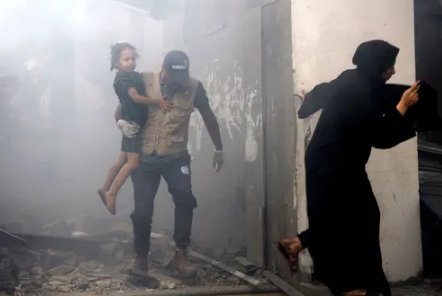
Opening image: Israelis in Ashkelon in the aftermath of rocket barrages launched from Gaza – October 7, 2023. (Photo: Reuters) Image 2: Phyllis Bennis (photographer unknown). Image 3: Members of a Palestinian family rush out of a bombed house during Israeli airstrikes on Gaza City – October 9, 2023. (Photo: Eyad Al-Baba/AFP via Getty Images)
I established The Wild Reed in 2006 as a sign of solidarity with all who are dedicated to living lives of integrity – though, in particular, with gay people seeking to be true to both the gift of their sexuality and their Catholic faith. The Wild Reed's original by-line read, “Thoughts and reflections from a progressive, gay, Catholic perspective.” As you can see, it reads differently now. This is because my journey has, in many ways, taken me beyond, or perhaps better still, deeper into the realities that the words “progressive,” “gay,” and “Catholic” seek to describe.
Even though reeds can symbolize frailty, they may also represent the strength found in flexibility. Popular wisdom says that the green reed which bends in the wind is stronger than the mighty oak which breaks in a storm. Tall green reeds are associated with water, fertility, abundance, wealth, and rebirth. The sound of a reed pipe is often considered the voice of a soul pining for God or a lost love.
On September 24, 2012,Michael BaylyofCatholics for Marriage Equality MNwas interviewed by Suzanne Linton of Our World Today about same-sex relationships and why Catholics can vote 'no' on the proposed Minnesota anti-marriage equality amendment.
"I believe your blog to be of utmost importance for all people regardless of their orientation. . . . Thank you for your blog and the care and dedication that you give in bringing the TRUTH to everyone."– William
"Michael, if there is ever a moment in your day or in your life when you feel low and despondent and wonder whether what you are doing is anything worthwhile, think of this: thanks to your writing on the internet, a young man miles away is now willing to embrace life completely and use his talents and passions unashamedly to celebrate God and his creation. Any success I face in the future and any lives I touch would have been made possible thanks to you and your honesty and wisdom."– AB
"Since I discovered your blog I have felt so much more encouraged and inspired knowing that I'm not the only gay guy in the Catholic Church trying to balance my Faith and my sexuality. Continue being a beacon of hope and a guide to the future within our Church!"– Phillip
"Your posts about Catholic issues are always informative and well researched, and I especially appreciate your photography and the personal posts about your own experience. I'm very glad I found your blog and that I've had the chance to get to know you."– Crystal
"Thank you for taking the time to create this fantastic blog. It is so inspiring!"– George
"I cannot claim to be an expert on Catholic blogs, but from what I've seen, The Wild Reed ranks among the very best."– Kevin
"Reading your blog leaves me with the consolation of knowing that the words Catholic, gay and progressive are not mutually exclusive.."– Patrick
"I grieve for the Roman institution’s betrayal of God’s invitation to change. I fear that somewhere in the midst of this denial is a great sin that rests on the shoulders of those who lead and those who passively follow. But knowing that there are voices, voices of the prophets out there gives me hope. Please keep up the good work."– Peter
"I ran across your blog the other day looking for something else. I stopped to look at it and then bookmarked it because you have written some excellent articles that I want to read. I find your writing to be insightful and interesting and I'm looking forward to reading more of it. Keep up the good work. We really, really need sane people with a voice these days."– Jane Gael
"Michael, your site is like water in the desert."– Jayden