To mark yesterday’s feast of Saints Sergius and Bacchus, I share today an excerpt from Kittredge Cherry’s informative piece entitled “Sergius and Bacchus: Paired Male Saints Loved Each Other in Ancient Roman Army.”
I also share the portrait of Sergius at right and the portrait of Bacchusbelow, both of which are by artist Nicolo’ Mazzucato.
________________
Saints Sergius and Bacchus were third-century Roman soldiers, Christian martyrs and men who loved each other. . . . They are by far the best documented, most widely worshiped and most influential male paired saints in Christian history. They are some of the earliest Christian martyrs. The close bond between Sergius and Bacchus has been emphasized since the earliest accounts, and recent scholarship has revealed their homosexuality. The oldest record of their martyrdom describes them as erastai (Greek for “lovers”). Scholars believe that they may have been united in the rite of adelphopoiesis (brother-making), a kind of early Christian same-sex marriage. Their names were often included in these rites of same-sex union, along with other saintly male pairs. Some see them as patron saints of same-sex couples. But their devotion to each other has inspired people of every sexual orientation over the centuries.
From ancient times until today these “gay saints” have inspired some of the most beautiful art depicting the holiness of same-sex couples, sometimes in a homoerotic way. A classic example of paired saints, Sergius and Bacchus were high-ranking young officers in the Roman army. Sergius was primicerius (commander) and Bacchus was secundarius (subaltern officer). They were tortured to death around 303 in present-day Syria after they refused to attend sacrifices to Zeus, thus revealing their secret Christianity.
Yale history professor John Boswell names Sergius and Bacchus as one of the three primary pairs of same-sex lovers in the early church in his 1995 book Same Sex Unions in Pre-Modern Europe. (The others are Polyeuct and Nearchus and Felicity and Perpetua.) Paired military saints were popular in the Middle Ages [and] Sergius and Bacchus were the most famous and one of the earliest couples. . . . An appendix in the book includes Boswell’s translation of “The Passion of Sts. Serge and Bacchus” from the original Greek text dated 373-395. It was the first time that an ancient hagiography of Sergius and Bacchus was ever translated into English.
Today LGBTQ Christians in the west can get status from their religion but may hide their sexual orientation to avoid condemnation. However Sergius and Bacchus faced the opposite dilemma. In the Roman army homosexuality was accepted and perhaps even encouraged, but Christianity was taboo.
To read Kittredge Cherry's article in its entirety (and view a number or artistic depictions of Sergius and Baccchus), click here.
Kuan Yin, the genderfluid spirit of compassion in Buddhism, is sometimes thought of as a queer Christ figure or LGBTQ role model. Buddhists celebrate the enlightenment of Kuan Yin every year in July or August. This year the date is July 28, 2021.
Transcending gender identity, Kuan Yin appears in whatever form is necessary to help people in need: sometimes female, sometimes male, sometimes androgynous.
Christians honor Christ as savior, and Kuan Yin is a type of Buddhist savior figure called a bodhisattva — an enlightened person who is able to reach nirvana (heaven) but delays doing so out of compassion in order to save others from suffering.
Artists often show Kuan Yin with eyes in the hands and feet. They are like the wounds of Christ, but Kuan Yin can see with them. Kuan Yin is also associated with the mother of Christ. When Christianity was persecuted in Edo-era Japan, the “hidden Christians” created states of Mary disguised as Kuan Yin.
Also known as the goddess of mercy, Kuan Yin goes by different names in different places, including Avalokiteshvara in India, Tara (female) or Chenrezig (male) in Tibet, and Kannon in Japan.
Writers and scholars who have explored the queer side of Kuan Yin include Patrick S. Cheng, an Episcopal priest who teaches at Chicago Theological Seminary; Hsiao-Lan Hu, religious studies professor at the University of Detroit Mercy; and Toby Johnson, a former Catholic monk turned author and comparative religion scholar.
Kuan Yin as queer Asian Christ figure
In the introduction to his 2003 essay “Kuan Yin: Mirror of the Queer Asian Christ,” Cheng explains:
Kuan Yin, the Asian goddess of compassion, can serve as a mirror of the queer experience. Specifically, Kuan Yin affirms three aspects in the life of queer people that are often missing from traditional images of the divine: (1) queer compassion; (2) queer sexuality; and (3) gender fluidity. In other words, Kuan Yin can be an important means by which gay, lesbian, bisexual and transgender people can see ourselves as being made in the image of God.
Cheng writes clearly about the connection between Kuan Yin and Christ in the section where he describes his personal search for queer Asian Christ figures:
I have been intrigued by the possibility of Kuan Yin serving as a christological figure for queer Asian people. For me, it has been difficult to envision the Jesus Christ of the gospels and the Western Christian tradition as being both queer and Asian (although I do recognize that queer theologians and Asian theologians have tried to do so in their respective areas). It is my thesis that Kuan Yin might serve as a symbol of salvation and wholeness for queer Asian people of faith.
Click for the whole essay “Kuan Yin: Mirror of the Queer Asian Christ” in English or in Spanish.
Hsiao-Lan Hu presented a paper on “Queering Avalokiteśvara” at the 2012 American Academy of Religion annual meeting. She noted that the Lotus Sutra says that Avalokitesvara will appear to teach different beings in different forms, based on what they can accept.
In the summary of her paper, Hu writes, “Of the 33 forms listed in the Lotus Sutra, seven are explicitly female, indicating that the Bodhisattva of Compassion transcends gender identity. . . . What is the theoretical ground in the Buddhadharma (Buddha’s teaching) that justify or even propel such conceptualization? How does that theoretical ground compare to modern-day queer theory?”
She summed up her paper in the 2013 Women’s and Gender Studies Newsletter from the University of Detroit Mercy:
Avalokiteśvara’s multi-morphic manifestation affirms different beings in their specific identities, while his/her transformability points to the possibility of moving beyond the confinement of any particular identity. For people of minority identities, the Bodhisattva thus can be both a source of comfort and a model for coping with reality in which they often need to perform different roles.
It is said there are Three Wonders of the Bodhisattva. The first is that he is androgynous, simultaneously both male and female, transcending the polarity of gender. That’s why he is such a sweet and lovable fellow: he blends the best of masculinity and the best of femininity.
The second wonder is that he sees there is no difference between nirvana and the life of suffering and rebirth in time, no difference between eternity and temporality, no difference between heaven and earth. This is why he could renounce his own nirvana and embrace all human experience. This life is nirvana; this is heaven on earth.
And the third wonder is that the first two wonders are the same!
That’s why this is such a nice myth for gay people to entertain. It says we’re really all One, all reflections of one another, that the distinction between male and female is illusory and needs to be transcended and that transcending gender is part and parcel with experiencing heaven now.
Avalokiteshvara is portrayed as the androgynous young being, beloved by everybody who knows him. That is very much like the ideal so many gay people find themselves looking for as a lover (and as a sense of themselves). And in the way that we gay people find the world a reflection of ourselves, so this myth says it really is. When we love another man or another woman, seeing their beauty and consciousness as like ours in homosexual attraction, that being we’re loving is the being that is ourself. No duality, no polarization.
Queer theologian Robert Shore-Goss applies the bodhisattva concept to queer Christian life in “Bodhisattva Christianity: A Case of Multiple Religious Belonging” in the 2013 book Queering Christianity: Finding a Place at the Table for LGBTQI Christians. Goss pastored Metropolitan Community Church in the Valley (North Hollywood, CA) after serving as chair of the religious studies department at Webster University in St. Louis.
The Wild Reed's 2017 Queer Appreciation series continues with the highlighting of a special work of art commemorating the "Orlando martyrs," the 49 people shot to death a year ago today at the Pulse gay nightclub in Orlando, Florida. The incident also saw over 50 people injured. The Pulse nightclub site is now in the process of being made into a permanent memorial and museum.
Right: Commemorating the Orlando shooting victims: Johnpaul Vazquez, right, and his boyfriend Yazan Sale, sit by Lake Eola, in downtown Orlando. (Photo: Carolyn Cole/Getty Images)
The June 12, 2016 shooting at Pulse is the deadliest by a single shooter in U.S. history, and the second deadliest in world history, after the 2011 Norway attacks. The incident is also recognized as the deadliest attack on LGBT people in United States history and the worst mass killing of LGBT people in the west since the Holocaust.
One of the newest and most spiritually powerful artworks about the Orlando martyrs is “Triptych for the 49,” a mixed media piece by gay artist Tony O’Connell of Liverpool. It is a shrine shaped like three-part altarpiece. The artist is mounting images of each martyr on reclaimed closet doors, along with queer saints Sebastian and Joan of Arc as “wrathful protector saints.”
O’Connell is working to finish it in time for a private showing on the anniversary of the massacre on June 12. A public exhibit is being planned for later this year. The artist will keep posting updates and new photos of “Triptych for the 49” on O’Connell’s Orlando Martyrs Facebook page as he completes and exhibits the work.
The Orlando martyrs speak to society today through Tony O’Connell’s art. “The world has changed very much in my life but Orlando reminds us that we are all still more vulnerable than polite liberal straight society would like to admit. I think every gay person must have been scarred by the massacre because it reminds us again that there is hate specifically directed at us,” he explained to the Jesus in Love Blog at Q Spirit.
In his new creation, O’Connell made haunting digital images with blue haloes inside Gothic window shapes framing the faces of each person who died in the Orlando shooting. He will arrange them in rows on the central panel, flanked by the guardian saints on two hinged panels. Gold leaf ornamentation adds to the air of sanctity. The whole triptych stands almost six feet tall.
The repetition of the format for all 49 faces allows the individuality of each victim shine through. The viewer’s heart and attention are drawn here and there to connect with different souls: the one in the pink shirt, the one with tattoos, the one with the bowtie . . .
Like standard religious icons, they gaze directly into the viewer’s eyes, seeming to invite conversation. Icons are traditionally considered to be “windows to heaven,” and O’Connell’s commemorative altarpiece provides a glimpse into a queer hereafter.
It is no accident that O’Connell made his shrine to the Orlando martyrs out of wood once used as closet doors. “At some level coming out of the closet is always a revolutionary act of courage because each LGBT person knows on whatever level that the choice to come out could invite potential rejection, or violence or even worse,” he said.
Rainbow haloes indicate that the large figures guarding the martyrs are LGBTQ saints: Sebastian Joan of Arc. Sebastian is a favorite theme in O’Connell’s art and spirituality. He re-enacted the saint’s martyrdom with a sculptural Sebastian to condemn violence against LGBTQ people in a 2015 performance art film. It included a “Litany of the Queer Saints.” He may write a new litany for the Orlando martyrs.
Raised Roman Catholic, O’Connell was rejected by the church when he came out as gay in his teens. He has been a practicing Buddhist since 1995. Much of O’Connell’s work deals with affirming the holiness of LGBTQ lives.
To read Kittredge Cherry article highlighting Tony O'Connell's "Triptych for the 49" and other artists' tributes to the Orlando martyrs, click here.
Above and below: Memorials in front of Pulse nightclub in Orlando. (Photos: John Raoux/AP and Joe Burbank/Orlando Sentinel/TNS/Getty Images)
The Wild Reed's 2017 Holy Week series continues with a second excerpt from "Resurrecting the Authentic Christ: Jesus as Guide to Mystical Love in Action," an interview with scholar and teacher Andrew Harvey published in the 2012 collection of Harvey's works entitled Radical Passion: Sacred Love and Wisdom in Action. (For Part 1, click here.)
This year's series also includes images that seek to depict Jesus as the embodiment of the Cosmic Christ, which, says Harvey, is an expression in the West for the universal force of divine love, "the force of active, divine love that streams from the godhead to the creation."
One of the things that you discover in mystical experience is that the universe is alive in its ultimate depths. There's a very astonishing correspondence between the human consciousness and the divine consciousness. The whole that is the universe is both utterly impersonal and utterly and totally personal. In many mystical traditions the personal aspect is said to be a person. In Hinduism it's said to be the Purusha. In Sufism it's said to be the Friend or the Beloved; and in Christianity it's said to be the Cosmic Christ.
Everyone who's had a mystical experience has come into contact with what you could call the Cosmic Christ, but a very important way of connecting with the fullness of the Cosmic Christ is, I believe, looking at how the Cosmic Christ expressed his or her nature in the life of Jesus. Why this is important is, I believe, because Jesus brought a unique intensity of justice to the world's experience of God.
Other great liberators have helped us to see the nature of desire, to see how we must deal with our emotions, to see the nature of the illusion of the world, but I think Jesus, more than any of the great liberators, wanted to use this power of awakening to transform the existing conditions of the world, to create what he calls the Kingdom on earth. This Kingdom is the kingdom of justice, mercy, and radical equality. It's this kingdom that we need to create on the planet now if it's going to be preserved. We need a mystical awakening that's simultaneously an opening to the highest transcendent godhead and the mystical awakening that makes us aware that we are committed, through that awakening, to act responsibly at every level in society, to change society. We need an awakening, in other words, that's political and active and social and economic as well as purely personal. Jesus is a tremendous guide to the radical inclusiveness of such an awakening.
Images:Doyle Chappell. About Chappell's depictions of the Cosmic Christ, Kittredge Cherry of Jesus in Love Blogwrites:
A Cosmic Christ appears with subtle LGBT symbolism in the work of Chicago artist Doyle Chappell.
He has done variations on the Cosmic Christ theme for years – most recently in colorful windows dedicated Sept. 20, 2015 at A Church 4 Me Metropolitan Community Church where he is a member. The phrase “Cosmic Christ” refers to Christ who is continually incarnated in all creation.
“In the windows for A Church 4 Me in Chicago, the Christ wears a diamond earring on the left ear which for me is a bit of a gay reference,” Chappell told the Jesus in Love Blog.
Multiple intersecting and nested pink triangles within triangles repeat a symbol imposed on gay prisoners in Nazi Germany and later reclaimed by the LGBT community.
“The triangle is more than a gay symbol,” Chappell explained. “It is to me a symbol of ancient wisdom that points to a higher level of consciousness toward the ‘Omega Point’ as expressed by the philosopher and Jesuit priest Pierre Teilhard de Chardin, one of the first theologians to show interest in the ‘Cosmic Christ.’”
Ultimately Chappell used LGBT imagery to enhance his vision of a Cosmic Christ for everybody. “My main intent was to honor the idea that ‘The Cosmic Christ’ is in all that has been created since the Big Bang and beyond our concepts of Christianity . . . in all particles of creation and certainly all life and honors all who seek to connect with the sacred wisdom,” he said.
Today is the feast day of John the Evangelist, commonly considered to be Jesus’ “Beloved Disciple.”
Over at the indispensable Q Spirit, Kittredge Cherry commemorates John with an insightful post that explores in both word and image the close bond he shared with Jesus – a bond which, as Kitt notes, “has been celebrated by artists since medieval times.” Furthermore, writes Kitt, “the idea that [Jesus and John] were homosexual lovers has been inspiring queer people and causing controversy at least since the 16th century.”
The idea that Jesus and his Beloved Disciple had a sexual relationship dates back at least to the early 16th century, when English playwright Christopher Marlowe was tried for blasphemy on the charge of claiming that “St. John the Evangelist was bedfellow to Christ and leaned always in his bosom, that he used him as the sinners of Sodoma.”
In 1550 Francesco Calcagno, a citizen of Venice, was investigated by the Inquisition for making the heretical claim that “St. John was Christ’s catamite,” which means a boy or young man in a pederastic sexual relationship with an older man.
“A close reading of the texts in which the beloved disciple appears supports the hypothesis that the relationship between him and Jesus may be understood as that of lovers," Jennings writes. "As it happens, both Jesus and the beloved are male, meaning that their relationship may be said to be, in modern terms, a ‘homosexual’ relationship” (p. 34).
After Jesus died, John went on to build a close, loving relationship with his younger disciple and scribe, Prochorus, bishop of Nicomedia. Tradition says that John was the only one of Christ’s original twelve apostles to live to old age, and the only one not killed for his faith. He died in Ephesus around 100 AD.
To read Kittredge Cherry's article “John the Evangelist: Beloved Disciple of Jesus – and Maybe His Lover” in its entirety, click here.
Author and art historian Kittredge Cherry, who founded and maintains the excellent Jesus in Love Blog, has composed a beautiful prayer for the Day of Silence taking place today.
Founded in 1996 by the Gay, Lesbian and Straight Education Network (GLSEN), the Day of Silence is a student-led national event that brings attention to anti-LGBT name-calling, bullying and harassment in schools.
Students from middle school to college take a vow of silence in an effort to encourage schools and classmates to address the problem of anti-LGBT behavior by illustrating the silencing effect of bullying and harassment on LGBT students and those perceived to be LGBT. . . . The Day of Silence has reached students in all 50 states and the District of Columbia, as well as those as far away as New Zealand, Singapore and Russia. More than 10,000 students register their Day of Silence participation with GLSEN every year. And public figures such as Laverne Cox, Jim Parsons, RuPaul, Tyler Oakley, Kirsten Vangsness, Kristin Chenoweth, Billy Bean, Vicky Beeching, Steve Grand, Chely Wright, and many others have publicly supported students participating in the GLSEN Day of Silence.
Following is the "long version" of Kittredge Cherry powerful prayer. For the "Twitter version" and for links to the prayer in Spanish and Portuguese, click here.
________________________________________
Day of Silence Prayer
by Kittredge Cherry
Silence is memory....
Remembering those who died young,
Driven to suicide by bullying
Or killed
Because of who they loved
Because of the way God created them
Because they were called
Gay, lesbian, bi, trans, queer, sodomite…
Remembering Tyler Clementi, Leelah Alcorn, Brandon Teena, Matthew Shepard, Gwen Araujo, Haylee Fentress, Paige Moravetz, and many, many more.
Silence is action….
Calling attention to how people are silenced
When bigotry is disguised as humor,
When prejudice turns into threats
And even violence.
Silence is solidarity…
Students, family, teachers, friends
Who care enough
To share the stigma,
To stand with the queer and questioning
Stopping hate with compassion.
Silence is pride, LGBTQ pride…
Not letting the bullies win.
Claiming our right to be.
With dignity
Part of God’s rainbow.
Silence is prayer…
For Mary’s child.
Whenever any child is bullied,
Christ is bullied.
Whenever any child is called names,
Christ is called names.
Mary’s child said,
“Whatever you do to the least of these,
you do to me.”
With sighs too deep for words,
Listening in the silence
For the still small voice of God.
Amen.
News last week of the death of David Bowie has generated a lot of comments from people about how, in the 1970s and '80s, the singer and entertainer had helped them accept themselves as LGBT and/or queer people.
For one thing, writes Wilton, Bowie's "claims to be gay or bisexual were almost certainly never anything other than a publicity-seeking gambit."
Continues Wilton:
It seems to have been Bowie's then manager, Ken Pitt, who decided to play the gay card. He arranged for Jeremy, the only gay publication in Britain at the time, to publish an article about Bowie in January 1970. This was followed in 1972 by an interview for Melody Maker in which the singer stated, "Yes, of course I'm gay, and always have been." In a 1976 Playboy interview he declared himself bisexual rather than gay.
Such published statements were combined with onstage antics such as fellating Mick Ronson's guitar [right] and some very public homoerotic partying with Mick Jagger, Lou Reed, and Iggy Pop. But Bowie's appropriation of a gay persona always existed alongside explicit warnings from the star himself that nothing he said was to be believed.
In 1971, he cautioned, "My songwriting is certainly not an accurate picture of how I think at all." This is just as well, since close analysis of Bowie's "gay" lyrics reveals little gay pride. Lady Stardust sings "songs of darkness and disgrace"; the gay seducer in "Aladdin Sane" has a "tongue swollen with devil's love," and after he "smelt the burning pit of fear" (you don't need to be Freud to spot an anal metaphor here!), the protagonist knows he will never "go down to the Gods again."
Wilton believes that it was an "indication of the repressive invisibility of gayness in 1970s Britain that, however cynical and (arguably) homophobic Bowie's flirtation with queer sexuality, it is remembered as liberating and exhilarating by many gay [people] in both the United Kingdom and the United States."
I can't say that I personally found any aspect of Bowie's musical career to be liberating. This was because in the singer's heyday I was too young to recognize, let alone appreciate (or rather project a liberating message onto) either his music or his various stage personas. I would, however, discover a sense of authentic liberation (as both a gay man and an aspiring integrated human being) years later in the music of Kate Bush, Dusty Springfield and Buffy Sainte-Marie.
That being said, it's undeniable that for many, many people, David Bowie was very much a queer messiah. The following testimonies bear witness to this.
The death of David Bowie feels somehow apocalyptic. I'm sure this is true for many queers for whom Bowie was the first outspoken and shameless sexual libertine in the rarified pop culture strata. He was the embodiment of glamour, talent, and a new kind of personal expression. Bowie inspired countless people to take personal risks which led them to their own forms of self-actualization. In the same way Holly, Candy, and Jackie – the Warhol Superstars – helped to liberate many trans feminine persons of that era, David Bowie liberated the gay, the bisexual, and the androgyne. Bowie was not an activist in the traditional sense and it's important to keep in perspective that it was the real disenfranchised trans women of color, flamboyant queens, dykes and gay men who brought the fight to the streets and changed the world on our behalf. But as a visionary and groundbreaking artist, Bowie provided a soundtrack and visuals which reshaped our world. He was a true Rock God.
In the days since his death, lesbian, gay, bisexual, and transgender fans have shared how the rocker influenced their lives and helped bring queer culture into the mainstream in the 1960s and 1970s. In essays, interviews, on Twitter and on Facebook, they told how his rise gave them strength.
Many saw a kindred spirit in Mr. Bowie’s various characters and gender-bending style, beginning with his first androgynous persona, Ziggy Stardust, in 1972. Not only had he made a glittery, alien-looking creature look cool, he had helped pioneer a sexy (and marketable) form of otherness that mainstream artists have tried to replicate in the decades since.
“In high school, Ziggy Stardust blasted confidence into my ears and said, ‘See, it’s O.K. to be different and strange and you are wonderful,’” wrote John Barlow, a Times reader from Atlanta. “Feeling those sentiments was important, especially as a gay youth who was not out at the time.”
The edginess of Mr. Bowie’s style earned him fast stardom and the freedom to play with gender and sexuality. He retired the Ziggy character, but continued to play with his image in a way that forced his viewers to rethink ideas of gender.
It may seem odd to a generation now – for whom gay pride comes with its own multi-letter acronym, LGBT – that a pop star could so radically collide and shatter traditional norms around sexuality and gender. But David Bowie did just that in the early 1970s and the challenge that he set, in terms of confronting definitions of sexuality and images of masculinity, prove as fresh today as they did then.
Coming out as I did in Britain of the late 1980s, gay men in their 30s and 40s would talk about what a revolutionary marker, a personal lightning strike, Bowie had been for them as boys and teenagers in the 1970s. Lou Reed walking on the wild side had also had his effect, but Bowie, as Ziggy Stardust, had quite literally beamed in from another planet.
According to author and cultural critic Mark Simpson, Bowie’s appearance on UK primetime institution Top of the Pops in 1972 singing ‘Starman’ “and his calculated draping of his fey arm around his gorgeous guitarist Mick Ronson was probably the most important ‘Gay Parade’ that ever happened in the UK.”
[My girlfriend] introduced me to her love of Bowie while hanging out at her place in Columbia Heights. Posters of his 1995 tour with Nine Inch Nails adorned the walls, and her Facebook profiles featured pictures of her at Bowie-esque Glam-Rock costume parties. She'd shared a ton of music with me before, but this went in a different direction. She had me lay back, close my eyes, and listen from the beginning that was "Space Oddity."
I was hooked then and there on that song about isolation and separation sung by a fellow queer person. As I continued to listen to song after song, I tried to guess when each was released. 1979? No, 1975. 1983? No, 1979. After missing the same way again and again, I realized that where Bowie went, pop music followed several years later. He struck me as a Nikolai Tesla-like figure: a genius in his field so far ahead of everyone else that no one could see it until many years later.
Still, this wasn't the important part.
She walked me through the personas of his early years. "I love how he plays with androgyny," she often commented, "there's something really beautiful and attractive about it." I refused to see at first, but as my own internalized transphobia ebbed a bit, it opened a window enough that I could see it too.
It wasn't just beautiful, it was amazing. Sexy and empowering in a way that said his bucket of fucks to give was empty long ago. From there, it wasn't that far a leap to accepting that queerness itself, in all its million shades, can be beautiful, sexy, and powerful too. Coming from a place where queerness was the antithesis of love, acceptance, and beauty, this paradigm shift was nothing short of radical and life changing, because I felt I could be all of these too.
Bowie, in sound and vision, was the consummate outsider; a rock star who redefined what a rock star could be.
Bowie demonstrated that a man could grow his hair, wear a dress and face full of make-up, and still be regarded as the coolest pop star on the planet.
Bowie talked about being bisexual and his career didn’t bomb. Bowie not only demonstrated that it was OK to be different, he was living proof that it was positively advisable.
It’s difficult today to grasp quite how powerful a message that was when he first rose to prominence in the 1970s, or the life-affirming influence it had on generations of LGBTI youth: Keep changing and pushing at boundaries; experiment and dress up; ignore those who tell you how you should live; don’t be afraid to re-invent yourself.
It’s true that for me as a teenager growing up in Iowa, Bowie embodied the archetype of the misunderstood queer messiah . . . although the salvation he promised was based on rock music (Ziggy Stardust) or alien technology (in The Man Who Fell to Earth). The inspiration that I found in Bowie became the foundation for my later understanding of the queer Christ.
My vocation now is to write about LGBTQ spirituality and the arts, and Bowie had all three aspects when I was a teen searching for role models: a cool queer persona, an artistic sensibility and strong visual style, and what I perceived as a subtle spiritual quality.
For so many gay men, the first pangs of childhood shame have actually nothing to do with an attraction to other boys and everything to do with the emergence of certain traits often described as "feminine." Not all gay men are "girly," that’s true. But I was. I remember drawing on my hand with pastel bubbly pens before a particularly joyless middle school Latin teacher pulling me aside to tell me that that’s something that only girls do, and ordering me to wash it off. I scrubbed my skin so furiously with hot water that it hurt.
For so many, it’s only much later in life that you discover that feeling girly – indeed feeling all shades of the gender rainbow – can be wonderful, no matter who you choose to sleep with or how you were born. If you’re like me, the eventual embrace of the traits that you were once told to hate was helped along, in no small way, by David Bowie. When I discovered Bowie a little later in high school, he was the first person I can recall doing the opposite of what that teacher did: he made being a girly boy seem not just brave, but pretty cool, too.
. . . If gayness were a church, I’d say we make Bowie one of its anointed saints. I cannot quantify precisely the effect he has had on the increasing visibility of gay and trans peoples throughout the world, but there are few figures, at least in the influential world of pop culture, that I’d give more credit to for expanding the boundaries of what we think of as beautiful.
Through my sadness, I keep remembering that he does not have to be alive for some fresh new 16-year-old boy – or girl, or girl wanting to be a boy, or boy wanting to be a girl, or some person who in fact has no gender at all – to discover Bowie, and help whomever needs it to reimagine that not so long after that part of queer life that seems like hell, it will feel like heaven.
[w]e for whom queerness is not a phase seem to have two options in terms of how we deal with Bowie’s fraught relationship to our name and our stuff. We can be pissed off and view his career as, at least in part, an act of sly cultural appropriation – one of many that pop has committed at our expense over the years. Or, more generously, we can allow that even if Bowie was not really sexually queer (gay, bi, or otherwise), he was one of the most culturally queer artists to grace this earth.
I’m partial to the latter view. As I wrote at length in 2015, I believe that cultural gayness is something that can and does exist apart from homosexuality. Gays may have developed the set of cultural practices that define gayness, or what some call the “gay sensibility” or “gay aesthetics,” but they need not be its only practitioners. Indeed, straight people (or whatever Bowie might have been) are theoretically just as capable of doing cultural gayness as gays are – and indeed, some may do it better. As a veritable innovator of gay style, Bowie would seem to be a natural fit in this category; you can’t appropriate what you help create. He may have bucked or played coy with identity labels – presaging our modern situation quite well – but, especially at the beginning of his career, he was recognizably “gay.” Culturally speaking, I think it’s a label he deserves.
Of course, Bowie’s legitimacy as a gay artist may not quell misgivings about his politics: As much as he enjoyed our clubs, he was apparently not terribly interested in gay liberation as a political project in the 1970s. And his typical swagger sometimes produced a strange blend of homophobia and misogyny when applied to real “queens” – particularly in that Playboy interview, in which he jokes about knowing “how to keep happy” in prison, treating his boys “like real ladies,” and having a predilection for young Japanese men who “are all queens until they reach 25.” However much of this you are willing to forgive as working-class-rock-star-before-PC bluster is a personal call; it complicates my feelings to a degree.
But then, artists as visionary as Bowie are necessarily complicated – they probably wouldn’t be very good otherwise. For myself, I think I will choose to remember Bowie as a peculiar – and incredibly effective – drag queen. The flood of obituaries and remembrances today form a chorus of praise for Bowie’s shifting self-presentation, his chameleon-like ability to revise his artistic identity in conversation with the zeitgeist. These are all nice ways of saying he understood drag—an art form arising from the fundamental (and hard-learned, for queer people) principle that we are all always performing and that masks are often a necessity in this life. Drag also draws its power from the world-changing potential of juxtaposition, of the jolt that’s generated when fishnet swaddles hairy thigh, when rock ‘n’ roll rigidity reclines upon chaise lounge, when expectation stumbles over reality.
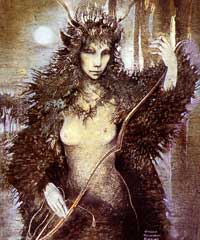
Over at the always informative Jesus in Love Blog, Kittredge Cherry has an insightful article on how the ancient mid-August festival of the lesbian goddess Diana (Artemis) has been adapted by Catholic and Orthodox churches into a feast day for the Virgin Mary.
Following, with added images and links, is an excerpt.
Midsummer feasts have celebrated the divine feminine on August 15 since before the time of Christ. Now devoted to Mary, the holiday known as the Feast of the Assumption (or Dormition) carries the torch of lesbian spiritual power to a new generation on the same date.
Saint Mary, mother of Jesus, is honored by churches on August 15 in a major feast day marking her death and entrance into heaven. Catholic and Orthodox churches call it the Feast of the Assumption or Dormition because they believe that Mary was “assumed” into heaven, body and soul.
The connections between Diana and Mary raise many questions. The concept of virginity has been used to control women, but sometimes it is a code word for lesbian. What shade of meaning is implied by the “virginity” of these two heavenly queens? Did the church patriarchs substitute wild lesbian Diana/Artemis with mild straight Mary – or is Mary more versatile and dynamic than many thought?
The Virgin Mary’s holiday was adapted – some would say appropriated – from an ancient Roman festival for Diana, the virgin goddess of the moon and the hunt. Diana, or Artemis in Greek, is sometimes called a lesbian goddess because of her love for woman and her vow never to marry a man. The ancient Roman Festival of Torches (Nemoralia) was held from August 13-15 as Diana’s chief festival.
According to mythology, Diana preferred the company of women and surrounded herself with female companions. They took an oath of virginity and lived as a group in the woods, where they hunted and danced together. Homoerotic art and speculations often focus on Diana’s relationship with the princess Callisto.
. . . Aspects of Diana and Artemis were taken over by the church more than 1,300 years ago. The Festival of Torches became the Feast of the Assumption. The Temple of Artemis at Ephesus in Turkey was one of the seven wonders of the ancient world, with an awe-inspiring statue of the “many-breasted” Artemis. The temple was destroyed and replaced by the Church of Mary. The Virgin Mary even assumed some titles once given to Artemis, including Queen of Heaven.
Feminists praise Diana/Artemis as an archetype of female power, a triple goddess who represents all phases of womanhood. She is the maiden, wild and free, with no need for a man. She is the “many-breasted” mother who nurtures all life. She is the crone, the mature hunter who provides swift death with her arrows in harmony with the cycles of nature.
LGBT people and allies may be inspired by the queer origins of this midsummer holiday. May the Queen of Heaven, by whatever name, continue to bless those who remember her.
To read Kittredge Cherry's article in its entirety, click here.
I established The Wild Reed in 2006 as a sign of solidarity with all who are dedicated to living lives of integrity – though, in particular, with gay people seeking to be true to both the gift of their sexuality and their Catholic faith. The Wild Reed's original by-line read, “Thoughts and reflections from a progressive, gay, Catholic perspective.” As you can see, it reads differently now. This is because my journey has, in many ways, taken me beyond, or perhaps better still, deeper into the realities that the words “progressive,” “gay,” and “Catholic” seek to describe.
Even though reeds can symbolize frailty, they may also represent the strength found in flexibility. Popular wisdom says that the green reed which bends in the wind is stronger than the mighty oak which breaks in a storm. Tall green reeds are associated with water, fertility, abundance, wealth, and rebirth. The sound of a reed pipe is often considered the voice of a soul pining for God or a lost love.
On September 24, 2012,Michael BaylyofCatholics for Marriage Equality MNwas interviewed by Suzanne Linton of Our World Today about same-sex relationships and why Catholics can vote 'no' on the proposed Minnesota anti-marriage equality amendment.
"I believe your blog to be of utmost importance for all people regardless of their orientation. . . . Thank you for your blog and the care and dedication that you give in bringing the TRUTH to everyone."– William
"Michael, if there is ever a moment in your day or in your life when you feel low and despondent and wonder whether what you are doing is anything worthwhile, think of this: thanks to your writing on the internet, a young man miles away is now willing to embrace life completely and use his talents and passions unashamedly to celebrate God and his creation. Any success I face in the future and any lives I touch would have been made possible thanks to you and your honesty and wisdom."– AB
"Since I discovered your blog I have felt so much more encouraged and inspired knowing that I'm not the only gay guy in the Catholic Church trying to balance my Faith and my sexuality. Continue being a beacon of hope and a guide to the future within our Church!"– Phillip
"Your posts about Catholic issues are always informative and well researched, and I especially appreciate your photography and the personal posts about your own experience. I'm very glad I found your blog and that I've had the chance to get to know you."– Crystal
"Thank you for taking the time to create this fantastic blog. It is so inspiring!"– George
"I cannot claim to be an expert on Catholic blogs, but from what I've seen, The Wild Reed ranks among the very best."– Kevin
"Reading your blog leaves me with the consolation of knowing that the words Catholic, gay and progressive are not mutually exclusive.."– Patrick
"I grieve for the Roman institution’s betrayal of God’s invitation to change. I fear that somewhere in the midst of this denial is a great sin that rests on the shoulders of those who lead and those who passively follow. But knowing that there are voices, voices of the prophets out there gives me hope. Please keep up the good work."– Peter
"I ran across your blog the other day looking for something else. I stopped to look at it and then bookmarked it because you have written some excellent articles that I want to read. I find your writing to be insightful and interesting and I'm looking forward to reading more of it. Keep up the good work. We really, really need sane people with a voice these days."– Jane Gael
"Michael, your site is like water in the desert."– Jayden