Showing posts with label Europe 2005. Show all posts

Friday, December 06, 2013

Europe 2005

Part 6: Paris


For reasons that I'll go into at a later time, I'm keen to wrap-up various series that I've started here at The Wild Reed. A few weeks ago, for instance, I concluded Pahá Sápa Adventure, my series of posts documenting time spent in the Black Hills of South Dakota earlier this year.

This evening I conclude a series started back in August of 2010, and which highlights the two weeks that my parents and I spent traveling in Europe in the summer of 2005. The main focus of this final installment is on our time in Paris. However, the first couple of photos are actually of Lucerne, Switzerland, which we visited while traveling to Paris from Florence, Italy.


Above: In this picture can be seen part of one of Lucerne's most famous landmarks, the Chapel Bridge (Kapellbrücke), a wooden bridge first erected in the 14th century.

About Lucerne Wikipedia notes:

Lucerne is a city in north-central Switzerland, in the German-speaking portion of that country. It is the capital of the Canton of Lucerne and the capital of the district of the same name. With a population of about 76,200 people, Lucerne is the most populous city in Central Switzerland, and a nexus of transportation, telecommunications, and government of this region. The city's urban area consists of 17 cities and towns located in three different cantons with an overall population of about 250,000 people.


Above: During our time in Lucerne we visited a Swiss village on the outskirts of the city. Part of the journey involved traveling in a horse-drawn wagon. It was while we were enjoying the warm Swiss sun and the beautiful alpine vistas that we heard about the terrible event that had taken place in the U.S.


Thursday, September 1, 2005 (11:57 p.m.)

I was in the picturesque and peaceful Swiss countryside this morning, enjoying a horse and carriage ride, when I was informed of the events in New Orleans. Tonight I've been watching CNN International in my Lucerne hotel room. As many as 1,000 people could be dead in New Orleans and elsewhere in the region as the result of Hurricane Katrina. Elsewhere, close to 1,000 people have been killed in Baghdad as a result of a stampede of people on a bridge. I've also just finished viewing a special commemorative program on the first anniversary of the Beslam massacre in Russia. So much suffering, chaos and destruction in the world. I pray for all affected by such realities – pray that they may know God's transforming love, strength and peace in their lives.

The U.S. officials, including President Bush, all seem totally inept. They also sound incredibly pompous and uncaring – more concerned about their reputations than the harsh truth that their response to this disaster has been totally inadequate. I pray that there will be justice and accountability in the weeks and months ahead.


Above: Paris!

Following is another excerpt from my journal.


Sunday, September 4, 2005

Paris was very beautiful and interesting – though, as with London, it's unfortunate that so many of its monuments and buildings honor military exploits and the conquests of empire.

At the Louvre on Friday night I located three statues of Antinous – one original piece from Roman times and two that were made in later times. I'm getting quite good at recognizing Antinous, which is just as well as the museum guides were hopeless.

After the Lourve we went on a night cruise on the Seine. Yesterday we visited the Eiffel Tower and Napolean's tomb.

Afterwards, Mum, Dad and I did our own thing by catching a city sightseeing bus and visiting the Arc de Triomphe. We then went in search of the last home of Maria Callas – which we found easily enough as the bus dropped us off quite close to Georges Mandel Avenue.

Last night we enjoyed a night of entertainment at a Parisian cabaret – complete with can-can dancers, acrobats and jugglers.


Above: A view of the base of the Eiffel Tower – Saturday, September 3, 2005.

Notes Wikipedia:

The Eiffel Tower (La Tour Eiffel) is an iron lattice tower located on the Champ de Mars in Paris. It was named after the engineer Gustave Eiffel, whose company designed and built the tower. Erected in 1889 as the entrance arch to the 1889 World's Fair, it has become both a global cultural icon of France and one of the most recognizable structures in the world. The tower is the tallest structure in Paris and the most-visited paid monument in the world; 7.1 million people ascended it in 2011. The tower received its 250 millionth visitor in 2010.

The tower stands 324 metres (1,063 ft) tall, about the same height as an 81-storey building. During its construction, the Eiffel Tower surpassed the Washington Monument to assume the title of the tallest man-made structure in the world, a title it held for 41 years, until the Chrysler Building in New York City was built in 1930. Because of the addition of the antenna atop the Eiffel Tower in 1957, it is now taller than the Chrysler Building by 5.2 metres (17 ft). Not including broadcast antennas, it is the second-tallest structure in France, after the Millau Viaduct.

The tower has three levels for visitors. The third level observatory's upper platform is at 279.11 m (915.7 ft) the highest accessible to the public in the European Union. Tickets can be purchased to ascend, by stairs or lift (elevator), to the first and second levels. The walk from ground level to the first level is over 300 steps, as is the walk from the first to the second level. Although there are stairs to the third and highest level, these are usually closed to the public and it is usually accessible only by lift. The first and second levels have restaurants.


Above: Mum and Dad on a night cruise on the River Seine – Friday, September 2, 2005.


Above: The Arc de Triomphe – Saturday, September 3, 2005.

About this impressive structure Wikipedia notes the following:

The Arc de Triomphe de l'Étoile is one of the most famous monuments in Paris. It stands in the centre of the Place Charles de Gaulle (originally named Place de l'Étoile), at the western end of the Champs-Élysées. The Arc de Triomphe (in English: "Triumphal Arch") honours those who fought and died for France in the French Revolutionary and the Napoleonic Wars, with the names of all French victories and generals inscribed on its inner and outer surfaces. Beneath its vault lies the Tomb of the Unknown Soldier from World War I.

The Arc de Triomphe is the linchpin of the historic axis (Axe historique) – a sequence of monuments and grand thoroughfares on a route which goes from the courtyard of the Louvre, to the Grande Arche de la Défense. The monument was designed by Jean Chalgrin in 1806, and its iconographic program pitted heroically nude French youths against bearded Germanic warriors in chain mail. It set the tone for public monuments, with triumphant patriotic messages.

The monument stands 50 metres (164 ft) in height, 45 m (148 ft) wide and 22 m (72 ft) deep. The large vault is 29.19 m (95.8 ft) high and 14.62 m (48.0 ft) wide. The small vault is 18.68 m (61.3 ft) high and 8.44 m (27.7 ft) wide. It was the largest triumphal arch in existence until the construction of the Arch of Triumph in Pyongyang, in 1982. Its design was inspired by the Roman Arch of Titus. The Arc de Triomphe is so colossal that three weeks after the Paris victory parade in 1919 (marking the end of hostilities in World War I), Charles Godefroy flew his Nieuport biplane through it, with the event captured on newsreel.


Above: The Louvre.

Notes Wikipedia:

The Louvre or Louvre Museum is one of the world's largest museums and a historic monument. A central landmark of Paris, France, it is located on the Right Bank of the Seine in the 1st arrondissement (district). Nearly 35,000 objects from prehistory to the 21st century are exhibited over an area of 60,600 square metres (652,300 square feet). With more than 8 million visitors each year, the Louvre is the world's most visited museum.

The museum is housed in the Louvre Palace (Palais du Louvre), originally built as a fortress in the late 12th century under Philip II. Remnants of the fortress are visible in the basement of the museum. The building was extended many times to form the present Louvre Palace.


Above: With the Antinous Mondragone in the Louvre – Friday, September 2, 2005.

Notes Wikipedia:

The Antinous Mondragone is a unique colossal 0.95 metre high marble example of the iconographic type of the deified Antinous, of c. 130 CE. It can be identified as him from the striated eyebrows, full lips, sombre expression and the head's twist down and to the right (reminiscent of that of the Lemnian Athena), whilst its smooth skin and elaborate, centre-parted hair mirror those of Hellenistic images of Dionysus and Apollo.

It formed part of a colossal acrolithic cult statue for the worship of Antinous as a god. Thirty-one holes in three different sizes have been drilled for the attachment of a head-dress (possibly a lotus flower or uraeus) in metal; the sculpture has also lost eyes in metal, ivory or coloured stone.

It is said to have been found at Frascati between 1713 and 1729 - it was certainly displayed as part of the Borghese collection at their Villa Mondragone there. The German art historian Johann Joachim Winckelmann made it better known by praising it in his History of Ancient Art, calling it "the glory and crown of art in this age as well as in others" and "so immaculate that it appears to have come fresh out of the hands of the artist." This was since, though Roman in date, it echoed the 5th century BC Greek style which Winckelmann preferred over Roman art.

In 1807 it was bought with a large part of the Borghese collections for Napoleon. Sometime since a brown layer of wax was added to give an opaque finish, along with plaster round the base of the neck to make the statue look more complete - these were both removed in recent cleaning. It is now held at the Louvre Museum, though it toured to the Henry Moore Institute, Leeds in 2006 for the exhibition "Antinous: The Face of the Antique."


Writes Vittorio Lingiardi of Antinous (or Antinoos) in Men in Love: Male Homosexualities from Ganymede to Batman:

Like Ganymede, Antinoos for centuries stood as a symbol of same-sex love, and also as a platonic ideal of spiritual love. Like Ganymede, Antinoos was transformed into a star: wanting his lover to be remembered for all eternity, [the emperor] Hadrian named a constellation after him. In the Almagest, Ptolemy’s first great compendium of Greek astronomy, the stars of Antinoos are mentioned as part of the Aqila (Eagle) group; in various ancient maps of the heavens.


The best book about Antinous and Hadrian is undoubtedly Royston Lambert's Beloved and God. It's a book that is not only scholarly but also eloquently written and entertaining.


Above: The façade of the Palais Garnier – Saturday, September 3, 2005.

According to Wikipedia:

The Palais Garnier is a 1,979-seat opera house, which was built from 1861 to 1875 for the Paris Opera. It was originally called the Salle des Capucines because of its location on the Boulevard des Capucines in the ninth arrondissement of Paris, but soon became known as the Palais Garnier in recognition of its opulence and its architect, Charles Garnier. The theatre is also often referred to as the Opéra Garnier, and historically was known as the Opéra de Paris or simply the Opéra, as it was the primary home of the Paris Opera and its associated Paris Opera Ballet until 1989, when the Opéra Bastille opened at the Place de la Bastille. The Paris Opera now mainly uses the Palais Garnier for ballet.

The Palais Garnier has been described as "probably the most famous opera house in the world, a symbol of Paris like Notre Dame Cathedral, the Louvre, or the Sacré Coeur Basilica." This is at least partly due to its use as the setting for Gaston Leroux's 1910 novel The Phantom of the Opera and, especially, the novel's subsequent adaptations in film and on stage.


Speaking of opera . . . One of the places my parents and I visited in Paris was the former home of opera legend Maria Callas, located at 36 Georges Mandel Avenue. Callas lived at this address from the late 1960s until her death on September 16, 1977.

In 2000, Georges Mandel Avenue was dedicated to Maria Callas (above).


Above: 36 Georges Mandel Avenue, Paris – the former home of Maria Callas.


Right: Dad snapped this photo of me standing at the front gates of 36 Georges Mandel Avenue – Saturday, September 3, 2005.


Above: A 1968 photograph showing Maria Callas in her Paris apartment at 36 Georges Mandel Avenue.

For a short video of pianist Robert Sutherland revisiting Callas' former apartment many years after her death, click here.

For more about Maria Callas, see the previous Wild Reed posts Remembering Maria . . . Celebrating Callas and Callas Remembered.


See also the previous Wild Reed posts:
Europe 2005 - Part 1: London
Europe 2005 - Part 2: Bruges and Brussels
Europe 2005 - Part 3: Germany and Austria
Europe 2005 - Part 4: Ah, Venezia!
Europe 2005 - Part 5: Rome and Florence

Images: Michael Bayly and Gordon Bayly.


Monday, October 11, 2010

Europe 2005

Part 5: Rome and Florence


In the summer of 2005 my parents and I spent two weeks traveling in Europe. I continue today with the special series of posts documenting our European adventure! (To start at the beginning of this series, click here.)


Above: St. Peter's Basilica - Vatican City, August 29, 2005.


Monday, August 29, 2005

I have to say that my initial impression of Rome was not a very good one. Overall it looks very shabby, with rubbish in the streets, graffiti on many building walls, prostitutes lining the roads, and even one guy taking a dump in the street! Political corruption has dogged Italy for years - and its effects, it would seem, are most clearly manifested here in Rome.

But then there is the city’s history - the ancient Roman ruins and the opulence of the Vatican. These aspects of the city were quite overwhelming. I’d like to spend a week or two here. As it was, we saw what we could in a singe day that ended up being quite exhausting.

One of my goals in Rome was to find a stature of Antinous (or An-tee-no, as Maria, our wonderful local guide, pronounced it!). He was the male lover of the Emperor Hadrian, and after his mysterious drowning in the Nile, Hadrian declared Antinous a god and built statues and shrines in his honor all over the empire.

Unfortunately, the wing of the Vatican Museum that houses a statue of Antinous was closed, while the National Museum of Archeology which, according to Maria, has the “most beautiful” statue of Antinous, is closed on Mondays!


Opening image and above: The Colosseum.


Above: The Italian city of Florence - Tuesday, August 30, 2005.

After Venice, Florence was my next favorite city that I visited during my 2005 tour of Europe. Indeed, I was quite enthralled by the beauty of this city - known as the “Jewel of the Renaissance.” Many famous works of art are housed in Florence, including Michelangelo’s “David,” which is housed there. The original is safely indoors and, upon entering to view it, visitors are told that photography is strictly prohibited. However, as you’ll see from the images below, at least two replicas of the famed statue can be seen (and photographed) in other parts of the city.


Above: The Basilica di Santa Maria del Fiore, the cathedral church (Duomo) of Florence.

Wikipedia
notes that the building was “begun in 1296 in the Gothic style to the design of Arnolfo di Cambio and completed structurally in 1436 with the dome engineered by Filippo Brunelleschi. The exterior of the basilica is faced with polychrome marble panels in various shades of green and pink bordered by white and has an elaborate 19th century Gothic Revival facade by Emilio De Fabris.”


Above: A replica of Michelangelo’s “David.”


Tuesday, August 30, 2005

I’ve paused in my wandering through the streets of Florence to enjoy a cool lemon soda at Caffé le Torri, a little streetside café.

One of the first places we visited upon our arrival was the gallery that houses Michelangelo’s incredible “David.” What a beautiful work of art it is. I’d never been that impressed or moved by photos of it, yet seeing it in the flesh, so to speak, is something altogether different. And in many ways, it is like seeing living human flesh – in all its detail and sensuality.

4:20 p.m.

I now I sit before the church that houses the bones of Michelangelo. I feel quite tired from walking around the old city and so am quite content to simply sit in the shade for a while, on the pavement still radiating the heat of the day. And it has been a hot day - as it was yesterday in Rome.

I’m on my tenth roll of film! I’ve tried to be sparing in what I photograph yet find it difficult to resist some really beautiful and interesting shots. Some views, however, have remained potential shots. I’m thinking of the many beautiful European men I’ve seen on the streets, in the hotels and cafés. Today, for instance, I observed a workman pausing in his labour beside his cement mixer. The man was posing naturally and beautifully - a rival to “David.” No, bettering David, for he truly breathes, moves, sweats.


As I've noted
previously, it seems Michelangelo would have shared my appreciation of and attraction to the male form. Notes Wikipedia:

Fundamental to Michelangelo’s art is his love of male beauty, which attracted him both aesthetically and emotionally. In part, this was an expression of the Renaissance idealization of masculinity. But in Michelangelo’s art there is clearly a sensual response to this aesthetic

The sculptor’s expressions of love have been characterized as both Neoplatoni and openly homoerotic; recent scholarship seeks an interpretation which respects both readings, yet is wary of drawing absolute conclusions.

. . . The greatest written expression of his love was given to Tommaso dei Cavalieri (c. 1509–1587), who was 23 years old when Michelangelo met him in 1532, at the age of 57. Cavalieri was open to the older man's affection: “I swear to return your love. Never have I loved a man more than I love you, never have I wished for a friendship more than I wish for yours.” Cavalieri remained devoted to Michelangelo till his death.

Michelangelo dedicated to him over three hundred sonnets and madrigals, constituting the largest sequence of poems composed by him. Some modern commentators assert that the relationship was merely a Platonic affection, even suggesting that Michelangelo was seeking a surrogate son. However, their homoerotic nature was recognized in his own time, so that a decorous veil was drawn across them by his grand nephew, Michelangelo the Younger, who published an edition of the poetry in 1623 with the gender of pronouns changed. John Addington Symonds, the early British homosexual activist, undid this change by translating the original sonnets into English and writing a two-volume biography, published in 1893.

The sonnets are the first large sequence of poems in any modern tongue addressed by one man to another, predating Shakespeare’s sonnets to his young friend by a good fifty years.

. . . It is impossible to know for certain whether Michelangelo had physical relationships (Ascanio Condivi ascribed to him a “monk-like chastity”), but through his poetry and visual art we may at least glimpse the arc of his imagination.


NEXT: Paris


See also the previous Wild Reed posts:
Europe 2005 - Part 1: London
Europe 2005 - Part 2: Bruges and Brussels
Europe 2005 - Part 3: Germany and Austria
Europe 2005 - Part 4: Ah, Venezia!


See also:
Michelangelo: Gifted Artist, Lover of Beauty and Secret Reformer of the Church


Saturday, September 25, 2010

Europe 2005

Part 4: Ah, Venezia!


In the summer of 2005 my parents and I spent two weeks traveling in Europe. I continue today with the special series of posts documenting our European adventure! (To start at the beginning of this series, click here.)


Friday, August 26, 2005

I’ve been in Venice for only twenty minutes yet already feel that this is going to be one of my favorite places of our tour. The walk from where the bus dropped us off to the Continental Hotel, situated right on the Grand Canal, was full of interesting and exciting sights and sounds. At 6:00 p.m. we’ll be embarking on a gondola ride and then returning to the hotel where we’ll be dining. Later, I plan to go out by myself and explore this unique city.


Above: St. Mark's Basilica, the cathedral church of the Roman Catholic Archdiocese of Venice.


Left: Mum and Dad in the Piazza San Marco (Saint Mark's Square). Behind my parents is St. Mark's Basilica, of which Wikipedia notes the following:

[St. Mark's] is the most famous of the city's churches and one of the best known examples of Byzantine architecture. It lies on Piazza San Marco adjacent and connected to the Doge's Palace. Originally it was the "chapel" of the Venetian rulers, and not the city's cathedral. Since 1807 it has been the seat of the Patriarch of Venice, archbishop of the Roman Catholic Archdiocese of Venice. For its opulent design, gilded Byzantine mosaics, and its status as a symbol of Venetian wealth and power, from the 11th century on the building was known by the nickname Chiesa d'Oro (Church of Gold).


Above: St. Mark's Basilica (left) and the Doge's Palace (right).


Above: St Mark's Campanile (Campanile di San Marco in Italian), the bell tower of St Mark's Basilica, perhaps the most recognizable building of Venice.


Saturday, August 27, 2005

Venice is shaping up to be my favourite place in Europe I've visited so far. For one thing I love that there are absolutely no cars! The Grand Canal, however, can get pretty chaotic, what with countless gondolas and all sorts of speeding boats and ferries vying for space.

I find the buildings incredibly beautiful, and I especially enjoy the Turkish influences reflected in much of the architecture. I wander the back streets, alleys and canals and get totally (and happily) lost! There's so much to see and so much atmosphere to simply absorb. I find myself photographing all kinds of interesting buildings - in particular, their ornamentation and windows.


Above: The Basilica of St Mary of Health (Basilica di Santa Maria della Salute in Italian).


Above: Brightly-painted houses on the island of Burano in the Venetian Lagoon. Located seven kilometres from Venice, Burano is a 40 minute trip by motorboat.

Above: A view of Venice's San Giorgio Maggiore Island - August 26, 2005.


NEXT: Rome and Florence


See also the previous Wild Reed posts:
Europe 2005 - Part 1: London
Europe 2005 - Part 2: Bruges and Brussels
Europe 2005 - Part 3: Germany and Austria
Casanova-Inspired Reflections on Papal Power - at 30,000 Ft.


Recommended Off-site Link:
Seven Cities About to Sink - Miriam B. Weiner (Yahoo! Travel, October 2010).


Wednesday, September 15, 2010

Europe 2005

Part 3: Germany and Austria


In the summer of 2005 my parents and I spent two weeks traveling in Europe. I continue today with the special series of posts that documents our European adventure! (To start at the beginning of this series, click here.)


Above: Cologne Cathedral - August 23, 2005.


Above: Heidelberg, Germany - August 23, 2005.


Above: Mum and Dad at Heidelberg Castle - August 23, 2005.

Tuesday, August 23, 2005

Today we traveled from Brussels to Karlsruhe via Cologne, Bonn, and Heidelberg. Along the way we enjoyed an hour-long Rhine River cruise from Boppard to Goar. The various sights of the Rhine river valley were all very beautiful – the vineyards on the steep hillsides and the little river towns, often with an imposing castle perched high above them. The great castle above Heidelberg and the city itself were very picturesque and interesting, yet I found myself strangely unmoved by the cathedral at Cologne. The giant billboards of Pope John Paul II and Pope Benedict XVI certainly didn’t impress me. They, like the lingering crowds of young Catholics from all parts of the world, were remnants of World Youth Day – celebrated just this past weekend in the city.

At Cologne Cathedral I thought of Eduard. He would have ensured that I would have left impressed by all sorts of details about its architecture and history. Together we would have smiled at the fervor of the singing and dancing youths in the shadow of Benedict's image, and wondered how long before the gay ones among them would recognize and reject the oppressive lies articulated by the Church about their reality.


Wednesday, August 24, 2005

Today our tour took us south to Austria. Tonight we lodge in Innsbruck. Earlier we enjoyed the sights of old Munich. Mum can’t get over the grandeur of the mountains.


Above: The Marienplatz of Munich, Germany. Part of the New City Hall, built between 1867 and 1909, can be seen to the right. At the center of the picture is the Mariensäule, a Marian column erected in 1638 to celebrate the end of Swedish occupation during the Thirty Years' War. It's topped by a golden statue of the Virgin Mary standing on a crescent moon as the Queen of Heaven, created in 1590.


Above: Munich's New City Hall. The twin towers in the background belong to the Frauenkirche, the Cathedral Church of Our Dear Lady (below) – famous for the footprint just inside its entrance which legend says is that of the Devil's!


Above and below: Innsbruck, Austria - August 25, 2005.


Above and left: The famous Golden Roof in Innsbruck.

Built by Archduke Friedrich IV in the early 15th century, the Golden Roof is actually a three-story balcony capped with 2,738 gold-plated copper tiles. Accordingly to a tourist brochure, it was “constructed for Emperor Maximilian I to serve as a royal box where he could sit in luxury and enjoy tournaments in the square below. Completed at the dawn of the 16th century, the Golden Roof was built in honor of Maximilian's second marriage to Bianca Maria Sforza of Milan (Maximilian was a ruler who expanded his territory through marriage, not conquest). Not wishing to alienate the allies gained by his first marriage to Mary of Burgundy, he had an image of himself between the two women painted on his balcony. The balustrade on the first floor is adorned with carved coats of arms, representing Austria, Hungary, the double-headed eagle of the Empire, Burgundy and Milan, as well as Tirol and Styria. The mural paintings show two standard-bearers with the flags of the Empire and the Province of Tirol.”


Above: Wilten Basilica, Innsbruck.


Thursday, August 25, 2005

First thing this morning we visited the highly decorative Wilten Basilica in Innsbruck. I took a photo of its interior and of an ornate grave in the churchyard. The building, built in 1751, typifies the baroque style of the Counter-Reformation. The region of Bavaria apparently remained very much a Catholic area throughout the tumultuous period of the Reformation.

Driving now to Salzburg. The mountains around us are spectacularly beautiful.

Above: Hohensalzburg Castle in Salzburg, Austria.


Above: This fountain, along with other Salzburg landmarks, was featured in the film The Sound of Music.


Above: While we were visiting Salzburg, the city was hosting the “Maria Callas and Swarovski – Jewels on Stage” exhibition.

Notes the exhibition’s booklet: “This special traveling exhibition celebrates the famous opera singer Maria Callas and her love for Swarovski crystal. . . . For her performances, the famous singer was known to favor the exclusive creations of the Marangoni Studios. She wore these Swarovski crystal jewels from 1940 until 1957. . . . She made her stunning 1954 United States debut wearing Swarovski jewelry exclusively created for her.”


Thursday, August 25, 2005

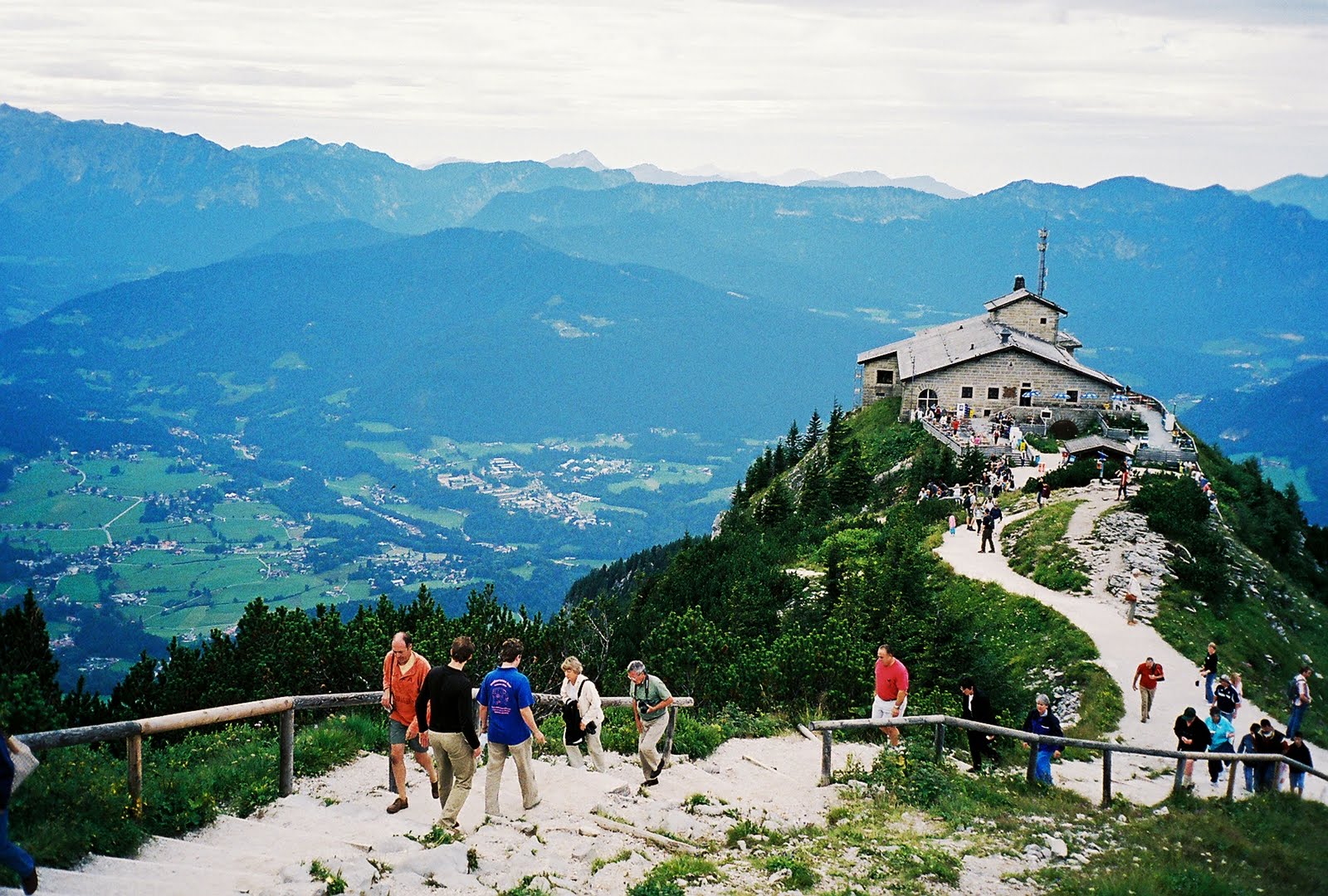
This afternoon we visited Kehlsteinhaus, the “Eagle’s Nest” – Hitler’s “conference room in the clouds” built for him by the Nazi Party in celebration of his 50th birthday. It certainly was interesting and the views of the Bavarian Alps were quite spectacular. Yet it was somewhat unsettling to be at a place where Hitler and his top Nazi officers may well have discussed, perhaps even planned, some of the most horrendous actions of their brutal and terrifying regime.*


It was also unsettling to see the restaurant there . . . and souvenir booths with snacks and postcards for sale. I feel that such a place deserves a more somber atmosphere; a museum-like hush. Or better still, a mausoleum-like silence. Why not make the place into a memorial for all the victims of the Nazi terror? Flags from all the countries decimated by the Nazis could be flown - a powerful symbol of defiance and victory in the face of what was endured by the populations of these countries.


* Since writing these words in my journal I've read the following at Wikipedia: "Hitler rarely visited the property. It has been suggested he only visited the Kehlsteinhaus around 10 times, and most times for no more than 30 minutes. However he did receive André François-Poncet (the departing French ambassador to Germany) there on October 18, 1938. Perhaps because of the lack of close association with Hitler, the property was saved from demolition at the end of the war."


NEXT: Ah, Venezia!


See also the previous Wild Reed posts:
Europe 2005 - Part 1: London
Europe 2005 - Part 2: Bruges and Brussels