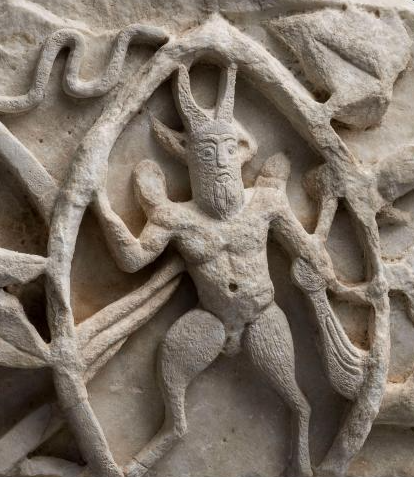
Showing posts with label Cernunnos. Show all posts

Sunday, August 30, 2026

The Crowned Spirit of the Wild

As summer weakens and the forest turns towards autumn, the stag becomes the crowned spirit of the wild. His antlers resemble bare branches holding the final light of the year, while their yearly shedding reflects the ancient rhythm of loss, renewal and returning strength.

In European folklore, the stag belonged to thresholds. He could lead hunters away from familiar paths, appear before encounters with the Otherworld and run through the darkness alongside the Wild Hunt. He represented sovereignty that could not be granted by human hands: instinctive, untamed and rooted in the land.

The stag does not mourn the fading sun. He carries it between his antlers, guiding its fire into the darker half of the year.

– Hex and Shadow Chronicles
via Facebook
August 18, 2026


See also the previous Wild Reed posts:
• Beloved and Antlered
• Cernunnos
• Integrating Cernunnos, “Archetype of Sensuality and the Instinctual World”
• Cernunnos in Autumn Light
• Cernunnos and Pan: “Witch-Fathers of the Wild”
• The Devil We (Think We) Know
• Ed Simon on Why We Need a Pagan Theology
• Phillip Clark on the Magi as Archetypes of “Witchy Faith”
• A Day to Celebrate the Survival of the Old Ways
• At Hallowtide, Pagan Thoughts on Restoring Our World and Our Souls
• The Pagan Roots of All Saints Day
• "A Dark Timelessness and Stillness Surrounds Her Wild Abandonment”
• Awakening the Wild Soul
• Thomas Moore on the Circling of Nature as the Best Way to Find Our Substance
• The Mysticism of Trees
• Mistwalking
• Holy Encounters Where Two Worlds Meet
• The Prayer Tree
• The “People Between”
• The Piper at the Gates of Dawn
• Late Summer Blooms (2025)
• Summer’s End (2024)
• Summer Vignettes (2022)
• Summer’s End (2021)
• Late Summer Blooms (2016)
• Summer’s Parting Gift
• Eternal Summer

Image 1: Artist unknown.
Image 2: Michael J. Bayly.


Thursday, May 01, 2025

Cernunnos and Pan: “Witch-Fathers of the Wild”


Today’s ancient Gaelic festival of Beltane celebrates the renewing energies of spring and the coming summer. As Brigit Anna McNeill so beautifully reminds us, Beltane “honours the life force in all wild ones, the fertility of the wild, and the medicine that is abundant at this time. Beltane means bright fire, which for me is the fire that ignites life.”

In acknowledging the pagan festival of Beltane and all it represents, I share today an insightful piece by The Wiccan Chef on two pagan entities: Cernunnos [KER-noo-nos] and Pan.


Right: A detail of “Encounter,” Sandra SanTara’s beautiful portrait of Cernunnos and Pan (2017).


As I’ve noted previously, I’m drawn to Cernunnos because of what he represents for humanity – and for men in particular. In terms of the latter, what the Antlered One represents stands in stark contrast to the vision of men and masculinity that is generally put forward by the patriarchal Abrahamic religions. Neo-pagan and eco-feminist scholar and author Starhawk sums up this difference succinctly in the following excerpt from her book The Spiral Dance.

If a man had been created in the Horned God’s image he would be free to be wild without being cruel, angry without being violent, sexual without being coercive, spiritual without being unsexed, and truly able to love.

I’ve also previously noted that my interest in the Pagan spiritual path and, in particular, the figures of both Cernunnos and Pan, has introduced me to a much broader and inclusive understanding of the “sacred masculine,” one that welcomes and celebrates queer incarnations of both masculinity and union with the Sacred. And for that I’m very grateful.

So with out further ado, here is what The Wiccan Chef says about these two gods, these two archetypal figures.

__________________

He sits in stillness, antlers crowned with vines, a serpent in one hand, a torc in the other. The animals know him. The earth breathes with him. He is the heartbeat beneath the forest floor. He is Cernunnos.

He laughs in a pitch that startles the wind, piping melodies that twist into the marrow. His hooves kick sparks. His lust is law. He is the ecstatic scream at the edge of reason. He is Pan.

They rise from different soil – one Celtic, one Greek – but their magic echoes through every shadowed glen and sunlit grove. For witches, pagans, and hedge-walkers, they are not just gods. They are the living wild, the Greenman’s shadow twin, the horned consorts of freedom and ecstasy.


The Horned God Archetype

The Horned God appears across cultures as a figure of power, wilderness, virility, and death-rebirth. He is not evil – as demonized by post-Christian narratives – but sacred, sensual, and sovereign.

Cernunnos, the so-called “Horned One,” is a mysterious figure whose name survives only on the Pillar of the Boatmen (1st century CE) and a few scattered inscriptions. But his image – cross-legged, antlered, surrounded by beasts – is ancient and magnetic. He governs life force, fertility, animal kinship, wealth, and the underworld (Green, 1992). In Wicca, he often embodies the divine masculine in union with the Goddess: not dominant, but equal and entwined.

Pan, meanwhile, is wildness incarnate. A rustic god of Arcadia, he ruled over shepherds, flocks, music, and lust (Burkert, 1985). His pipes could drive mortals mad, his presence spark “panic” – named after him. But he was also a protector of nature, a friend to nymphs, and a symbol of unashamed embodiment. He is freedom without permission.

Together, they form a divine polarity of stillness and motion, watchfulness and frenzy, ritual and release.


Wild Magic, Forest Power

In witchcraft, the wild is not a metaphor. It is a teacher, a temple, and a force. Horned gods guide witches who work with animals, herbs, primal energy, and deep earth wisdom.


Cernunnos is honored in solstice rites, underworld journeys, and abundance workings. His presence is grounding – rooted in the breath of the forest, in sacred cycles of birth and decay. Witches call on him for stability, connection, and animal kinship (McCoy, 1994).

Pan brings the ecstatic: rites of dancing, sex magic, laughter, wine, and revelation. His presence is invoked in hedge-crossing, trance states, music, and liminal magic. He is the lord of wild abandon, the guardian of sacred sensuality. He tears down the civilized mask – and in doing so, reveals the divine.

Witches walking the forest path may feel both at once:

The silence of the stag. The shout of the goat.

The deep root and the wild leap.


The Witch and the Horned God

For many witches – especially queer, neurodivergent, or eclectically spiritual – Cernunnos and Pan offer alternative models of masculinity: not controlling, but connected. Not patriarchal, but primal, creative, nurturing, and free.


They remind us that masculinity can be sacred without being dominant. That the body is holy. That desire is not sin – it’s spellcraft.

These gods are for those who speak with trees. Who run barefoot. Who craft with horn, bone, and leaf. Who know that the divine doesn’t only live in light – it pulses in shadow, too.

They are the Witch-Fathers – wild, watching, welcoming.


Mythic Echoes in the Here and Now

So what do Cernunnos and Pan offer today?

They invite us to remember the wildness we’ve buried. To unlearn shame. To move our bodies, howl our truth, and touch the moss with reverence.

They teach that magic is not only words whispered over candles. It is also sweat. Music. Laughter. Sex. Dirt under the nails.

They remind us that to walk the green path is to walk with life – not above it.

And that the horned ones are still waiting.

Not to rule.

But to dance.


References

Green, Miranda J. Symbol and Image in Celtic Religious Art. Routledge, 1992.

Burkert, Walter. Greek Religion. Harvard University Press, 1985.

McCoy, Edain. The Sabbats: A Witch’s Approach to Living the Old Ways. Llewellyn, 1994.

Conway, D.J. Celtic Magic. Llewellyn, 1990.

Hutton, Ronald. The Triumph of the Moon: A History of Modern Pagan Witchcraft. Oxford University Press, 1999.

Starhawk. The Spiral Dance. HarperOne, 1979.

________________


See also the previous Wild Reed posts:

BELTANE
• Casting Off the Darkness and Celebrating the Light
• A Time of Hope and Renewal
• Celebrating the Sheer Exuberance of May
• Beltane and the Fire Within
• Beltane and the Reclaiming of Spirit
• Beltane Morning Light
• The “People Between”

PAGAN SPIRITUALITY
• Ed Simon on Why We Need a Pagan Theology
• Phillip Clark on the Magi as Archetypes of “Witchy Faith”
• A Day to Celebrate the Survival of the Old Ways
• At Hallowtide, Pagan Thoughts on Restoring Our World and Our Souls
• The Pagan Roots of All Saints Day
• "A Dark Timelessness and Stillness Surrounds Her Wild Abandonment”
• Awakening the Wild Soul
• Thomas Moore on the Circling of Nature as the Best Way to Find Our Substance
• The Mysticism of Trees
• Mistwalking
• Holy Encounters Where Two Worlds Meet
• The Prayer Tree

CERNUNNOS
• Beloved and Antlered
• Cernunnos
• Integrating Cernunnos, “Archetype of Sensuality and the Instinctual World”
• Cernunnos in Autumn Light
• The Devil We (Think We) Know

PAN
• Biophilia, the God Pan, and a Baboon Named Scott
• The Piper at the Gates of Dawn
• Pan’s Labyrinth: Critiquing the Cult of Unquestioning Obedience


And at The Wild Reed’s brother site, The Leveret, see:
• The Divine Masculine Principle
• In the Image of the Horned God
• I Call to Cernunnos


Friday, May 27, 2022

Cernunnos


In the latest issue of Witches & Pagans magazine, author and Pagan clergyperson A.C. Fisher Aldag has an insightful article about the ancient archetype (or god) known as Cernunnos [KER-noo-nos].

As I’ve noted previously, I’m drawn to Cernunnos because of what he represents for humanity – and for men in particular. In terms of the latter, what the Antlered One represents stands in stark contrast to the vision of men and masculinity that is generally put forward by the patriarchal Abrahamic religions. Neo-pagan and eco-feminist scholar and author Starhawk sums up this difference succinctly in the following excerpt from her book The Spiral Dance.

If a man had been created in the Horned God’s image he would be free to be wild without being cruel, angry without being violent, sexual without being coercive, spiritual without being unsexed, and truly able to love.

I’ve also previously noted that my interest in the Pagan spiritual path and, in particular, the figures of both Cernunnos and Pan, has introduced me to a much broader and inclusive understanding of the “sacred masculine,” one that welcomes and celebrates queer incarnations of both masculinity and union with the Sacred. And for that I’m very grateful.

Given all of this, you can imagine how happy I was to see such a lengthy article about Cernunnos in Witches & Pagans, one of a number of alternative-type magazines displayed and sold at my local co-op. Following, with added images and links, is an excerpt from this article.

__________________________


Cernunnos is instantly recognizable to almost any Wiccan or neo-Pagan. The Horned Lord, antlers sprouting from his head, cavorting in the woodlands as the God of the Beasts. A figure of fertility, fatherhood, and fatality. Yet his name is rarely mentioned in historical documents or on artifacts, and actual literature about him is scarce. What we have learned about Cernunnos – or an entity identified as the Lord of the Forest – comes from a plethora of ancient artifacts, works of art, folklore, rirualized dramas and dances, and the speculation of archeologists and cultural anthropologists. Not to mention our own spiritual journeys.

The being we know as Cernunnos has parallel representation worldwide, in every location where cervids (the deer family), antelopes, or wild sheep and goats can be found. There are whole herds of anthropomorphized beings with animal features and human consciousness, mostly male, horned, and hooved. Hunting rituals evoke the image of a frolicking deer-man, a spear-carrying hunter, a guardian of the wilderness. Ceremonial dances, sacred masks, folkplays, and illustrations or statuary give homage to a wild forest deity or spirit on every continent, in a multiplicity of cultures.

• There are deer entities in Asia: the masked dancers of Japan, Nepal, Tibet and Bhutan.

• There are multiple antelop beings portrayed in African cultures from Sierra Leone to Mali.

• Mexico has the deer dance of the Yaqui people, also found in the southwestern USA.

• The Italian island of Sardinia has the Mamuthone, who appear during Carnival.

• Also in Italy are rock carvings or petroglyphs of a deer-man . . . and in France, and in Texas.

• Siberian shamans wear antlered headdresses during rituals.

• Bulgaria has deer mummers, dressed in colorful garb.

• Ancient Rome boasted a mosaic of a horned, bearded man.

• Mainland Europe has Mesolithic cave drawings, as well as Roman-era statuary and frescoes.

• There are over fifty images of the horned entity in what used to be the Roman-Gaulish territories.

• Denmark has the silver Gundestrup Cauldron, with its image of Celtic deities, animals, and a seated figure identified as Cernunnos.

• And the British Isles have plentiful legends, artifacts, coins, dances and folk dramas, all related to the sacred man-beast.


The fact that he has representation worldwide shows that the Horned Lord was a universal concept amongst any society which relied on hunting or agriculture for sustenance.

The mainland European images of the entity we call Cernunnos were likely the inspiration for Dr. Margaret A. Murray’s theory about a horned forest lord, which she wrote about in her book God of the Witches in 1933.

The romantic notion of a Lord of the Forest has been embraced by neo-Pagans ever since Murray published her books. The founder of Wicca, author Gerald Gardner, caused Cernunnos to gain a new recognition amongst modern magick-users of the Western Esoteric Traditions, as well as those who rediscovered the old-line folk practices of the British Isles. Since Gardner originally called the entity “Kernunno” (according to his priestess and author, Doreen Valiente), this leads me to believe that Gardner had heard the name and spelled it phonetically, and did not actually read material about the Roman inscription until later, and then adjusted it in his writings. Gardner wrote that Cernunnos was worshipped by the common people as a god of the hunt, who was an aspect of a “higher power” that they really could not understand. Gardner and Valiente viewed Cernunnos as “our Lord, the Horned One” equated with the “dread lord of the shadows” ruling the underworld. However, the God of the Woodlands had been lurking around Britain and France for a long time prior to the establishment of the Wiccan religion.

– A.C. Fisher Aldag
Excerpted from “Charismatic, Enigmatic Cernunnos”
Witches and Pagans: Earthwise Spirituality for Today
Issue 39, Spring 2022


– “Cernunnos” by Qviron Lethebain


See also the previous Wild Reed posts:
• Beloved and Antlered
• Integrating Cernunnos, “Archetype of Sensuality and the Instinctual World”
• Cernunnos in Autumn Light
• The Devil We (Think We) Know
• A Day to Celebrate the Survival of the Old Ways
• The Piper at the Gates of Dawn
• Biophilia, the God Pan, and a Baboon Named Scott
• Pan’s Labyrinth: Critiquing the Cult of Unquestioning Obedience
• Pagan Thoughs at Hallowtide
• The God from the House of Bread: A Bridge Between Christianity and Paganism
• The Pagan Roots of All Saints Day
• Celebrating the Coming of the Sun and the Son
• Advent: A “ChristoPagan” Perspective
• I Caught a Glimpse of a God
• The Prayer Tree

And at The Wild Reed’s brother site, The Leveret, see:
• The Divine Masculine Principle
• In the Image of the Horned God
• I Call to Cernunnos . . .


Wednesday, October 02, 2019

Cernunnos


. . . in Autumn Light


Writes Miranda Aldhouse-Green in her 1993 book, The Celtic Myths: A Guide to the Ancient Gods and Legends:

There is no hint at a dark side in the Celtic presentation of Cernunnos [KER-noo-nos] himself, but his human/beast ambiguity fed into early Christian notions of beastiality, pagan chaos, and contradictions of the notion that humans had been fashioned in the image of God.


See also the previous Wild Reed posts:
• Beloved and Antlered
• Integrating Cernunnos, “Archetype of Sensuality and the Instinctual World”
• The Devil We (Think We) Know
• A Day to Celebrate the Survival of the Old Ways
• The Piper at the Gates of Dawn
• Pagan Thoughs at Hallowtide
• The Pagan Roots of All Saints Day
• Celebrating the Coming of the Sun and the Son
• Advent: A “ChristoPagan” Perspective
• I Caught a Glimpse of a God
• The Prayer Tree


Related Off-site Links:
Cernunnos: Wild God of the Forest – Patti Wigington (Learn Religions, June 25, 2019).
Cernunnos: The Horned Pan of the Celts – Moe Bedard (Gnostic Warrior).
Cernunnos: History and Mythology of the Enigmatic Celtic Horned God – Dattatreya Mandal (Realm of History, July 27, 2019).
I Call to Cernunnos – The Leveret (November 16, 2016).
Concerning Cernunnos (Part 1) – Musings from Gelli Fach (July 23, 2011).
Concerning Cernunnos (Part 2): Accessing the Fruits of the Wild – Musings from Gelli Fach (July 27, 2011).
Sex and Death: The Lessons of Cernunnos – Rick Derks (Feral Druidry: The Crossroads Companion (September 16, 2011).

Images: Michael J. Bayly.


Sunday, June 03, 2018

Meeting (and Embodying) the Lover God


In Adam's Return, Richard Rohr writes about the Lover archetype/God-figure found within all the mystical traditions yet missing from mainstream Christianity.


It was a rainy Saturday yesterday here in Minneapolis. A good day to potter around indoors, catch up on household chores . . . and do a spot of blogging!

Pottering around the kitchen I saw on our all-purpose kitchen table a book that my housemate Tim is currently reading. It was Adam's Return: The Five Promises of Male Initiation by Richard Rohr, and I soon discovered that it's all about how men can journey toward both authentic masculinity (as opposed to toxic masculinity) and an ever-deepening experience of God; the two goals being intertwined.

Leafing through Adam's Return I found myself reading the chapter that explores what Rohr identifies as "the four parts of a man's soul." These parts can also be understood as archetypes or God figures that men are invited to enter into and, in accordance with their individual inclinations and gifts, embody. These archetypes are the king (or wise man), the warrior, the magician, and the lover. Of the four, the lover has been the most neglected, indeed frequently maligned and discredited, in the Christian West. Rohr contends that this is because many "official" expressions and structures of Christianity (for example, the hierarchy of the Roman Catholic Church) do not integrate and validate the sensual, pleasure-loving, erotic part of a man. Instead, this part is distorted in its suppression, taking on "devious and destructive directions."

Now, I should say that I'm wary of books about masculinity as, in general, I've found that they focus solely on the experiences and examples of heterosexual masculinity. It's as if queer men don't exist, or cannot be considered masculine. My interest in the Pagan spiritual path and, in particular, the ancient archetype (or God figure) of Cernunnos (left), has introduced me to a much broader and inclusive understanding of the "sacred masculine," one that welcomes and celebrates queer incarnations of both masculinity and union with the Sacred.


Although Rohr's Adam's Return does not name or discuss homosexuality in its exploration of masculinity and male initiation, it does at least offer an understanding of masculinity that neither maligns nor explicitly excludes the experiences and relationships of queer men. It feels like an uneasy compromise, though, doesn't it? And perhaps it is. After all, Rohr is a priest within a Roman Catholic religious order, and Roman Catholicism is far from integrated when it comes to the diversity of human sexuality. Could this account, perhaps even in an unconsciously way, for Adam's Return being similarly unintegrated with regards to queer men and their experiences? Regardless, the book is what it is, and for some it will be enough; for others, not so. The fact that I don't feel compelled to read it in its entirety, probably indicates where I stand on its lack of inclusion and integration regarding queer men.

That all being said, there are many important insights to be gained. For example, in another part of the chapter that caught my attention, Rohr offers an insightful and helpful historical and cross-cultural view of male initiation in relation to the four archetypes. He notes, for instance, that "classic male initiation tried to be a most daring, holy, and holistic thing. It blessed the penis and the naked body, honored holiness, the teacher, and the elder, turned military discipline against the ego instead of others, and held the whole thing together inside a sacred wholeness, the natural world, the big picture, or what Jesus would call the Kingdom of God."

Rohr also observes that, "Most culture initiated just one or another part of a man, which is why we cannot totally idealize them. With a broad brushstroke, I would say that Asia and aboriginal Australia tended to initiate the magician, Africa and most primal cultures idealized the warrior, the Latin and Mediterranean worlds honored the lover, while Europe and North America have always sought to develop the king (which is probably why the 'Western' culture dominates the earth!)."

Interesting stuff, wouldn't you say?

Anyway, here's that part of Richard Rohr's Adam's Return that discusses and explores the archetype of the Lover and its significance for men in their quest for psychological/sexual health and maturity, and for connection with the Divine both within and beyond. This excerpt has some added links and is accompanied by images depicting what I perceive to be men together experiencing the transforming and life-giving connection with one another and thus the Divine. Enjoy!


Do you think St. Francis really stopped being the king of parties? Do you think David of the dance, the psalms, the harp, and many lovers ever stopped being erotic? Could Rumi, Kabir, Tagore, or Hafiz have possibly written their sacred poetry if they were not sensuous and sensual men? Did St. Philip Neri really stop telling jokes and drinking wine? Did Mozart ever stop having fun? Did the cloistered contemplatives not know joy? I don't think so. They just moved joy and pleasure to the highest level which is the very definition of a mystic. The contemplative, or saint, is the most refined and highest level of the lover archetype.

It is strange that the West has largely created cultures of conspicuous consumerism, when it took as its ultimate hero and God figure a poor and simple man. You would think our God figure would be Dionysius or Pan. Why do most Eastern and Native peoples of the world consider the West to be greedy and materialistic? Why do we produce such a high rate of physically addicted people? Why is the search for affluence and pleasure our main concern? Could it be because we have not blessed the good side of joy and pleasure? Now it comes back and bites us from behind. When we consciously seek a certain amount of creature comfort in my life, I find that it satisfies me, and also will never satisfy me. That is a very life-giving and creative tension to live in.

I do not find the same kind of approach and avoidance attitudes towards pleasure in Hindu countries, among most Jews, and surely not among Native peoples. The lover part of a man was never paid his dues or given legitimate permission in Western Christianity. As many say, sexuality and sensuality is our ever recurring and "unhealed wound." Like petulant schoolboys, we Christians sneak all the fun that we can at the expense of underdeveloped countries, our neighbors, and the health of our own bodies and souls. We feel duly guilty about it all, but we don't usually stop. We priest deny ourselves sex, but then we insist on four-star hotels and restaurants. Carnival Catholics countries became a necessary decadence to justify receiving the ashes the next morning. Something has not come to balance inside us, and we remain schizoid. We go to the outer world for our daily pleasures, but we seldom allow them to bring us to God, or even to ourselves. We remain split. Flesh is bad and Spirit is good in our terrible dualism. Yet the Christian religion is supposed to be incarnational – a love affair between flesh and spirit. It is really quite strange.

Ours is the only religion in the world that dares to believe that God became flesh. The religion that chews on the flesh of God has a very sensuous, sexual symbol for the transformation of the lover; we call it the Eucharist. Christianity says that God is Love but does not appear to really enjoy the lover. Despite all the Bach Masses, Baroque churches, incense, vestments, and luxuriant art, we still made our religion into a moralistic matter instead of a mystical joy. Our operative God image was much more a banker, a judge, a timekeeper, or an accountant, but seldom a real lover – in any sense that the normal man understands. Like Michal, the daughter of Saul, we despise David for dancing half naked in church (1 Samuel 6:16); we look away from Shakers, Pentecostals, and holy rollers. Religion should be a proper and dignified thing, we think. The hot sins for the Baptists and Catholics are always associated with the body. This is no religion of incarnation.

Frankly, it is the Hindu sacred poets, Sufi mystics like Rabi'a and Rumi, the Christian saints like John XXIII, Hildegard of Bingen, Francis of Assisi, Julian of Norwich, and Therese of Lisieux, or Jewish masters, like the Baal Shem Tov, Abraham Heschel, and Martin Buber, who seem to have met the lover God. The mystics of all religions know this lover God, but they are never allowed to set the tone for the ordinary Christian, Jew, Hindu, or Muslim on the street. We were all lost in law, customs, and holy wars, which largely nullified any chance of a truly love-based ethic for any of the three monotheistic religions. As Paul said so strongly, reliance upon moralisms makes grace impossible (Galatians 3), and it even leads to the death of the soul (Romans 7). Moralisms keep us making lists for God instead of making love to God.


In short, if religion does not integrate and validate the sensual, pleasure-loving, erotic part of a man, it takes devious and destructive directions. If you do not bless it and bow to it, it turns on you and controls you, as we have seen in the recent pedophile scandal. If you bless it, it also shows its limited value and longs for something higher. The most loving men I have met, the most generous to society and to life, are usually men who also have a lusty sense of life, beauty, pleasure, and sex – but they have very realistic expectations of them. The smaller pleasures have become a stairway and an invitation to higher [I'd say deeper] ones, almost by revealing simultaneously their wonderful and yet limited character.

The true lover wastes no time in guilt and no time in gluttony either. As Dom Bede Griffiths said, "Sex is far too important to eliminate entirely, and it is far too important to do lightly. The only alternative is to somehow 'consecrate' it." I am personally convinced this is true.

– Richard Rohr
Excerpted from Adam's Return:
The Five Promises of Male Initiation

pp. 128-131


See also the previous Wild Reed posts:
• Manly Love
• Reclaiming the Power of Male Touch
• Beloved and Antlered
• Integrating Cernunnos, "Archetype of Sensuality and the Instinctual World"
• Edward Sellner on the Archetype of the Double and Male Eros, Friendships, and Mentoring
• A Fresh Take on Masculinity
• Rockin' with Maxwell
• Vessels of the Holy
• The Body: As Sacred and Knowing as a Temple Oracle
• No Altar More Sacred
• To Be Held and to Hold
• An Erotic Encounter with the Divine
• Spirituality and the Gay Experience
• The Holy Pleasure of Intimacy
• The Many Manifestations of God's Loving Embrace

Image 1: Genia Minache
Image 2: The "Cernunnos" type antlered figure or "horned god," on the Gundestrup Cauldron (National Museum of Denmark).
Image 3: Elmer Bäck and Luis Alberti in Peter Greenaway's 2015 film Eisenstein in Guanajuato.
Image 4: Adam's Return cover art: "Mystic Christ" by John Guiliani.
Image 5: Subjects and photographer unknown.
Image 6: Jerome and Lorenzo. (Photographer unknown)
Image 7: Shutterstock. (Source)
Image 8: Ben Baur and Marc Sinoway in the 2012 TV series Hunting.


Sunday, December 10, 2017

Advent: A "ChristoPagan" Perspective


Last Sunday was the first Sunday of Advent in the Christian tradition and as writer Katie Jenkins reminds us in the piece I share below, it is a liturgical season of waiting and a time to reorient ourselves to what it is we are waiting for: our recognition of the "in-breaking of God into our own personal lives and communities."

Advent was established by the early church at this time of year because of the many long-established pagan understandings and rituals to do with winter here in the northern hemisphere. Indeed, the Christian year, as Joyce and River Higginbotham note in their book ChristoPaganism: An Inclusive Path, is a combination of the pagan earth-centered yearly cycle and the church's own Christ-centered one. Both the pagan year and the church year begin in December – at the Winter Solstice and at Advent respectively.

I purposely opened this post with an image of Cernunnos, the ancient Celtic deity (or archetype) of nature, life and flourishment, as a way of honoring the pagan roots of the Christian church's Advent season, along with the shared understandings and symbolism of both traditions. It's an honoring rooted in a "ChristoPagan" perspective, to be sure!

I appreciate how Cernunnos is depicted, and how this depiction relates to a lot of the things associated with Advent. After all, in writing about Advent, Katie Jenkins talks about such things as humility, yearning, waiting, being still, connecting with our deepest self, discerning, and being present. I see all these things reflected in this particular image of Cernunnos. And, of course, Advent is also all about seeking and hoping to recognize God in, as Jenkins puts it, "small, daily, unforeseen ways." I dare say Cernunnos, in true pagan fashion, is recognizing the sacred in the beauty of the natural world around him, and, in particular, in those two birds perched together in the winter tree!

Yes, even in the dark and cold of winter the Sacred Presence is with us. Our task is to be constantly reorienting ourselves so that we recognize and embody this presence. That for me is what both Advent and the Winter Solstice remind us to do, especially in times that are bleak and seemingly lifeless.

Advent is a time to reorient ourselves to the world and to God. It is a humble time of recognizing one’s need and yearning for God’s presence to break into the world.

The waiting we are called to do during Advent is not the busy, numbing, frenetic kind of waiting, but the stilling, germinating kind
that connects you deeply with the present and your true self. . . . We open ourselves up to await the in-breaking of God into our own personal lives and communities here in the present. It is a time to connect with our hope and our desire.

It is a season for us to settle down deeply into ourselves – to hear our heart cry, to find that spark of life and hope deep within the darkness of unknowing. Desires unfulfilled. Hope unmet. Longing unsatisfied. It is a time of discernment, of waiting, of being present.

Because of this, it seems appropriate that in the northern hemisphere, this is the darkest time of year . . . and appropriate that the beginning of the church calendar would likewise begin in stillness and the dark, with us facing our deepest fears and desires, cultivating our hope for the light.

In the silence and the darkness, we hear our own heart’s cry, our own flame of desire, our own longing for God. . . . We are learning to look for God and hoping [to recognize] God . . . in small, daily, unforeseen ways.

– Katie Jensen
Excerpted from "Entering Advent: Journey Into Darkness"


See also the previous Wild Reed posts:
• An Advent Prayer
• Advent: The Season of Blessed Paradox
• Active Waiting: A Radical Attitude Toward Life
• No Other Time, No Other Place
• The Centered Life as an Advent Life
• Rejoice? (Advent 2012)
• Advent 2011: Thoughts and Reflections (Part 1)
• Advent 2011: Thoughts and Reflections (Part 2)
• Advent 2011: Thoughts and Reflections (Part 3)
• Advent 2011: Thoughts and Reflections (Part 4)
• Thoughts on Waiting . . . and a Resolution
• My Advent Prayer for the Church
• Advent: Renewing Our Connection with the Sacred
• Celebrating the Coming of the Sun and the Son
• Christmastide Approaches

Related Off-site Links:
What Is Advent About After All? – Paul Menter (Aspen Daily News, December 6, 2017).
Advent: Hearing God in a Female Voice – Joe Kay (Sojourners, December 4, 2017).
Second Sunday of Advent Invites Us to a Meta-dream – Mary M. McGlone (National Catholic Reporter, December 9, 2017).
Happy Holidays. Yes, All of Them – Thomas L. Knapp (Stanwood Camano News, December 12, 2017).
Look to the Coming Light to Refresh your Winter-weary Soul: Winter Solstice Can Be a Spiritual Experience – Andrea Thompson McCall (Press Herald, December 12, 2017).

Image: Artist unknown.


Thursday, October 26, 2017

Beloved and Antlered


Earlier this week Yvette, one of the chaplain interns, approached my work space and asked, “Who’s that?”

She was referring to the statue of Cernunnos (KER-noo-nos) by Maxine Miller that I have on my desk.


Ever since I first talked about Cernunnos during our “Sharing Our Stories” group time, which was also when I first shared this particular statue with my fellow chaplain residents and our supervisors, I’ve been waiting for the opportunity to talk about Cernunnos with someone who wasn’t present that day.

I had definitely felt encouraged by those in the group to display this statue at my work station and to welcome any conversations among the interns it prompted.

Here now was my chance!

All the more vexing, then, to find myself tongue-tied in response to Yvette’s sincere question.

“That’s Cernunnos, the ancient Celtic god of . . . of fertility and of the wild. . . . Of, er, all wild things. . . . Nature . . .”

I heard my voice trail off.

My response, though, seemed to satisfy Yvette, who moved closer to examine the details of Cernunnos.

“His chest and stomach look like they form a face,” she remarked.

“Yeah, they kinda do,” I said. “It’s probably the artist’s attempt to evoke the Green Man (left), another ancient mythical figure. Have you heard of him?”

“Oh, yes. We had stories of him in Chicago. He scared me. He was the one we said would get naughty children. ‘Look out or else the Green Man will get you!’”

“Oh!” was all I could manage to reply, as Yevette cheerily went on her way.

I subsequently found out that the Green Man that Yvette was referring to was Raymond "Ray" Robinson (1910–1985), a severely disfigured man whose years of nighttime walks made him into a figure of urban legend in western Pennsylvania. According to Wikipedia, “Robinson was so badly injured in a childhood electrical accident that he could not go out in public without fear of creating a panic, so he went for long walks at night. Local tourists, who would drive along his road in hopes of meeting him, called him The Green Man or Charlie No-Face. They passed on tales about him to their children and grandchildren. . . . The famed nickname of ‘Green Man’ came from his skin, which was purported to be green because of the electrical shock he suffered.”

The Green Man I was referring to was altogether different – an ancient motif found in many cultures and across time, and related to natural vegetative deities. It is most frequently interpreted as a symbol of rebirth, representing the cycle of growth each spring.

Like the Green Man, there’s often much confusion and misunderstanding around Cernunnos. This is not surprising given that the early Christian Church basically turned Cernunnos into Satan, replacing his stag antlers with demon’s horns, tail, and cloven feet. A similar degradation befell Pan, the Greek god of the wild, shepherds, and flocks.

I’m drawn to the pagan figure of Cernunnos because of what he represents for humanity – and for men in particular. In terms of the latter, what the Antlered One represents stands in stark contrast to the vision of men and masculinity that is generally put forward by the patriarchal Abrahamic religions. Neo-pagan and eco-feminist scholar and author Starhawk sums this difference up succinctly in the following excerpt from her book The Spiral Dance.

If a man had been created in the antlered God’s image he would be free to be wild without being cruel, angry without being violent, sexual without being coercive, spiritual without being unsexed, and truly able to love.


In all aspects of my life – including my work as a chaplain – I desire to be “truly able to love.” The call to embody such love can definitely be found in Christianity, Judaism, and Islam, but there’s so much other “stuff” – sexist and heterosexist stuff – that is part and parcel of these religions that I’ve simply grown weary of having to deal with. It seems to me, and I’m still very much exploring this idea, that many of the indigenous and pagan spiritualities were (and are) much more open to recognizing and celebrating the presence of the Sacred in lives and relationships marked by a range of gender and sexual diversity, exploration, and expression.


How might the expression of a spirituality – one reflective of all that Cernunnos represents – look like in the context of my life? . . . My chaplaincy work? . . . My prayer life?

I’ve been thinking a lot about such things ever since Cernunnos began dwelling at my work station. . . . And I’ve come up with the beginnings of a response – a prayer which, for now, I’ve entitled “Beloved and Antlered.”

I should say that I do not believe that this prayer that I’ve written (and started to say each day) denies the deepest roots of my Catholic Christian tradition – roots that actually go deeper than what we understand today as Roman Catholicism. I'm not praying to a deity named Cernunnos. Rather, I'm aligning myself with the Sacred Presence within and beyond all things through the archetype of Cernunnos. Also, perhaps to fully grasp what I’m saying, one needs to remember that the Christian church has a long history of incorporating (some would say appropriating) pagan lore into its own spiritual understandings, many of which share with paganism themes of transformation and life beyond death. (See, for example, the previous Wild Reed posts “The Pagan Roots of All Saints Day” and “Celebrating the Coming of the Sun and the Son.”)

Finally, this prayer reflects my interest in that deep river of mysticism that flows beneath and feeds all the great religious traditions, with paganism perhaps being the tradition closest to this deeper source. Paganism, after all, Thomas Moore reminds us, “is not a belief system but a way of life in which one appreciates the holiness of every facet of experience and honors that holiness with specific rites and images.”

With all this in mind (and heart) I share “Beloved and Antlered.”


Beloved and Antlered,
At one with all creation;
Awaken me.

Seeker of the forest’s hidden paths
And the beauty within both beast and man;
Guide me in the ways of deeper understanding.

Trusting one, accompanied by stag and dog,
You are both wild and tame, hard and soft;
Teach me the ways of balance.

Twilight dancer, dwelling on thresholds
Both within and beyond;
Illuminate the sacred spaces in-between.

Ancient archetype of Holy Mystery,
To you I look for inspiration, courage, and hope.
May your presence be known to me always.


See also the previous Wild Reed posts:
• Integrating Cernunnos, "Archetype of Sensuality and the Instinctual World"
• The Piper at the Gates of Dawn
• The Devil We (Think We) Know
• The Pagan Roots of All Saints Day
• The Prayer Tree
• Celebrating the Coming of the Sun and the Son
• Edward Sellner on the Archetype of the Double and Male Eros, Friendships, and Mentoring
• In the Garden of Spirituality – Diarmuid Ó Murchú
• In the Garden of Spirituality – James B. Nelson
• Sex as Mystery, Sex as Light (Part 1)
• Sex as Mystery, Sex as Light (Part 2)
• The Dancer and the Dance
• Manly Love
• A Fresh Take on Masculinity
• Rockin' with Maxwell
• Learning from the East
• Winter . . . Within and Beyond

Related Off-site Links:
I Call to Cernunnos – The Leveret (November 16, 2016).
Concerning Cernunnos (Part 1) – Musings from Gelli Fach (July 23, 2011).
Concerning Cernunnos (Part 2): Accessing the Fruits of the Wild – Musings from Gelli Fach (July 27, 2011).

Image 1: Valerie Herron.
Image 2: Michael Bayly. (Artwork by Maxine Miller.)
Image 3: Artist unknown.
Image 4: "Hircine" by Raiecha.
Image 5: Artist unknown.
Image 6: Source.


Monday, September 18, 2017

The Prayer Tree


Compassionate Creator,
within and beyond all things,
holy are your names.
May your ways of wisdom and compassion,
clarity and courage
be known and embodied by all.

Grant what we need each day
in bread and insight.
Loose the cords of mistakes that bind us
as we release the strands we hold of others' guilt.
Do not let surface things delude us
but free us from all that holds us back
from our true purpose.

From you radiates all life and love,
the song that beautifies all.
From age to age it renews.
May your compassion be the ground from which spring
all our actions of body, speech and mind.

Amen.


This prayer to the Compassionate Creator is one I've being praying a lot lately. In fact, I've been praying it at least twice a day – and always at the same spot: beside the tree that features in the photos of this post. This particular tree grows beside Minnehaha Creek, not far from my home in south Minneapolis.

I pause at this tree each morning and afternoon as I walk to and from my bus stop. You see, each week day morning I catch the #5 bus on Chicago Avenue, which takes me to Abbott Northwestern Hospital where, since the end of last month, I've been working as a resident chaplain. I've discovered that my time of prayer at this tree is a beautiful way to prepare me for my chaplaincy work . . . as well as to start and close my work day. It has become a holy place and time, to be sure.

Perhaps not surprisingly, I feel very connected to this tree. Also, the prayer I pray beside it is one which has long been very meaningful to me. I shared part of it at The Wild Reed back in 2009. Later in a 2013 post, I shared it in its entirety for the first time.

You might be wondering where this prayer comes from. The short answer is that it's a version of the "Our Father" which, in large part, is Neil Douglas-Klotz's translation of the Aramaic words of Jesus. I say "in large part" because I have adapted it somewhat. Douglas-Klotz's version can be found in his book Prayers of the Cosmos: Reflections on the Original Meaning of Jesus' Words. It can also be found online, here.


Much of the beauty of this experience of prayer is due to the tree by which I pray, along with this tree's location. It really can feel like I’m in the woods. Yet it’s woodland located in the heart of the city: a paradox, of sorts – a world within a world.

In many indigenous spiritualities, including the indigenous or pagan spirituality of Europe, any tree can be representative of the tree, that is, the World Tree or Cosmic Tree. In numerous religious traditions the World Tree is represented as a colossal tree which supports the heavens, thereby connecting the heavens, the terrestrial world, and, through its roots, the underworld. The Tree of Life, which connects all forms of creation and is mentioned in the Judeo-Christian Book of Genesis, is an expression of the World Tree.

To get to the oak tree by which I regularly pray, one must go off the paved pathways. There is a track, but no doubt for many, it’s a hidden, unknown one. And yet it’s one that leads to the “Tree of Life.” All of this brings to mind the Beloved and Antlered One, “seeker of the forest’s hidden paths,” a powerful and beautiful way of acknowledging all the different, unorthodox ways that one can seek and find the Sacred.

During my forays into this urban wilderness, I rarely encounter other people, especially in the early morning. I have no problem with this. Indeed, it appeals to me. I also must admit that the incongruence of my walking this dirt track in the woods dressed in my work clothes – tie, vest, and all – appeals to me.

There’s a sense of two worlds merging, of crossing over into a different time and/or dimension. If the experience were to be visualized, say, in a graphic novel, it could be as a Victorian gentleman traversing some future and/or alien world. Indeed, I’m drawn to such characters, stories, and images – from the time traveler of H.G. Wells’ The Time Machine to Nathan Appleby (Colin Morgan) of the BBC series The Living and the Dead (left and below).

They are men – cultured and sensitive – who, in some inexplicable way, find themselves out of place and/or time. And yet they deal with this – despite feelings of trepidation and even of fear. They take risks, and are prepared to venture into the unknown – while all the time snappily dressed! So, yes, they are definitely hero-figures for me, but not so much in an action-hero sense but rather a grounded-hero sense.


Without trivializing the matter, I think it is possible to ask the question: Are the things that inform and animate these rather fanciful depictions – the sense of journeying, of boundary crossing, of encountering the unexpected and unknown – are they that far removed from the often nebulous role of the chaplain?

Deeper still: Do I not potentially enter a whole new world, another’s life, each and every time I enter a patient’s room?

Are there not unknown and strange realities, truths, even specters that I may encounter and be asked to engage with in my pastoral interactions?

How do I stay grounded in my own embodied reality and truth while still being present, attuned, and attentive to others?

I have no definitive answers, but I do know that I’ve come to experience groundedness through my daily prayer by and with the oak whose roots are nourished by the waters of Minnehaha Creek.

Which brings to mind and heart another realization: When I first started walking along the creek in late August it was still summer. The foliage was full and deep and green. In the last few weeks, however, things have changed. Of course, this is not surprising, given that September is very much a time of transformation, the time in the northern hemisphere of the “darkening equinox,” the balance between sun and shadow. Given how much of my spirituality resonates with themes and images of journey, balance, and transformation, it’s little wonder I find myself drawn to the Autumnal Equinox in a few days' time, and to the very sensually-discernible ways it is manifested in the woods I walk through every day. One can see it in the changing colors, hear it in the softly falling leaves, and smell it in the wet and decaying vegetation underfoot.


For the ancients, autumn was full of the “magic” of change. For the Celts, among whom Cernunnos walked, this time of year was a profound reminder of the spiral of life – birth, growth, death, decay, and regeneration. This mystery is at the heart of the Autumnal Equinox . . . and indeed of all expressions of pagan spirituality.

And here’s yet another realization: it’s a very different experience walking through the woods and being with the oak in the morning than it is in the afternoon. It even looks in some mysterious way, like a different place. I’ve come to understand that this is because of the light. In the afternoon, there is what I would call regular or normal light, while in the morning there is the light of twilight – that mysterious in-between time that is neither yet also both night and morning. In this eerie light all looks different – enchanted, if you like.

I’ve discovered that I’m drawn to and have an affinity for in-between places. One of my favorite places in my homeland of Australia is a rock platform in Guruk (aka Port Macquarie), a place that at times can be both sea and land; a place where it can feel as though I’m walking on water!

I can’t tell you how much I love being at this place – this sacred place. By this I mean that whenever I'm at this particular place I always feel at one with the energizing and transforming presence within and beyond all things.

This Presence goes by many names: Life Force, the Universe, Divine Love, Great Spirit, Holy One, Sacred Mystery, God. I don't believe what name we use ultimately matters. What is important is that we find the name and/or image that best attunes us to this Presence, and that we then immerse ourselves in it, allowing it to awaken, energize, transform, and guide us. My experience of this place, this little rock platform on the south-eastern Australian coast, never fails to open me to all these things. And I’m finding my time with the oak tree by the creek, here in Minnesota, half-the-world away, is doing the same thing.


* Writes Angie O'Gorman in the Pax Christi USA booklet, Coming to Consciousness: Reflections for Lent 2011:


From the work of Neil Douglas-Klotz and others who have studied ancient Aramaic – the language of Jesus – we know that "The Lord's Prayer" is not as neatly translated into English as the biblical versions would have us believe. Most Aramaic words have several possible "literal" translations. The following analysis is based on Douglas-Klotz's book, Prayers of the Cosmos.

Abwoon d'bwashmaya, the first line of the Our Father in Aramaic, does not simply translate as "Our Father who art in heaven." Abwoon does not specify gender but rather the birthing process, and d'bwashmaya does not mean a far-off place in the sky where God reigns over us. It has more the sense of light and sound emanating throughout all creation. And Jesus would not have used the phrase "Kingdom of God." The image did not exist in ancient Aramaic. The closest form transliterates as teytey malkuthakh and carries a sense of unity rather than a style of government. Teytey meant "come," but also had a sense of mutual desire and fulfilment of a goal. Malkuthakh referred to a quality of governing that guided life toward unity. The word shares its root with Malkatuch, the name of the Great Mother (Earth) in the Middle East long before Jesus' time.

Jesus' message largely passed through Greek translators before coming to us, and thus we get a Greek rather than a Jewish or Aramaic worldview. Was Christianity lost in translation?


Above: My friend Mahad at the Prayer Tree – Sunday, August 12, 2018.


For other prayers I find particularly meaningful, see:
• Prayer of the Week – August 3, 2015
• The Most Sacred and Simple Mystery of All
• Prayer of the Week – November 5, 2013
• Prayer of the Week – November 14, 2012
• The Art of Gentle Revolution
• Prayer of the Week – April 12, 2010
• A Prayer for Compassion


See also the following related Wild Reed posts:
• Move Us, Loving God
• Andrew Harvey on Radical, Divine Passion in Action
• Active Waiting: A Radical Attitude Toward Life
• Called to the Field of Compassion
• "Window, Mind, Thought, Air and Love"
• The Soul of a Dancer
• The Art of Dancing as the Supreme Symbol of the Spiritual Life
• Balance: The Key to Serenity and Clarity
• Memet Bilgin and the Art of Restoring Balance
• Sufism: Way of Love, Tradition of Enlightenment, and Antidote to Fanaticism
• The Sufi Way
• The Pagan Roots of All Saints Day
• Celebrating the Coming of the Sun and the Son
• In the Garden of Spirituality – Jeanette Blonigen Clancy
• Beltane and the Reclaiming of Spirit
• "I Caught a Glimpse of a God"
• Integrating Cernunnos, "Archetype of Sensuality and the Instinctual World"
• The Body: As Sacred and Knowing as a Temple Oracle
• The Piper at the Gates of Dawn
• Autumn . . . Within and Beyond
• Winter . . . Within and Beyond


Images of the Prayer Tree: Michael J. Bayly (April 2017, May 2017, June 2017, September 2017, December 2018, and August 2018).