Wednesday, October 16, 2013

Orlando Cruz: Rainbow Warrior

.


What's not to love about Puerto Rican featherweight fighter Orlando Cruz?

I mean, he's the first boxer to declare publicly that he's gay; he's currently ranked No. 4 among featherweights by the World Boxing Organization (WBO); he's a thoughtful and articulate role model for living a life of authenticity, and he looks great in a pair of rainbow-colored briefs!

Of course, as you may already know, Cruz suffered a professional disappointment this past weekend when his attempt to become the first openly gay boxer to win a world title was thwarted by Mexican boxer Orlando Salido. More about that later.

First, here's a little of how Cruz explained his decision to come out when speaking in October 2012 with Donald McRae of The Guardian.

I decided to be free. They can call me maricón, or faggot, and I don't care. Let them say it because they can't hurt me now. I am relaxed. I feel so happy. But to make this announcement to the whole world I had to be very strong. I have done well as a boxer, I've only lost two of my 21 fights. I won those other fights but, all this time, I have been living with this thorn inside me. I wanted to take it out of me so I could have peace within myself. I am proud to be Puerto Rican, just like I am proud to be a gay man. But I was sad and angry a long time because there are two doors to death over this one issue. There is suicidal death – when a gay man cannot stand being unaccepted and takes his own life. And there is homophobic murder. In both these situations I want to be a force for change.


At around the same time as his interview with McRae, Cruz also spoke to Bob Velin of USA Today, noting that:

I've been fighting for more than 24 years and as I continue my ascendant career, I want to be true to myself. I want to try to be the best role model I can be for kids who might look into boxing as a sport and a professional career.


Well, he's certainly been – and continues to be – that!

I'm also sure that in his personal life, Cruz will continue to grow and blossom as an out gay man. And I have no doubt that his August 2013 announcement that he will marry his partner José Manuel (pictured with Cruz at left) is all part of his inspiring journey of authenticity.

The career of a professional boxer, however, is an unpredictable one. One day you're on top of the world, the next you're face down in the ring. Of Orlando Cruz's recent experience of this unpredictability, L.Z. Granderson of ESPN.com says the following:

The night [of Saturday, October 12] was supposed to complete the storybook ending for Orlando Cruz: openly gay boxer walks into arena draped in a gay pride flag, defeats opponent and homophobia, claims world championship.

But then very little in life, especially as it pertains to sports, goes the way it's supposed to.


Writing in The Guardian newspaper of Cruz's defeat, Ryan Maquiñana notes:

A year had passed since the 32-year-old Cruz garnered global attention and support from the boxing community for publicly announcing his sexual orientation. The southpaw donned rainbow flag-themed trunks for the fight and had vowed to continue his historic run by upsetting the favoured [Orlando] Salido.

However, neither experience nor the crowd were on Cruz's side. Salido had twice held a piece of the title during a career that started 17 years ago aged 15 in his native Mexico. Ultimately he proved too tough an assignment for Cruz, who was appearing in his first major title bout after winning four consecutive fights against lesser competition.


I appreciate Sean Ingle's words on Cruz's recent defeat in the ring, words that help put this disappointment in Cruz's professional life into a broader perspective.

Shortly after Orlando Cruz's forehead crumpled to the canvas in the early hours of Sunday morning, an act of involuntary genuflection wrought by a blunting right hook and left uppercut, his opponent Orlando Salido offered this verdict: "He's a good fighter, he moves well in the ring," he said. "But he's not anything special."

In boxing terms, Salido, now the WBO featherweight champion, was right. Cruz was defiant but he took a beating. At 32, he is unlikely to fight for a world title again. But we can also say this: by coming out as the first openly gay fighter, and then scrapping until his synapses were sparked, he will have chiselled away at fossilised perceptions and inspired others for generations to come. By that measure, Cruz is special indeed.


Related Off-site Links and Updates:
Orlando Cruz Becomes First Boxer to Announce He Is Gay – Peter Walker (The Guardian, October 4, 2012).
Orlando Cruz Becomes Boxing's First Openly Gay Man – Bob Velin (USA Today, October 3, 2012).
Why the Surprise When a Gay Boxer Comes Out? – Paul Flynn (The Guardian, October 6, 2013).
Orlando Cruz: "I Wanted to Take Out the Thorn Inside Me and Have Peace" – Donald McRae (The Guardian, October 18, 2012).
Orlando Cruz, Gay Boxer, Wins First Fight Since Coming OutAssociated Press via USA Today (October 20, 2012).
Boxer Orlando Cruz to Marry His BoyfriendThe Guardian (August 15, 2013).
'Maricón': A Word That Haunts Us All – Monica Trasandes (The Huffington Post, August 20, 2013).
Orlando Cruz Says Coming Out Gay Was About RespectOn Top Magazine (September 25, 2013).
Orlando Cruz: The Gay Boxer Who is Breaking Barriers – Steve Bunce (The Independent, October 9, 2013).
Orlando Cruz Will Wear Rainbow Colors, Pink Gloves to Support LGBT Community, Breast Cancer Awareness – Kevin Iole (Yahoo! Sports, October 9, 2013).
Boxer Fighting for Chance to Be Sport's First Openly Gay World Champion Will Take on His Opponent in Rainbow Shorts to 'Win Respect' – Jessica Jerreat (Daily Mail, October 12, 2013).
Orlando Cruz Rocks His Rainbow Briefs At Title Fight Weigh-In – Nigel Campbell (Instinct, October 12, 2013).
Orlando Cruz, Gay Boxer, Loses In Title Fight Shot – Tim Dahlberg (Associated Press via Huffington Post, October 12, 2013).
Gay Boxer Orlando Cruz Loses Bid for Featherweight Title – Steve Pep (Towleroad, October 13, 2013).
Orlando Cruz Beaten in Historic World Championship Bid – Ryan Maquiñana (The Guardian, October 12, 2013).
Out and Proud: An Interview with Orlando Cruz, Boxing's First Openly Gay Man – Gabriel Leão (Fightland, April 8, 2015).


Tuesday, October 15, 2013

Quote of the Day

Today’s tea party-ized Republicans speak less for Wall Street or Main Street than they do for the seething resentments of white Southern backwaters and their geographically widespread but ideologically uniform ilk. Their theory of government, to the extent that they have one, derives from John C. Calhoun’s doctrine of nullification — that states in general and white minorities in particular should have the right to overturn federal law and impede majority rule. Like their predecessors in the Jim Crow South, today’s Republicans favor restricting minority voting rights if that is necessary to ensure victory at the polls.

The remarkable resurgence of these ancient and despicable doctrines is rooted in the politics of demographic and cultural despair. A series of focus groups that Democratic pollster Stan Greenberg conducted of evangelical and tea party Republicans (who, combined, constitute a majority of party members) found that they entertain a widespread and fatalistic belief that the United States is well on its way to becoming a socialist state by virtue of the growing number of non-white Americans’ dependence on government. Encapsulating the groups’ perspectives, Greenberg writes: “Their party is losing to a Democratic Party of big government whose goal is to expand programs that mainly benefit minorities.”

It does not register with these Republicans that Obamacare, which facilitates more widespread access to privatized insurance, is nowhere as socialistic as Medicare and Social Security. It seems that some believe that Obamacare is socialistic because they fear it will chiefly benefit the welfare queens of Republican lore, while Social Security and Medicare beneficiaries include millions of deserving people just like them — the disproportionately elderly and white Republican Party’s members.

– Harold Meyerson
"A Tea Party Purge Among the GOP"
The Washington Post
October 15, 2013


UPDATES:
At 11th Hour, GOP Blinks in Standoff – Jonathan Weisman and Jennifer Steinhauer (The New York Times, October 16, 2013).
Senate Passes Bill to Reopen the Government and Raise the Debt Ceiling – Chris Moody and Olivier Knox (Yahoo! News, October 16, 2013).
Republican Party's 'Humiliating' Defeat Raises Prospects of Lasting Party Split – Dan Roberts and Paul Lewis (The Guardian, October 16, 2013).
Here Lies the Tea Party, 2009 - 2013Truth-Out.org, October 16, 2013).
Was the Point Republicans Made in the Shutdown Worth the Price? – Jerry Seib (The Wall Street Journal, October 16, 2013).
The Irrational Fear of President Obama – Jonathan Capehart (The Washington Post, October 16, 2013).
Government Reopens After Congress Ends 16-Day Shutdown – Andrew Taylor (Associated Press via Yahoo! News, October 17, 2013).
Shutdown is Over, But There Will Be a Next Time – Diane Winston (Religion Dispatches, October 17, 2013).

Related Off-site Links:
House Republicans Implode as Tea Partiers Force Boehner to Kill His Own Debt Ceiling Bill – Jason Easley (PoliticusUSA.org, October 15, 2013).
U.S. Warned of Credit Downgrade as Republicans Inch Closer to the Brink – Dan Roberts, Paul Lewis, and Dominic Rushe (The Guardian, October 15, 2013).
China Presses U.S. to Lift Debt Limit as Tea Party Says Butt Out – Ian Katz and Michael C. Benderon (Bloomberg.com, October 15, 2013).
House GOP, News Media Fail to Inform American Public on Budget Deficit – William Pfaff (TruthDig.com, October 15, 2013).
The Compassion Shutdown – Eric Fought (EricFought.com, October 15, 2013).
Republicans Are Delusional About U.S. Spending and Deficits – Dean Baker (The Guardian, October 14, 2013).
The South is Holding America Hostage – Michael Lind (Salon, October 13, 2013).
Obamacare: The Rest of the Story – Bill Keller (The New York Times, October 13, 2013).
Shutdown: New Phase in a Very American Coup – Sam Webb (People's World, October 11, 2013).
Role of the U.S. Catholic Bishops in the Shutdown: Holding Government Funding Hostage in Battle Against Contraceptive Coverage – William D. Lindsey (Bilgrimage via The Progressive Catholic Voice, October 10, 2013).
Single-Payer Prescription for What Ails Obamacare – Amy Goodman (TruthDig.com, October 9, 2013).
Has GOP Already Defeated Obamacare? State Opt-Outs Leave Millions of Poor Without Health InsuranceDemocracy Now! (October 3, 2013).

See also the previous Wild Reed post:
Quote of the Day – October 5, 2013


Sunday, October 13, 2013

Autumn Dance


See also the previous Wild Reed posts:
"Thou Hast Thy Music Too"
O Sacred Season of Autumn
Autumn Hues
The Beauty of Minnesota in Autumn
Rainy October Afternoon
Out and About – September 2007

Image: "Autumn Dance" by Michael J. Bayly.


The Tenth Leper: A Man in Love


Today's gospel reading was about Jesus' healing of ten lepers, and how only one of these lepers, a Samaritan, returned to thank Jesus.

In a reflection printed in the worship aid at the Spirit of St. Stephen's Catholic Community today, the thoughts of Patricia D. Sanchez and Barbara Brown Taylor on this story were shared. I found this reflection, which is actually an excerpt from a lengthier commentary by Sanchez, to be quite powerful. Perhaps you will too!


The grateful Samaritan – who was doubly doomed in the eyes of the Jews, first by his leprosy and then by the fact that he was a Samaritan – chose not to obey Jesus and did not go show himself to the priests. Rather, he returned to Jesus, glorified God and thanked him. For this, he was assured that his faith had saved him. As Barbara Brown Taylor has put it, nine behaved like good lepers, good Jews; only one, a double loser, behaved like a man in love."

Brown Taylor goes on to explain that she herself knows how to obey. She reads her Bible, says her prayers, pays her pledge like a steady, law-abiding disciple. After all, such behaviors have kept the great ship of the church afloat for more than two millennia. But, says Brown Taylor, "I do not know how to be in love. I am one of the nine, but I am intrigued by the tenth leper, whose passion is confounding.

– Patricia D. Sanchez
Excerpted from "Passionate Gratitude"
National Catholic Reporter
October 12, 2013


See also the previous Wild Reed posts:
Why Jesus Is My Man
Jesus: Path-blazer of Radical Transformation
Quote of the Day – June 18, 2010
"Who Is This Man?"
Teilhard de Chardin and the Heart of Jesus
The Sacred Heart: "Mystical Symbol of Love"
The Triumph of Love: An Easter Reflection
Joy: The Most Infallible Sign of God’s Presence
Prayer of the Week – March 27, 2011

Image: "Ten Lepers" by James Christensen.


Friday, October 11, 2013

For National Coming Out Day, Four Memorable Quotes

.
Make no mistake, hiding one's true self away in a closet and creating a facade of heterosexuality is not without its consequences. It may appear to have a degree of safety but from my experience they are very unhealthy places and do all kinds of terrible things to individuals psychologically, emotionally and behaviorally . . . to say nothing of projection. The damage of the fear, shame, guilt and self-loathing that exist inside a closet are often reflected unknowingly in the external life of the individual. In or out of the closet; there is a price to pay. Each individual must weigh up the consequences of honesty, openness, secrecy and deception for themselves. Coming out, for most of us, is like an exorcism that releases us of the darkness we have lived in for years and caused us to believe awful things about ourselves. On the other side of the looking glass are freedom, light and life.

– Anthony Venn-Brown
Excerpted from A Life of Unlearning: A Journey to Find the Truth


The closet symbolizes isolation, the individual without society, a stranger even to the self.

– Kathy Weston


Every gay person must come out. As difficult as it is, you must tell your immediate family. You must tell your relatives. You must tell your friends if indeed they are your friends. You must tell the people you work with. You must tell the people in the stores you shop in. Once they realize that we are indeed their children, that we are indeed everywhere, every [fallacy], every lie, every innuendo will be destroyed once and all. And once you do, you will feel so much better.


Coming out, and by extension coming out stories, are important because people evolve when they tell the truth. Some people evolve when they hear the truth.

– Lucy Jane Bledsoe
“Finding Myself in Antarctica”
The Gay and Lesbian Review
July-August 2010


See also the previous Wild Reed posts:
Coming Out: An Act of Holiness
The Raising of Lazarus and the Gay Experience of Coming Out
Something to Think About – September 6, 2013
Quote of the Day – October 24, 2012
The Longing for Love: God's Primal Beatitude
Quote of the Day – November 1, 2011
Standing Strong
Soul Deep

And for my own coming out story, see The Wild Reed series, In the Footsteps of Spring:
Introduction
Part 1: The Light Within
Part 2: Shards of Summer
Part 3: Intimate Soliloquies
Part 4: Coming Out
Part 5: No Stranger Am I


Monday, October 07, 2013

Photo of the Day


See also the previous Wild Reed posts:
Sergius and Bacchus: Martyrs, Saints, Lovers
Honoring (and Learning from) the Passion of Saints Sergius and Bacchus
Sergius and Bacchus: Martyred Lovers

Related Off-site Links:
Sergius & Bacchus, October 7th: Patron Saints of Gay Marriage? – Terence Weldon (Queering the Church, October 7, 2013).
Saints Sergius and Bacchus: Male Couple Martyred in Ancient Rome – Kittredge Cherry (Jesus in Love Blog, October 7, 2013).
Memorial of Our Lady of the Rosary – Terence Weldon (Queering the Church, October 7, 2013).

Image: Michael J. Bayly.


Sunday, October 06, 2013

In the Archdiocese of St. Paul-Minneapolis, the Unravelment Continues


Earlier today my friends Lisa (above), Paula, and I gathered on the steps of the Cathedral of St. Paul with members and supporters of the Survivors Network of those Abused by Priests (SNAP). Here we distributed leaflets expressing a number of concerns about Archbishop Nienstedt's response to recent sex abuse and cover-up scandals in the Archdiocese of St. Paul-Minneapolis.

Lisa's sign points to the fact that at the same time last year that Archbishop Nienstedt was actively campaigning to deny civil marriage rights to same-sex couples, he and his administration failed to warn parishioners of a priest, Curtis Wehmeyer, with a history of sexual misconduct. Wehmeyer is now serving five years after being convicted of sexually abusing two boys and possessing child pornography. Throughout his ultimately unsuccessful anti-marriage equality campaign, the archbishop declared that granting civil marriage rights, benefits, and responsibilities to same-sex couples would threaten what he (and others) call "traditional marriage."

During this same time period, Archbishop Nienstedt failed to alert police to certain pornographic images confiscated from the computer of a second priest, Jonathan Shelley. It's since been revealed that Archdiocesan leaders debated internally for a year whether some of the images met the legal definition of child pornography. In early 2012 Jennifer Haselberger, Chancellor for Canonical Affairs, examined the images which at that time were being stored in the basement of the chancery. She determined that some of them were "definitely 'borderline' child pornography" and showed them to both Archbishop Nienstedt and Vicar General Peter Laird. In response, Laird ordered Haselberger to hand the images over to him.

Weeks passed and Haselberger, growing increasingly alarmed and impatient that nothing was being done about either the images or Shelley, decided to take matters into her own hands. In February 2013 she notified civil authorities of the stash of pornographic material at the chancery. Shortly after, she resigned from her position in Nienstedt's administration. In her April 2013 letter of resignation to the archbishop, Haselberger stated that it had become impossible to continue in her position given her "personal ethics, religious convictions, and sense of integrity." When news broke last week about the reasons for Haselberger's resignation and the archdiocese's inaction and possible coverup – Laird resigned as Vicar General.

The St. Paul Police Department's sex crimes and vice units found no child pornography in the materials provided to them by the archdiocese. However, in a September 29 police report, concerns were expressed that the archdiocese had not handed over all the evidence. Last Friday, St. Paul police obtained a copy of the priest's pornography-filled computer files. A police spokesman said he did not know whether the contents would merit reopening the case. Meanwhile, the county attorneys for Ramsey and Washington Counties said that they are ready to prosecute the case if police find anything illegal on the computer.

Following are excerpts from the Star Tribune's coverage of today's events:

Many Twin Cities parishioners heard a pulpit announcement Sunday saying that Archbishop John Nienstedt had appointed a new vicar, who will choose members for an independent task force to begin meeting this week to review all issues related to allegations of clergy misconduct. The task force will recommend new actions or policies and its findings will be made public, the archdiocese said. The new vicar is the Rev. Reginal Whitt, of the University of St. Thomas Law School.

. . . The task force has been criticized as a public relations gambit by the Survivors Network of those Abused by Priests (SNAP), whose national director, David Clohessy, went to the Cathedral of St. Paul on Sunday afternoon to hand out fliers urging churchgoers to alert authorities to suspected sexual crimes and misdeeds by clergy members.

In a written statement earlier Sunday, SNAP said that the archdiocese’s new task force wouldn’t be independent because Whitt, who will select its members, was appointed by the archbishop. Nienstedt himself should be investigated for possible involvement in a coverup, the group said. SNAP also called for a state or federal investigation into the coverup allegations.

Archdiocese spokesman Jim Accurso declined to comment on SNAP’s criticism.


Above: David Clohessy (left), National Director of the Survivors Network of those Abused by Priests (SNAP), being interviewed by a reporter from the Star Tribune.


Above: My friend Paula Ruddy being interviewed by Rupa Shenoy of Minnesota Public Radio. Paula's sign expresses her gratitude to Jennifer Haselberger.


Updates: New Documents Show Church Leaders Debated Legality of Priest's Porn – Madeleine Baran (Minnesota Public Radio, October 7, 2013).
St. Paul Police Will Reopen Child Pornography Investigation of Priest – Mike Cronin, Tom Scheck, and Madeleine Baran (Minnesota Public Radio, October 8, 2013).
For an Abusive Priest, Retirement Income Came with a Premium – Madeleine Baran (Minnesota Public Radio, October 9, 2013).
New Church Task Force on Clergy Abuse Begins Its Work – Rupa Shenoy (Minnesota Public Radio, October 9, 2013).
Woman Files Sexual Abuse Lawsuit Against St. Thomas Priest and Professor – Madeleine Baran (Minnesota Public Radio, October 14, 2013).
Archdiocese of Wobegon – Grant Gallicho (Commonweal, October 14, 2013).

Related Off-site Links:
Victims Group Dismisses Archdiocese Review of Clergy Sexual Abuse Cases as 'Nothing But a Smokescreen' – Mike Cronin, Madeleine Baran, Tom Scheck, Jon Collins, and Rupa Shenoy (Minnesota Public Radio, October 6, 2013).
Archdiocese Coverup Allegations Draw Chastisement, Charity – Jim Adams (Star Tribune, October 6, 2013).
Under Fire, Archbishop Nienstedt Scrambles to Respond – Jean Hopfensperger (Star Tribune, October 6, 2013).
Archdiocese Case Reads Like a Dan Brown Novel – Jon Tevlin (Star Tribune, October 5, 2013).
Washington County Attorney Opens Investigation of Priest; Archdiocese Attorney Says No Evidence of Child Porn Found – Dan Browning, Kevin Giles and Kevin Duchschere (Star Tribune, October 5, 2013).
Former St. Paul Archdiocese Employee Asks for Comprehensive Review of Clergy – Jackie Crosby (Star Tribune, October 5, 2013).
Minnesota Archdiocese Accused of Withholding Child Porn from Police – Joe Winter (National Catholic Reporter, October 4, 2013).
Archdiocese Hid Hugo Priest's Child Porn Stash, St. Paul Police Say – Emily Gurnon (Pioneer Press, October 4, 2013).
Former Official: Archdiocese Didn't Report Priest's Pornography – Madeleine Baran and Mike Cronin (Minnesota Public Radio, October 4, 2013).
Rev. Peter Laird, Top Deputy of Archdiocese, Resigns – Madeleine Baran and Rupa Shenoy (Minnesota Public Radio, October 3, 2013).
Former Archdiocesan Accountant: Church Paid Priests Despite Sexual Misconduct – Madeleine Baran and Tom Scheck (Minnesota Public Radio, September 30, 2013).
"Trust Your Shepherds" – Rev. Michael Tegeder (The Progressive Catholic Voice, September 26, 2013).
Archdiocese Knew of Priest's Sexual Misbehavior, Yet Kept Him in Ministry – Madeleine Baran (Minnesota Public Radio, September 23, 2013).

See also the previous Wild Reed posts:
Gay Men in the Vatican Are Giving the Rest of Us a Bad Name
Homosexuality and the Priesthood
Report: Homosexuality No Factor in Abusive Priests
Weakland, the Clergy Sex Abuse Scandal, and Homophobia
What Is It That Ails You?

Images: Michael J. Bayly.


Saturday, October 05, 2013

Quote of the Day

The shut-down of our government, and the extremism that lies behind it, is a direct result of America's surging inequality. When almost all the gains of economic growth go to a small group at the top, most Americans – working harder than ever just to keep what they have – become anxious and angry. That fear and anger is easily used by demagogues, bankrolled by a handful of billionaires, to distract attention from what's really happening – and put blame instead on the poor, who are accused of being "takers," and on government, which is accused of encouraging idleness. So food-stamp funding is slashed, red state governors and legislators refuse to expand Medicaid, and many in the middle see the Affordable Care Act as a giveaway to those who don't deserve it. Meanwhile, tax loopholes for the rich become steadily larger.

It has happened before in history: Economic fear and anxiety are directed at scapegoats, while a handful of super rich pour money into big lies that entrench their privileged position. The savage inequality America is experiencing is pulling us apart, and giving the purveyors of hate exactly what they want.

Robert Reich
October 5, 2013


Related Off-site Links:
How Would We Report on the Government Shutdown If It Were Happening in Another Country? – Joshua Keating (Slate, September 30, 2013).
Why Conservative Vitriol Against Obama Goes Over the Top – Myles Spicer (MinnPost, September 30, 2013).
Catholic, Other Religious Leaders Decry U.S. Government ShutdownCatholic News Service via National Catholic Reporter (October 1, 2013).
Quote of the Night: This Is Why Our Government Has Shut Down – Chez Pazienza (The Daily Banter, October 1, 2013).
The Reign of Morons is Here – Charles P. Pierce (Esquire, October 1, 2013).
Americans by 72% Oppose Shutdown Tied to Health Care Cuts – Greg Giroux (Bloomberg.com, October 1, 2013).
More Up Is Down From The GOP Leadership And It's Evangelical Supporters – Colleen Kochivar-Baker (Enlightened Catholicism, October 3, 2013).
GOP Biggest Fear Occurring – Republicans Loving Obamacare – Egberto Willies (EgbertoWillies.com, October 3, 2013).
The Rise of the New Confederacy – Colbert King (The Washington Post, October 4, 2013).
The Government Shutdown Survival Guide: Why Laughter Always Wins – Ryan Honick (The Daily Banter, October 4, 2013).

UPDATES: After the Shutdown, Maybe a Little Equality? – Sam Pizzigati (TruthOut.org, October 6, 2013).
GOP in Grave Danger of Losing House in 2014, Polls ShowThe Huffington Post (October 6, 2013).
How the Right Wing Manipulated the Government Into a Shutdown – Scott Martelle (TruthDig.com, October 6, 2013).
Obama to Boehner: Just Let Congress Vote – Luke Johnson (The Huffington Post, October 7, 2013).
Republicans' Handling of Shutdown Increasingly Unpopular – Ariel Edwards-Levy (The Huffington Post, October 7, 2013).
The Most Irresponsible Officials in Washington DC Are the 'Moderate' Republicans – Josh Barro (Associated Press via Yahoo! Finance, October 8, 2013).
The Role of the U.S. Catholic Bishops in the Shutdown: Holding Government Funding Hostage in Battle Against Contraceptive Coverage – William D. Lindsey (Bilgrimage, October 10, 2013).


Friday, October 04, 2013

Astounded

Yes, astounded. That's the best word I can think of to describe how I'm feeling and (just like Prince Valiant pictured at left) no doubt sometimes looking these days as I watch momentous events at both the local and global church level unfold – and, in some cases, unravel.

To appreciate what I mean, let me take you back to this day – the feast of St. Francis of Assisi – six years ago. This will help highlight some of the astounding differences between the situation then and what's taking place now.

Back in 2007 I wrote about a group of Catholics in the St. Paul-Minneapolis Archdiocese coming together to launch a new online forum called The Progressive Catholic Voice. We felt there was a need for such a forum as the official channels of communication in the archdiocese, including The Catholic Spirit newspaper, were not open to sharing progressive Catholic perspectives. We decided that if we couldn't access the media, we'd become the media!


Repairing the church

We intentionally called ourselves "progressive" as we were drawn to participate in our church’s wondrous capacity to grow, change, and evolve in ways that ever increasingly reveal God’s transforming love in our midst. We also intentionally chose to dedicate our new venture to St. Francis as we were inspired by how he listened for and responded to God’s call to "repair my church."

Back in 2007 we acknowledged that this call continued to resound in a Roman Catholic Church that, at its worst, is corroded and weakened by clericalism, hypocrisy, intellectual dishonesty, a profound lack of imagination, and a monarchical mindset and structure totally contrary to Jesus’ egalitarian model of community. The launching of The Progressive Catholic Voice was one way that local Catholics sought to pro-actively respond to these threats and challenges to the building of a church that truly embodies the "good news" of Jesus.

Another pro-active response soon followed in April of 2009 with the formation of the Catholic Coalition for Church Reform (CCCR). For the past four years CCCR has been working to envision and build a local Catholic community alive with Jesus' message of inclusivity, equality, and transforming love. CCCR finds inspiration and purpose in integrating and embodying the gospel message, Catholic practice, and the ‘new creation story’ emerging from contemporary science.

I helped co-found CCCR and continue to serve on its board. To date we've hosted three Synods of the Baptized. The most recent was last weekend. It drew 300 people, featured Sister Gail Worcelo, sgm, and was entitled "Co-creating the Living Church." Synod 2013 built on previous synods which focused on "Taking Our Place at the Table" (2010) and "Making Our Voices Heard" (2011). The latter launched the Council of the Baptized, which serves as "the voice of the community, discerning the direction of the Holy Spirit among us." To date, the Council of the Baptized has researched and published position papers calling for lay preaching, financial transparency and accountability, the re-establishment of an Archdiocesan Pastoral Council, and the participation of the Catholic people in the selection of bishops.


Differing models of church

It should be noted that the activities of both CCCR and the Council of the Baptized have been consistently dismissed and denounced by Archbishop John C. Nienstedt. He has repeatedly refused invitations to meet with representatives from both groups. He does not see us as part of the church, and has warned Catholics against attending our events.

Archbishop Nienstedt's dismissive stance on CCCR, the Council of the Baptized, and indeed any Catholic who questions or disagrees with him is supported, indeed fueled by a model of church promulgated by both Pope John Paul II and Pope Benedict XVI. It's the "smaller, purer" model of church; one that gladly shows the door to those who express sincere questions of conscience and/or who faithfully dissent from official church edicts on issues relating to sexuality, or from decisions like those of Archbishop Nienstedt to actively (and expensively) campaign against civil marriage rights for same-sex couples.

The "smaller, purer" model of church championed by Pope Benedict XVI and Archbishop Nienstedt is not the model of church that groups like CCCR believe God is calling us to build, to embody. Rather, drawing from the life and message of Jesus, the insights of contemporary Catholic theologians, and the experiences of the Catholic faithful, we envision a pilgrim church, a living church – one that's very much still growing and evolving into the reality of Christ, "the fused one," present within and among us.

Such ongoing transformation – of ourselves as individuals and as community – requires the participation of all. It also requires open communication, a willingness to be vulnerable, and the building and maintaining of an environment that invites and welcomes diversity and dialogue. We don't limit "the church" to the hierarchy but rather see it as the "people of God." All are welcome. All have something to contribute as together we continue our journey of ever-expanding consciousness into the fullness of God. Given this participatory and 'welcoming of all' understanding of church, you can understand why many of those involved with CCCR found Archbishop Nienstedt's denouncements and refusal to engage in dialogue both baffling and hurtful.

Yet something quite astounding has occurred: We have a new pope whose approach to thinking and talking about the church actually mirrors in a number of important ways the approach that The Progressive Catholic Voice, CCCR, and other church reform-focused individuals and groups have long embraced!

"We should not think that 'thinking with the church' means only thinking with the hierarchy of the church," said Pope Francis in his recent interview with Antonio Spadaro, S.J. "[The] church with which we should be thinking is the home of all, not a small chapel that can hold only a small group of selected people. We must not reduce the bosom of the universal church to a nest protecting our mediocrity."

This is a clear rejection of the "smaller, purer" model of church. Indeed, it brings to mind the title of the 2008 prayer breakfast at which the seeds of CCCR were first planted: "Here Comes Everyone!"


Beyond authoritarianism to dialogue

Much to the relief and astonishment of many Catholics, Pope Francis is open to dialogue and consultation – something his predecessors were not open to, and something that CCCR and the Council of the Baptized have been so far unsuccessful in facilitating between their members and members of our local clerical leadership.

Writing about this aspect of Francis' ecclesiology – his way of talking about the church – David Gibson notes:

When the cardinals gathered last March to elect a successor to Benedict XVI, many Catholics were praying for a reformer who would tilt the church toward the progressive side of the spectrum. The cardinals, and many other bishops, were mainly concerned with getting a pope who would get the Roman Curia off their backs and maybe even listen to their concerns once in a while.

Both prayers may have been answered, but the most significant development may be Francis’ vow to have a “real, not ceremonial consultation” in which he hears all points of view and where everyone can speak freely.

Francis wants to consult with the bishops, but it doesn’t stop there: He wants the bishops to consult with their people, to “support the movements of God among their people with patience.” The point is that the institutional church needs to account for the beliefs of the “people of God.”

He expressed that most provocatively in highlighting that all Catholics — rather than the pope alone — "are infallible in matters of belief."

Francis' appreciation of consultation comes from reflecting on his past mistakes, when he vaulted to a senior leadership position in the Jesuits at the age of 36 and alienated many with his “authoritarian way of making decisions.” The church, too, has been guilty of that fault, he says, and he wants to change that.


Of course, the way to change an authoritarian way of making decisions is to invite and foster dialogue – a key goal of CCCR. In his recent dialogue with La Repubblica's founder Eugenio Scalfari, Pope Francis expressed the same goal.

We need to get to know each other, listen to each other and improve our knowledge of the world around us. Sometimes after a meeting I want to arrange another one because new ideas are born and I discover new needs. This is important: to get to know people, listen, expand the circle of ideas. . . . [A] Vatican-centric view neglects the world around us. I do not share this view and I'll do everything I can to change it. The Church is or should go back to being a community of God's people, and priests, pastors and bishops who have the care of souls, are at the service of the people of God.


It remains to be seen if Archbishop Nienstedt will follow Pope Francis' example and be of service to the people of God by actually getting to know them through dialogue. Admittedly, such service is probably not high on his agenda just now due to a rather major issue he's dealing with among his fellow clerics. (Yes, it's that astounding unraveling I mentioned earlier.)


A horizontal church

Speaking of this particular unraveling in the Archdiocese of St. Paul-Minneapolis, it should be noted that CCCR and progressive local Catholics in general have long recognized clericalism as a diseased system. Pope Francis agrees, noting that: "[W]hen I meet a clericalist, I suddenly become anti-clerical. Clericalism should not have anything to do with Christianity." (Clericalism, unfortunately but not surprisingly, is at the root of the pornography cover-up scandal that's currently astounding many here in Minnesota.)

Aware of the dangers of clericalism and as Catholics mindful of the church's capacity for growth and change, we've also talked about the need for a strong horizontal dimension to the church, not simply a vertical, hierarchical one. The pope shares this perspective, remarking that he intends on "gently, but firmly and tenaciously" creating "a Church with an organization that is not just top-down but also horizontal."

The creation of such a church will require open communication with the laity. I trust that the pope is serious about such communication. And when it happens we will be, as our most recent synod title describes it, "co-creators of the living Church." I believe the pope, like so many of us, is discovering that, at its best, the church is, as Cletus Wessels, O.P. said, not hierarchical but holarchical, not a pyramid but a web of relationships.

Pope Francis also appears to have evolved beyond theological imperialism, which puts him in stark contrast to his predecessor. At the heart of theological imperialism, says theologian Darmuid Ó Murchú, is the claim that "our religion contains the fullness of revelation, in the light of which all other religions are deemed to be somehow inferior."

Pope Francis is not motivated by such triumphalist thinking. He states, for example, that "there is no Catholic God" and that "a spark of divine light is within each of us." He also says that "proselytism is solemn nonsense, it makes no sense. We need to get to know each other, listen to each other and improve our knowledge of the world around us."


Great hope

Some will no doubt be quick to point out that all of these similarities I've highlighted between Pope Francis and church reform-focused groups such as CCCR are to do with leadership style, with focus, and with approach. The teachings of the Church on, say, homosexuality, remain unchanged. This is true. The pope has not changed any church teachings. But he is doing three important things.

First, he is giving permission to Catholics to not be fixated on issues such as gay marriage. He himself doesn't seem particularly interested in such issues. And when it comes to gay issues, he compels us to first and foremost focus on the person:

When God looks at a gay person, does he endorse the existence of this person with love, or reject and condemn this person? We must always consider the person. Here we enter into the mystery of the human being.


And then, of course, there's the pope's now famous statement on gay men and the priesthood: "If someone is gay and he searches for the Lord and has good will, who am I to judge?"

Again, it's important to note that church teaching on the sinfulness of "homosexual acts" has not changed. Accordingly, I agree with Jamie Manson when she writes:

What Francis doesn't seem to understand is that it is precisely the teaching of the church that is doing the wounding. If the teaching remains the same, the harm will only continue, regardless of how warm the welcome appears to be.


However, at this point I think it's helpful to highlight the second important thing Francis is doing: He is creating an environment for dialogue and the exchange of perspectives, insights, and ideas. This type of communication and sharing has the power to change hearts and minds. We saw this powerfully demonstrated during last year's "marriage amendment" campaign (see here and here). If at some future time church teaching on homosexuality is ever changed, it will in large part be because of the changed hearts and minds that had come about as a result of the type of dialogue Francis is encouraging today.

Third, and this in many ways follows from the creation of an environment of dialogue, Francis is very clearly saying that our church is one that can and has and will continue to change. He notes, for instance, that: "The view of the church’s teaching as a monolith to defend without nuance or different understandings is wrong." The church, continues Francis, "must better understand how human beings understand themselves today, in order to develop and deepen the Church’s teaching [and to] grow in the understanding of the truth."

These words give great hope to those who sincerely believe that the church, the people of God, is still growing in awareness of complex realities such as sexuality. They also validate, I believe, not only the important sharing of personal stories that many LGBT Catholics and their families engage in, but the theological undertakings of Catholic thinkers such as Margaret Farley and Todd Salzman and Michael Lawler. These theologians' scholarly books on sexuality were denounced under the reign of the previous pope (as was my own book, Creating Safe Environments for LGBT Students: A Catholic Schools Perspective). Yet in light of Pope Francis' recent comments they are doing exactly what he says needs to be done: helping the church grow in understanding on how we as humans — as sexual beings — understand ourselves and thus the truth of God's presence in our lives and our world.


Change is coming

David Gibson observes that Pope Francis "seems to echo the 19th-century English convert, Cardinal John Henry Newman, who has been both celebrated and condemned for his writings on how doctrine evolves over time. It was Newman who famously said: 'To live is to change, and to be perfect is to have changed often.'"

I agree with Gibson when he writes that "it is unclear how long any changes might take under Francis, or exactly what form they will take. But . . . it seems inevitable that change is coming."

And just how threatening is this to some Catholics? Well, let me just say that the same people who for years have been highly (and often nastily) critical of groups like CCCR are simply aghast at the things Pope Francis has been saying. Which reminds me of the maxim: My opponent's opponent is my friend.

Who would have thought it would have come to this? Yes, like I said, I'm often quite astounded these days.


Related Off-site Links:
The Pope's Radical Whisper – Frank Bruni (New York Times via The Progressive Catholic Voice, September 22, 2013).
A Big Heart Open to God: An Exclusive Interview with Pope Francis – Antonio Spadaro, S.J. (America, September 30, 2013).
The Pope: How the Church Will Change – Eugenio Scalfari (La Repubblica, October 1, 2013).
Can the Pope Help End the Culture Wars? – Robert Christian (Washington Post, September 23, 2013).
Twin Cities Parishioners—Those Who See Big Change, Some Who Don't—Respond to Pope – Beth Hawkins (MinnPost, September 23, 2013).
Dueling Worldviews – Paula Ruddy (The Progressive Catholic Voice, August 19, 2013).
Franciscans' Global Leader: Pope's Assisi Trip Time to Consider Church Reform – Joshua J. McElwee (National Catholic Reporter, October 3, 2013).
It's Time for Real Authority for Women in the Church – Editorial Staff (National Catholic Reporter, October 5, 2013).
The Wounds Will Not Heal If the Teachings Remain the Same – Jamie Manson (National Catholic Reporter, September 25, 2013).

See also the previous Wild Reed posts:
What It Means to Be Catholic
Introducing the Catholic Coalition for Church Reform
Preparing to Claim Our Place at the Table
Many Voices, One Church
"Something Exciting and Joyous"
The Call to be Dialogical Catholics
The Holarchical Church: Not a Pyramid But a Web of Relationships
It’s Time We Evolved Beyond Theological Imperialism
Comprehending the "Fullness of Truth"
Authentic Catholicism: The Antidote to Clericalism
Quote of the Day — September 19, 2013
The Onward Call

Image: Prince Valiant as drawn by Gary Gianni (November 11, 2007).


Wednesday, October 02, 2013

The Piper at the Gates of Dawn


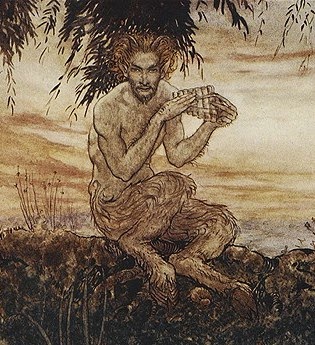
Recently I was talking with my friend Paula about Kenneth Grahame's The Wind in the Willows. Paula asked if I remember that part of the story where Mole and Rat encounter Pan. It's one of her favorite chapters of the book, in large part because of its strange and haunting beauty.

To be honest, I only have a vague recollection of it. But, then again, even though I read The Wind in the Willows as a child, it could well be that I never actually encountered this particular part. How could this be?, you may ask. Well, according to Jamie Andrews of the British Library, the chapter in question, "The Piper at the Gates of Dawn," is "normally dropped because it jars, seems so strange compared to all the others and, to some, is vaguely homo-erotic."

Grahame, however, says Andrews, "thought it essential."

So what's this "strange" chapter of The Wind in the Willows all about? Well, it starts with Rat and Mole searching the river for a lost baby otter named Portly. Soon, however, they find themselves drawn by a distant haunting melody to a small island:

Slowly, but with no doubt or hesitation whatever, and in something of a solemn expectancy, the two animals passed through the broken tumultuous water and moored their boat at the flowery margin of the island. In silence they landed, and pushed through the blossom and scented herbage and undergrowth that led up to the level ground, till they stood on a little lawn of a marvellous green, set round with Nature’s own orchard-trees — crab-apple, wild cherry, and sloe.

"This is the place of my song-dream, the place the music played to me," whispered the Rat, as if in a trance. "Here, in this holy place, here if anywhere, surely we shall find Him!"

Then suddenly the Mole felt a great Awe fall upon him, an awe that turned his muscles to water, bowed his head, and rooted his feet to the ground. It was no panic terror — indeed he felt wonderfully at peace and happy — but it was an awe that smote and held him and, without seeing, he knew it could only mean that some august Presence was very, very near. With difficulty he turned to look for his friend, and saw him at his side cowed, stricken, and trembling violently. And still there was utter silence in the populous bird-haunted branches around them; and still the light grew and grew.

Perhaps he would never have dared to raise his eyes, but that, though the piping was now hushed, the call and the summons seemed still dominant and imperious. He might not refuse, were Death himself waiting to strike him instantly, once he had looked with mortal eye on things rightly kept hidden. Trembling he obeyed, and raised his humble head; and then, in that utter clearness of the imminent dawn, while Nature, flushed with fullness of incredible color, seemed to hold her breath for the event, he looked in the very eyes of the Friend and Helper; saw the backward sweep of the curved horns, gleaming in the growing daylight; saw the stern, hooked nose between the kindly eyes that were looking down on them humorously, while the bearded mouth broke into a half-smile at the corners; saw the rippling muscles on the arm that lay across the broad chest, the long supple hand still holding the pan-pipes only just fallen away from the parted lips; saw the splendid curves of the shaggy limbs disposed in majestic ease on the sward; saw, last of all, nestling between his very hooves, sleeping soundly in entire peace and contentment, the little, round, podgy, childish form of the baby otter. All this he saw, for one moment breathless and intense, vivid on the morning sky; and still, as he looked, he lived; and still, as he lived, he wondered.

"Rat!" he found breath to whisper, shaking. "Are you afraid?"

"Afraid?" murmured the Rat, his eyes shining with unutterable love. "Afraid! Of him? O, never, never! And yet—and yet—O, Mole, I am afraid!"


The "unutterable love" that radiates from Rat reminds me of the mystic's response to God as "the Beloved." It's a response found within a range of mystical traditions – Christian, Sufi, Jewish – and one that often has erotic, including homo-erotic, overtones. I'm drawn to this type of universality, though to be sure it's a catholicity of religion rather than of church.

Grahame's depiction of his characters' encountering of Pan also calls to mind theologian Paul Collins' writing on the Latin word terribilis, which he says points to the awe and trepidation required of one who is in the presence of God. It's a word that emphasizes the fact that God "is wholly other, not anthropomorphic, not domesticated. God is ultimately a mysterium in the sense that the divine is a phenomenon to be explored, not a reality to be possessed or defined."

This sacred mystery goes by many names. In his 2012 article in Credo, Matthew Claridge notes that Grahame's description of Pan shares similarities with descriptions of Christ. He writes, for example, that:

There is a great deal here that a biblical Christian should appreciate and even accept—Christ is indeed the Lord of the Jubilee, the “Friend and Helper” of little creatures such as sparrows, flowers and frail men, the Lion of Judah and Lamb that was slain. There is definite truth in the fact that when we finally behold Christ, his blinding beauty, glory, and irresistible power will instantly transform and beautify our souls, purging it of all lesser loves (Rom. 8.1; 1Jn. 3.1ff). Indeed, like Pan’s song which is carried along the Wind, a song that creates and upholds the world, so we live in a world infused with the Spirit of Christ performing the same unconscious, untraceable functions (Jn. 3.8; 16.7ff.).


Jason Pitzl-Waters, a modern-day pagan, believes that Grahame’s portrayal of Pan was "instrumental in the slow establishment of this horned god (and other horned gods to come) in the minds and hearts of his British readers." Continues Pitzl-Waters:

[Grahame's] Pan, like the Pan of fellow authors Maurice Hewlett, Eden Phillpotts, and Lord Dunsany was a sort of “Green Jesus,” a savior of the natural world. A figure who would save humanity from destructive progress, and free them from outdated and restrictive moral codes.


All of which reminds me of Fran Recacha's painting entitled "Pan and the Defense of the Last Tree." It's a powerful, thought-provoking work of art, and one that can be viewed by clicking here.


Related Off-site Links:
Mole and Rat Meet the Horned God Pan in British Library Summer Exhibition – Mark Brown (The Guardian, February 28, 2012).
Beyond the Wild Wood – Alan Jacobs (First Things, October 2009).
Christ and Pan in The Wind in the Willows – Matthew Claridge (Credo Magazine, July 6, 2012).
The Wind in The Willows and the Voice of Old Gods – Mark Chadbourne (August 23, 2013).
Piper at the Gates of Dawn: Pan, Kenneth Grahame and Wind in the WillowsBeachcombing's Bizarre History Blog (April 6, 2015).

See also the previous Wild Reed posts:
Pan's Labyrinth: Critiquing the Cult of Unquestioning Obedience
"More Lovely Than the Dawn": God as Divine Lover
"Joined at the Heart": Robert Thompson on Christianity and Sufism
The Inherent Sensuality of Roman Catholicism
Never Say It Is Not God
It Happens All the Time in Heaven

Image 1: Arthur Rackham's illustration of Pan from The Wind in the Willows.
Image 2: Michael Hague.
Image 3: Artist unknown.


Wednesday, September 25, 2013

Prayer of the Week


As a deer longs for flowing streams,
so longs my soul for You,
O Beloved.
My soul thirsts for the Beloved,
for the Living Water.

When may I come and behold
your face?

– Excerpted from Psalm 41
as translated by Nan C. Merrill
in Psalms for Praying: An Invitation to Wholeness


See also the previous Wild Reed posts:
"More Lovely Than the Dawn": God as Divine Lover
"Then I Shall Leap Into Love . . ."
Prayer of the Week – April 4, 2011
Prayer of the Week – December 9, 2010
The Glimpse of His Face at Morning
The Soul Within the Soul
In the Garden of Spirituality – Hazrat Inayat Khan
Quote of the Day – November 16, 2011

Image: Michael J. Bayly.


Tuesday, September 24, 2013

Quote of the Day

I look forward to hearing an enthusiastic response from Archbishop John Nienstedt as he welcomes, through newly opened eyes, Pope Francis’ firm rebuke of the church’s narrow and judgmental focus on controversial social issues, to the detriment of respect for the profound law of love handed down from Jesus.

I know the archbishop holds his obligation of obedience to the pope in high regard. So I trust we will begin to see a redirection of energy from doctrinal authority to appreciation of personal conscience as he refocuses our attention to authentic matters of spirit and creates the mandated new atmosphere within the Archdiocese of St. Paul and Minneapolis.

Archbishop Nienstedt has shown himself to be a man of relentless vitality for causes he chooses to champion. It could be breathtaking to watch this shepherd evolve as a man of true vision, rather than religious myopia.

– Shawn Gilbert
Letter to the Editor of the Pioneer Press (St. Paul)
September 24, 2013


See also the previous Wild Reed post:
Quote of the Day – September 19, 2013
Progressive Perspectives on Archbishop Nienstedt's Anti-Gay Activism

Related Off-site Links:

Pope's Blunt Remarks Pose Challenge for Bishops – Rachel Zoll (Associated Press via Yahoo! News, September 21, 2013).
Here's How America Feels After the Pope's Landmark Statement on Gays and Abortion – Jaweed Kaleem (The Huffington Post, September 24, 2013).
Pope Francis is a Liberal Catholic – William Saletan (Slate via the Star Tribune, September 21, 2013).
The Pope's Radical Whisper – Frank Bruni (New York Times via the Progressive Catholic Voice, September 22, 2013).
Local Parishioners — Those Who See Big Change, Some Who Don't — Respond to Pope – Beth Hawkins (MinnPost, September 23, 2013).


Sunday, September 22, 2013

The Art of Surrender


There is something tremendously important and tremendously difficult at stake in surrendering ourselves to another human being. This surrender has the capacity both to destroy us and to redeem us. We hate to be compelled to surrender any aspect of ourselves to other people. And yet, we suffer terribly when we refuse to open up the boundaries of our selves to the impact of other selves. In acts of surrender we often are brought to the realization that we neither control nor fully understand the boundaries of the self anyway. This realization is both terrifying and liberating. It cannot be faced. It must be faced.

– Morgan Meis
"The Storytellers"
The Smart Set
September 9, 2013


See also the previous Wild Reed posts:
Love as Exploring Vulnerability
The Longing for Love: God's Primal Beatitude
The Holy Pleasure of Intimacy
Liberated to Be Together
Passion, Tide and Time
"I Want You to Become a Part of Me – Each to Become a Part of the Other"
The Many Manifestations of God's Loving Embrace
Human Sex: Weird and Silly, Messy and Sublime
Dew[y]-Kissed
Getting It Right
Quote of the Day – September 11, 2012
Your Scent I Know
Cherish
Mmm, that Sweet Surrender
In the Garden of Spirituality – Diarmuid Ó Murchú
Jesus and the Art of Letting Go