Wednesday, November 15, 2006

Richard Flanagan Wants a "Gentler, More Generous" Australia

In a recent post, I shared a number of insights expressed by Irene Khan, the Secretary General of Amnesty International.

She has been one of two people I’ve recently seen interviewed on Australian T.V. whom I would call “inspiring.” The other has been Australian author
Richard Flanagan, who was interviewed by Kerry O’Brien on the ABC program, The 7.30 Report.


Notes O’Brien: “Tasmanian writer Richard Flanagan has to be Australia’s most unlikely Rhodes Scholar and looking at his life before and after Oxford, it is no surprise that he hated the experience. Something of an iconoclast, whose award winning books have the opportunity to polarise critics but nonetheless win him awards, Flanagan started his adult life as a daredevil kayaker who has survived near-death experiences on previously unexplored rapids and trying to row Bass Strait to become one of his country’s most celebrated authors. He also wrote and directed the film version of his early book The Sound of One Hand Clapping. A subsequent novel, Gould’s Book of Fish won the 2002 Commonwealth Writers Prize for what the judges described as “a touch of genius”. His work has been published in 25 countries and he is currently working on a script for Baz Luhrmann’s latest film on Australia. But [his latest novel] The Unknown Terrorist could be the most contentious for his harsh critique of what he believes modern Australia has become.”

Indeed, when sharing his perspective on contemporary Australia, Flanagan notes: “We’re materially rich, but spiritually impoverished. . . .I’m tired of hearing about how to invest our super and about rising property prices. There is something else that’s going on in Australia, a sort of spiritual malaise that I find sickening, in a word. At the end of the day it is our Australia, too, and a lot of people want it back. They want a gentler, more generous, kinder Australia”.

Following are excerpts from The 7.30 Report’s interview with Richard Flanagan.

____________________________________

Kerry O’Brien: When you started [your new novel] The Unknown Terrorist, did you really intend to write such a bleak book?

Richard Flanagan: I wanted to write a book that was a mirror to these times and a book that I hoped might be a warning to people about what I feel are a series of frightening tendencies in our society.

Kerry O’Brien: You describe two thugs beating up an old vagrant in Sydney’s King’s Cross: “They kept on for a few minutes more, kicking him as if he were to blame for everything in that dirty, dead decade they were all condemned to live through. A sack of shit that had once been a man in a place that had once been a community in a country that had once been a society.” Is that what Australia has become for you?

Richard Flanagan: I think it’s become that for many people. We are more frightened, we are more frightening; we are less free, we are more unjust; we are more callous; there’s a greater divide of wealth and power. And the truth gets ever harder to get out. So, that was very much how I felt, and that story sort of captured it in a few sentences.

Kerry O’Brien: That’s a pretty grim view.

Richard O’Flanagan: It is, but it is hard to have any other view at this point in time. But I think there are always sources for hope, and I try and take my compass from the hope. . . . There’s been too much faked jubilation about our prosperity and I’m tired of hearing about how to invest our super and about rising property prices. There is something else that’s going on in Australia, a sort of spiritual malaise that I find sickening, in a word. At the end of the day it is our Australia, too, and a lot of people want it back. They want a gentler, more generous, kinder Australia, not the kind of Australia they are getting presented with every day at the moment.

Kerry O’Brien: Not possible to have both: your Australia and an Australia where people do care about super for retirement and do care about a comfortable lifestyle?

Richard Flanagan: Of course it is possible to have both, but I think when this period is judged by historians it will be seen that we had a moment of great prosperity when we could have done so much to build a better, stronger, more democratic society and, because of fear, we went the other way.

Kerry O’Brien: Your book has a drug mule named Tariq who is mistaken for a terrorist and a rather sad pole dancer who couldn’t be further from the terrorist stereotype but who gets sucked into the vortex anyway. What are you saying? That the whole terrorist fear in Australia is a myth, that there is no real threat of terrorism?

Richard Flanagan: There is a threat of terrorism. There is obviously a very real threat of terrorism, but I think as a society we ought be fearful when that is used to attack our freedoms and to attack the truth. And really, we’ve gone from reds under the bed to tea towels under the table, and it’s been used to subvert our democracy and that frightens me just as much as a terrorist attack, because we now have a society that’s capable of doing quite horrific things to innocent people and it is very difficult for those people to get justice.

Kerry O’Brien: And, yet, I mean, that’s a subjective view and I know it is shared by some others, but government in these circumstances does find itself having to walk a fine line, doesn’t it, between protecting its citizens and going a step too far?

Richard Flanagan: Of course it does, but I don’t think we achieve it by constantly using fear to subvert what we ought be defending, our principles of freedom and truth telling.

Kerry O’Brien: At the beginning and the end of the The Unknown Terrorist, you said that love is not enough, but it is all we have. You talk of the hopelessness and failure of human love. Yet, in the family you grew up in, and your own family now, it seems there’s been a lot of love at the centre of your life. How do you explain that apparent contradiction?

Richard Flanagan: All of my books have been about love. But when I started writing this book I realised that we lived in a world where it was ever harder to manifest love, where people were increasingly isolated from the things that really fed their spirit in a positive way: family, friends, land and so on. We live in a world where we are ever more divorced from what makes us spiritually rich and of course we’re materially rich, but spiritually impoverished. I wanted to have a character who wants to love, but is denied the chance to love and in the end is presented as simply an object of hate. Look at what that person might do in those circumstances. Because I think as a society this epidemic of loneliness, of sadness, is really related to the way in so many ways, we’re stopped from being able to show love, express love and be love to one another.

To read Kerry O’Brien’s interview of Richard Flanagan in its entirety, click here.

To read the Sydney Morning Herald’s review of The Unknown Terrorist, click
here.


See also the previous Wild Reed post,
Irene Khan: Shaking Things Up Down Under.

Tuesday, November 14, 2006

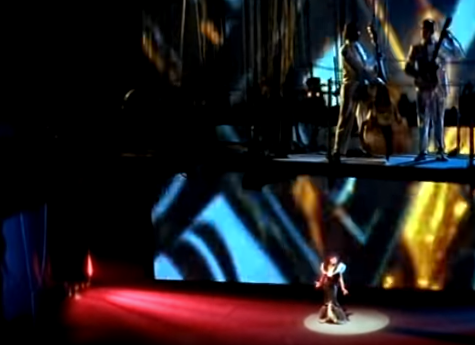
The Rhythm Divine


I love this song. And its accompanying video matches perfectly its haunting lyrics and rich, elegant sound. . . .


You know that my tears
Have kept me away.
The longer you're gone
I'll hunger and shake.
From Warsaw to Rome
I'll wait out of time.
With you in my heart,
the Rhythm Divine.


It is, of course, “The Rhythm Divine” by the Swiss techo duo Yello, featuring the legendary Shirley Bassey on vocals. Released in 1987, the song was a minor hit in several European countries.

_______________


April 2015 Update: Writes Niall McMurray:

In the mid to late eighties there was a bizarre sort of supermarket trolley dash by male pop stars seemingly hell-bent on scooping up every past-their-sell-by-date-but-still-safe-to-consume female diva from the sixties and seventies. And so in fairly short order, Sandie Shaw, Dusty Springfield, Eartha Kitt, Liza Minnelli and Shirley Bassey found themselves in the pages of Smash Hits for the first time in their careers, and back on Top of the Pops – often for the last. Some of the results were absolutely stellar, namely “Hand in Glove,” “What Have I Done to Deserve This?” and “Losing My Mind.” Others – specifically “Cha Cha Heels,” were cynical campy nightmares which did no favours to any of the parties involved (in this case Bronski Beat and Eartha Kitt).

Pet Shop Boys and The Smiths knew exactly how to treat their charges – with sincerity. Neil Tennant once addressed the “camp” issue by pointing out that pure camp is actually 100% sincere, and he was spot on. “Cha Cha Heels” represents a crass idea of what camp is, whereas something like “So Sorry, I Said,” which he and Chris Lowe wrote and produced for Minnelli is absolutely sincere, and incredibly effective as a result. Boris Blank and Dieter Meier, better known as Yello, clearly understood this too, and in 1987 they approached Shirley Bassey with a song they’d written specifically for her with Billy MacKenzie of The Associates.


“The Rhythm Divine” belongs to an incredibly small genre I like to call Music for Spies – icy, atmospheric and moving at a gloriously glacial pace, it’s a Bond theme minus the bombastics, made for shadowy transactions in dark corners of romantic European cities. What’s so astonishing about it is how little of it there actually is – the backing track is incredibly sparse, just an ominous synthesiser presence and the occasional brass flourish. The entire record hangs on two things – Bassey’s perfectly pitched, precision timed lead, and MacKenzie’s multi-tracked, Greek chorus-like backing vocal. Both are just incredible.


For more of Shirley Bassey at The Wild Reed, see:
• Time of the Tigress
• The Living Tree: Shirley Bassey and Me
• History Repeating
• Oscar Highlights 2013
• Quote of the Day – February 26, 2013
• Shirley, Shirley, Shirley!
• Happy Birthday, Shirley!

Other featured musicians at The Wild Reed:
Dusty Springfield | David Bowie | Kate Bush | Maxwell | Buffy Sainte-Marie | Prince | Frank Ocean | Maria Callas | Loreena McKennitt | Rosanne Cash | Petula Clark | Wendy Matthews | Darren Hayes | Jenny Morris | Gil Scott-Heron | Shirley Bassey | Rufus Wainwright | Kiki Dee | Suede | Marianne Faithfull | Dionne Warwick | Seal | Sam Sparro | Wanda Jackson | Engelbert Humperdinck | Pink Floyd | Carl Anderson | The Church | Enrique Iglesias | Yvonne Elliman | Lenny Kravitz | Helen Reddy | Stephen Gately | Judith Durham | Nat King Cole | Emmylou Harris | Bobbie Gentry | Russell Elliot | BØRNS | Hozier | Enigma | Moby (featuring the Banks Brothers) | Cat Stevens | Chrissy Amphlett | Jon Stevens | Nada Surf | Tom Goss (featuring Matt Alber) | Autoheart | Scissor Sisters | Mavis Staples | Claude Chalhoub | Cass Elliot | Duffy | The Cruel Sea | Wall of Voodoo | Loretta Lynn and Jack White | Foo Fighters | 1927 | Kate Ceberano | Tee Set | Joan Baez | Wet, Wet, Wet | Stephen “Tin Tin” Duffy | Fleetwood Mac | Jane Clifton | Australian Crawl | Pet Shop Boys | Marty Rhone | Josef Salvat | Kiki Dee and Carmelo Luggeri | Aquilo | The Breeders | Tony Enos | Tupac Shakur | Nakhane Touré | Al Green | Donald Glover/Childish Gambino | Josh Garrels | Stromae | Damiyr Shuford | Vaudou Game | Yotha Yindi and The Treaty Project | Lil Nas X | Daby Touré


Friday, November 10, 2006

The Bible and Homosexuality

On Monday I shared Catholic theologian William Hunt’s insightful commentary on the Christian tradition and same-sex marriage.

My friend William’s commentary reminded me of another excellent reflection on this issue – one written by Vincent Smiles and published last November in the St. Cloud Times (see below).

Note: The constitutional amendment which Smiles refers to and if passed would have banned same-sex marriage and all legal equivalents in Minnesota, was defeated earlier this year. The Minnesota Pastors Summit was an event aimed at encouraging religious leaders to support the proposed Minnesota “marriage amendment”. The summit, held one year ago today, November 10, saw the rare and unusual collaboration of Christian fundamentalists and the Catholic hierarchy in an unsavory effort to support the enshrinement of discrimination into the Minnesota state constitution.

_______________________________________

Bible’s Views on Homosexuality Aren’t so Easy for Us to Decipher
By Vincent M. Smiles
College of St. Benedict/St. John’s University

St. Cloud Times
November 27, 2005


The Minnesota Pastors Summit has thrown its religious weight behind a state constitutional amendment that would ban not only same-sex marriage but even same-sex civil unions and thus deny health and other benefits to the lifelong partners of gays and lesbians.

Hopefully, the pastors will back away at least from this latter aspect of the amendment. Although, whether they ought to support such an amendment at all is open to considerable question. Using the state constitution to legislate morality is a dubious procedure at best.

The logical next step would seem to be an amendment that will curtail the rights of those found guilty of adultery or other immoral acts.

They have not so far proposed any such ideas, but the logic of this campaign suggests that they ought to do so. After all, adultery is a proven threat to marriage, whereas homosexuality is not.

Speaking as a Catholic theologian, I find the pastors moral certainty about homosexuality quite puzzling.

Informed theological debates in recent years have demonstrated only one thing clearly: There is no basis for absolute certainty on this issue. To be sure, the Vatican has made an amazing number of pronouncements on homosexuality in recent years, all of them condemning homosexual acts while emphasizing the obligation of compassion toward homosexuals.

Nevertheless, careful theological analyses, whether examining the biblical texts or wider issues, have been far less dogmatic than either the Vatican or the pastors.

In 1977, for instance, the Catholic Theological Society of America, responding to the Vatican’s text Persona Humana, which dealt with various sexual matters (premarital sex, masturbation and homosexuality), published a lengthy study
(Human Sexuality: New Direction in American Catholic Thought, Paulist Press), which far from fully endorsed all of the Vaticans conclusions.

On homosexuality the study said, for instance: “It is difficult to say anything about homosexuality that is not of a provisional nature. ... Simply citing verses from the Bible outside of their historical context and then blithely applying them to homosexuals today does grave injustice both to Scripture and to people who have already suffered a great deal from the travesty of biblical interpretation.”

When they turn to pastoral guidelines, the authors warn that persons involved in pastoral ministry need to examine their own attitudes toward homosexuals, because unconscious prejudices resulting from biased education or societal attitudes do serious injustice.

Given the long-standing ignorance about homosexuality and negative attitudes toward it, which of us can claim to be totally free of such prejudices?

The study goes on to suggest that homosexuals in stable, loving relationships should be left in peace by pastors.

This is recommended not simply as a lesser of two evils but as a positive good. The study even goes on to say that prayer, even communal prayer, for two (homosexual) people striving to live Christian lives, incarnating the values of fidelity, truth and love, is not beyond the pastoral possibilities of a Church whose ritual tradition includes a rich variety of blessings.

The study is well aware, however, that social repercussions might make such blessings inadvisable.

Perhaps the pastors might profitably read this and other studies before they deliver their promised sermons to their congregations about this issue. Such a lengthy and careful study, endorsed by a large number of thoughtful theologians, ought to give pause to those — whether the pastors, the Vatican or anyone else — who proclaim the truth on this matter.

For most people, the Bible constitutes the primary source, and the text that almost everyone imagines as settling the matter is Genesis 19, the story of Sodom and Gomorrah. Unfortunately, very few people examine the text carefully.

It is clearly not a story about homosexuality in the sense of same-sex couples being lovingly committed to one another. It tells of the men of Sodom wanting to force themselves on Lot’s divine visitors — in other words, it is a story about attempted gang rape.

If stories about rape could truly provide divine teaching about human sexuality, then what lessons should be drawn from Shechem’s rape of Dinah (Genesis 34) or Amnon’s rape of Tamar (2 Samuel 13)?

Do these stories teach that there is something wrong with men being attracted to women? Surely not! No more can any conclusions about homosexuality be drawn from the Sodom story of violent rape.

When Jesus referred to Sodom, he interpreted its sin as a refusal to accept visitors sent by God (Matthew 10:15); there is no word from Jesus condemning homosexuality.

The usual interpretations of Genesis 19 bespeak not accurate reading of Scripture, but prejudice against homosexuals. As voters decide whether they wish to support the pastors’ campaign, hopefully they will examine all sides of the issue.

This is the opinion of Vincent M. Smiles, who teaches theology courses at CSB/SJU that include study of the issue of homosexuality. He is married with three children.


______________________________

Above: Michael Bayly (executive coordinator of the Catholic Pastoral Committee on Sexual Minorities) and Randi Reitan (of SoulForce Minnesota) at the November 10, 2005 rally to support equal civil marriage rights for all Minnesotans.

The Minnesota Pastors Summit – an event aimed at encouraging religious leaders to support the proposed “marriage amendment” banning same-gender marriage and all legal equivalents – did not go unopposed by people of faith in Minnesota.

Although both the summit and the proposed “marriage amendment” were actively supported by the Archdiocese of St. Paul/Minneapolis, a number of Catholic groups – including the Catholic Pastoral Committee on Sexual Minorities (CPCSM), Dignity/Twin Cities, Catholics for Equality, and Catholic Rainbow Parents – played a key role in organizing a coalition of Christian churches, groups, and individuals to challenge the Pastors Summit.

In October 2005, CPCSM and Catholic Rainbow Parents initiated efforts to protest the Pastors Summit. A coalition called People of Faith for Equal Civil Marriage Rights was formed which organized a rally on November 10 outside the Pastors Summit’s venue, Grace Church in Eden Prairie.

Such organizing efforts involved the collaboration of a number of ecumenically diverse faith communities dedicated to defeating the proposed amendment. From this proactive and ecumenical dialogue and action emerged the
Faith Family Fairness Alliance, of which a number of Catholic organizations and individuals are members.


See also the previous Wild Reed posts:
On Civil Unions and Christian Tradition
This “Militant Secularist” Wants to Marry a Man
“Catholic Teaching on Homosexuality is Complex and Nuanced”, says Theologian
The Catholic Church and Gays: An Excellent Historical Overview
Celebrating Our Sanctifying Truth
Good News from Minnesota
The Non-negotiables of Human Sex
The Sexuality of Jesus

Thursday, November 09, 2006

Irene Khan: Shaking Things Up Down Under

In the past week I’ve had the good fortune to see two inspiring people being interviewed on Australian T.V.

Today I’d like to share the insights of one of these people,
Irene Khan, Secretary General of Amnesty International and the 2006 recipient of the Sydney Peace Prize. On October 31, Khan was interviewed by Tony Jones on the ABC’s Lateline program.


In this interview, Khan discusses the recent controversial remarks about women made by Australian Muslim leader Sheik Hilaly. She also talks about the problems she sees in contemporary Australian society – especially in relation to the treatment of refugees and the Australian government’s failure to sign a series of protocols including the optional protocol on torture, along with the government’s failure to criticize the United States for human rights abuses.

“[It’s from my] sense of admiration for Australia,” says Khan, “that I’m trying to shake things up here. The world needs Australia, an engaged Australia, and not an Australia that’s turning away from the international system”.

Following are excerpts from Lateline’s interview with Irene Khan.

___________________________________

Tony Jones: You’ve arrived [in Australia] just in time for this fierce debate on Sheik Hilaly’s Ramadan sermon which clearly states that women are Satan’s soldiers wielding the weapons of seduction. . . . Is this a particularly Islamic perversion, these kinds of comments?

Irene Khan: I wouldn’t put it [as] Islamic. What it does reflect is a kind of patriarchal authoritarian society where women are seen as sexual objects, a society where the whole emphasis is on woman’s body as a piece of property that is owned by others and therefore women cannot control their lives, cannot control their bodies. What he’s reflecting is that kind of thinking which is, in my view, medieval because things have moved on.

Tony Jones: You’re a visitor here and it’s a hard question to ask you but what do you think should happen to [Sheik Hilaly]?

Irene Khan: Well, I think people like him should not be given the privilege of being considered as leaders because . . . I think there’s a question on the part of the Muslim community and there is a question on the part of the larger community as to how much space do you give to views that reflect only a very narrow part of the community. The Muslim community is a very large community with many diverse points of views, very diverse history from Morocco to Indonesia. To have a single voice like this to be seen representing the community I think is actually to create a situation where your religious identity takes over all other identities and you’re seen as this Muslim person with this kind of a very narrow point of view.

Tony Jones: You’ve seen in Britain where you live a similar phenomenon but does it worry you looking at what’s happening here, to see how much the debate about what’s Australian and un-Australian in terms of cultural values has crept into this whole debate?

Irene Khan: Well, I think there are a few red herrings in this debate. One is the issue of what women wear because that’s an issue of freedom of expression, and women should be free to wear what they want to wear, whether they want to wear a veil or not. The second issue here I think is this sort of identifying people by their religion only and not through multiple identities that everyone has. And the third one, and this is a very important one, is to try to find out what are the global values on which you want to build multiculturalism. You cannot build multiculturalism only on your cultural values or on my cultural values. We have to have something that’s broader and common and universal. Here as a human rights activist, of course, I believe human rights provide that type of values because it’s universal. It applies to everyone and there needs to be more recognition of what it is that we have together, not just as Australians, or British, but as human beings. And from that perspective, learning to respect each other.

Tony Jones: Here in Australia, of course, the very idea of multiculturalism has itself entered the debate. People from the Prime Minister on down are questioning whether multiculturalism is, in a fact, a good thing.

Irene Khan: I would say multiculturalism is not a choice for government policy anymore. Multiculturalism is an aspect of global society. We live in a globalised world where we expect to have a free market and free flowing goods and ideas and we want to retain our own culture and have a single culture. I'm sorry, it doesn’t work that way. The challenge for political leaders and other leaders is how do you manage that multiculturalism. It’s not a question of putting into place something else.

Tony Jones: It’s very hard, isn’t it, because how do you manage it in a situation like this where someone is saying things which are clearly outside of the values of the mainstream of the country which distort those values so clearly that people are upset and worried that that is now ingrained in Islam.

Irene Khan: I think the first thing is education. There needs to be a lot more education of what is universal and what is peculiar. I think women’s rights and equality of women and respect for women is, for me, a universal value. It’s not something peculiar to Australia and it’s not something that is denied in Muslim societies either. So it’s, in my view, what [Sheik Hilaly] says is an aberration of even his own culture and religion. So there are fundamental and common ideas of justice and equality and respect that exist and one has to start from that point of view and begin the conversation of what is it that’s common about us rather than what [are] different shades of us and to move away from the extremes to the middle ground to give space to [a] plurality of voices, different people speaking . . . including women themselves.

Tony Jones: In your speech accepting [the Sydney] Peace Prize you make some pretty harsh observations about Australia generally and its reputation as a country of “the fair go”. What is the main problem that you see?

Irene Khan: Well, what I see is that Australia is a country with a very rich culture and history of engagement at the international level of being generous to refugees, of participating on human rights debates. But in recent years, Australia has been withdrawing from that, turning inwards. Its policy on refugees, particularly with mandatory detention is a very harsh one, it has rejected Kyoto protocol, for example, on environment and so on, turning away from that and that's very dangerous because I think the world needs an Australia that is engaged and open and willing to play its part as a member of the international community.

Tony Jones: You don't see the Kyoto protocol as some sort of human rights issue, do you?

Irene Khan: It’s not a human rights issue but it's a very important issue of international cooperation.

Tony Jones: You’ve been very critical of the Government for failing to sign a series of other protocols including the optional protocol on torture, and also for not criticising the United States for human rights abuses. Now, those comments are going to play into a political debate here, you must be aware of that.

Irene Khan: Well, I think issues like torture, prohibition against torture is not politics, it’s a fundamental principle of humanity and Australia as a member of the international community, should speak out against it. Australian citizens have complained of being tortured. [David] Hicks is one of them. There’s another case of Mamdouh Habib. These are Australian citizens who claim to have been tortured and it’s Australia’s responsibility to speak out . . . because Australia was one of those countries that actually participated in the international convention that banned torture. So it has this history, this contribution it has made to develop international standards, and it should now not only live by them but make sure others live by [them] too.

Tony Jones: You ironically link all of these criticisms to the key Australian value of mateship. Tell us why you chose to do that?

Irene Khan: Well, I think it’s a very powerful sentiment [and] principle that you have here in Australia about mateship which is about solidarity . . . about sticking together. And in the international world today, there are problems from refugees to terrorism, to environment to human rights where you need that kind of international solidarity and that is where I find that the Howard Government while pushing forward mateship as a key value, [as an] Australian value, does not itself show that same degree of mateship at the international level.

Tony Jones: It's a pretty bold strategy for a visitor who’s won a peace prize to come here and lecture Australians on how to deal with its own values like mateship, you’ve done that deliberately, obviously?

Irene Khan: Well, I believe Australians like straight talking. I mean you guys talk straight from the shoulder, you say how things are and you like to hear how things are. I’m sure you will take it in that spirit.

Tony Jones: You’re prepared for a torrent of not only support, in some quarters, but angry responses in other quarters, and the normal pieces and editorials and so on, saying: who is this woman coming here to Australia and telling us what to do?

Irene Khan: Actually I admire Australia. I've worked here in South-East Asia on refugee cases in the 1980s and I saw how generous Australia was, how many refugees have made their homes here. I’ve seen the way in which Australian diplomats negotiated at an international level and brought into place a human rights principle and the contribution they made to international law and international system. And so it is from that sense of admiration for Australia that I’m trying to shake things up here because we need – the world needs – Australia, an engaged Australia, and not an Australia that’s turning away from the international system.


To read Tony Jones’ interview with Irene Khan in its entirety, click here


See also the Wild Reed post, Richard Flanagan Wants a Gentler Australia.

Wednesday, November 08, 2006

Actually, I Do Feel Like Dancing


Scissor Sisters have a great song out at the moment that is proving to be a massive hit here in Australia (and just about everywhere else, from what I can gather).

Ironically, “I Don’t Feel Like Dancing” makes you want to do the exact opposite. And I particularly want to dance after hearing the results of the U.S. mid-term elections.

Don’t get me wrong, I’m not so much celebrating the victory of the Democrats, as the defeat of George W. Bush and his war-mongering cronies in the House of Representatives, and possibly the Senate. And if the results of this election say anything, it’s that the American people are fed-up with this war-mongering.

Yet as the
World Socialist Web Site (WSWS) insightfully notes, “the Democratic Party is the beneficiary of overwhelming anti-war sentiment that it did nothing to encourage and which stands in stark opposition to its own pro-war policy.”

In fact, says the WSWS, “there is a vast chasm between the massive anti-war sentiment within the electorate and the commitment of Democratic Party leaders to 'victory in Iraq' and continued prosecution of the 'war on terror'.”

The outcome of the elections is not only “an overwhelming repudiation of the war in Iraq,” according to the WSWS, but has also “revealed that the American people overwhelmingly stand to the left of the entire political establishment.”

Accordingly, warns the WSWS, “those who voted for the Democratic Party in order to express their opposition to the Bush administration and the war will rapidly discover that a Democratic electoral victory will produce no significant change in US policy, either abroad or at home. Millions of working people and youth will sooner rather than later come into direct conflict with the Democrats.”

Oh well, for now, at least, I feel elated.

And I think D. Stephen Heersink over at The Gay Species sums up the reasons for such (albeit, short term) elation when he declares: “Divided Government Returns. The People have awakened from their slumbers. It won’t get worse! It might even get better. . . . Crack the champagne! The Demon has been Checked and Check-mated! The Reign of Terror may yet be over. . . . Tonight, we can again hope.”

So what better way to celebrate the (partial) downfall of the homophobic neo-conservatives in the U.S. than with the colourful video of “I Don’t Feel Like Dancing” from the oh-so-very gay Scissors Sisters – a song about a guy who’d rather be at home in bed with his boyfriend than out dancing. Enjoy – and feel free, of course, to dance!


Monday, November 06, 2006

On Civil Unions and Christian Tradition

Catholic theologian and former CPCSM president William Hunt, has shed much needed light on the same-sex marriage issue in a recent Pioneer Press guest editorial.

As you’ll see, William is an astute thinker and gifted writer. Not surprisingly, he has a contribution in the book I’ve recently completed editing, Creating Safe Environments for LGBT Students: A Catholic Perspective (Haworth Press), due out in December.

______________________


On Civil Unions and Christian Tradition
Wisconsin’s Marriage Amendment


By William C. Hunt
Pioneer Press
October 31, 2006


Christians concerned about the so-called marriage amendment to the Wisconsin Constitution would do well to examine our own religious tradition, in particular a centuries-old condemnation of an “unnatural” practice.

This practice is mentioned more than 15 times in the Hebrew Bible — always in the negative sense of a serious offense. Christian leaders condemned it as an unnatural vice for more than 1,500 years. In 1312 an ecumenical council of the Catholic Church condemned as heretics all those who argued that this practice was not sinful. Dante places people guilty of this vice in the seventh ring of hell. Martin Luther equated this sin with theft and murder and insisted that anyone who engaged in this activity should not be buried in consecrated ground.

What was this sin? Homosexual activity? No, it was taking interest on loans, a practice called usury.

How did church leaders go from universal condemnation of interest-taking to the situation today, where Thrivent Financial for Lutherans sings the praises of compound interest and the Vatican runs a bank?

Part of the explanation comes from a radical change in our understanding of money. Ancient peoples thought of money as merely a medium of exchange. If you loaned your neighbor a cow, you could expect some payment for it because the cow was useful. It produced milk and pulled your plow and might even bear a calf. Coins, on the other hand, just lay in a bag and didn't produce anything. Charging interest was seen as contrary to the very nature of money. Treating something sterile as though it were productive was going against nature.

Also, lending money was closely associated with oppression of the poor, especially when interest rates were often 50 percent per year or higher. At the time of Jesus, high interest rates were driving more and more peasants off their land and into the ranks of day laborers and beggars who could not make enough to feed themselves and their families. Usury imposed a death sentence of slow starvation on its victims.

Over time, our understanding of money has become much more nuanced. For us, money is a human invention, not something with natural value. In addition to being a medium of exchange, we see money as equivalent to productive resources, an abstract measure of purchasing power (as opposed to bartering), and something that stores value.

Likewise, our understanding of interest has become more discriminating. Not all interest-taking is bad. Usury laws still prohibit unreasonable rates of interest that prey on the poor, but low-interest loans actually help poor people lift themselves out of poverty.

In the biblical period and for much of Christian history, homosexual activity was condemned for many of the same reasons as usury. Ancient peoples had no concept of homosexual orientation as a natural phenomenon. In a male-dominated patriarchal society homosexual activity among men was seen as degrading to the passive partner. It was unnatural because he allowed himself to be reduced to the essentially lower status of a woman. Also, biblical authors and church leaders commonly understood homosexual activity only in the context of idol worship, promiscuity and violence.

The 20th century witnessed a revolution in our understanding of sexuality, something comparable to the scientific revolution in Galileo's time. Today we hold to the natural equality of the sexes, and we are aware that committed, loving sexual relationships between persons of the same gender are possible. True, we continue to condemn promiscuity and rape in homosexual as well as in heterosexual relationships, but it flies in the face of facts to consider homosexual relationships only in that light.

To sum up, because we understand the nature of money differently, we are not opposed to all interest-taking. Now that we understand homosexuality differently, need we be opposed to all homosexual activity? Could it be that we are in the midst of a development of social consciousness and even of church teaching on this subject?

If so, just as now is not the time to reinstate laws that prohibit all interest on loans, so also now is not the time for a constitutional amendment that prohibits committed sexual unions between gay and lesbian persons.

William C. Hunt holds a doctorate in theology from the Catholic University of America. He writes from his home in rural Somerset, Wisconsin.


See also the previous Wild Reed posts:
• This “Militant Secularist” Wants to Marry a Man
• “Catholic Teaching on Homosexuality is Complex and Nuanced”, says Theologian
• The Catholic Church and Gays: An Excellent Historical Overview
• Celebrating Our Sanctifying Truth
• Good News from Minnesota
• The Non-negotiables of Human Sex
• The Sexuality of Jesus


The Question of an “Informed” Catholic Conscience

The National Coalition of American Nuns (NCAN) recently issued an “open letter to Catholic voters”, which provides an alternative to the Roman Catholic hierarchy’s voter education efforts throughout the U.S.

Writing in the Denver Post, Eric Gorski notes that the letter urges Catholic voters “to challenge church teachings against abortion and gay marriage while weighing a broad range of social issues on Election Day.”

“Opposing war and treating immigrants with compassion are included in a list of seven issues outlined by the group”, writes Gorski. “The letter also states, ‘We encourage respect for the moral adulthood of women and will choose legislators who will recognize the right of women to make reproductive decisions and receive medical treatment according to the rights of privacy and conscience.’ [Sister Mary Ann Cunningham of Denver, an NCAN board member] said many Catholics disagree with the church’s opposition to legalized abortion for ‘compassionate, faithful reason’. [. . .] The nuns’ letter also says citizens ‘in committed relationships – whether marriages or civil unions’ – should have adoption, inheritance and other rights.”

According to Gorski, Archbishop Charles Chaput of Denver has urged Catholics to “act Catholic” when they vote or run for office and called opposition to abortion and gay marriage “foundational.”

The archbishop’s comments remind me of the Voter’s Guide for Serious Catholics published by
Catholic Answers, an “evangelical Catholic” publishing house, in the lead-up to the 2004 U.S. elections. This “guide” lists a number of “non-negotiable issues” – including abortion, fetal stem cell research, and same-sex marriage – that Catholics must “never support through their votes.” The “guide” also attempts to discuss the role of conscience and erroneously concludes that “a well-formed conscience will never contradict Catholic moral teaching.”

In response to such a contention, the
Catholic Pastoral Committee on Sexual Minorities (CPCSM), as part of the Twin Cities-based Inclusive Catholics network, organized and hosted in 2004 a three-part series, “In Good Conscience,” which explored the Catholic understanding of conscience, its formation, and its connection to both personal morality and social justice.


Informing the Catholic conscience

“It is the responsibility of a Catholic to vote their conscience, but [it must be] their rightly formed conscience, their educated conscience,” declares Jeanette DeMelo, spokeswoman for Archbishop Chaput of Denver, in response to the NCAN's open letter.

I actually agree with this statement. Our moral choices should be the result of an informed or “educated” conscience.

Yet some within the church insist that it is only the “official” church which can properly “educate” and “inform” the Catholic conscience.

Such Catholics are adamant that one knows if one’s conscience is rightly formed if it conforms with what the Magisterium, the official teaching office of the church, says about various moral matters.

Yet if this was really the case, why have a conscience? What’s the point of it when we have the Magisterium?

Also, if we relinquish our personal conscience in favor of the Magisterium , what do we do with statements like the following:

Above the pope as an expression of the binding claim of church authority, stands one’s own conscience, which has to be obeyed first of all, if need be against the demands of church authority.

Such a statement explicitly differentiates between one’s “own conscience” and “church authority.” Yet is this statement simply the ramblings of a dissident theologian, a “militant secularist” in Catholic disguise?

Actually, no, it’s not.

They are, in fact, the words of Fr. Joseph Ratzinger (now Pope Benedict XVI), and he is talking about the Catholic teaching on the primacy of conscience. The pope’s explanation is excepted from a commentary on “Gaudium et Spes” (“The Church in the Modern World”) published in Commentary on the Documents of Vatican II (Vorgrimler, Herbert (Ed.), Burns and Oats, 1969, p. 134.)

So, one can, in good conscience, dissent from the church’s official moral teaching. But, of course, one can only do so as a result of an “informed” conscience. Which brings us back to the crucial question: How does one go about properly informing one’s conscience?

Believe it or not, I think we should allow the church to inform our consciences, but I don’t limit “the church” to the hierarchy of the Roman Catholic Church. In it’s broadest and, I believe, most catholic sense, the church is the entire people of God; the whole Body of Christ, in other words.

For instance, in forming my conscience on how I am to live I am compelled to be open to the experiences and insights of the entire people of God, not just the teachings of the Magisterium. These experiences and insights are just as important as the doctrines of the church when it comes to informing my conscience. The tragedy is that the Magisterium itself, as the teaching office of the church, should be similarly engaged in such a universal, i.e. catholic, process of discernment.


A growing gap

Unfortunately, the official church is not engaged in such a catholic endeavor. The church as people of God, however, most certainly is. Hence the growing gap between Catholic teaching and Catholic practice; the hierarchy and the laity.

Why has the hierarchical church retreated from such compassionate engagement and discernment with the wider church, the Body of Christ, when it comes to matters of human sexuality?

There are a number of reasons for this. One is to do with the fact that the majority of Western church leadeship bodies (including the Vatican and its various departments and offices) maintain a view of God that emphasizes the transcendent at the expense of the immanent reality of the sacred. Their ecclesiastical structures, methods of defining and maintaining authority, and their emphasis on a “high” Christology, all reflect this overt emphasis on transcendence. If a more balanced, and thus more authentic approach is to be embraced, all such structures and methods must be transformed by taking into consideration the theological and pastoral concerns, experiences, and insights of contemporay Christians.

Another reason for the hierarchical church’s failure to develop a sexual theology aligned with the Spirit of God present in the lives and relationships of the people of God, was articulated by Dr. Simon Rosser in 2004 when I interviewed him for CPCSM’s Rainbow Spirit journal.

Rosser is an internationally renowned researcher on sexuality and sexual health, and a clinical psychologist and psychotherapist. On the issue of the church’s current sexual theology, Rosser, himself a Catholic gay man, observed that, “The theology of human sexuality that the church is teaching is seriously disturbed. [. . .] Part of the problem is that as the scientific world advanced, the church first didn’t keep pace with change, and then became a refuge for those frightened of change, including the psychosexually underdeveloped. I don’t think it’s fair to expect the church to be ahead of science, but when it lags so far behind, it loses credibility and starts becoming extremist.”

Rosser also made the interesting point that from his observations and experience, “fundamentalists of various varieties – Muslim, Jewish, Catholic, and Christian – appear to percieve science and medicine as a threat, and seem to confuse their particular brand of God’s Revelation with ultra-conservatism. They all interpret their special brand of ‘truth’ to condemn homosexuality. Curiously, all of them are simultaneously displaying the scandals you get when ultra-orthodoxy runs amok – scandals of power, pedophilia, and abuse.”

It seems rather hopeless, but folks like Simon Rosser and others do provide roadmaps to a more healthy and hopeful theology on human sexuality.

“I think the first step,” says Rosser, “is for the scientists and the bishops to sit down at the same table and talk. [. . .] Signs of real reform, as opposed to cosmetic cover-up, include reform of the Vatican level – holding the [Vatican’s] Congregation of the Faith responsible for overseeing both the sexual abuse by clergy and the promotion of pedophilic theology, ‘mainstreaming’of Catholicism from ultra-conservative positions to more moderate ones, and the establishment of genuine dialogue between scientists and bishops on this issue.

“I have a lot of hope because I think the situation is so bad that American Catholics will be forced to think for themselves. And that’s a good thing. Whether it’s homosexuality, contraception, premarital sex, divorce, masturbation, or HIV prevention, the official church position is now so extreme, so negative, so ultra-conservative, and so ill-informed, that I’m confident that less than five percent of Catholics actually believe or follow Catholic sexual teaching”.

“In this situation, either the church reforms, or it dies”, insists Rosser. “Given the ability of the Catholic Church to survive, I’m confident it will reform.”


A hopeful and prophetic movement

And I too am confident – especially when we have such prophetic and courageous Catholic groups such as the National Coalition of American Nuns, CPCSM, Catholic Rainbow Parents, DignityUSA, New Ways Ministries, and Fortunate Families, all of which are open to having their views and their consciences informed by prayer, dialogue, and an openness to the presence of God throughout the entire church – an entirety which includes the church’s lesbian, gay, bisexual, and transgender members.

It’s appropriate that the laity (which in Catholicism includes nuns and brothers) is at the forefront of this hopeful and prophetic movement. As Catholic theologian Joan Timmerman notes in her book, The Mardi Gras Syndrome: Rethinking Christian Sexuality: “Fortunately [within our male-dominated church, there are] women and sympathetic men [. . .] searching the Scriptures and the tradition to ask questions about sexuality that go far beyond the issues of marital intercourse and unborn life to the issues of human development. The mandate for this basic research and recasting comes directly from the church through the words of Pope Paul VI: ‘It belongs to the laity, without waiting passively for orders and directives, to take the initiative freely and to infuse a Christian spirit into the mentality, customs, laws, and structures of the community in which they live.’”

Members of the laity, says Timmerman, “call for communal structures that provide for development of their active side as well as their receptive side [. . .] as persons whole in themselves. Recognizing the Gospel promise of redemption as wholeness, men and women can do something effective about the contradictory and irrelevant proposals that the church still offers as ethical solutions” to problems of life, sexuality, and marriage.

The National Catholic Coalition of American Nuns’
open letter to Catholic voters is but one example of “persons whole within themselves” embarking on a faith-filled and informed endeavor to counter the official church’s “contradictory and irrelevant proposals” on issues of human sexuality.

That such endeavors continually surface from the informed consciences of Catholics and, as a result, bring hope and empowerment to individuals, couples, families, and groups within the church (despite the efforts of ultra-conservatives to dismiss and malign them) gives me hope that the church is indeed a living body of faithful seekers. And one which continues to be guided by the Spirit in its pilgrim journey of renewal and reform.


See also the previous Wild Reed posts:
Reflections on the Primacy of Conscience
“Catholic Teaching on Homosexuality is Complex and Nuanced” Says Theologian

Recommended Off-Site Links:
Understanding Conscience: Making the Right Choice by Richard Benson, C.M.
Bishop Misses Mark in Assault on Understanding Conscience by Max Charlesworth.


Saturday, November 04, 2006

Introspection: The Remedy for Hypocrisy

Over at alternet.com, Nathaniel Frank, a Senior Research Fellow at the Michael D. Palm Center at the University of California, has posted an insightful article on the latest sex scandal to rock the embattled U.S. Republican Party.

Note how once again a social commentator has made connections between the Republican leadership and the Catholic hierarchy when discussing hypocrisy.

Following are some excerpts from this particular piece, with thanks to my friend Lydia for alerting me to it.

______________________________


Haggard, Foley and GOP Preach Against the Vices They Can’t Shake
By Nathaniel Frank
November 4, 2006

Are all homophobic Republicans secretly gay? The leaders of the party with a penchant for condemning others would do well to look inward. It’s time to call them on their hypocrisy.

In the latest sign of rank hypocrisy among social conservatives, the president of the 30-million member National Association of Evangelicals has resigned amidst accusations that he had a relationship with a male prostitute. Ted Haggard, who is married with five children, is a frequent adviser to the White House, and a staunch advocate of banning marriage rights for gays and lesbians.

[. . .] What are we to make of a reigning conservative regime that lists the following inglorious claims to fame: Strom Thurmond, a notoriously racist senator who turned out to have a black lover; a Republican indictment of President Clinton's sexual license headed up by a team of philanderers; a Congress full of divorces passing an anti-gay law known as the “Defense of Marriage Act”?

In the pundit corner, we recently saw three giants of conservative moralizing unmasked as incapable of restraining their own vices: William Bennett turned out to be addicted to gambling, Rush Limbaugh to drugs. Meanwhile, Ralph Reed, the hand-picked youthful leader of the religious right, was quietly helping the corrupt lobbyist, Jack Abramoff, enable everything that religious conservatives oppose: casinos on Indian reservations and compelled abortions and sex slavery in the Northern Mariana Islands, an American territory.

And this is not even to mention the Catholic Church’s strident indictment of sexual freedom as it shuffled its own cadre of child-molesting priests from parish to parish.

The cover-ups and power grabs, of course, are simply raw politics. But the pattern here may reveal something more striking than the obvious reality that those in power will sacrifice almost anything to stay there. The Republican Party appears to be chock full of people who make a life of preaching against the very vices they can’t shake. Why?

For answers to the puzzles that seem to infest the conservative worldview, we might dust off our old Freud texts. From the father of psychoanalysis, we learn the concept of “reaction formation” which describes how we react to our own unacceptable impulses. Reaction formation is a classic “defense mechanism” – an unconscious behaviour designed to ward off uncomfortable feelings. Sometimes we react to our discomfort with ourselves in harmless ways, such as when a man cheats on his wife and brings her flowers to ease his guilt. Other times, the reactions can be punitive – we judge and condemn others who exhibit the very impulses that we, ourselves, cannot control. This is frequently the case when dealing with lust or greed.

[. . .] Reaction formation is one of the few explanations that help us make sense of all the hypocritical moralizing: the preachers are preaching to themselves!

What is the solution to this misplaced effort to restrict others’ behavior? For Freud, it was therapy. But more broadly, it’s a dose of introspection, an ability to look inward, and to shift focus from others’ behavior to our own. If hypocrisy in American political life is, in part, a symptom of inadequate introspection, if our fear that we can’t control ourselves leads to an unconscious effort to control others, we’ll continue to reach for a magnifying glass when what we really need is a mirror.

[. . .] Social conservatives must be called on their hypocrisy, not simply as a matter of justice, but so that Americans can fully understand the roots and impact of the politics of moral judgment.

Virtue, it’s true, is necessary to a healthy democracy; but it begins inside.


Nathaniel Frank is Senior Research Fellow at the Michael D. Palm Center at the University of California, Santa Barbara, and teaches history on the adjunct faculty at New York University's Gallatin School. His publications on gay rights and other topics have appeared in the New York Times, Washington Post, The New Republic, Los Angeles Times, Newsday, Philadelphia Inquirer, Lingua Franca and others.

To read this article in its entirety, click here.

See also the previous Wild Reed post, What the Republican Leadership and the Catholic Hierarchy Have in Common.

Friday, November 03, 2006

Somehow

Over at Sandals at the Gate, Br. Karekin has recently posted the following testimony by Kevin Tillman. With the U.S. Congressional mid-term elections only days away, it’s a timely rally call, albeit a very poignant one.

_____________________________

After Pat’s Birthday
By Kevin Tillman


Note: Kevin Tillman joined the Army with his brother Pat (pictured above) in 2002. They served together in Iraq and Afghanistan. Pat was killed in Afghanistan on April 22, 2004. Kevin was discharged in 2005.

It is Pat’s birthday on November 6, and elections are the day after. It gets me thinking about a conversation I had with Pat before we joined the military. He spoke about the risks with signing the papers. How once we committed, we were at the mercy of the American leadership and the American people. How we could be thrown in a direction not of our volition. How fighting as a soldier would leave us without a voice . . . until we get out.

Much has happened since we handed over our voice:

Somehow we were sent to invade a nation because it was a direct threat to the American people, or to the world, or harbored terrorists, or was involved in the September 11 attacks, or received weapons-grade uranium from Niger, or had mobile weapons labs, or WMD, or had a need to be liberated, or we needed to establish a democracy, or stop an insurgency, or stop a civil war we created that can’t be called a civil war even though it is. Something like that.

Somehow our elected leaders were subverting international law and humanity by setting up secret prisons around the world, secretly kidnapping people, secretly holding them indefinitely, secretly not charging them with anything, secretly torturing them. Somehow that overt policy of torture became the fault of a few “” bad apples” in the military.

Somehow back at home, support for the soldiers meant having a five-year-old kindergartener scribble a picture with crayons and send it overseas, or slapping stickers on cars, or lobbying Congress for an extra pad in a helmet. It’s interesting that a soldier on his third or fourth tour should care about a drawing from a five-year-old; or a faded sticker on a car as his friends die around him; or an extra pad in a helmet, as if it will protect him when an IED throws his vehicle 50 feet into the air as his body comes apart and his skin melts to the seat.

Somehow the more soldiers that die, the more legitimate the illegal invasion becomes.

Somehow American leadership, whose only credit is lying to its people and illegally invading a nation, has been allowed to steal the courage, virtue and honor of its soldiers on the ground.

Somehow those afraid to fight an illegal invasion decades ago are allowed to send soldiers to die for an illegal invasion they started.

Somehow faking character, virtue and strength is tolerated.

Somehow profiting from tragedy and horror is tolerated.

Somehow the death of tens, if not hundreds, of thousands of people is tolerated.

Somehow subversion of the Bill of Rights and The Constitution is tolerated.

Somehow suspension of Habeas Corpus is supposed to keep this country safe.

Somehow torture is tolerated.

Somehow lying is tolerated.

Somehow reason is being discarded for faith, dogma, and nonsense.

Somehow American leadership managed to create a more dangerous world.

Somehow a narrative is more important than reality.

Somehow America has become a country that projects everything that it is not and condemns everything that it is.

Somehow the most reasonable, trusted and respected country in the world has become one of the most irrational, belligerent, feared, and distrusted countries in the world.

Somehow being politically informed, diligent, and sceptical has been replaced by apathy through active ignorance.

Somehow the same incompetent, narcissistic, virtueless, vacuous, malicious criminals are still in charge of this country.

Somehow this is tolerated.

Somehow nobody is accountable for this.

In a democracy, the policy of the leaders is the policy of the people. So don’t be shocked when our grandkids bury much of this generation as traitors to the nation, to the world and to humanity. Most likely, they will come to know that “somehow” was nurtured by fear, insecurity and indifference, leaving the country vulnerable to unchecked, unchallenged parasites.

Luckily this country is still a democracy. People still have a voice. People still can take action. It can start after Pat's birthday.

Kevin Tillman,
Brother and Friend of Pat Tillman


Wednesday, November 01, 2006

This "Militant Secularist" Wants to Marry a Man

I’ve always thought that a sure sign that your message is actually getting out to folks is when people have a go at you for whatever it is you’re saying. Even a negative response, I’ve always maintained, is better than none.

Not that what follows can be really called a “response”. It’s a reaction, and like all reactionary endeavors it is uninformed and lacking in substance.

On the website of the ultra-conservative Catholic newspaper,
The Wanderer, I recently discovered that I’ve been identified and denounced as a “militant secularist”.

Indeed, according to the The Wanderer (which, incidentally, I’ve always thought was a very cool name, though an odd one for a group that sees itself as the guardians of orthodoxy) I’m not only a “militant secularist” but also a “self-described specialist on the spirituality of coming out” – all of which is news to me.

Anyway, here’s that part of the article that highlights my “secularist” ministry work in the Twin Cities:


He Wants To Marry A Man

[. . .] And then there is the ongoing defiance of [Archbishop] Flynn and his directives at St. Joan of Arc’s Parish, which continues to promote the gay agenda, as exemplified by the Sunday, January 15 “homily” given by Michael Bayly marking Martin Luther King Day.

In October 2004, Archbishop Flynn sent two of his auxiliary bishops to St. Joan of Arc to inform the pastor, Fr. George Wertin, to pull information about the parish’s participation in the Twin Cities’ gay pride parade from its web site, and to stop the practice of lay preaching. Wertin subsequently resigned from the parish
[actually, I think he simply retired], but Bayly, the director of the Catholic Pastoral Committee on Sexual Minorities, and a self-described specialist on the “spirituality of coming out,” continues to preach at the parish [“continues”? I’ve only spoken there once].

In his homily, Bayly denounced Church teaching on homosexuality, Archbishop Flynn’s support for the state’s proposed marriage amendment, and endorsed the adoption of children by gay couples.

“I hope one day to marry the man I love,” Bayly told the congregation, “and I have a dream of holding our marriage ceremony within the tidal zone of a beach, in that place ‘somewhere in between’ the land and the sea.

“Of course as you’re well aware, such a legal arrangement is currently impossible in Minnesota where neither sacramental nor civil marriages are recognized. And if our archbishop and others in the archdiocese have their way, not only would civil marriage be banned, but all legal equivalents, such as domestic partnerships and civil unions.

“I lament the recent actions taken by the archdiocese in support of the so-called Minnesota Marriage Amendment, an amendment that would enact such a sweeping ban on all types of same-gender unions. Such actions are a clear sign that the institutional Church has closed itself off from the Spirit of God present and active in the lives and relationships of gay and lesbian people.

“The actions of the archdiocese derive from a place of extremism, and we know this because there’s no acknowledgment of the need for dialogue on this issue, let alone the attempt to engage in such dialogue.

“When it comes to the issue of homosexuality, our Church hierarchy seems to be operating from that extreme position of religious imperialism: We have the answers, we have always had the answers, there can be no change, your experiences in the matter don’t count, you need to be quiet, you need to obey.

“It doesn’t sound like the voice and message of Jesus, does it?

“The total disregard of the findings of science is another way that we can tell that the recent actions of the archdiocese come from a place of extremism. The archdiocese justifies its active support of the ‘marriage amendment’ by stating that same-gender marriage would be harmful for children as children do best in two-parent families in which the ‘complementarity of the sexes’ is present. Yet to date, no relevant or credible evidence to support such a contention has been presented by the archdiocese. There are studies available that address this issue, yet none of their findings support the statements of the archdiocese.

“One example: In a 2002 article in Pediatrics [vol. 109, n. 2, February 2002, pp. 341-344], the official journal of the American Academy of Pediatrics, it is reported that ‘a growing body of scientific literature demonstrates that children who grow up with one or two gay and/or lesbian parents fare as well in emotional, cognitive, social, and sexual functioning as do children whose parents are heterosexual. Children’s optimal development seems to be influenced more by the nature of the relationships and interactions within the family unit than by the particular structural form it takes.’

“Clearly, there’s a tension within our Church when it comes to talking about issues of human sexuality. And I think this is because we often have two different models of revelation in conflict whenever we engage in such talk.”


Wow! I think it’s great that The Wanderer quoted so much of my homily.

I also think it’s telling that no attempt was made whatsoever to refute anything I said. Not one iota!

Is it a case of “silence equals consent”? Probably not. But it is clear evidence that facts and reason are the enemies of reactionary ideology. It’s also evidence that ultra-conservatives seem only able to react, and rarely willing or able to meaningfully engage or respond to the valid questions and insights raised by myself and others within the Church.

And why are they so opposed to dialogue and engagement? Well, by definition, reactionaries are against change to the political, social, and/or religious status quo. And how does any change of this type take place? Often it’s through dialogue and engagement with those who have different opinions, experiences, and insights from our own.

Yet why is it that, for some, reaction is the only answer to prospects of growth and change? Benedictine sister, Joan Chittister, reflects on this question in her book Called to Question: A Spiritual Memoir, and suggests that it belies “the kind of spirituality that gets out of touch with reality and so calls itself spiritual because of it”.

“We create a false dilemma”, says Chittister, “and call it holiness: the sacred versus the secular; God versus the world; spirituality versus worldliness. We look for Jesus in the temple, but never with the crowds.”

And why is this a problem? Because, says Chittister, we’re called to recognize that “life itself is of God, that the natural is sacred, and that an inward life and immersion in life are of a piece [. . .] To seek God means to find God around us. [. . .] To awaken, to grow, we must be fully engaged in the process of living, [and] it is the choices we make every day in our lives, either to grow or to stagnate, that determine the depth of our soul”.

I find it fascinating that when reading something like the previously quoted excerpt from The Wanderer, it’s as if no one outside the reactionary world exists as a subject with whom which engagement would be considered an option. Those of us with different experiences and perspectives, and who are open to God's presence in the world and thus the ongoing development of our faith tradition, are simply regarded as objects, and terms like “secularist” and “homosexual activist” are often code words employed to denote this objectification.

I also find it intriguing that the mere reiteration of, for instance, my words as one of these “secularists”, is often all that is needed to validate the ultra-conservative/reactionary perspective. Pesky details like my and others’ experience of God in our lives and relationships, or the findings of science, are simply ignored or discounted. And again, this stems from a fear of being invited, encouraged, or challenged to change.

I feel genuinely sorry for young people, growing into awareness that they are gay, who are members of families dominated by people who allow themselves to be defined by a reactionary ideology. And, believe it or not, I also feel sorry for these reactionary folks themselves, as there doesn’t seem to be much love or joy in their lives.

Which is more than I can say about their feelings for me. Take for instance the following comment left on the message board of haloscan.com.

“[W]e are also counting our ‘blessings’ that the instigator of [. . .] blasphemy in this area, Michael Bayly of CPCSM, is in Australia. He’s probably instigating the same garbage there. In my dark moments, I imagine him taking a flight out of Sydney and ending up on the Lost island, but I suppose that’s not very Christian of me.”

No argument from me on that one.


To read my January 15, 2006 homily, “Somewhere In Between”, in its entirety, click
here.