Wednesday, December 12, 2012

Out and About – Autumn 2012

I was about to post photos of Sunday's first winter storm here in Minnesota when I realized I still had this "Out and About – Autumn 2012" post saved as a draft!

I first began my "Out and About" series in April 2007 as a way of documenting my life as an “out” gay Catholic man, seeking to be all “about” the Spirit-inspired work of embodying God’s justice and compassion in the Church and the world.

And so it continues . . .


Above: With my dear friend Joan in early October. We'd just enjoyed a wonderful "jazz brunch" at the Aster Cafe after attending liturgy at Spirit of St. Stephen's Catholic Community.


Above: "I'm ready for my close-up, Mr. DeMille!" On September 24 I was the guest on Suzanne Linton's SCCTV program Our World Today. I was on the show speaking as the executive coordinator of Catholics for Marriage Equality – Minnesota (C4ME-MN). During the course of the hour-long broadcast, four of the five 'vignettes' of C4ME-MN's Catholics for Marriage Equality video series were shown and discussed.

For more about my work with C4ME-MN this past fall, click here.

To watch my interview on Our World Today, click here.


As important as the work of C4ME-MN is, it doesn't pay enough to live on. Hence my other job . . . as a part-time coordinator with a local meals-on-wheels program. That's what I'm pictured working at above.

The thing I like most about my work with meals-on-wheels is that at the end of every day I know I've making a difference in people's lives. I mean, as meaningful as the work of C4ME-MN is, we rarely see positive social change around marriage equality happening immediately. It's coming, to be sure; and of course what we're doing is important as, in many ways, we're 'planting seeds' for the future reality of full equality for LGBT people. But it's very much future-oriented work. With my work with meal-on-wheels, however, I experience the satisfaction of knowing that every day – here and now – our work is making a very real difference in people's lives. These two very different types of work make for a good balance in my life. And for that I'm very grateful.


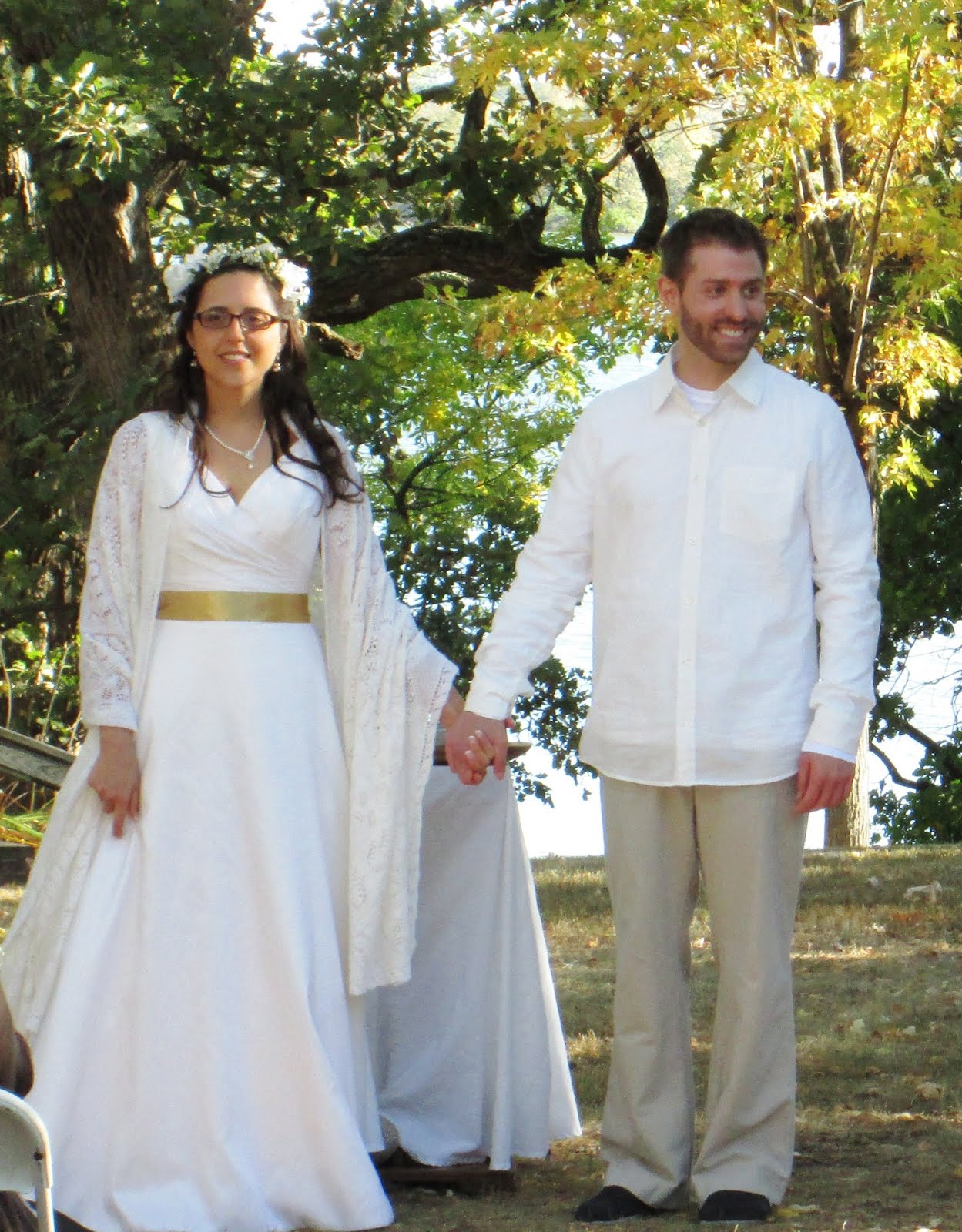
Above and left: The autumn equinox wedding of Eve and Daniel.

Right: With friends Joan (the mother of the bride) and Nick.

Yes, it's true: you know you're getting old when you're closer in age to the mother of the bride than to the bride!


Above: Autumn in Minnesota! For more images of the beautiful fall colors this year, see here, here and here.


Above: Friends Mark, Walter and Raul. We were out with others at the Loring Kitchen and Bar on the evening of October 6, farewelling Raul who was leaving Minnesota to return to Mexico.


Above: Mark, Dan, Miss Daisy, Raul, Walter and Barry.


Right: Sitting (at right) with Dan, Miss Daisy and Raul.


Above: At the October 10 celebration for my dear friends Rita and Brigid's birthdays. Rita had recently turned 90 and Brigid 80!


Above: The famous McDonald Sisters: Brigid, Jane, Kate and Rita – October 10, 2012.


Above: Friends Tom and Darlene White, who feature in the C4ME-MN produced DVD Catholics for Marriage Equality.


Part of my work with Catholics for Marriage Equality MN during the autumn involved distributing our 'Another Catholic Voting No' yard signs, bumper stickers and buttons. In the picture above, five members of a local Catholic family, despite being too young to vote, happily display the buttons they requested their mother get for them! She had originally come just for a yard sign.

Left: What I called a "tree of living flame in the eye of the storm"! To read what I mean by this, click here.


Above: Jay Michaelson, author of God vs. Gay? The Religious Case for Equality, speaking at the annual Call to Action MN conference, October 20, 2012.


Above: Many of the 100+ people who attended the October 23 Vigil for All Minnesotan Families at the Cathedral of St. Paul, Minnesota.


Right: October 23 was also my 47th birthday! Close enough to Halloween, I guess, to get this specially-wrapped present!


I celebrated my birthday with a number of friends at Fabulous Ferns in St. Paul, including from left above, Kathleen, Paula, Tim and Paul.


Left: Brent, Marguerite, Rita and Cheryl.


Above: Brigid, Sue Ann, Kathleen, Joey and Kate,


Right: Lisa, Eileen, Bernie and Sue Ann.


Above: Later in the week I celebrated my birthday with friends Liana, Curtis, John and Noelle. (And little Charlie, of course!)

Left: Friends Joan and George also took me out one night for my birthday. We had a delicious meal at the Corner Table restaurant in Minneapolis.


Above: With my friend Curtis and our four-legged friends Charlie and Eddie – October 2012.


Right: With Quinn.


Above and below: Celebrating my friend Noelle's birthday – October 28, 2012.


Above: Standing with fellow Catholics at a special prayer vigil in St. Cloud, MN. The purpose of the vigil was to pray for peace, justice, hope, and healing around the divisive 'marriage amendment.'

For more images and commentary on this event, click here.


Above: Celebrating with friends Mary Kay, Brent and Lisa the historic advances for marriage equality that resulted from the November 6 U.S. elections. One of these advances involved the defeat of the anti-gay 'marriage amendment' in Minnesota.


Above: Mary Kay Orman (left), the director of C4ME-MN's Catholics for Marriage Equality DVD, stands with some of the Catholics who feature in the DVD by sharing their "stories of faith family and marriage." Pictured are Brent and Lisa, Grace, and Bob.


Above: Friends Cheryl and Kathleen with Jacob Sustaita, Music Director of the Minnesota Philharmonic Orchestra – Sunday, November 11, 2012.


Above: Singer/songwriter David Rovics performing at Occupy Live! – November 13, 2012. Sponsored by the Minnesota Alliance of Peacemakers and held at Hennepin Avenue United Methodist Cathedral, Occupy Live! provided an opportunity to "learn more about what is happening within the local Occupy Movement, and to determine how each one of us can make a difference." Presentations were made by members of Occupy Homes MN, Occupy Minneapolis, and the Whealthy Human Village.

For my friend Mary Lynn's reflections on Occupy Minneapolis, see here and here.


Above: My friend Bernie Rodel, co-chair of the Catholic Coalition for Church Reform (CCCR), welcomes attendees to the group's November 15 event calling for accountability and transparency in archdiocesan finances.

For Minnesota Public Radio's report on this event, click here.


Above: My friend and housemate Tim with one of the two squirrels we've caught in and around our home! Here in Minnesota at around this time of year there's often a movement of critters such as squirrels, mice and birds into human habitations. Understandably, they're trying to escape the cold and scarcity of food that the approaching winter brings.


Above: Standing by one of the beautiful bur oak trees near Coldwater Spring – Sunday, November 18, 2012. For more images and commentary on this beautiful part of Minneapolis, click here.


Above: I love this photo of Eddie and I – even if Eddie does look like he has the eyes of a hellhound!


Above and left: The first fire of the season . . . at the always welcoming home of my friends John and Noelle.


Liana, Curtis, Kim and Mike (above) and John and Noelle (left) – Thanksgiving 2012. I'm certainly thankful for these beautiful friends in my life!


Above: My friend Mike and I with Eddie and Charlie.


Right: Putting up my Christmas tree – Monday, November 26, 2012.

For more images and a bit about the history of Christmas trees, click here.


Above: Standing at left with Catholic marriage equality leaders from Maine, Minnesota, Maryland and Washington. Pictured next to me from left: Anne Underwood, co-founder of Catholics for Marriage Equality – Maine; Ryan Sattler, primary Catholic lay organizer for the Maryland Marriage Equality Campaign; Joseph Palacios, co-founder of Catholics for Equality; Cynthia Beliveau of Catholics for Marriage Equality – Maine; Jim Smith of Catholics for Marriage Equality – Minnesota; Barbara Guzzo, co-founder of Catholics for Marriage Equality – Washington; Jeannine Gramick, co-founder of New Ways Ministry; Marianne Duddy-Burke, president of DignityUSA; Francis DeBernardo, executive director of New Ways Ministry; and Chris Pumpelly of Catholics United.

We gathered with pro-marriage equality faith leaders from Maine, Maryland, Minnesota, Washington and North Carolina on December 3-4 at the Washington, DC headquarters of the Human Rights Campaign. Together we celebrated recent advances in marriage equality in our respective states, and strategized and planned for further nationwide advances in the journey toward full equality for LGBT individuals, couples and families. Our gathering was called "Triumphs of Faith," and was, without doubt, a very inspiring event. As executive coordinator of C4ME-MN I was honored to be part of it. (For more photos and commentary, click here.)


Left: While in Washington, D.C. I visited the Smithsonian's National Museum of the American Indian.

For more photos and commentary, click here.


Above: Back in Minneapolis and out for dinner with friends (from left) Brian, Larry, John and Rick – Saturday, December 8, 2012.


Above: Autumn 2012 came to an end on Sunday, December 9, when Winter Storm Caesar dumped over 10 inches of snow over the Twin Cities metro area. More images of the winter wonderland that ensued coming soon!


See also the previous Wild Reed posts:
Out and About – Winter 2012
Out and About – Spring 2012 (Part 1)
Out and About – Spring 2012 (Part 2)
Out and About – Spring 2012 (Part 3)
Out and About – Summer 2012


Sunday, December 09, 2012

Quote of the Day

We have few occasions in life to be witness to extraordinary history. This is one of those days. Today same-sex couples in Washington are getting married under a law approved by the voters. For the first time in the United States, their marriage is legal not because of actions by legislatures or courts but because their equal rights were affirmed by their peers across the state at the ballot box. That shift is momentous.

. . . As my own daughters taught me, this is indeed the civil rights issue of our time. There will come a time when, across our country, the ability to marry the person you love will not be an issue. Future generations will look back and wonder why we ever denied this basic human right. We can't rest until that moment. . . .

– Gov. Chris Gregoire
"On Being Witness to History"
The Huffington Post
December 9, 2012


Related Off-site Links:
Washington Gay Marriage Law Takes Effect – Rachel La Corte (HuffPost Gay Voices, December 9, 2012).
Poll: Plurality Supports Gay Marriage – James Hohmann (Politico.com, December 9, 2012).
U.S. Supreme Court to Hear Gay Marriage Cases – Liz Goodwin (Yahoo! News, December 7, 2012).
Risk to Same-Sex Marriage "Very Great" in Supreme Court – Adam Serwer (Mother Jones, December 7, 2012).
George Will: "Quite Literally, the Opposition to Gay Marriage is Dying" – George Stephanopoulos (ABC News, December 9, 2012).
Roman Catholic Bishops Call for Prayers Against Marriage Equality – Dan Rafter (HRC Blog, December 7, 2012).
Catholic Gregoire Shares 'Personal Journey' to Supporting Same-Sex Marriage – Joel Connelly (SeattlePi.com, January 6, 2012).
New Polls Highlight Catholic, National Support for Marriage Equality – Sunnivie Brydum (The Advocate, December 6, 2012).
Why Do So Many Catholics Support Marriage Equality? Blame the Catholic Imagination – Jamie L. Manson (National Catholic Reporter, October 10, 2012).

See also the previous Wild Reed posts:
O Happy Day
Something to Celebrate
Marriage: "Part of What is Best in Human Nature"
The Same People


Photo of the Day


Related Off-site Link:
Winter Storm Caesar Dumping Snow on Upper Midwest – Chris Dolce and Jon Erdman (Weather.com, December 9, 2012).

See also the previous Wild Reed posts:
Photo of the Day – November 12, 2012
Just in Time for Winter
First Snowfall
Winter Garden
Northwoods
A Snowy December – with an Aussie Connection

Image: Michael J. Bayly.


Friday, December 07, 2012

Beatrice Marovich on Divinity and Animality in Life of Pi

Earlier this evening I saw Ang Lee's Life of Pi (in 3D!). It's a beautiful and thought-provoking film, and one that does justice to Yann Martel's powerful 2001 novel upon which it is based.


Beatrice Marovich has written an incredibly insightful and equally thought-provoking review of the film over at Religion Dispatches. Here's just part of what she says . . .

The movie makes me believe in the power of living, lively, lovely animal bodies. It makes me believe that the world without them would be less extraordinary. And it seems to feed the idea that there is something about these creatures – about animality as such – that can save us humans from ourselves, from imminent ecological catastrophe.

That is to say, these fantastic animals appear to offer some sort of salvation. It’s as though, if we’re able to really believe in animals, another sort of world might be possible. And animality, animal bodies, are the gateways to this alternate universe.

This proposition may sound a bit delusional. Perhaps it also sounds a bit dangerous (as delusions often are). But it wouldn’t have sounded odd to the notorious scholar of myth and religion, Mircea Eliade. In his 1957 book Myths, Dreams, and Mysteries, he argued that there is something about the human connection with non-human animals that reveals a kind of nostalgia for Eden before the fall, a paradise.

Eliade believed that human individuals who were able to “befriend” animals, to speak what he called the “language of the animals,” might be capable of accessing an almost superhuman spiritual life. They were taking one step closer towards renewing the fabled harmony between humans and animals that is central to many paradise myths. He believed that anthropological data on shamans substantiated his claims. But he also believed that we see a clear example of this in the Christian figure of Saint Francis, who famously preached his gospels to the birds and the fish and has been formally declared the “patron saint of ecology.”

The philosopher Jacques Derrida also argued, in some of his last lectures, that in a culture where the human being is understood to be the figure of sovereign authority – the figure that holds the reins of political power – divinity and animality bleed into one another in a kind of excluded space. The more powerful humanity becomes, in other words, the less power is held by those elements that humanity excludes, such as divinity or animality. The result, he suggests, is that we’re left with a kind of “divinanimal” exclusion.

Environmental thinkers have long charged that “Western” culture, particularly contemporary North American culture, and particularly Christianity, is anthropocentric. Everything revolves around the human being, like planets around the sun. Together, I think, Eliade’s and Derrida’s ideas bring divinity and animality close together: they become intimate in ways that exclude humans, or that beckon to them.


Are we haunted by the figures of divinity and animality that have been pushed to the fringes of our cultural and political existence? From those fringes, where animals and the divine exist, do they begin to blend strangely together? Do the gods begin to appear in the form of animals? And do animals seem to leave their footprints along the paths toward salvations? Do they, together, whisper to us their promises of another world? Of something greater than human being? . . .


To read Beatrice Marovich’s review in its entirety, click here.


Related Off-site Link:
Animal Energies – The Leveret (December 23, 2007).

See also the previous Wild Reed posts:
• The Sannyasi and the Tiger
• Francis and the Wolf
• Something to Think About – May 26, 2012
• Photo(s) of the Day


Photo(s) of the Day


See also the previous Wild Reed posts:
Photo of the Day – October 27, 2012
Photo of the Day – April 4, 2012
Photo of the Day – May 24, 2011
Photo of the Day – March 23, 2011
Photo of the Day – July 15, 2010
Photo of the Day – May 22, 2010
Photo of the Day – April 27, 2010

Images: Michael J. Bayly.


Thursday, December 06, 2012

O Happy Day

"Love made history in Seattle [today]," write Joel Connelly and Casey McNerthney in their SeattlePI.com article, "Same-Sex Marriage Makes History."

Yes, today was the first day that same-sex couples in Washington State could obtain marriage licenses after the State Legislature passed a marriage equality law earlier this year which voters approved on November 6.

Pictured at right is the Catholic governor of Washington, Chris Gregoire, signing Referendum 74, the citizen-passed measure that legalizes same-sex marriage in the state. Gregoire and Secretary of State Sam Reed (also pictured at right) both signed the document on Wednesday, December 5, 2012. Since marriage licenses have a three day waiting period in Washington, it won't be until this Sunday, December 9, that gay marriages can begin to take place.

Following are excerpts from Connelly and McNerthney's SeattlePI.com article, accompanied by a number of beautiful images from this historic day.


In the predawn darkness 300 couples got licenses that will allow them to marry their same-sex partner.

The event began at 12:01 a.m. as men and women stood in line to take advantage of the marriage law that the Legislature passed early this year and voters approved in November.

They formed an eager, festive crowd, with couples young and old braving a night-time chill and wee-hours wait for the chance to make history at the normally dull King County Administration building. Supporters cheered for them with roses, coffee, hand-warmers and serenades of "Going to the Chapel."

The licensing marathon was expected to last more than 18 hours. Just after 1 p.m., more than 400 licenses had been issued.

"Marriage should be a happy time, and it's a happy night," said State Sen. Ed Murray, D-Wash., who was among the crowd with his partner, Michael Shiosaki. Murray was the chief sponsor of the marriage equality legislation passed by the Legislature last February.

Exactly one month has passed since Washington voted – and King County voted overwhelmingly – in favor of same-sex marriage through Referendum 74.


Above: James (left) and Paul have been together 40 years and were the first same-sex couple to receive a marriage license in Clark County, Washington today. (Image: Seattle Times)


Above: Parents Amanda Beane and Anne Bryson-Beane wait to get a marriage license with their seven children at the King County Administration Building before midnight on Wednesday, December 5, 2012. (Photo: Joshua Trujillo/SeattlePI.com)

Amanda Beane and Anne Bryson-Beane, who have seven adopted kids, also picked up a marriage license, after being together for 15 years. They will be married at their home parish, Faith Luthern Church, on Jan. 26, 2013.

"Each of our adopted children understands that you can call someone family all you want, but until the court says it's forever, you are not seen as a 'real' family: When I marry my wife, for the first time our family will be seen by everyone for what we are – a forever family," said Anne Bryson-Beane.


Above: Junia Ribeiro, left, and her partner Patty Oh are greeted as the walk out of the King County Administration Building with their marriage license on Thursday, December 6, 2012. (Photo: Joshua Trujillo/SeattlePI.com)


Above: Kelly Middleton, 24, and her partner Amanda Dollente, 29, embrace after they received their marriage license at the King County Administration Building on Thursday, December 6, 2012. (Photo: Joshua Trujillo/SeattlePI.com)


Above: Jane Abbott Lightly and her partner Pete-e Petersen, right, celebrate as King County Executive Dow Constantine signs their marriage license at the King County Administration Building on shortly after midnight on Thursday, December 6, 2012. (Photo: Joshua Trujillo/SeattlePI.com)

Jane Abbott Lighty and Pete-e Petersen, a West Seattle couple of 35 years, were the first couple to get a license, after waiting decades to get married. As the clock struck midnight, a crowd led by King County Executive Dow Constantine clapped and cheered, and Lighty, 77, and Petersen, 85, raised their hands to take an oath.

"People who have been waiting all these years to have their rights recognized should not have to wait one minute longer," said Constantine, who stayed up into the wee hours to issue the county's first marriage licenses.

"To have our 35-year loving relationship publicly honored and celebrated and have this be a legal marriage means everything to both of us," said Lighty, a former nurse. She and Petersen, a former Korean War flight nurse, will be wed at a Seattle Men's Chorus concert at Benaroya Hall this weekend.


Above: Couples, including columnist Dan Savage and his partner Terry Miller, right, wait in line for their marriage licenses at the King County Administration Building on Thursday, December 6, 2012. Savage is a prominent gay rights activist. (Photo: Joshua Trujillo/SeattlePI.com)

Nationally known sex-advice columnst Dan Savage and his partner were also among the first couples to pick up a marriage license.

"It's really a remarkable journey we've been on and such a remarkable sea change," he said. "And not just for gay people, but straight people have changed, too. It's gotten better for us because straight people have gotten better about us."


Above: Amy Andrews, right, smiles as she wears a veil while standing in line with her partner Jeri Andrews. (Photo: AP/SL)


Above: Larry Duncan, 56, and Randy Shepherd, 48, as they apply for a marriage license in the King County Administration Building. (Photo: Meryl Schenker)

About this particular image, Joshua Trujillo writes:

Originally from Dallas, Texas, they told Schenker they moved to Washington 7 years ago because it was more gay friendly.

The soft-spoken couple from North Bend, who have been together for 11 years, finally reached the front of the line about 1:30 a.m. As they took an oath in front of a representative of King County, Schenker captured the simple moment with a master’s eye. She said that as part of documenting the event, she was looking for a picture that would challenge stereotypes.

When told today that the photo was being shared on social media and starting to appear on national blogs, they both laughed. “That’s just who we are,” said Shepherd.


12/9/12 UPDATES:
Washington Gay Marriage Law Takes Effect – Rachel La Corte (HuffPost Gay Voices, December 9, 2012).
On Being Witness to Extraordinary History – Gov. Chris Gregoire (HuffPost Gay Voices, December 9, 2012).


Related Off-site Links:
Washington Same-Sex Marriage Measure Signed Into Law By Chris Gregoire – Rachel La Corte (Huffington Post, December 5, 2012).
Dozens Line Up for Gay Marriage Licenses – SeattlePI.com (December 5, 2012).
Gregoire Shares 'Personal Journey' to Supporting Same-Sex Marriage – Joel Connelly (SeattlePi.com, January 6, 2012).
New Polls Highlight Catholic, National Support for Marriage Equality – Sunnivie Brydum (The Advocate, December 6, 2012).
The Major Gay Marriage Cases Facing the Supreme Court Friday – Liz Goodwin (Yahoo!News.com, December 6, 2012).

See also the previous Wild Reed posts:
Something to Celebrate
Marriage: "Part of What is Best in Human Nature"
The Same People
The Changing Face of "Traditional Marriage"
Dr. Erik Steele and the "Naked Truth on Same-Sex Marriage"
Jim David on the "Actual Benefits of Same-Sex Marriage"
Steve Chapman: "Time is On the Side of Gay Marriage"
The Longing for Love: God's Primal Beatitude
It Is Not Good to Be Alone
A Pediatric Physician's Helpful Perspective on Same-Sex Parenting


Wednesday, December 05, 2012

A Visit to the National Museum of the American Indian


I recently had the opportunity to visit the Smithsonian's National Museum of the American Indian in Washington, D.C.

Given that I focused on the Oglala warrior and mystic Crazy Horse in my last post, this visit was quite timely. In fact, one acquisition of the museum that I specifically wanted to see was the shirt pictured at right, which is believed to be associated with the "strange man of the Oglalas." Unfortunately, however, this particular item is currently not on display! Oh, well, my visit was still very much worthwhile, as I hope the following images and commentary show.

The museum was established by an Act of Congress in 1989 and is founded on the collection of the former Museum of the American Indian/Heye Foundation in New York City. The collection is distinguished by more than 800,000 works of aesthetic, cultural, historical and spiritual significance. Most of these objects (including, it would seem, Crazy Horse's shirt!) are cared for at the Cultural Resources Center in Maryland. The museum's acquisitions span more than 10,000 years of Native heritage in the U.S. (including Hawai'i), Canada and Latin America.


The museum features four permanent exhibitions: Our Universes presents Native belief; Our Peoples centers on Native history; Our Lives focuses on contemporary Native life; and Return to a Native Place highlights the Native peoples of the Chesapeake region.

Another feature of the museum is the impressive Lelawi Theater. Here visitors can view the 13-minute film Who We Are, which is a beautiful and inspiring celebration of the vitality and diversity of Native life.


When I was at the museum on Sunday, I also saw the special exhibition, A Song for the Horse Nation, which "presents the epic story of the horse's influence on American Indian tribes, beginning with the return of horses to the Western Hemisphere by Christopher Columbus to the present day."


Above and below: Parts of the museum's Our Peoples exhibition.


The display above notes that:

The first 150 years of Contact [between Europeans and the indigenous peoples of the Americas] witnessed one of the greatest transfers of wealth in world history. Gold, silver, and labor from the Americas created and transformed international economies and permanently linked the Western Hemisphere with Europe, Asia, and Africa.

Riches from the Americas made Spain an international superpower, whose empire stretched from Europe to South America and the Philippines – the largest empire since the Age of Julius Caesar.

Perhaps 20 million Indians died as a direct result of Contact. Tens of million more perished from disease.

Little of the gold made by Native people before Contact survives in its original form. Museums and collections hold almost all of what remains.


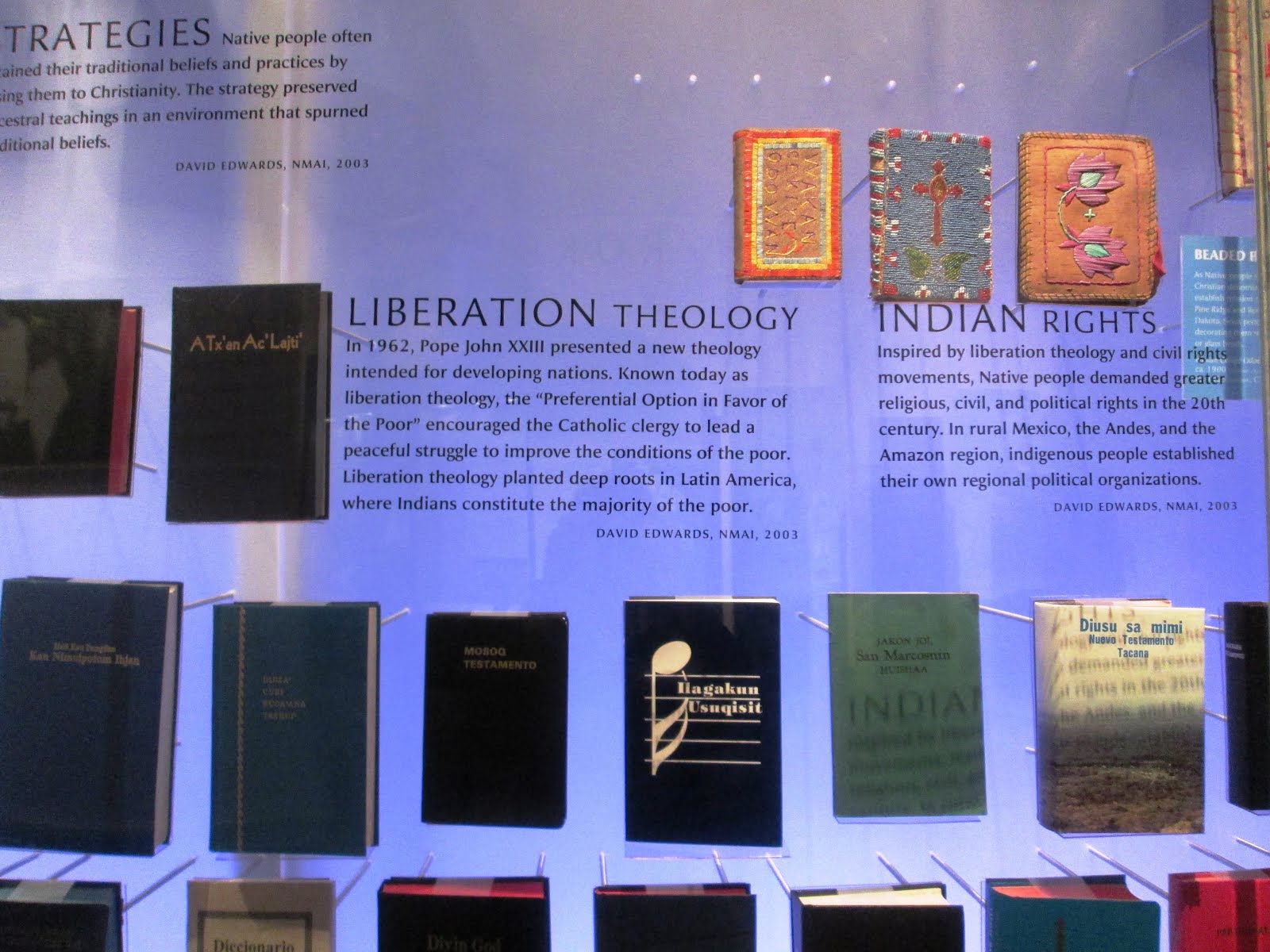
Above and below: Parts of the Our Peoples exhibition that explore how Christian churches were instruments of both dispossession and resilience for the Native peoples of the Americas.


Above: The Catholic Church's liberation theology gets a mention when its noted that:

In 1962, Pope John XXIII presented a new theology intended for developing nations. Known today as liberation theology, the "Preferential Option in Favor of the Poor" encouraged the Catholic clergy to lead a peaceful struggle to improve the conditions of the poor. Liberation theology planted deep roots in Latin America, where Indians constitute the majority of the poor.


Above: I was impressed and moved by "The Storm: Guns, Bibles, and Governments," part of the Our Peoples exhibition. Here's how it's described:

Foreign intrusion swept over Native America like a hurricane. Within this space, images of Indian life flash by, caught in a whirl of guns, Bibles, and treaties. Howling winds and lightening illuminate the sky.

At the center you'll encounter Eye of the Storm, a work of installation art by Edward Poitras (Saulteaux/Metis). This is a place of stillness, a space in time where Indians regrouped, adopting elements of the storm to keep their cultures alive. The piece features evidence of Native survivance: seeds of corn, cardinal direction markers, pages from the Biblical book of Revelation, and a hat similar to one worn by Wovoka (ca. 1858-1932), a Paiute holy man whose prophesies of regeneration inspired the Ghost Dance movement of the 1890s.

Storms come and go, but life continues. There is regeneration and renewal, rebirth and rebuilding – always and forever. Native history is not over. It continues, as yet unwritten.


I was glad to see one of my favorite singer/songwriters, Buffy Sainte-Marie, acknowledged and celebrated not only in the Lelawi Theater's Who We Are video, but in the above display of the Our Lives exhibition. The album cover featured in this display is of Buffy's 1967 album Fire & Fleet & Candlelight.


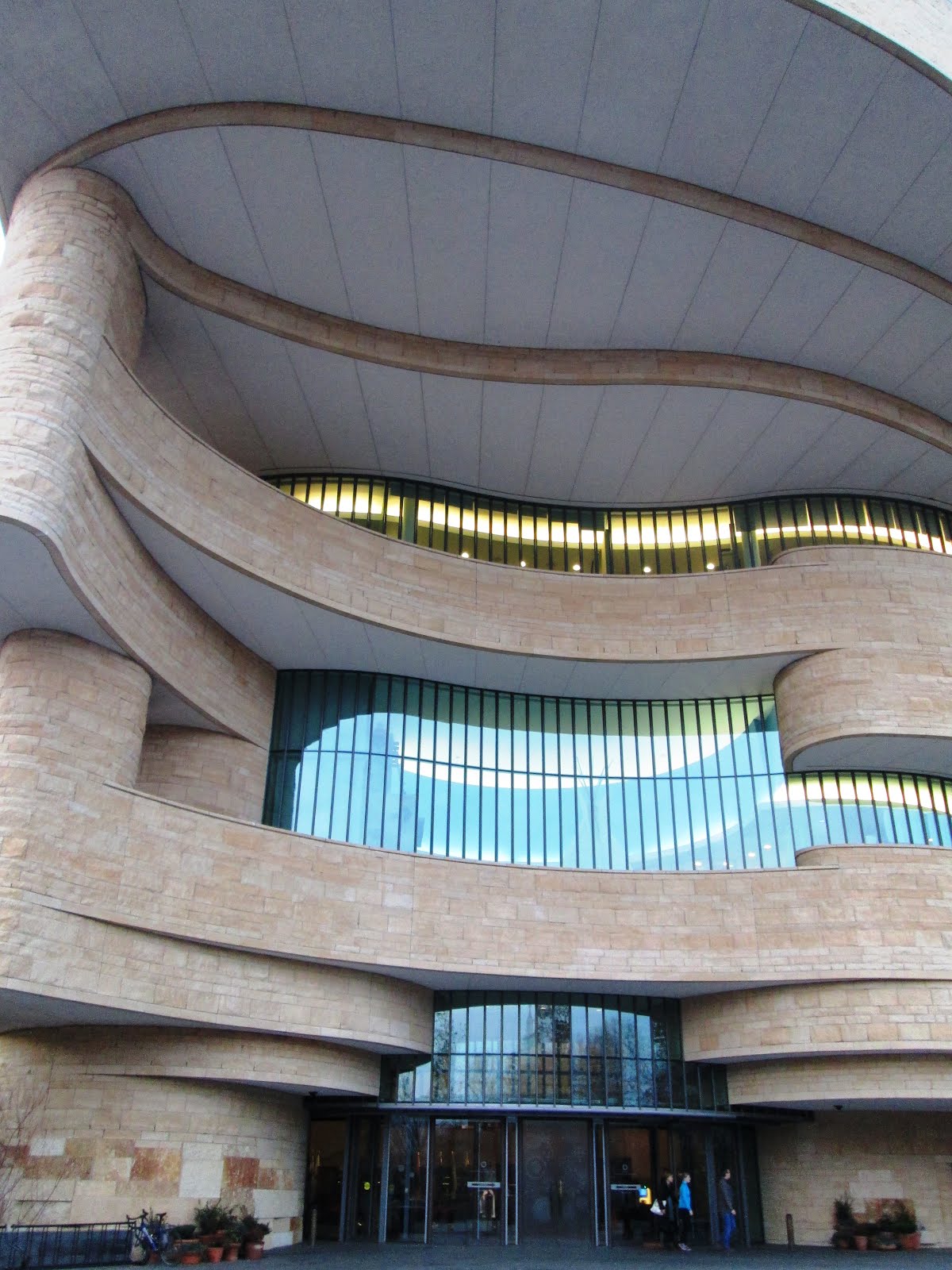
Above and below: Of the actual museum building, an informational brochure notes the following.

Designed by Douglas Cardinal (Blackfoot) and a team of Native architects and consultants – including Johnpaul Jones (Cherokee/Choctaw) and artist/designer Ramona Sakiestewa (Hopi) – the museum, draped in Kasota limestone, is a structure in which nature's rough beauty and architecture's creative elegance come together in perfect harmony. The building is aligned to the cardinal directions and to the center point of the [nearby] Capitol dome, and is filled with symbols and forms that reflect the Native universe, including representations of nature, astronomy, and objects from the collection.


See also the previous Wild Reed posts:
Crazy Horse: "Strange Man" of the Great Plains
"Something Sacred Dwells There"
Michael Greyeyes on Temperance as a Philosophy for Survival
Something Special for Indigenous Peoples Day
North America: Perhaps Once the "Queerest Continent on the Planet"
In the Garden of Spirituality – Paul Coelho
Something to Think About – November 24, 2011

Images: Michael J. Bayly (except for image 2 and image 6 which are from the website of the Museum of the American Indian).


Saturday, December 01, 2012

Crazy Horse: “Strange Man” of the Great Plains

Above: Michael Greyeyes as Crazy Horse
in John Irvin’s 1996 telemovie Crazy Horse.


I’m currently reading Larry McMurtry’s 1999 biography of the Oglala Lakota warrior and mystic Crazy Horse (ca. 1840-1877). It’s a compelling and well-written account of the now legendary figure who during his relatively short lifetime was known by his people as “Our Strange Man.”

Although I don’t particularly relate to the warrior aspect of Crazy Horse, I do respect and admire his courage, humility, and genuine care and concern for his people. By all accounts, he was a man of few words and somewhat of a loner. Writes McMurtry:

There was something of the hermit, the eremite, in him; he was known to walk through his own camp without appearing to notice anybody. When, late in his life, his family began to worry about his tendency to wander off alone in dangerous country, he told them not to worry, there were plenty of caves and holes he could live in; and had it not been for his sense of responsibility to the people of his village – who knew that he would do his best to feed them – he might well have slipped away and lived in those caves and holes.


The image of Crazy Horse walking through his camp without appearing to notice anybody brings to mind Robbie Robertson’s reference to Crazy Horse in his song “Ghost Dance”: Crazy Horse was a mystic / He knew the secret of the trance.

McMurtry also notes that Crazy Horse encountered whites only when he could no longer avoid them. “For almost the whole of his life he avoided all parleys, councils, treaty sessions, and any meeting of an administrative or political nature, not merely with whites but with his own people as well,” writes McMurtry.

According to McMurtry, the Lakota (or Sioux) were a “tolerant, non-compulsive people.” Individuals were allowed to “follow their own bent,” and differing abilities were recognized and accepted. This was just as well, since Crazy Horse was indifferent to tribal norms. He ignored, for instance, the sundance and, writes McMurtry, “didn’t bother with any of the ordeals of purification that many young Sioux men underwent.” Orthodoxy was never Crazy Horse’s way. Yet another reason, no doubt, for my admiration and interest in his life and story. I also appreciate and resonate with author Chris Hedges’ observation that Crazy Horse’s “ferocity of spirit remains a guiding light for all who seek lives of defiance.”

My introduction to the unorthodox and defiant life of the “strange man of the Oglalas” was through John Irvin’s 1996 telemovie Crazy Horse, starring renowned actor, dancer, director and choreographer Michael Greyeyes. Filmed on location in South Dakota, the film has been described as a “gripping story with a fine cast” and praised for its attention to detail.

In The Journey of Crazy Horse: A Lakota History, historian and author Joseph M. Marshall III is highly critical of movie portrayals of Crazy Horse yet concedes that Irvins’ film “came the closest” in credibly portraying the life and story of the “strange man of the Oglalas.”


Above: Members of the cast of Crazy Horse (1996).
From left: Wes Studi (as Red Cloud), Buffalo Child, Michael Greyeyes

(as Crazy Horse), Steve Reevis, and Nathaniel Arcand (as Little Hawk).
The film also features Irene Bedard as Black Buffalo Woman,
August Schellenberg as Sitting Bull, Peter Horton as

George Armstrong Custer, and Sheri Foster as Black Shawl.


Like Crazy Horse, I grew up in a landscape dominated by expanses of earth and sky. And, as I discuss here, this expansiveness undoubtedly influenced and shaped my spirituality and theological outlook. In my case, this landscape is the Liverpool Plains of the Namoi River valley (right), situated in northwest New South Wales, Australia. It’s a predominately flat area; the tallest hills rising no more than 400-500 metres (1,300-1,600 ft) above sea level. The climate is hot in summer, mild in winter – and dry. Rainstorms in catchment areas, however, occasionally cause flooding of the Namoi River. My hometown of Gunnedah and its surrounding areas were originally inhabited by indigenous Australians who spoke the Kamilaroi (Gamilaraay) language. The area now occupied by the town was settled by Europeans in 1833, ten years or so before the birth of Crazy Horse half way around the world in an area close to the border of Wyoming and South Dakota.


Above: My "bone country."


As I read Larry McMurtry’s biography of Crazy Horse I’m reminded of the deplorable ways that the indigenous populations of both Australia and North America have been treated by their respective European colonizers. Yet I’m also reminded of the beauty of the landscape of my childhood and youth – a landscape that I feel very much claims me, despite my present geographical distance from it. McMurtry’s evocative writing has also strengthened my resolve to one day visit those parts of the Great Plains of America where Crazy Horse lived and died.

Following is an excerpt from McMurtry’s book in which he eloquently writes about the Great Plains and Crazy Horse’s connection to them.


[The] great American steppe was Crazy Horse’s home during his whole life. His attachment to these plains never weakened; he was born to those great skies and those long horizons, and he kept to them as long as he could. . . . [H]e refused to be chased from his home country. The range that he traveled in his life was spacious, but it wasn’t infinite. He went south a few times to Kansas, west as far as the Bighorn Mountains, north and east to the Missouri country; but the land where he roamed and fought mainly was plains country: Nebraska, Wyoming, South Dakota, eastern Montana. Rarely if ever was he east of the 100th meridian, that important line on the map that told whites where the Great American Desert began.

It wasn’t desert, of course – Geronimo lived in a desert. Crazy Horse lived near the center of the great grassland steppe that stretched from Texas well into Canada. Then and now, the central plains were the least populated part of the United States. To those not attuned to their subtleties the plains are merely monotonous emptiness. But to those who love them, the plains are endlessly fascinating, a place where the constant interplay of land and sky is always dramatic; gloomy sometimes, but more often uplifting. Despite their unpopularity with the general public, many writers have penned rhapsodies to the plains, and the eyes of many artists – from Catlin and Bodmer on – have been challenged by them.

The American plains, like all the world’s great steppes, are the natural home for grazing animals and nomadic peoples, and are particularly ideal for certain large ruminants such as the buffalo. The plains have never welcomed either the plow or the fence, The balance of the grasses, the wildlife, and the climate is delicate, easily disturbed. Not merely Crazy Horse but all the Plains Indians recognized with dismay that the whites were indifferent to this balance and likely to destroy it.

Nomads, of course, can be wanton too; like most humans they are inclined to the binge. But in the main, they held a sacramental attitude toward the earth and its creatures, whereas the white attitude from the first was essentially commercial.

. . . Crazy Horse was not unaware of mountains. He knew the Bighorns and the Black Hills, was born near and died not far from Bear Butte. But for most of his life he was a man of the Great Plains. His rivers were the Platte, the Niobrara, the Powder, the Yellowstone, the Tongue, the Little Missouri. He lived under one of the most generous skies in the world. Again, many commentators have recognized that such skies, hovering over the rolling land, with the horizons a mystery, with mirages frequent, makes the plains a place that calls forth imaginings. Those long vistas, those splendid clouds tempt the imagination as the plains of Castile tempted Don Quixote. When Plains people die, white or Indian, they speak of a going up, for where would the spirit go except into the sky? It is easy on the plains to imagine things not seen, worlds not known. Crazy Horse, in his wanderings over the summer plains, would have seen many mirages, which perhaps encouraged him in his belief that this world, with its buffalo and horses, is only the shadow of the real world. He was in a way a prairie Platonist, seeing an ideal of which the day’s events were only a shadow. His belief in the two worlds seems to have made him exceptionally cautious where the camera is concerned. He didn’t want any white man to snatch his shadow, coax it into a little box. He wouldn’t even allow his friend Dr. McGillycuddy, the doctor who so faithfully treated his wife Black Shawl for tuberculosis, to take his picture. He believed it would shorten his life; and his life did indeed end not long after he came to the place where cameras – the little boxes that snatched shadows – were common.

This strange man of the Oglalas was always a man of the central plains. He would not be driven from them. . . . He was determined to hold to the country that was his own, and in the end, that is what he did.

– Larry McMurtry


Above: Michael Greyeyes as Crazy Horse
in John Irvin’s 1996 telemovie Crazy Horse.


Related Off-site Link:
Time to Get Crazy – Chris Hedges (TruthDig, July 2, 2012).

See also the previous Wild Reed posts:
• “Something Sacred Dwells There”
• Michael Greyeyes on Temperance as a Philosophy for Survival
• Something Special for Indigenous Peoples Day
• North America: Perhaps Once the “Queerest Continent on the Planet”
• In the Garden of Spirituality – Paul Coelho

Image 1: A still from John Irvin’s Crazy Horse (1996).
Image 2: A portrait of Crazy Horse drawn in 1934 by a sketch artist interviewing Crazy Horse's sister, who claimed it was an accurate image.
Image 3: VHS cover of John Irvin’s Crazy Horse (1996).
Image 4: Photographer unknown.
Images 5-6: Michael J. Bayly.
Image 7: Cover of Larry McMurtry’s Crazy Horse: A Life. Design by Paul Buckley. Painting by Stephen Johnson.
Image 8: EllasEdge.
Image 9: A still from John Irvin’s Crazy Horse (1996).