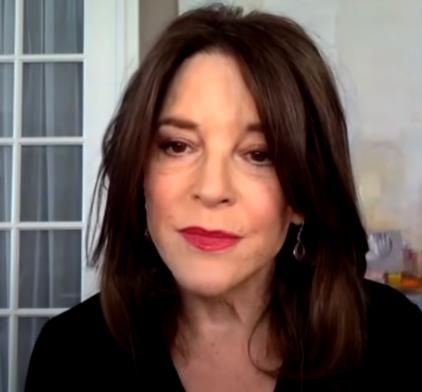
Recently on Rising, author, activist, and former presidential candidate Marianne Williamson discussed Democrats' efforts to raise the minimum wage and explains how it reveals what is wrong with centrist Democrats and the U.S. economy.
Tina Smith is a U.S. senator from Minnesota who recently shared on Facebook her very insightful and cogent thoughts on why the U.S. Senate’s filibuster rule, which requires a 60-vote supermajority to pass legislation, needs to be abolished.
Smith’s piece, subsequently republished at Common Dreams, is reprinted below with added links.
______________________
The Senate needs to abolish the filibuster. Right now, the Senate has 50 Republican senators. They represent less than 44% of America. And yet they still have the power to stop us from passing laws that a majority of America wants.
I’ve spent a lot of time thinking about this, and to be honest I started out believing we should keep the filibuster. Without it, I reasoned, what would stop a conservative president and Congress from doing terrible damage to women’s health care, voting rights and civil rights. But the more I thought about it, the more I realized that the filibuster has long been the enemy of progress. In fact, it’s been a highly effective tool to thwart the will of the people.
The U.S. Senate has a lot of rules that most people don’t understand – including most Senators. Most of these rules don’t spring from the Constitution or the minds of the founders; they have grown out of a centuries long battle between about who gets to decide.
So who does decide? You may think the answer is obvious: In our Republic, the people decide. In state legislatures, city halls, county boards and in the U.S. House of Representatives, a majority of those elected by the people decide. But in the U.S. Senate, the rules are uniquely different. In reality, every day in the U.S. Senate a minority can decide. And they do it by threatening to talk to death any idea, policy or proposal that they don’t like. That’s what the filibuster is. And that’s why it has to go.
The filibuster didn’t come from the Constitution, or from our founders. It grew up as tool developed by a minority in the senate – mostly white, racist Southern senators from the Democratic party – to protect their interest in owning and exploiting Black bodies. After the Civil War, and passage of the 13th, 14th and 15th amendments, and after a brief period of hopefulness for the future of Black Americans, the filibuster became an even more powerful tool, used to deny voting rights and the opportunity for Black people to own a home or land, and to build wealth and opportunity for their own families.
If you have fond memories of watching the movie Mr. Smith Goes to Washington, and the heroic Mr. Smith using the power of debate to turn the Senate toward more justice, I’m sorry to tell you that does not happen in the Senate. In fact, the modern filibuster usually doesn’t include any debate at all. What happens is that a senator merely threatens to filibuster, then they go home to dinner. There’s no debate and not even any talking. And definitely not any legislating.
Some will argue that the filibuster is a crucial stopgap, designed to protect the rights of the minority against an overweening majority that would trample those rights. They say that the filibuster encourages compromise and it makes the Senate the famous “cooling saucer” that stops the federal government from careening from one extreme to the other. I’ve not seen that. What the filibuster does is allow a minority of Senators to just say no to any idea they don’t like. They don’t have to negotiate because they can stop anything. [Republican Senator] Mitch McConnell is the master of obstruction, but the big problem is that this is fundamentally undemocratic.
This past Saturday I walked through my south Minneapolis neighborhood, across the Franklin Ave. Bridge, and down to the east bank of the Mississippi River. It was a beautifully bright and warm day; a spring-like day in many ways.
The winter’s snow and ice were rapidly melting, and pools of water – large and small – were everywhere, requiring careful navigation to avoid getting one’s shoes wet, if one was bothered by such a thing, that is.
I’ve long been drawn to – and enchanted by – the reflections in these puddles and pools, especially the reflections of trees.
Of course, looking upon the surface of these shallow pools of water, everything reflected in them appears upside-down. They are like windows into another world.
Photos of these “worlds” are even more intriguing when they themselves are are turned upside-down so that the trees are right-side up but the surrounding area around the water is now upside-down!
Here are a few more photos from my walk around the neighborhood last Saturday. Enjoy!
His widow Simone Ledward Boseman accepted on his behalf [left]. “He would thank God. He would thank his parents. He would thank his ancestors for their guidance and their sacrifices,” she said. “He would say something beautiful, something inspiring, something that would amplify that little voice inside of all of us that tells us you can, that tells you to keep going, that calls you back to what you are meant to be doing at this moment in history.”
Boseman died at 43 last summer following a four-year battle with colon cancer, a diagnosis he hadn’t shared publicly. His performance as in Ma Rainey’s Black Bottom was his final film role, following Spike Lee’s Da 5 Bloods and his megastar status as the Black Panther in the Marvel universe.
Filmmaker Merrill Aldighieri
remembers Carl Anderson
Today is the 76th anniversary of the birth of the late, great American singer and actor Carl Anderson (1945-2004), whom I’ve been honoring throughout February – the month of both his birth and death.
This honoring concludes today with something very special: my recent interview with filmmaker Merrill Aldighieri (right) who worked with Carl on a number of projects in the mid-1980s.
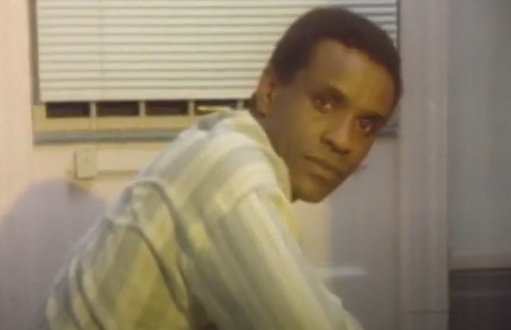
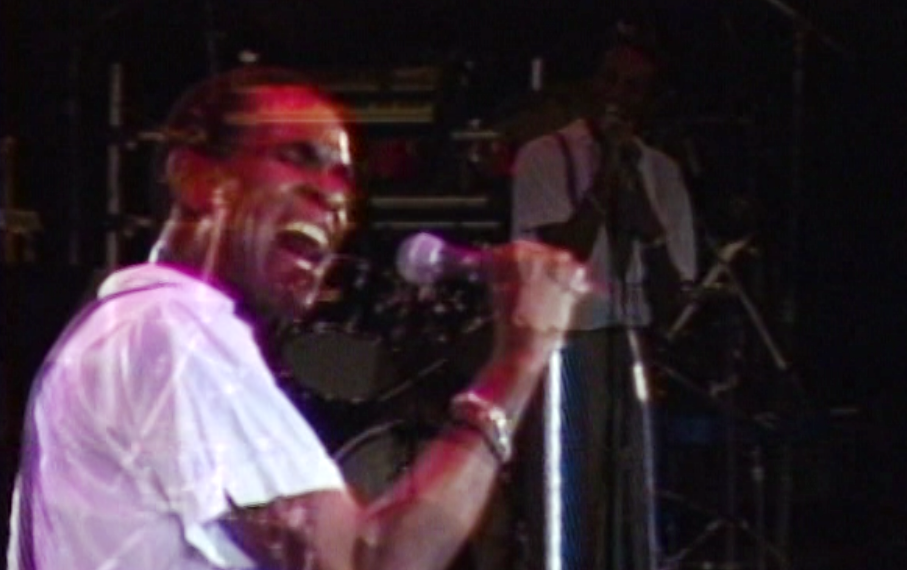
Merrill’s first project with Carl was in 1986 when she directed the music video for his recording of “Buttercup.” Later that same year she filmed Carl in concert at Washington, D.C.’s Carter Barron Amphitheater. At that same time she interviewed him in Rock Creek Park, Carl’s favorite place in Washington.
As you’ll see, in my interview with her, Merrill reflects upon working with Carl on all of these projects and more. First, though, here is the “Buttercup” music video that Merrill directed for Carl. Enjoy!
Michael Bayly: How did it happen that you came to work with Carl?
Merrill Aldighieri: I was invited to make a music video for “Buttercup” by his manager Mike Caplan. It had to be done ASAP so we got to work right away. There was no time for him to mail me a copy of the song, so Carl sang it to me over the phone. When he was done, I said, “You sing just like Stevie Wonder.” Carl replied, “You mean Stevie Wonder sings just like me!” It was many years before I learned how Carl mentored Stevie Wonder, and then the conversation came back to me!
Before your professional relationship with Carl, what did you know about him and his career?
I knew nothing, zip about Carl before that singing phone call.
What was Carl like to work with?
Carl was wonderful to work with, very open to direction. His experience working on the soaps [most prominently Days of Our Lives] was a great asset. [In making the music video] he was surrounded by amateurs yet they all blended in an ensemble. There was no script and I was improvising on the spot. It was more like play than work. Carl went with the flow. The shoot went great and we were shooting all over the place, including Grand Central Station. We did the whole shoot in one day and night.
Right: Merrill Aldighieri in 1986 (photographed by John A. Mozzer).
What was he like as a person? What qualities stand out for you, even after all these years?
Carl’s laugh, smile, openess all stand out to me. The interview I did with him by the river was the most challenging, and I asked a lot of him. He had some reluctance, but I won his trust.
The music video you made with Carl in 1986, “Buttercup,” is very much of its time in terms of outfits, hairstyles, colors, etc. . . .
Where did the ideas for the visuals, locations and story line come from? What was it like making the video? What memories of it stand out the most for you?
The ideas came from me. I started with the lyrics and planned scenes based on the words. As I look at the clip, I think there is a touch of Jean Cocteau influence in there. I was friends with the artist who made the furniture. He and his brother also designed the package art for the DANSPAK series. I built one scene around that.
At the time I did not know any tall black women except one I met when I was in Washington D.C. speaking at the Kennedy Center, so I called her and flew her to NYC to play opposite Carl. I just thought they would look good together. It turned out she was the younger sister of [Susan Beaubian] the woman Carl acted with who played his wife in The Color Purple. I thought this was an extraordinary coincidence. The other performers in the video were friends, neighbors, and friends-of-friends. One was a 14-year-old boy who just hit puberty and grew about a foot in one month. I bumped into him in my elevator and invited him to be in the clip. He was part of my ensemble from then on.
What is the story behind the 1986 concert at the Carter Barron Amphitheater? What was it like filming that concert? What are your fondest memories of it? Were there challenges that you recall?
The Carter Barron Concert production was the idea of Carl’s manager Mike Caplan. He expected we would be able to sell it to BET, and Gloria Loring's cameo appearance seemed like a great bonus. The production was expensive so we were kind of stressed. The filming I shot during the rehearsal was the most fun I had. The concert was really tough. Very hot, unpredictable. My camera was on a tripod and I was used to doing hand held camera, so I was a bit of a fish out of water. I did the editing from U-Matic working dubs of the Betacam masters. We were very disappointed to never sell the concert to BET. The programmer said Carl was not “Black enough.” I was pretty miffed. This was at a point when rap was huge. So this sat on the shelf for decades.
What was it like to work with Carl on this particular concert project? He seems very energized and animated. Was this how he was most of the time? Were there quieter, more reflective moments for him? What was he like during those quieter times?
The interview by the river is a good example of his more quiet times, and he was very philosophical, very warm and honest. It was a powerful moment. We also were in Washington, D.C. making a fundraising film to save a historical Black theatre, the Lincoln Theatre. I will have to upload that one of these days. The odd thing about that, a wonderful project, is that we were so excited to have secured an interview with the Mayor of Washington DC, Marion Barry. You can imagine our horror and shock when after finishing our editing with the intro by Mayor Barry, he was all over the news after being caught in that awful sting operation. This kind of sunk our fundraising video.
In working with Carl, do you feel you got to know him as a person and not just a work colleague? Did you ever meet or get to know his family? Or did he have clear boundaries around things like that?
We only had a few days together over the years and I did not get to know him, except that even in a few hours I felt like I did get to know him. I was New York-based, he was not, so our paths only crossed creatively. My partner’s parents took a shine to him and went to see him whenever he performed at the Atlantic City casinos, and he always remembered them warmly.
I’ve always felt that Carl never received the attention and accolades that he and his music deserved. Why do you think he never achieved a higher profile in the music industry and thus never became more well-known with the general public?
I think that rap music shifted the audience attention and ballads and traditional melodic crooning was geared to an older audience. I am not really well placed to judge though, as I was involved with experiemntal, no wave, and new wave music which was on the fringe of the market share. But the series I released with Sony was meant to break new music on video and give lesser known artists a foot in the business. Carl was, under this guise, a big headliner compared to some of the other groups in my ecclectic compliations.
When you heard of Carl’s death, what were your first thoughts? As the years have passed, what do you find yourself missing or regretting most about his life so sadly cut short?
I can’t answer. I can't think about him as dead. I know that sounds weird, but there it is.
Is there anything else you would like to share about your memories of Carl?
He was bigger than life! Speaking with him was like communing with a great whale, some deep sea creature that knows depths us minnows can’t imagine.
POSTSCRIPT: Merrill Aldighieri has produced a DVD entitled Carl Anderson: The Work Tapes. It contains all of the projects mentioned in my interview with Merrill, including Carl’s live 1986 performance at the Carter Barron Amphitheater, the official promotional video for “Buttercup,” and the “river interview.” All in all, it’s a must-have for admirers of Carl and his music.
Alexandria Ocasio-Cortez [AOC] believes that faith is about more than just spittle from a pulpit. If Jesus came to transform us, then AOC is the living embodiment of what it means to be transformed by the personhood of Jesus.
She isn’t into name-dropping her relationship with Christ. Instead, she has taken to heart the principles that Christ lived by and is doing her damndest to live by the example Christ set. Well, I don’t have to tell you. Listen to what she says about her own faith: “By nature, a society that forgives and rehabilitates its people is a society that forgives and transforms itself. That takes a radical kind of love, a secret of which is given in the Lord’s Prayer: Forgive us our trespasses, as we forgive those who trespass against us. And let us not forget the guiding principle of “the least among us” found in Matthew: that we are compelled to care for the hungry, thirsty, homeless, naked, sick and, yes – the imprisoned.”
AOC believes faith should compel us toward caring for others. You know, the way Jesus did.
Image: Rep. Alexandria Ocasio-Cortez, D-N.Y., is seen on the House steps of the Capitol before the House passed a $2 trillion coronavirus aid package by voice vote on Friday, March 27, 2020. (Photo: Tom Williams/CQ Roll Call/AP Images)
The best tool for cultivating a capacity to respond quickly and powerfully to fast moving circumstances is the cultivation of stillness. That’s why meditation is the best preparation for the urgency of [the times we are living through]. It prepares the nervous system to act quickly without wasting energy or leaking life force.
We can’t achieve the transformational possibilities of this moment unless we’re willing to build the internal musculature that will give us the strength to do so.
It’s nothing we can get to by rational or psychological analysis alone, accumulating more data, or by doing more work of any external kind. Inner peace comes from inner work. It builds non-reactivity. It builds detachment. It builds courage. It builds insight and intuition. It deepens the mind. It expands the heart. And through us it will build a new world.
Today is the 17th anniversary of the passing of singer and actor Carl Anderson, whom I’ve been honoring throughout February – the month of both his birth and death.
This honoring continues today with the sharing of “Nightingale,” a hauntingly beautiful song written by Leonard Cohen and Anjani Thomas, and dedicated to Carl.
“Nightingale” first appeared on Cohen’s album Dear Heather, released in October 2004, eight months after Carl’s death. The song features the vocals of Cohen, Thomas and Sharon Robinson. Thomas composed the music for the song using an abandoned poem of Cohen’s. Because Anjani Thomas had known and worked with Carl, “Nightingale” was dedicated to him.
According to the official Leonard Cohen message board, Cohen’s poem helped Thomas through a difficult time in her life, and she not only “connected its romantic lines with Carl’s voice,” but “heard the melody immediately.” The album Dear Heather was also dedicated to Carl, along with Cohen’s ailing friend Irving Layton and the late Canadian poet A. M. Klein.
In 2006, Anjani Thomas re-recorded “Nightingale” for her album, Blue Alert. I actually prefer this version of the song to the one on Dear Heather, and so it’s the one I share today in honor of Carl.
I built my house beside the wood
So I could hear you singing
And it was sweet and it was good
And love was all beginning
Fare thee well, my nightingale
’Twas long ago I found you
Now all your songs of beauty fail
The forest closes ’round you
The sun goes down behind a veil
’Tis now when you would call me
So rest in peace, my nightingale
Beneath your branch of holly
Fare thee well, my nightingale
’Twas long ago I found you
Now all your songs of beauty fail
The forest closes ’round you
Fare thee well, my nightingale
I lived but to be near you
Tho’ you are singing somewhere still
I can no longer hear you
Try as I might, I can’t produce the adult hardness towards a snowfall, full of resentment at the inconvenience. I love the inconvenience the same way that I sneakingly love a bad cold: the irresistible disruption to mundane life, forcing you to stop for a while and step outside your normal habits. I love the visual transformation it brings about, that recolouring of the world into sparkling white, the way that the rules change so that everybody says hello as they pass. I love what it does to the light, the purplish clouds that loom before it descends, and the way it announces itself from behind your curtains in the morning, glowing a diffuse whiteness that can only mean snow. Heading out in a snowstorm to catch the flakes on my gloves, I love the feeling of it fresh underfoot. I am rarely childlike and playful except in snow. It swings me into reverse gear.
Snow creates that quality of awe in the face of a power greater than ours. It epitomizes the aesthetic notion of the sublime, in which greatness and beauty couple to overcome you – a small, frail human – entirely.
I established The Wild Reed in 2006 as a sign of solidarity with all who are dedicated to living lives of integrity – though, in particular, with gay people seeking to be true to both the gift of their sexuality and their Catholic faith. The Wild Reed's original by-line read, “Thoughts and reflections from a progressive, gay, Catholic perspective.” As you can see, it reads differently now. This is because my journey has, in many ways, taken me beyond, or perhaps better still, deeper into the realities that the words “progressive,” “gay,” and “Catholic” seek to describe.
Even though reeds can symbolize frailty, they may also represent the strength found in flexibility. Popular wisdom says that the green reed which bends in the wind is stronger than the mighty oak which breaks in a storm. Tall green reeds are associated with water, fertility, abundance, wealth, and rebirth. The sound of a reed pipe is often considered the voice of a soul pining for God or a lost love.
On September 24, 2012,Michael BaylyofCatholics for Marriage Equality MNwas interviewed by Suzanne Linton of Our World Today about same-sex relationships and why Catholics can vote 'no' on the proposed Minnesota anti-marriage equality amendment.
"I believe your blog to be of utmost importance for all people regardless of their orientation. . . . Thank you for your blog and the care and dedication that you give in bringing the TRUTH to everyone."– William
"Michael, if there is ever a moment in your day or in your life when you feel low and despondent and wonder whether what you are doing is anything worthwhile, think of this: thanks to your writing on the internet, a young man miles away is now willing to embrace life completely and use his talents and passions unashamedly to celebrate God and his creation. Any success I face in the future and any lives I touch would have been made possible thanks to you and your honesty and wisdom."– AB
"Since I discovered your blog I have felt so much more encouraged and inspired knowing that I'm not the only gay guy in the Catholic Church trying to balance my Faith and my sexuality. Continue being a beacon of hope and a guide to the future within our Church!"– Phillip
"Your posts about Catholic issues are always informative and well researched, and I especially appreciate your photography and the personal posts about your own experience. I'm very glad I found your blog and that I've had the chance to get to know you."– Crystal
"Thank you for taking the time to create this fantastic blog. It is so inspiring!"– George
"I cannot claim to be an expert on Catholic blogs, but from what I've seen, The Wild Reed ranks among the very best."– Kevin
"Reading your blog leaves me with the consolation of knowing that the words Catholic, gay and progressive are not mutually exclusive.."– Patrick
"I grieve for the Roman institution’s betrayal of God’s invitation to change. I fear that somewhere in the midst of this denial is a great sin that rests on the shoulders of those who lead and those who passively follow. But knowing that there are voices, voices of the prophets out there gives me hope. Please keep up the good work."– Peter
"I ran across your blog the other day looking for something else. I stopped to look at it and then bookmarked it because you have written some excellent articles that I want to read. I find your writing to be insightful and interesting and I'm looking forward to reading more of it. Keep up the good work. We really, really need sane people with a voice these days."– Jane Gael
"Michael, your site is like water in the desert."– Jayden