Wednesday, October 18, 2006

Boorganna (Part I)


Hidden deep in the Port Macquarie hinterland is Boorganna Nature Reserve.

Last Friday, my parents and I, along with our friends George and Yonni, drove from Port Macquarie, through the lush and picturesque mountains, to the township of
Comboyne. From here, we proceeded to the Boorganna Nature Reserve and the beautiful Rawson Falls.

Established in 1904, Boorganna Nature Reserve is the second oldest nature reserve in the state of New South Wales. Covering close to 400 hectares, the reserve is a remnant of the former extensive rainforest of the Comboyne Plateau.


Above: Unlike much of the rest of Australia, which for the past six years has been experiencing the worst drought in recorded history, the area around Comboyne and Boorganna Nature Reserve remains very lush and green.


Above and below: Views of Boorganna Nature Reserve accompanied by a Rod Cameron poem from his book Karingal: A Search for Australian Spirituality.


At Kambul *
By Rod Cameron, OSA

I walk to the trees and feel their friendly bark.
I press their fragile leaves into my hand.
I stand amidst the dancing of the grass
and listen to the silence of the land.

If I fail to see the sacred in living things
and even in this random flake of stone
then to my eyes the Universe is closed
and I wander as a stranger all alone.

In gentle voice this world is full of words
that calm the talking tumult in my brain.
‘Stand still and learn to see with spiritual sight
or the pain of all your searching is in vain.’


* Kambul is a cattle property near Mareeba.


Above and below: Rawson Falls as photographed from the viewing platform at the end of Boorganna’s main 1.7 kilometre-long walking trial. Another trial leads to the base of the falls.


NEXT: Boorganna (Part II).

See also the previous Wild Reed posts:
Afternoon
Rocky Beach
A Spring Swim
Pacific Skies
Alva Beach
Coastal Views
Bago Bluff
A Solitary Ramble
In the Garden of Spirituality: Rod Cameron.


Monday, October 16, 2006

Making Sure All Families Matter

Well, I may be marking time in Australia, but back in Minneapolis the good folks who comprise the Catholic Pastoral Committee on Sexual Minorities, along with those inspiring Catholic Rainbow Parents, are making sure that a progressive Catholic voice is heard in response to all manner of reactionary, fear-based rhetoric.

Recently, members of both groups
joined with other “fair-minded” Minnesotans to protest Focus on the Family founder, James Dobson, when he rolled into town to drum up support for anti-gay candidates in the lead up to the November elections.

And now, Mary Lynn Murphy, Coordinator of Catholic Rainbow Parents, has written a powerful response to a
recent piece by Minneapolis Star Tribune columnist, Katherine Kersten.

Kersten had used her October 11 column to promote the outrage of a couple of parents who are upset by “Families All Matter,” a school-based curriculum developed by
Amaze , which encourages children to explore a range of diversity issues through reading.

Along with topics such as racism and disabilities, the “Families All Matter” curriculum also addresses “GLBT [gay, lesbian, bisexual, and transgender] family members”. To make matters worse for the two mothers and Kersten, an out male gay teacher is one, of the no doubt hundreds of teachers, integrating the “Families All Matter” curriculum into his classroom teaching.

When schools allow for a discussion in the classroom of GLBT individuals, couples, and families, without considering those parents who do not recognize or support such people and families, then parental authority is being undermined, declares Kersten.

In response to such a charge, Mary Lynn Murphy, the parent of a straight daughter and a gay son, had the following letter published in the Star Tribune:


Kersten Back to Attacking Gays

Now that President Bush is on the political skids, Katherine Kersten distracts us again with the old reliable gay issue. This time it’s about how an “out” teacher in Minneapolis undermines parental authority.

Talk about undermined authority: Parents who just try to love and affirm their GLBT children are undermined every day – in schools where antigay slurs are constant occurrences, in churches that label our kids “disordered and inclined toward evil,” in a society that denies them full rights of citizenship in civil unions, and in newspapers where right-wing columnists utilize their lives as political cannon fodder.

Parent Gena Bounds may indeed feel undermined by one “out” teacher and his school staff. Loving families of GLBT persons are undermined every day, everywhere, by an entire system. So much for our parental authority.

Mary Lynn Murphy, St. Paul
Star Tribune, October 13, 2006


Mary wasn’t the only one to respond to Kersten. Here’s what two other Minnesotans had to say on the matter, via their letters to the editor of the Star Tribune:


Limit the Hysteria

Parents who claim that schools are undermining their authority over their kids need to actually begin doing some real parenting.

Teaching about diversity of sexual orientation is but one of many topics that schools and society must present to all children and, when necessary, parents as well. Parents who feel threatened by topics such as these are themselves victims of narrow-minded, homophobic influences which seem to be all too prevalent.

Society and children are better served by programs like “Families All Matter” than they are by timid school programs that neither challenge the mind nor engage the spirit. AMaze should be a required program in all public schools and parents should read the materials as well as kids. Maybe then we would begin to reduce the hysteria over the present reality of homosexual people who are our neighbors and friends.

George Hutchinson, Minneapolis
Star Tribune, October 13, 2006


Bad Timing for an Anti-Gay Column

It's ironic that on the eighth anniversary of
Matthew Shepard’s death – October 12 – Katherine Kersten would write another column bemoaning the tolerance of homosexuality in schools.

Jim Sustacek, Rosemount
Star Tribune, October 14, 2006


See also the previous Wild Reed post Catholic Rainbow (Australian) Parents.

“The Gay Old Party Comes Out”

My friend Lydia recently e-mailed me an insightful commentary written by Frank Rich and published October 15 in the New York Times.

Titled “The Gay Old Party Comes Out”, the piece exposes the gross hypocrisy of the “split between the Republicans’ outward homophobia and inner gayness”, a pathological split that, incidently, is also present in the Catholic Church. Rich's commentary also explores how the party’s demonizing of gays in the wake of the Foley scandal, reflects “the kind of blood libel that in another era was spread about Jews”.

Following is an extended excerpt from this highly informative piece:


If anything good has come out of the Foley scandal, it is surely this: The revelation that the political party fond of demonizing homosexuals each election year is as well-stocked with trusted and accomplished gay leaders as virtually every other power center in America. “What you’re really seeing is the Republican Party on the Hill,” says Rich Tafel, the former leader of the gay Log Cabin Republicans whom George W. Bush refused to meet with during the 2000 campaign. “Across the board gay people are in leadership positions.”

Yet it is this same party’s Congressional leadership that in 2006 did almost nothing about government spending, Iraq, immigration or ethics reform, but did drop everything to focus on a doomed constitutional amendment banning same-sex marriage.

The split between the Republicans’ outward homophobia and inner gayness isn’t just hypocrisy; it’s pathology. Take the bizarre case of Karl Rove. Every one of his Bush campaigns has been marked by a dirty dealing of the gay card, dating back to the lesbian whispers that pursued Ann Richards when Mr. Bush ousted her as Texas governor in 1994.

Yet we now learn from The Architect, the recent book by the Texas journalists James Moore and Wayne Slater, that Mr. Rove’s own (and beloved) adoptive father, Louis Rove, was openly gay in the years before his death in 2004. This will be a future case study for psychiatric clinicians as well as historians.

So will Kirk Fordham, the former Congressional aide who worked not only for Mark Foley but also for such gay-baiters as Senator James Inhofe of Oklahoma (who gratuitously bragged this year that no one in his family’s “recorded history” was gay) and Senator Mel Martinez of Florida (who vilified his 2004 Republican primary opponent, a fellow conservative, as a tool of the “radical homosexual agenda”). Then again, even Rick Santorum, the Pennsylvania senator who brought up incest and “man-on-dog” sex while decrying same-sex marriage, has employed a gay director of communications. In the G.O.P. such switch-hitting is as second nature as cutting taxes.

As for Mr. Foley, he is no more representative of gay men, whatever their political orientation, than Joey Buttafuoco is of straight men. Yet he’s a useful creep at this historical juncture because his behaviour has exposed and will continue to expose a larger dynamic on the right. The longer the aftermath of this scandal continues, with its maniacal finger-pointing and relentless spotlight on the Republican closet, the harder it will be for his party to return to the double-dealing that has made gay Americans election-year bogeymen (and women) for so long.

The moment Mr. Foley’s e-mails became known, we saw that brand of fear-mongering and bigotry at full tilt: Bush administration allies exploited the former Congressman’s predatory history to spread the grotesque canard that homosexuality is a direct path to pedophilia. It’s the kind of blood libel that in another era was spread about Jews.

The Family Research Council’s Mr. Perkins, a frequent White House ally and visitor, led the way. “When we elevate tolerance and diversity to the guidepost of public life,” he said on Fox News Channel, “this is what we get — men chasing 16-year-old boys around the halls of Congress.”

A related note was struck by The Wall Street Journal’s editorial page, which asked, “Could a gay Congressman be quarantined?” The answer was no because “today’s politically correct culture” — tolerance of “private lifestyle choices” — gives predatory gay men a free pass. Newt Gingrich made the same point when he announced on TV that Mr. Foley had not been policed because Republicans “would have been accused of gay bashing.” Translation: Those in favor of gay civil rights would countenance and protect sex offenders.

This line of attack was soon followed by another classic from the annals of anti-Semitism: the shadowy conspiracy. “The secret Capitol Hill homosexual network must be exposed and dismantled,” said Cliff Kincaid of Accuracy in Media, another right-wing outfit that serves as a grass-roots auxiliary to the Bush administration. This network, he claims, was allowed “to infiltrate and manipulate the party apparatus” and worked “behind the scenes to sabotage a conservative pro-family agenda in Congress.”

There are two problems with this theory. First, gay people did not “infiltrate” the party apparatus — they are the party apparatus. Rare is the conservative Republican Congressional leader who does not have a gay staffer wielding clout in a major position.

Second, any inference that gay Republicans on the Hill conspired to cover up Mr. Foley’s behaviour is preposterous. Mr. Fordham, the gay former Foley aide who spent Thursday testifying under oath about his warnings to Denny Hastert’s staff, is to date the closest this sordid mess has to a whistle-blower, however tardy. So far, the slackers in curbing Mr. Foley over the past three years seem more straight than gay, led by the Buffalo Congressman Tom Reynolds, who is now running a guilt-ridden campaign commercial desperately apologizing to voters.

A Washington Post poll last week found that two-thirds of Americans believe that Democrats would behave just as badly as the Hastert gang in covering up a scandal like this to protect their own power. They are no doubt right. But the reason why the Foley scandal has legs — and why it has upstaged most other news, from the Congressional bill countenancing torture to North Korea’s nuclear test — is not just that sex trumps everything else in a tabloid-besotted America.

The Republicans, unlike most Democrats (Joe Lieberman always excepted), can’t stop advertising their “family values,” which is why their pitfalls are as irresistible as a Molière farce. It was entertaining enough to learn that the former Christian Coalition leader Ralph Reed wanted to go “humping in corporate accounts” with the corrupt gambling lobbyist Jack Abramoff. The only way that comic setup could be topped was by the news that Mr. Foley was chairman of the Missing and Exploited Children’s Caucus. It beggars the imagination that he wasn’t also entrusted with No Child Left Behind.

Cultural conservatives who fell for the G.O.P.’s pious propaganda now look like dupes. Tonight on 60 Minutes, David Kuo, a former top official in the administration’s faith-based initiatives program, is scheduled to discuss his new book recounting how evangelical supporters were privately ridiculed as “nuts” in the White House. If they have any self-respect, they’ll exact their own revenge.

We must hope as well that this crisis will lead to a repudiation of the ritual targeting of gay people for sport at the top levels of the Republican leadership in and out of the White House. For all the president’s talk of tolerance and “compassionate conservatism,” he has repeatedly joined Congress in wielding same-sex marriage as a club for divisive political purposes. He sat idly by while his secretary of education, Margaret Spellings, attacked a PBS children’s show because an animated rabbit visited a lesbian couple and their children. Ms. Spellings was worried about children being exposed to that “lifestyle” — itself a code word for “deviance” — even as the daughter of the vice president was preparing to expose the country to that lifestyle in a highly promoted book.

“The hypocrisy, the winking and nodding is catching up with the party,” says Mr. Tafel, the former Log Cabin leader. “Republicans must welcome their diversity as the party of Lincoln or purge the party of all gays. The middle ground — we’re a diverse party but we can bash gays too — will no longer work.” He adds that “the ironic point is that the G.O.P. isn’t as homophobic as it pretends to be.” Indeed two likely leading presidential competitors in 2008, John McCain and Rudy Giuliani, are consistent supporters of gay civil rights.

To read “The Gay Old Party Comes Out” by Frank Rich in its entirety, click here.

See also the previous Wild Reed post:
What the Republican Leadership and the Catholic Hierarchy Have in Common

Sunday, October 15, 2006

Tariq Ali Discusses Rudyard Kipling

One of the books I’ve read while in Australia is Conversations with Tariq Ali: Speaking of Empire and Resistance.


This book is comprised of a number of interviews that David Barsamian, founder and director of Alternative Radio, has conducted over the years with novelist, filmmaker, author, and social commentator, Tariq Ali (pictured above in Minneapolis in February 2003).

One part of the book that I particularly found interesting was when Barsamian and Ali discussed “the pied piper of British imperialism”, Rudyard Kipling.

Following are excerpts from this particular interview, conducted in February 2004, and entitled in the book, “Enablers of Empire”.

As you’ll see, it’s quite frustrating and tragic how much of their discussion is appropriate to current events – in particular, the situation in Iraq.


David Barsamian: Let’s consider the great bard of empire – the pied piper of British imperialism, Rudyard Kipling, who coined the term “white man’s burden”. His evolution is very interesting: He lost his son in World War I, and then wrote “Epitaphs of the War”. Let me read you a couple of the lines: “If any question why we died, Tell them, because our fathers lied.”

In another poem, titled “A Dead Statesman”, he wrote:

I could not dig: I dared not rob:
Therefore I lied to please the mob.
Now all my lies are proved untrue
And I must face the men I slew.
What tale shall serve me here among
Mine angry and defrauded young?


Tariq Ali: Very beautiful lines – and very relevant to the war in Iraq, to the young men and women Blair and Bush decided to send to their death, to the young Iraqis and old Iraqis, ten thousand of them, who have been killed. I love that poem by Kipling, and in fact I used it in one of my speeches in the run-up to the war.

Kipling was a very strange guy: he was from a ruling-class British family – he was related to Stanley Baldwin, the prime minister of Britain [ . . . ] There is no doubt Kipling was a bard of the empire.

There’s a wonderful poem by Bertolt Brecht about Kipling. Brecht, like many of us, disliked Kipling’s politics, but at the same time, couldn’t help admiring his verses.

There’s a poem by Brecht about the deaths in the First World War. He talks about the last days of Queen Victoria, and he says in his refrain:

“Oh, East is East and West is West!”
Their hireling minstrel cried.
But I observed with interest
Bridges across that great divide
And huge guns trundling East I’ve seen
And cheerful troops keeping them clean.
Meanwhile, from east to west, back rolled
Tea soaked in blood, war wounded, gold.

It’s a wonderful poem. Brecht translated a number of Kipling’s poems into German and used them as songs in his plays.

Kipling is interesting – he may be the only “imperial” novelist who couldn’t help being, at the same time, very critical of aspects of empire. He was the only British writer at the height of the empire who could capture and convey the accents of ordinary English working people: he was the bard of the Tommies in India; he spoke for them as well. The upper crust of the empire in India, therefore, did not like much of Kipling’s work – not because he was pro-Indian but because he was an advocate for the lower-class English people who were forced to serve the needs of the empire.

That poem you read has a history itself: I think Kipling knew that he was to blame for his son’s death – it was not just the politicians who lied. Kipling’s son had very bad eyesight, which would have prevented him from being drafted into the army, but Kipling used his position in British society – pulled rank, as they say – to make sure that his son’s disability was ignored and he could enter the army. He died in battle not long after enlisting, and one of his fellow soldiers said he was killed because his glasses had fallen off and he couldn’t see. When Kipling heard this, of course, he was devastated; that poem expresses Kipling’s bitterness and anger with himself. He knew that jingoism had driven him to send his own son to die.

David Barsamian: In “On the Road to Mandalay” – one of Kipling’s most famous poems – he writes, “Ship me somewhere east of Suez, where the best is like the worst, / Where there aren’t no Ten Commandments an’ a man can raise a thirst.”

It conjures up a whole notion of the East as a kind of
terra nullius, either an empty land or just a place of great sensuality, where the white man could go forth and have women and treasures and magic lamps and flying carpets.

Tariq Ali: We can see this Orientalist exotica at work; that was the only world they could see, because they never looked any deeper. Kipling, to be fair, did, but most didn’t.

There were not only women to be had but, we mustn’t forget this, also men. Boys of every age were readily available in that world – it was not regarded as something scandalous.

In some of Kipling’s short stories, we can see where his interests totally dovetail with those of the empire: he portrays the Bengali, for example, as a short, dark, permanent talker with the mentality of a clerk, babu. The British were very threatened by the Bengalis, because the Bengalis picked up the English language very quickly, learned a great deal, and produced an intelligentsia which challenged the empire before any other part of India. Raja Ram Mohan Roy, the Hindu reformer, used to say, “What Bengal thinks today, India thinks tomorrow.”

The intellectual Bengali, who asks too many questions, thinks too much, and talks too much – which they resented – was counterposed with the beauty of the martial races: the Punjabi Jay peasant fighter, and, of course, the Pathan, descended from the tribes of Alexander the Great, the six-foot-tall men of fair skin, often with red hair and blue eyes, who peopled the Northwest Frontier of India – where homosexuality was part of everyday life. Bisexuality, one should say – boys for pleasure and women for procreation. Kipling and lots of other English administrators fell for that.

I’ve always wondered – I don’t know whether there is any evidence for this – whether Kipling himself was bisexual, because some of the emotional intensity in those short stories is quite staggering; it is almost as if he had had an affair with someone. It’s like the character Ronald Merrick, in Paul Scott’s The Raj Quartet, who is both repulsed and attracted to India.


Photograph of Tariq Ali from Faces of Resistance by Michael Bayly.

See also the previous Wild Reed posts:
• A Reign of Ignorance and Fear in the U.S.
• John Le Carré’s Dark Suspicions
• Capitalism on Trial
• R.I.P. Neoclassical Economics
• When Terror is the Foil
• Taking on Friedman
• The Exception to the Rulers
• An Unholy Alliance in Iraq
• United 93: A Socialist Perspective
• What's a Conscientious Faggot to Do?


Saturday, October 14, 2006

Thursday, October 12, 2006

Revisiting a Groovy Jesus (and a Dysfunctional Theology)

My sister-in-law recently lent me a VHS copy of Norman Jewison’s 1973 cinematic interpretation of Andrew Lloyd Weber and Tim Rice’s “rock opera”, Jesus Christ Superstar.

I watched it last night and, as always, was quite moved by many aspects of it. The song “Could We Start Again, Please,” for instance, can still bring a tear to my eyes!

Jewison’s use of the Israeli desert locations is phenomenal. And, of course, those groovy 1970s’outfits and hairdos are really something! In fact, I’ve always thought that because the sound of this musical is so reflective of the early ‘70s, any production of it that fails to somehow have the look of this era comes across as deficient.

It was also interesting to watch the film for the first time in over ten years, and realize that during that time I’ve dated a guy who looks like
Bob Bingham, the actor who plays the High Priest, Caiaphas – though minus the bushy beard and baritone singing voice! (Plus, Caiaphas must have one of the best lines in the film: “One thing I’ll say for him, Jesus is cool.”)


Of course, I find certain aspects of Jesus Christ Superstar problematic. For a start, the film perpetuates the fallacy that Mary of Magdala was a prostitute.

It also reinforces the anti-Semitism of much of the New Testament by erroneously placing the bulk of the blame for Jesus’ torture and execution on the Jews rather than the Romans, as the following song from the film clearly demonstrates.


Let’s be clear: Jesus’ death was not primarily a result of his falling out with the religious authorities of his day. If this had been the case, then the Jewish religious leaders could simply have had him stoned to death, without having to consult the Roman authorities. Contrary to what Caiaphas says to Pilate in Jesus Christ Superstar, the Jews did indeed have their own “laws to put a man to death.”

Yet Jesus wasn't stoned to death, he was crucified, and crucifixion was the Roman method of execution for those considered to be political and social agitators.

Furthermore, any depiction of the life of Jesus of Nazareth that makes Judas a more compelling and sympathetic character than Jesus himself, has missed the boat.


Judas, electrifyingly portrayed by the late Carl Anderson (right), also gets the most visually (and symbolically) intriguing scenes (like the one in which he is being pursued across the desert by modern-day tanks!)


He also gets the best songs. One of these is the opening number, “Heaven On Their Minds” (see below) – a number which, from the get-go, brings into impressive focus all the best elements of Jewison’s film – location, costumes, performances, and the passion and political intrigue inherent to any story that pits a message of egalitarianism and liberation against the oppressive and dehumanizing might of imperial power.


Anderson’s performance is a show-stopper – and remember this is the first song! His portrayal of the despairing and ultimately frightened Judas, desperately attempting to warn Jesus of the wrath of the occupying Romans, is both mesmerizing and heartbreaking. Just listen to the despair in his voice when, towards the end of the song, Judas laments, “He won’t listen to me.”


Without doubt, Judas is a well-developed and sympathetically-drawn character in Jesus Christ Superstar. Unfortunately, the same cannot be said about Jesus, played in the film by Ted Neeley.


In Jesus Christ Superstar, Jesus is depicted as an “innocent puppet,” a hapless player in a vast cosmic game in which he has no hand in calling the shots, as “everything is fixed” and thus nothing can be changed. He is a tool to be used in some grand design not of his making.


Notions of a violent God

Of course, such an understanding isn’t that far removed from the orthodox view of Jesus’ death, for as my friend Jack Nelson-Pallmeyer notes in his latest book, Is Religion Killing Us? Violence in the Bible and the Quran, “many Christians [believe in] a gracious God who loves us enough to send his only son to die in our place so that we might avoid punishment, go to heaven instead of hell, and have eternal life.”

Yet such a “rose-colored” interpretation, insists Nelson-Pallmeyer, conceals “brutal images of God.”

“If we believe that Jesus died for us so that we will not be condemned,” says Nelson-Pallmeyer, “then we should ask, ‘Condemned by whom?’ The answer is, God. What remains unstated in classic Christian statements of faith is that Jesus dies in order to save us from God, not from sin. More precisely, Jesus’ sacrificial death saves us from a violent God who punishes sin.”

“The idea that God sent Jesus to die for our sins makes sense only if we embrace violent and punishing images of God featured prominently in the Hebrew Scriptures,” concludes Nelson-Pallmeyer. Like the writers of the Hebrew Scriptures, many of the New Testament writers project abusive, violent power onto God.


Why did Jesus die?

So, if we reject the notion that Jesus was predestined to die for the sins of humanity, why then did he die? And what is the significance of his death for those of us who claim to be his followers?

Well, I always like to say that it isn’t so much Jesus’ death that saves, but rather his life – a life which, of course, led to his eventual death at the hands of those heavily invested in a system of dominating imperial power; a hegemonic power, willing to do whatever it takes to stay in control. Sound familiar?

Theologian Daniel Helminiak, in writing about Jesus as a “model for coming out,” suggests that, “Jesus did not know precisely where his life was leading and what the exact outcome would be – although, as circumstances unfolded, it would not have taken a rocket scientist to figure it out, and toward the end he must have realized that his sense of authority was on a collision course with the authorities [of the hegemonic power of his day].”

And yet Jesus persisted in preaching and living his message of God’s inclusive love and radical hospitality.

I’ve come to believe that it was for this message that Jesus ultimately died. Indeed, Jesus believed in it so much that not even the prospect of torture and death could deter him from imparting the liberating message of both God’s love and humanity’s potential to be, like him, living embodiments of this transforming love.

Helminiak reflects a similar view when he writes that, “Jesus’ death was redeeming only insofar as it was the ultimate expression of his human virtue. Precisely his virtue restores human commitment to, and trust in, God. Jesus’ human fidelity – first to himself and thereby to God, from whom he came – is what reconciles humankind with God. [ . . .] The self-affirmation of this wondrous human being, even in the face of death, is Jesus’ saving contribution.”

“The lesson of Jesus is a lesson about human living,” says Helminiak. “The lesson is that fulfillment in life must come from our being ourselves. [. . .] As Jesus' experience shows, we know God and God’s will only in probing our own hearts; we will be true to God by being true to our deepest and best selves.”

Affirming such an understanding of Jesus’ life and death allows Helminiak to echo the perspective of Nelson-Pallmeyer: “Away with other notions”, says Helminiak, “for example, that God intended Jesus’ gruesome murder [. . . ] or that in justice God demanded Jesus’ blood, or that Jesus was born precisely to die in sacrifice for others, or that Jesus’ painful death was the price paid to God for sin! These notions [. . .] make God out to be an ogre. They are also bad psychology: They encourage unhealthy attitudes” . . . as attested by centuries of religious imperialism, “holy” wars, inquisitions, and persecution of anyone whose experiences take them beyond the parameters of orthodoxy.

It’s enough to make you ask, “Could we start again, please?”


See also the related Wild Reed posts:
• Why Jesus Is My Man
• Judas and Peter
• Jesus: Our Guide to Mystical Love in Action
• Jesus and Social Revolution
• The "Incident" in the Temple
• Blaming the Jews, Canonizing Pilate
• "I've Been Changed; Yes, Really Changed"
• Mary of Magdala
• Mary Magdalene – "An Icon for Our Century"
• A Prayer on the Feast of Mary Magdalene
• The Sexuality of Jesus
• Reflections on The Da Vinci Code Controversy
• Thoughts on The Da Vinci Code
• Jesus Was a Sissy
• Christianity and the Question of God's Presence in the Midst of Hardships and Heartache
• Discerning and Embodying Sacred Presence in Times of Violence and Strife
• Resisting the Hand of the Empire
• Carl Anderson: “Still One of the Greatest Interpretations of Judas on Film”
• Carl Anderson’s Judas in Jesus Christ Superstar: “The Gold Standard”
• Carl Anderson’s Judas: “A Two-Dimensional Popular Villain Turned Into a Complex Human Being”


Wednesday, October 11, 2006

What the Republican Leadership and the Catholic Hierarchy Have in Common

I’ll give you a clue: It can be discerned in the recent debacle involving U.S. Republican Congressman Mark Foley.

But first, an insightful socialist perspective on this same scandal . . .

Patrick Martin, writing for the
World Socialist Web Site, notes that Foley’s recent resignation, “is a serious political blow to the Bush administration and its efforts to retain control of the House and Senate in the November 7 midterm election.”

Writes Martin:

Foley quit within hours of media reports of his sexually explicit e-mails and instant messages to teenage male pages and former pages at the House of Representatives. The scandal cuts across Republican efforts to use anti-gay bigotry and concerns over Internet pornography as key components of their drive to mobilize Christian fundamentalist elements. Republican campaign aides have admitted the demoralizing effect on their ‘base.’

As an exposure of the hypocrisy and cynicism of the Republican Party appeal to ‘family values,’ the Foley affair has few equals. Foley was the Republican co-chairman of the Congressional Missing and Exploited Children’s Caucus, a group whose announced purpose included fighting against ‘online child sexual exploitation.’ President Bush hailed Foley and his colleagues as a ‘SWAT team for kids’ only two months ago—at a time when Foley’s conduct was widely known within the top leadership of the House Republicans.

At the same time, the enthusiasm with which congressional Democrats have seized upon the scandal stands in sharp contrast to their unwillingness to oppose the Bush administration and the Republicans on far more significant issues. The same Democrats who issue moralizing pronouncements against the verbal abuse of 17-year-old boys have no problem voting military appropriations so that the Bush administration can send 19-year-olds to their deaths in imperialist wars in Iraq and Afghanistan.”

The Foley affair underscores the descent of both big business parties to the point where all issues of political substance are suppressed in favor of scandal-mongering and mudslinging. This process has debased political discourse in the United States and stultified public consciousness. At the same time, ever-larger sections of working people are becoming alienated from the entire political establishment.

After resigning from Congress on Friday, Foley checked himself into a rehab center and issued a statement that he had an alcohol problem. Late Tuesday afternoon, Foley’s attorney issued a statement on behalf of the ex-congressman, confirming that Foley was gay and revealing that he had been molested by a [Catholic] clergyman as a teenager. Foley had never had sex with an underage boy, his attorney said.

This account, which seems plausible, only underscores the element of political savagery in the response by congressmen of both parties to Foley’s evident psychological and emotional problems. Both parties react by calculating the advantages and disadvantages in their struggle over positions and political power, while seeking to outdo one another in denouncing their erstwhile ‘esteemed colleague.’

To read Patrick Martin’s article in its entirety, click here.

Elsewhere on the web,
Baptized Pagan has highlighted two thoughtful responses to the scandal, recently published in the Boston Globe, one of which explores how the scandal highlights similarities between the Republican leadership and the Catholic hierarchy.

In an
opinion piece entitled “The Gay Problem in the GOP”, David Link writes:

If [the Foley scandal] has a familiar ring, look in the Catholic Church for the bell. Republican leadership was acting like the Catholic hierarchy, which played shell games with men accused of sexually abusing children. And there's a good reason for the similarity. The inability to deal straightforwardly with gay people leads to other kinds of truth-avoidance when things go south. But that's what comes from not wanting to know something, and going out of your way to remain ignorant.

And then there’s this great
letter-to-the editor of the Boston Globe from Christian Draz (author, incidentally, of a thought-provoking critique of Brokeback Mountain).

As a gay man living for more than two decades in Boston, I have known many gay men raised in strict Catholic homes, two of whom were molested by their priests. Not one of them grew up to be a closeted Republican who worked to criminalize his own behavior. Foley should have sought professional help, as many of my friends did, long before he mixed alcohol, his own apparent homophobia, congressional pages, and the Internet, and brought himself to this ignominious place. If he had taken personal responsibility for his mental health earlier, it would not be thrust upon him now by events he set in motion by his very failure to do so.

Of course, the Catholic hierarchy frowns upon “personal responsibility” on the part of gay people, as, for the vast majority of them, such responsibility entails the rejection of the deeply dysfunctional sexual theology championed by the Vatican.

Free thinking and personal responsibility are expected to be sacrificed on the Vatican-constructed altar of unquestioning obedience. Such denial and repression can only have destructive consequences – not dissimilar to those seen in the Mark Foley scandal.

Sunday, October 08, 2006

Update from the Great South Land


Well, friends, my return to the U.S. has been delayed yet again.

Basically, I’m still waiting to receive word on the scheduling of my interview with officials at the U.S. consulate in Sydney. This is the last step in what has turned out to be a longer-than-expected process to return to the U.S. with green card status. I now hope to be back in Minnesota sometime in early November.

In the meantime, I’ve been getting up to date with various vaccinations, along with other U.S. visa requirements such as undergoing a national police check so as to certify that I have no “disclosable court outcomes” or “outstanding matters” recorded against me. I'm happy to report that I have a clean record!

Without doubt, I’ve had a very enjoyable time in Australia and, in particular, I’ve greatly treasured the opportunities for reconnecting with family and friends – from
Townsville to Wagga Wagga, Gunnedah to Wollongong, and Port Macquarie to Goulburn.

Meanwhile, the summer sun increases each day, the flags are out on Town Beach, and the lifesavers are on patrol. I’m even starting to get a nice tan! Flowers are blooming and the trees are blossoming, and school students are once again on holiday break – this time before their return to school for the last term of the year.

And I realized this morning that I’ve now spent more of 2006 in Australia than in the U.S.


I have mixed feelings about this. Obviously, as I've already noted, I am very grateful for the chance to reconnect with family and friends that my time here has afforded. But I'm also aware of an ever-increasing desire to return and resume my life in the States and, in particular, my involvement in the local justice and peace community, my participation in the CSJ consociate program, and my work with CPCSM.

Of course, such work has not ground to a halt during my sojourn in Australia. Since my arrival in Australia in late May, I’ve been kept busy with various aspects of the upcoming publication of CPCSM’s first book, Creating Safe Environments for LGBT Students: A Catholic Schools Perspective.

In particular, I’ve been corresponding, via e-mail, with the folks at the U.S.-based Haworth Press as we work to edit and finalize the manuscript of the book. I’ve also been e-mailing a range of individuals and organizations – from the Vatican’s Congregation for the Doctrine of the Faith to theologian Joseph O’Leary, from retired Catholic bishops to the Gay and Lesbian and Straight Educators Network (GLSEN) – so as to secure permission to reprint various material in Creating Safe Environments for LGBT Students: A Catholic Schools Perspective.


As I’ve noted in a previous post, Creating Safe Environments for LGBT Students: A Catholic Schools Perspective is a 5-session training program of strategies, resources, and reflections aimed at empowering Catholic high school professionals in their interactions with youth who have either come out as lesbian, gay, bisexual or transgender (LGBT) or who struggling with questions related to sexual orientation and/or identity.

You could call it a “safe staff” training manual for the Catholic high school context, one that is slated for publication by Haworth Press in winter 2006/2007.

The program itself grew out of a series of “safe staff” training workshops developed by CPCSM and implemented in the mid-late 1990s in a number of Catholic high schools in the Archdiocese of St. Paul/Minneapolis. I feel very honored to have played a small role in these original workshops, and a major role in producing from them the great resource and faith testimony that is Creating Safe Environments for LGBT Students: A Catholic Schools Perspective.

While in Australia over the last four months, I’ve been grateful to a number of friends who have been keeping me up to date with events in Minnesota. I recently heard, for instance, that three-hundred people gathered in St. Paul last Tuesday to protest the visit of James Dobson, founder of the homophobic organization,
Focus on the Family. Dobson was in town to lend support to a Focus on the Family rally aimed at helping elect anti-LGBT candidates this fall.

According to
OutFront Minnesota, “more than 300 fair-minded Minnesotans [ . . . ] demonstrated in downtown St. Paul. The crowd cheered, chanted, and received lots of supportive honking from rush hour drivers”.

“The event”, says OutFront Minnesota, “showed that respect and fair treatment of all our families are values we will stand up and fight for.”

Demonstrators held up a host of signs, some of which read: “I stand for all families”, “I love my transgender daughter”, and “James Dobson does not speak for all Christians”.

I look forward to my return to Minnesota and my involvement in important pro-active events like this, and to resuming my work with CPCSM and collaborating with a range of groups and communities dedicated to bringing about positive change within both the Church and society in relation to LGBT people.

For photos of the October 3 demonstration against James Dobson, click
here.

Saturday, October 07, 2006

Alexander’s Great Love

I watched Oliver Stone’s 2004 film, Alexander, the other night.

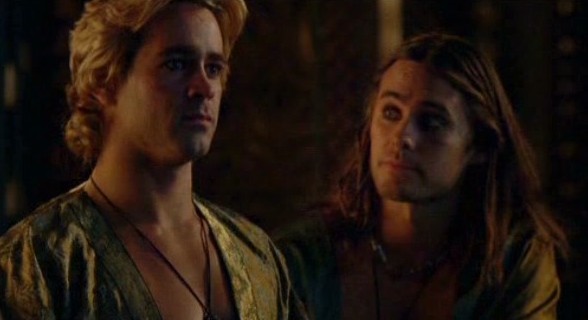
Up until now, I’ve avoided this particular film adaptation of the life of Alexander the Great (starring Colin Farrell in the title role) as I’d heard that Stone downplays Alexander’s relationship with Hephaistion, his best friend, military companion, and lover.

Well, I’m happy to say that that is not the case. Indeed, the film depicts with honesty and, at times, great beauty, Alexander’s love of men, and the affectionate and sexual expression of such love – primarily with Hephaistion (played by Jared Leto, pictured below), but also with the Persian eunuch, Bagoas. [NOTE: See the 2007 update, “Alexander’s Other Great Love,” at the end of this post.]
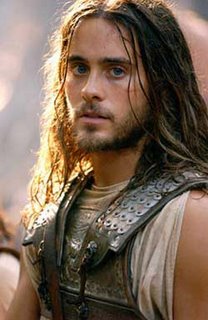
Of course, those uncomfortable with the thought of Alexander the Great being intimate with other men are prone to stress that “homosexuality” and “bisexuality” are modern-day concepts that cannot and should not be projected back onto the lives of the ancients. This is true. But neither can or should the idea of men of ancient times being lovingly and physically intimate with each other be denied outright or minimalized by insisting, for instance, that Alexander and Hephaistion simply shared a deep and close “friendship”.

Some also point to the historical record of Alexander’s disgust towards the selling of young and beautiful male youths and, by extension, his disdain towards relationships based solely on carnal satisfaction, as proof that Alexander would not have been sexually intimate with another male. His ethical stance on such matters, however, doesn’t automatically mean that Alexander was not attracted to the male form or that he did not cultivate loving and consentual relationships with men that were foundational in his life and which were emotionally and physically expressed and sustained.

Yet does our acknowledgment of this mean that we can say that Alexander the Great was gay?

“Categories of male honor and male shame [in ancient Greek culture] did not revolve around the homo/hetero axis,” says Roger Lancaster, a professor of anthropology and cultural studies at George Mason University in Fairfax, Virginia, and author of The Trouble with Nature: Sex and Science in Popular Culture. “It was more complex and freer in some ways, but way more constrained in others.”



To the question of whether or not Alexander the Great can be considered gay, Lancaster insists that, “the angle that most historians or anthropologists would take [ . . . ] is that it’s a meaningless question. It’s not a question the Greeks would ask, nor would they understand the question.”

Yet as
Brian Moylan notes, “other observers say this doesn’t mean [Alexander's] same-sex relationships should be completely ignored.”

One such “observer” is Bill Leap, a professor of anthropology at American University in Washington, D.C. “To say [Alexander] wasn’t gay is pushing him in the closet,” he says.


Although Leap doesn't go so far as to describe Alexander as gay, he is nevertheless adamant that “we can say he had sexual relationships with men and he favored the company of men and he enjoyed them with great commitment and gusto [ . . . ] The bottom line was Alexander was romantically and sexually attracted to men. There’s room to argue if he was gay, but there is no way to argue that he was straight in any way shape or form.”

In his extensive piece for the Washington Blade, Brian Moylan notes that, “In Greek and Macedonian society, sexual relationships between older men and younger men were not uncommon. Not only would the older male, called the erastes in Greek, be the active partner sexually, but he would also mentor the younger eromenos in things such as civic life and warfare. When the young man grew older, he would take on his own eromenos.

“However, these sexual relationships were always based on the higher social status of one man over the other, and both men would eventually have to marry women and engage in family life, so there were few exclusively homosexual men.”

“One noteworthy facet of Alexander and Hephaistion’s relationship”, says Moylan, “ is that they were of similar age and social standing, though Alexander was the king.”

Alexander thus broke a taboo in Greek society, but that taboo wasn’t male love.


Yet, even before the release of Alexander in 2004, the thought of “male love” in a cinematic depiction of the life of Alexander the Great incensed some people. A group of Greek lawyers, for instance, threatened to sue both Oliver Stone and the Warner Bros. film studio for what they claimed was as inaccurate depiction of the personal life of Alexander, despite the fact that Stone had hired Robin Lane Fox, an Oxford University historian and a highly regarded Alexander scholar, to work as a consultant on the movie to ensure its historical accuracy.

Not surprisingly, historians and other commentators viewed the threatening lawyers to be in error, noting that they were looking at the film’s depiction of sexual mores through a contemporary lens, one heavily overlaid with a type of morality that reflects fundamentalist Christian taboos on various issues of human sexuality. Interestingly, after an advanced screening of the film, the lawyers dropped their threat of litigation.

I guess the depiction of Alexander’s personal life was not, in their eyes, too gay. To others, however, most notably gay people, the film’s depiction of Alexander wasn’t gay enough!

Interestingly, Sean Lund, national news media coordinator for the Gay and Lesbian Alliance Against Defamation (GLAAD), saw the lack of overt sex scenes involving Alexander and Hephaistion as a positive, noting that, “The only sex acts portrayed in the film are thematic representations of battle and conquest and power. Obviously what Hephaistion and Alexander had was completely different from that. They had a deep romantic love for one another, and that difference might go some way in explaining why you don’t see caring loving intimacy portrayed on the screen.”

As I've noted previously, I was actually quite pleasantly surprised by the film’s treatment of Alexander’s relationships with Hephaistion and Bagoas, perhaps because I was expecting the worst. There was little else in the film, however, that I found of great interest.


David Walsh succinctly notes that, “Stone’s film treats the best-known episodes in the life of Alexander of Macedon”, basically “his education at the hands of Aristotle, his early military exploits as an adolescent, his succession as king of Macedonia after the assassination of his father, Philip of Macedon, his defeat of the Persians, his travels to and conquest of much of the known and unknown world (Egypt, Babylonia, Persia, Media, Bactria, the Punjab and the valley of the Indus) before his death at the age of 32.”


“In Stone’s version”, continues Walsh, “Alexander the Great (Colin Farrell) seems driven by the desire to compete with and surpass the feats of his father (played by Val Kilmer) and escape his dreadful, all-consuming mother, Olympias (Angelina Jolie). Furthermore, he apparently conquers Asia largely to overcome his fear of death. The desire to ‘Hellenize’ (spread the influence of Greek civilization) the Eastern world or make economic and political gains seem like afterthoughts.

“Alexander tells us little about its central figure or the sort of society he emerged from or envisioned. Its goings-on are rather silly. It’s not at all clear what Stone is getting at, other than suggesting that conquering the world is exhausting and psychologically damaging work. He wants us to admire youth and heroism, but a sensibility that finds it difficult to distinguish between the exploits of Jim Morrison of The Doors and Alexander of Macedon may be lacking some fundamental ingredient.”

Racheline Maltese, writing for the
Associated Press, complains that “Stone’s retelling of Alexander the Great’s military conquests is muddled”, and that, “We are never given a sense as to Alexander’s motivation, nor a clear explanation of the progress of Alexander’s empire. We get no hint at matters of Alexander the Great’s character and skill as supported by the historical record – the intellect, strategy and military genius are never discussed, and the battle scenes are so poorly written that one of them needs subtitles just for the audience to follow it.”


Oh well, at least the film’s depiction of Alexander and Hephaistion’s loving relationship satisfies and inspires some folks, as can be seen by the artwork of "Theband" (right) and "Mrs. Ledger" (below).


UPDATE: Alexander’s Other Great Love


In February 2007, Alexander Revisited – The Final Cut was released as a 2-DVD set.

Critic Jeff Shannon notes that this release “should stand as the definitive version of [Oliver] Stone’s much-maligned epic about the great Asian conqueror . . . This is unquestionably a better film than it used to be, leaving us to wonder why it took three separate efforts to shape Alexander into its best possible presentation.”

From my perspective, one of the strengths of Alexander Revisited is that it explores in much greater depth than its predecessors, Alexander’s relationship with the eunuch Bagoas (played by actor and dancer Francisco Bosch, pictured below).


Stone may have Alexander and Hephaistion talk all lovey-dovey and exchange a brotherly hug in a couple of scenes, but it’s definitely Bagoas’ show when it comes to getting the great king to respond with any real physical tenderness and passion. Indeed, the film presents one particularly beautiful and sensual love-making scene between the two men that leaves one to wonder if it was in fact Bagoas, and not Hephaistion, who was Alexander’s great love.


In a February 2006 interview with The Advocate, Stone himself expressed his belief that this was indeed the case, declaring that: “Bagoas was the main one in Alexander’s life.”

“Francesco [Bosch], who was a Spanish dancer, was amazingly sensitive,” says Stone of the actor who played Bagoas. “I just thought he was not only sexy, but the way that he kisses Alexander, the way they kiss, tongu[ing] each other . . . there’s a tenderness there that you feel, and that’s what matters to me. And in a way, I thought that [scene when Bagaos dances for Alexander] in India was a carnal scene between them.”


“There was a different relationship between Alexander and Hephaistion,” Stone contends. “I never felt that he and Alexander were lovers after youth. I felt that they had a bond created from their youth that was indestructible, but I don’t think they continued that relationship.”


In the “Author’s Note” at the conclusion of her acclaimed 1972 novel The Persian Boy, Mary Renault also muses on the nature of Alexander’s various relationships: “That Hephaistion was [Alexander’s] lover seems, on the evidence, probable to the verge of certainty, but is nowhere actually stated . . . Bagoas is the only person explicitly named in the sources as Alexander’s eromenos [‘beloved’].”

A synopsis of Renault’s book reads as follows: “Alexander is a man with little experience of sensuality, but a profound need of affection. Bagoas’ famous beauty has been much exploited, but his affection has been needed by no one. Their meeting is irresistible to both. The adventures of Alexander’s last seven years, some stirring, some tragic, are thus told by Bagoas, an expert courtier and courtesan, sophisticated far beyond his years, boyish only in his devotion. It is a tale rich in historical insight and detail, especially in Bagoas’ view of Alexander's growing sympathy with his Persian subjects, a markedly different view from that of the victorious Macedonians, jealous of their status as master race.”

According to Wikipedia, Alexander and Bagoas’ relationship “seems to have been well-known and approved among Alexander’s troops, as Plutarch recounts an episode (also mentioned by Dicaearchus) during some festivities on the way back from India in which his men clamor for [Alexander] to openly kiss the young man, who had just won a song and dance contest: ‘Bagoas . . . sat down close by [Alexander], which so pleased the Macedonians, that they made loud acclamations for him to kiss Bagoas, and never stopped clapping their hands and shouting till Alexander put his arms round him and kissed him’.”

Renault has pointed out that this incident took place very soon after the crossing of the Gedrosian desert, “when all those present were survivors of that harrowing incident.” In the author’s note in The Persian Boy she writes: “After all these vicissitudes, Bagoas was not only still high in [Alexander’s] affection, but evidently well liked even by the xenophobe Macedonian troops, in itself surprising.” Elsewhere she argues that Bagoas “must have earned the admiration and affection of the army by his courage and fortitude, and his help to others, during the desert crossing.”


The Persian Boy is written from the perspective of Bagoas, and following is how, in the book, he comprehends his relationship with his rival Hephaistion:


How easily he could have had me poisoned, or accused me through false witness, or had jewels hidden in my pack and charged me with their theft; something like that would have happened long ago at the Persian court, if I’d displeased a powerful favorite. He had a rough tongue among fellow soldiers, yet had never used it on me. If we had to meet, he would just speak to me as if to some well-born page, civil and brisk. In return I offered respect without servility. Often I wished him dead, as, no doubt, so he did me; but we had reached an unspoken understanding. Neither of us would have robbed Alexander of anything he valued; so we had no choice.

Of Bagoas’ fate after the death of Alexander, little is known. It is generally believed that he spent his remaining days living quietly in Alexandria – the ancient Egyptian capital founded by his famous lover.


Above: Theband's portrait of Bagoas.


Thursday, October 05, 2006

Gunnedah (Part IV)

This is the fourth and final post documenting my recent visit to (and my previous life in) my Australian hometown of Gunnedah.


Above: On Sunday, September 24, 2006, my parents and I visited Heather and John Sills – our neighbours in Beulah Street, Gunnedah for over thirty years. Pictured from left: John, Heather, and my parents, Margaret and Gordon.


Above: John and Heather’s 1961 wedding with, at right, my mother as bridesmaid, and my father as groomsman.


Above: The Sills family – 1991. From left: Troy, John, Jillian, Heather, and Jenny.


Above: Jenny with my elder brother Chris on his fifth birthday – January 1968.


Above: Troy and I at my brother’s fifth birthday party – January 1968.


Above: My younger brother Tim with Jillian – early 1970s.


Above: Gunnedah superheroes! From left: Me, Jillian, Troy, and Tim.


Above: With Jillian and my brother Tim in the Namoi River – January 1981.


Above: Tim, Jillian, and Deano, my family’s Yellow Labrador – January 1981.


Above: With Jillian in 1988.


Above: Celebrating my brother Tim’s wedding. From left: Mum, Heather, Jillian, John, Nanna Smith (Dad’s mother) and Dad – October 1990.


See also the Wild Reed posts:
Gunnedah (Part I)
Gunnedah (Part II)
Gunnedah (Part III)
One of These Boys . . .
A Lesson from Play School
Catholic Rainbow (Australian) Parents
The Bayly Family - July 2006 (Part I)
The Bayly Family - July 2006 (Part II)
The Bayly Family - July 2006 (Part III)
My Brother, the Drummer
Like Father, Like Daughter
A Rabbit’s Tale
Remembering Nanna Smith