Sunday, October 12, 2014

Tina Beattie: Why I Stay

Why [stay in] a male-dominated institution where progressive liberalism is repeatedly thwarted?

Progress is a dubious concept, and our rights and freedoms are daily corroded by the politics of greed, power and wealth. The Catholic church has a rich tradition of social teaching and solidarity with the poor which challenges these neo-liberal corporate values and offers a different way of living. It is a rich and diverse tradition, weaving together a vast multicultural family that defies the growing xenophobia and exclusivity of modern western societies. It offers a perspective from which to evaluate our muddled values and short-term goals against a more enduring and hopeful outlook on what it means to be human.

The church’s intellectual heritage is a complex mixture of theology, philosophy, art and science that enriches the mind, even if its own leaders have tended to be the worst enemies of this tradition – the sex abuse scandal has revealed a malignant darkness at the heart of the hierarchy. Yet all this is just as true of life outside the church. One should expect better of those who claim to be Christian, but in reality we humans are a species with a peculiar proclivity towards violence, shame and corruption.

Christians call it original sin, and I find in the Catholic church a powerful narrative of hope and redemption in the midst of that.

It is surely worth struggling for.

– Tina Beattie
Excerpted from "Sex, Marriage and the Catholic Church"
The Guardian
October 8, 2014.


For more insights from theologian Tina Beattie, see:
Quote of the Day – January 14, 2012
Quote of the Day – September 13, 2012

See also the previous Wild Reed posts:
Knowing What to Do, Knowing Why to Stay
Staying on Board
One Catholic Gay Parent Who Isn’t Leaving the Church
Choosing to Stay
A Brave Hope
What It Means to Be Catholic
"I Love the Radical Catholic Church"


Tuesday, October 07, 2014

On the Feast of Sts. Sergius and Bacchus, Thoughts on Marriage Equality in the U.S. and the Vatican's Synod on the Family

.
"Marriage of Saint Sergius and Saint Bacchus" (2013)
by Tony de Carlo.


One of the many pearls of wisdom that has stayed with me from my 2004 interview of Catholic theologian and author Mary Bednarowski is the following response by Mary to my question about authority within the Catholic tradition.

I understand “authority” as residing in both the individual and the community. For quite some time I’ve thought about “authority” as that in which I can place my trust. For me that means that as an individual who is a member of a faith community, I have to exercise my own conscience as an informed adult within the framework of the moral guidance offered by my community. If my conscience is not “clear” – that is, if I don’t know where I stand on a moral issue – I must seek clarity. Sometimes it comes from within the Church. Sometimes it comes from the culture in combination with the Church. Sometimes the culture in some aspect or another is, for the moment, ahead of the Church. As an individual and as a member of a community, I have to figure out how to hold it all together. It is my obligation to come to know “in what I can place my trust.” This whole ongoing process is informed by human experiences – mine and others, individual and communal. However we understand the workings of God in our midst and whatever our doctrine of the Church, there is no institutional Church that exists apart from the human community and its experiences and struggles.


I've been reflecting on Mary's words in light of two events that I believe clearly illustrate her observation that sometimes the culture is ahead of the church. The first of these is the Vatican's Synod on the Family, which began this past weekend and which I'll discuss later in this post. The second is the news that the U.S. Supreme Court has declined to hear appeals from five states that were challenging lower-court rulings legalizing same-sex civil marriage. At first glance, this decision may not seem particularly important, but it's actually quite significant. By declining to hear these appeals the court has given a final legal stamp of approval to marriage equality in five states: Indiana, Utah, Oklahoma, Virginia and Wisconsin. It has also set the stage for legalization in six other states that also fall under the lower courts' jurisdiction: Colorado, Wyoming, West Virginia, North Carolina and South Carolina. As a result of the Supreme Court's decision, the Washington Post declared that the legal argument over same-sex marriage is "all but over."


Beyond the hierarchy

In light of these two events serving as an example of "the culture being ahead of the church," or more accurately, the hierarchy of the church, here's a relevant quote from Simon Rosser, another wise and inspiring person I interviewed in 2004.

The Church is in a tough place right now. On the one hand, the Church teaches that science and theology can never be truly in conflict since Catholicism teaches they are reflections of the same God. On the other hand, Catholic sexual theology is about 150 years behind science in some fundamental assumptions about sex and sexuality.

The theology of human sexuality that the Church is teaching is seriously disturbed, so science/medicine and theology appear at times diametrically opposed. Part of the problem is that as the scientific world advanced, the Church first didn’t keep pace with change, and then became a refuge for those frightened of change, including the psychosexually underdeveloped. I don’t think it’s fair to expect the Church to be ahead of science, but when it lags so far behind, it loses credibility and starts becoming extremist.


The headline today of a National Catholic Reporter article initially gave me hope that the bishops gathered in Rome may actually be thinking about moving away from their "disturbed" and "extremist" sexual theology.

"Among First Synod Discussions: Changing Harsh Language, Trying 'Graduality'," read the headline of Joshua J. McElwee's article. Yet I soon discovered that this "graduality" doesn't refer to the gradual movement on the part of the bishops to a place where church teachings on sexuality are reflective of the findings of both science and human experience. Rather, according to Cardinal Vincent Nichols, who spoke to reporters at today's daily briefing, the theological notion of "graduality," which apparently is indeed a recurring theme of the synod, refers to Catholics "growing toward adherence or understanding of church teaching throughout their lives."

So it seems it's always the people who must change, who must conform their lives to church teaching, and never the other way around. Although this is disappointing to hear, it's not particularly surprising. After all, the clerical leadership is very much entrenched in its erroneous and dysfunctional sexual theology. I really don't expect it to evolve beyond it anytime soon, a failure that is both pathetic and sad.

Still, things are moving in the right direction beyond the hierarchy, as recent events in the U.S. concerning marriage equality attest, and as can be discerned in the experiences and insights of many Catholics attuned to the transforming love of God in the lives, relationships, and families of lesbian, gay, bisexual, and transgender people. A number of these Catholics gave presentations at "The Ways of Love," a conference focused on the pastoral care of homosexual and trans people, and which took place in Rome in the days leading up to the synod. As well as reporting on this conference, the folks at New Ways Ministry are doing a stellar job in covering the synod itself from a gay Catholic perspective.

It's also crucial to remember that just because the bishops aren't evolving, gradually or otherwise, in their thinking about sexuality, it doesn't mean that the church, as people of God, is not. I've long maintained that the problem isn't that Catholics don't have an informed and healthy theology on sexuality. We do! It's been and continues to be developed and articulated by many people, including John McNeill, Fran Ferder and John Heagle, Jeannine Gramick, Mary Hunt, Daniel Maguire, Joan Timmerman, Daniel Helminiak, Cletus Wessels, Margaret Farley, James Alison, Todd Salzman and Michael Lawler, Tina Beattie, Francis DeBernardo, Bishop Geoffrey Robinson, and many others. Perhaps most fundamentally, this alternative theology is being embodied, lived out, by Catholics.

The crucial question is, when will the bishops, the gatekeepers of orthodoxy, acknowledge this and allow the experiences and insights of Catholics to shape official Catholic teaching on sexuality? The ongoing failure on the part of the bishops to engage in this process is a major problem for the credibility and life of the church.


Sergius and Bacchus

I think it's something special that yesterday's major step forward for marriage equality occurred so close to today's feast of Sts. Sergius and Bacchus, whom some consider the patron saints of gay marriage. Of course, it's also interesting, and somewhat ironic, that the feast day of these saints coincides with the Vatican's Synod on the Family. Others, too, have noted and remarked on this, including Terence Weldon.

As the bishops in Rome continue to deliberate on marriage and the family, while largely ignoring queer families, it’s appropriate to recall that the synod coincides with the memorial of two saints, Sergius and Bacchus, who remind us that the Christian Church has not always so studiously avoided any recognition of same–sex relationships, but has in fact blessed and even celebrated them.


And then there's theologian Daniel Maguire's perspective and advice to the bishops, found in his 2008 book Whose Church?, and still very relevant for today.

The Catholic hierarchs, lagging again behind the wisdom of the Church [as understood as the people of God], are very upset by same-sex unions. “Disordered,” they call them. Help, however, is available to these bishops, right in their tradition. Same-sex unions are found in the first thousand years of Christianity and were even liturgically celebrated. Rather than fulminating against same-sex unions, the bishops should kneel and say a prayer to Saints Sergius and Bacchus, a same-sex couple whose marriage is preserved in a seventh-century icon showing Jesus as the pronubus (official witness, “bestman”) at their wedding.


Related Off-site Links:
Vatican Begins Landmark Synod to Discuss Family Life – James Reynolds (BBC News, October 5, 2014).
Pope Seeks "Open" Debate on Family Issues as Progressives Seek Change and Conservatives the Maintaining of the Status Quo – Nicole Winfield (Associated Press via The Star Tribune, October 5, 2014).
You've Got Male: A Synod on the Family Slideshow – Mary E. Hunt (Religion Dispatches, October 6, 2014).
One Step Closer to Marriage Equality – The Editorial Board (The New York Times, October 6, 2014).
The Supreme Court Just Quietly Made Marriage Equality the Law of the Land in Many States – Ian Millhiser (ThinkProgress.org, October 7, 2014).
60 Percent Of Americans Soon Will Live In States With Marriage Equality – Sam Stein and Amanda Terkel (The Huffington Post, October 7, 2014).
Here's What Could Happen Next in the States That Still Ban Gay Marriage – Brad Heath (USA Today via The Huffington Post, October 7, 2014).
These States Still Won't Issue Same-Sex Marriage Licenses – Roxana Hegeman (Associated Press via The Huffington Post, October 7, 2014).
Same-Gender Couples Mentioned in Synod Talk, But Not In a Very Positive Way – Francis DeBernardo (Bondings 2.0, October 7, 2014).
No Change in Doctrine from Synod, Say Bishops – Thomas Reese (National Catholic Reporter, October 7, 2014).
Catholic Church Reform's Alternate Gathering on the Family Highlights Lay Vocation – Joan Chittister (National Catholic Reporter, October 2, 2014).
Clericalism and Laity-ism: Twin Evils in Our Church – Brian Willette (The Progressive Catholic Voice, July 6, 2011).
Saints Sergius and Bacchus: Male Couple Martyred in Ancient Rome – Kittredge Cherry (Jesus in Love Blog, October 7, 2014).

UPDATES: Sex, Marriage and the Catholic Church – Tina Beattie (The Guardian, October 8, 2014).
The Supreme Court, Same-Sex Marriage and the Synod – Maureen Fiedler (National Catholic Reporter, October 9, 2014).
Bishops Rethinking Development of Theology and Annulment Process at Synod – Joshua J. McElwee (National Catholic Reporter, October 9, 2014).
Two More Cardinals Back Communion for Divorced and Remarried – John L. Allen Jr. (Crux, October 9, 2014).
Gay Rights Groups Hail New Catholic Tone – Nicole Winfield (Associated Press via Yahoo! News, October 10, 2014).
Cardinal Raymond Burke Takes Break from Vatican Synod to Say Ugly Things About Gay Relationships – Antonia Blumberg (The Huffington Post, October 10, 2014).
Vatican Debate on Gays Provokes Strong Reaction from All Corners – Josephine McKenna (Religion News Service, October 10, 2014).

For more of Sergius and Bacchus at The Wild Reed, see:
Sergius and Bacchus: Martyrs, Saints, Lovers
Honoring (and Learning from) the Passion of Saints Sergius and Bacchus
Sergius and Bacchus: Martyred Lovers
Photo of the Day – October 7, 2013

For more insights from Daniel Maguire, see the previous The Wild Reed posts:
Quote of the Day – April 10, 2012
Daniel Maguire: "Heterosexism, Not Homosexuality, is the Problem"
Daniel Maguire on the Progressive Core of Catholicism
Daniel Maguire on Catholicism's "Long History of Demeaning Sexuality"
Daniel Maguire on Sex as Liturgy
Daniel Maguire in Minneapolis

Image 1: "Marriage of Saint Sergius and Saint Bacchus" (2013) by Tony de Carlo.
Image 2: A 7th century icon of Saints Sergius and Bacchusfrom St. Catherine's Monastery on Mt. Sinai, Israel, now in an art museum in Kiev, Ukraine. (Wikimedia Commons)


Monday, October 06, 2014

Autumn Rose


See also the previous Wild Reed post:
In Autumn Light
O Sacred Season of Autumn
"Thou Hast Thy Music Too"

Image: Michael J. Bayly.


Saturday, October 04, 2014

Quote of the Day

Repeatedly over the last year and a half, I’ve written about teachers in Catholic schools and leaders in Catholic parishes who were dismissed from their posts because they were in same-sex relationships and — in many cases — had decided to marry.

. . . The blunt truth of the matter is that during a period when the legalization of gay marriage has spread rapidly in this country, from just six states in 2011 to more than three times that number today, Catholic officials here have elected to focus on this one issue and on a given group of people: gays and lesbians.

Their moralizing is selective, bigoted and very sad. It’s also self-defeating, because it’s souring many American Catholics, a majority of whom approve of same-sex marriage, and because the workers who’ve been exiled were often exemplars of charity, mercy and other virtues as central to Catholicism as any guidelines for sex. But their hearts didn’t matter. It was all about their loins. Will the church ever get away from that?

Pope Francis seems inclined to do so, and is nudging other Catholic leaders with his carefully chosen words and artfully orchestrated symbols. He’s probably not telegraphing any major shift in church teaching — which, by the way, changes plenty over time — but he’s signaling that Catholics who run afoul of it needn’t be vilified.

– Frank Bruni
Excerpted from "The Church's Gay Obsession"
The New York Times
October 4, 2014


See also the previous Wild Reed posts:
Quote of the Day – May 31, 2014
Quote of the Day – August 22, 2013
Quote of the Day – June 15, 2013
A Head and Heart Response to the Catholic Hierarchy's Opposition to Marriage Equality
Responding to Bishop Tobin's Remarks on Gay Marriage
Rediscovering What Has Been Written on Our Hearts from the Very Beginning
Beyond the Hierarchy: The Blossoming of Liberating Catholic Insights on Sexuality
God Weighs In on the Gay Marriage Debate

Image: Ben Wiseman (New York Times).


Francis and Elias


Drawing on the findings of Franciscan scholar Kevin Elphick, Kittredge Cherry posted earlier today on her blog an insightful commentary to mark the feast day of St. Francis Assisi.

Following is an excerpt from Kitt's post, one entitled "Francis of Assisi's Queer Side Revealed."

Historical records reveal a queer side to Saint Francis of Assisi, one of the most beloved religious figures of all time. The 13th-century friar is celebrated for loving animals, hugging lepers, and praying for peace, but few know about his love for another man and his gender nonconformity. His feast day is today (October 4).

Francis is “a uniquely gender-bending historic figure” according to Franciscan scholar Kevin Elphick He has spent years researching the queer side of Saint Francis, including travel to to the Italian town of Assisi. There he photographed artwork depicting the man he believes may have been the saint’s beloved soulmate: Brother Elias of Cortona.

When Francis (1181-1226) was a young man, he had an unnamed male companion whom he dearly loved – and who was written out of history after the first biography. Other Franciscan friars referred to Francis as “Mother” during his lifetime. He encouraged his friars to be mothers to each other when in hermitage together, and used other gender-bending metaphors to describe the spiritual life. He experienced a vision of an all-female Trinity, who in turn saluted him as “Lady Poverty,” a title that he welcomed.

The earliest companion of Francis, a man whom Francis “loved more than any other because he was the same age” and because of “the great familiarity of their mutual affection” remains nameless. Elphick's research suggests that the unnamed soulmate of Saint Francis was Brother Elias of Cortona. Francis called Elias “Mother” and gave him a special blessing. Elias expressed much concern about Francis’ body and his health. Francis and Elias each describe the other in affectionate terms. However, very quickly after Francis died, Elias is written out of history and discredited. Elphick presents the scholarly evidence about their relationship in the detailed article at the Jesus in Love Blog: “Brother Elias: Soulmate to Saint Francis of Assisi?

. . . In his thesis, Elphick points out, “Because homosexuality and ‘gay’ identities are modern constructs, it is impossible and inaccurate to attempt to read these modern categories into the personalities of historical figures.” Instead he uses the word “homoaffectional” to describe the relationship of Francis and his beloved companion.

“[Francis and Elias'] relationship is inescapably homoaffectional," writes Elphick, “describing a shared intimacy between two Medieval men. That this first companion disappears from the later tradition is cause for suspicion and further inquiry. . . . The tone in [Thomas of] Celano’s earliest account captures the flavor and intimacy of this relationship, perhaps too much so for an increasingly homophobic church and society.”


To read Kitt's article "Francis of Assisi's Queer Side Revealed" in its entirety, click here.


For more of Francis of Assisi at The Wild Reed, see:
St. Francis of Assisi: Dancer, Rebel, Archetype
Francis of Assisi: God's Gift to the Church
No Mere Abstraction
St. Francis of Assisi and Human Sexuality
Francis of Assisi: The Antithesis of Clericalism and Monarchism
Francis and the Wolf
Solar Brother

See also:
Same-Sex Desires: "Immanent and Essential Traits Transcending Time and Culture"
Sergius and Bacchus: Martyrs, Saints, Lovers
Polyeuct and Nearchus: "Brothers by Affection"
Michelangelo: Gifted Artist, Lover of Male Beauty, and Secret Reformer of the Church
Manly Love

Image: Francis of Assisi and the man he loved in “They Shelter in a Cave” by José Benlliure y Gil, 1926. (Wikimedia Commons)


Friday, October 03, 2014

Quote of the Day


If the Eucharist is essentially an encounter with the real presence, rather than essentially an institutional-cum-cultic event, then surely [Jesus’] social interactions make it abundantly clear: hunger, not worthiness underpins Table Fellowship. To allow the law, cultic statutes, and theology to take precedence over mercy and love and encounter, is tantamount to perpetuating the hard line rigour of those Pharisees who complained bitterly and moralised pompously about so many things.

Their approach fostered a cold, superficial temple-based religion. But Jesus invited his followers to a change of heart, a heart oriented to the one called, Abba – Father: a relational, God-based faith.

– Peter Day
Excerpted from "An Open Letter to Cardinal Pell"
Pearls and Irritations
September 23, 2014


See also the previous Wild Reed posts:
The Challenge of Eucharist
"Receive What You Are, the Body of Christ"
Celebrating and Embodying Divine Hospitality
“Take, All of You, and Eat”: Communion and the Rainbow Sash
My Rainbow Sash Experience
Responding to Cardinal Pell
Chris McGillion Responds to the “Exacerbating” Actions of Cardinal Pell
Trusting God's Generous Invitation
Compassion, Christian Community, and Homosexuality
Reflections on the Primacy of Conscience
The Two-Sided Catholic Crisis
Nicole Sotelo: "Jesus Was Not Focused on Priesthood"


Thursday, October 02, 2014

"A Dark Timelessness and Stillness Surrounds Her Wild Abandonment"


Kate Bush's series of "Before the Dawn" concerts concluded last night at London's Hammersmith Apollo. The concerts marked the singer's first return to the stage since The Tour Of Life in 1979.

To say "Before the Dawn" was a success would be an understatement. Tickets for the 22-date concert series sold out within fifteen minutes of going on sale in March and, throughout its 6-week run, the show, which incorporates music, theatre and film, has been hailed as an "ecstatic triumph," as "stunning," "awe-inspiring," "epic," "a masterpiece." (For The Wild Reed's compilation of review highlights, see the previous post, Can You See the Lark Ascending?)

Due to the overwhelming response to and caliber of her comeback to the stage, Kate has been nominated for two 2014 Q Awards: Best Act in the World Today and Best Live Act.


One of the most interesting reviews I've come across of "Before the Dawn" is by Martin "Youth" Glover of the influential band Killing Joke. With eloquence and insight, Glover explores the powerful mysticism that imbues the persona and music of Kate Bush.

Following (with added links) are excerpts from Glover's September 30 review.


[Kate opened her show] with "Lily" [which] lyrically is an explicit magical ceremony, a literal invocation/initiation in the style of the Rosicurician Orders, a la the Golden Dawn school of the western magical tradition. Gabriel before me, Raphael behind me . . . in the circle of fire.

This is key to understanding Kate. She has her own cult, her own mystery school tradition. Her unique strand of Shaivism, Dionysian and Druid philosophy, loosely wrapped up in a song and dance tradition. It’s part magical realism, overt nature spirituality and art house. (Hard to pull off in cynical, postmodern, narcissistic Britain)

She not only pulled that rabbit out of that hat but also managed to convert each and every one of us to her own personal church of the big sky, a church whose priests are owls, ravens, trees and clouds. When asked once who her favourite singers were, she replied “Nightingale, Blackbird and Thrush.” There is a barrenness in religions today. Whether in Christianity, Islam or false prophet new age gurus, humanity is rudderless, bedazzled by materialism. Kate’s communion with nature is the antidote. It is a call to joy, a celebration of the sublime. It’s about the intoxication of love and the ecstasy that follows. [It's] where wisdom lies, hidden deep within its mystical and poetic roots.

Kate’s "religion" is the tiny spark of light that defeats the dark forces that seek dominion over the natural world. . . . She exemplifies English pagan beauty. A dark timelessness and stillness surrounds her wild abandonment, whilst her voice charges at you like Boudicca returned, riding a golden chariot of weird melody, harmony and bitter dissonance.

. . . Kate is a once in a generation, like Blake, Lorca, Tennyson. She can master the avant garde within a pop dynamic, consistently delivering over decades, [and] mash up dozens of polarising, opposing genres of influences into a single focus with clarity and without compromise. (That's genius.) Intellectual, super serious, yet still very silly and lots of fun. . . . I felt very lucky, privileged to be able to bear witness to her mythical vision made manifest, her great masterpiece.

. . . The finale was "Cloudbusting," which she turned into a crowd singalong anthem, worthy enough to compete with Blake's "Jerusalem." . . . The vibe was amazing, magic in the air, Thunder in our hearts. Maybe the equinox helped but I couldn’t imagine anything but rapture, even from the most hardened cynic, experiencing this performance.

As we left I felt like I had just been slapped with a wet kipper, a different person than the one who entered three hours before. . . . The audience staggered out like stunned mullets and floated off into the brisk, river misty Hammersmith night, the world ever so slightly changed.

Martin Glover aka Youth from Killing Joke
Excerpted from "Kate Bush Live Review"
Louder Than War
September 30, 2014


Above: Fiona Wylie's illustration that accompanied Q Magazine's 5-star review of Kate Bush's 2005 album Aerial.

Wylie's artwork playfully and beautifully pays homage to the magical realism of Kate's persona and music. The depiction of Kate's dress and hair, along with the sense of things bursting forth, reflects the cover of Kate's 1980 album Never for Ever (left) but updates it with references to her then-new album. These references include the washing machine of "Mrs Bartolozzi" and the songbirds of Aerial's "A Sky of Honey" suite. Other aspects of Wylie's illustration reference Kate's 1993 album The Red Shoes, her time away while raising her son Bertie, and the honey-making bees of the, er, b-side track "You Want Alchemy."

Speaking of alchemy, to hear "How to Be Invisible," a track from Kate's 2005 album Aerial, click here.


Related Off-site Links:
Curtain Falls on Kate Bush Comeback – Neil Smith (BBC News, October 2, 2014).
After the Dawn: As the Curtain Closes, What Next for Kate Bush? – Paul Sinclair (Super Deluxe Edition, October 2, 2014).
Kate Bush Says She'll Return in 'A While' as She Wraps London Comeback Concerts – Lyndsey Parker (Yahoo! Music, October 2, 2014).
As Kate Bush's "Before The Dawn" Shows Come to a Close We Celebrate the Iconic Star's Comeback – Katy Forrester (The Mirror, September 30, 2014).
Do You Know What? – Some Thoughts After Seeing Kate Bush – Mark Taylor-Batty (Put the Kettle On, September 26, 2014).
Why Kate Bush's London Live Return Was So Special – Andrew Trendell (Gigwise.com, September 26, 2014).
The Continuing Allure of Kate Bush – Gillian G. Gaar (Wondering Sound, September 26, 2014).
Review: Kate Bush – "Before The Dawn"Retrocosm.net (September 26, 2014).
Kate Bush's Stunning "Before the Dawn" Show – Gillian Gaar (The Examiner, September 24, 2014).
All Hail the Queen: Kate Bush Returns in "Before the Dawn" – Victoria Sadler (The Huffington Post, September 22, 2014).
Kate Bush – "Before the Dawn" – David Solomons (Freq.org, September 16, 2014).
Kate Bush’s "Before the Dawn" – Christopher Pankhurst (Counter-Currents, September 11, 2014).
Kate Bush and Those Who Follow in Her WakePedlars World (September 11, 2014).
Standing Ovations for Kate Bush's Return in London – Bernard Zuel (The Age, September 11, 2014).

For more of Kate Bush at The Wild Reed, see:
"Can You See the Lark Ascending?"
Quote of the Day – August 17, 2014
Wow!
Scaling the Heights
"Oh, Yeah!"
Celebrating Bloomsday in St. Paul (and with Kate Bush)
"Rosabelle, Believe . . ."
Just in Time for Winter
"Call Upon Those You Love"
A Song of Summer

See also the previous Wild Reed posts:

The Piper at the Gates of Dawn
"Joined at the Heart": Robert Thompson on Christianity and Sufism
Toby Johnson on the Mysticism of Andrew Harvey
In the Garden of Spirituality – Andrew Harvey
Jesus: Mystic and Prophet
A Return to the Spirit


Wednesday, October 01, 2014

Monday, September 29, 2014

Return of the (Cornish) Native


A new BBC adaptation of Winston Graham's acclaimed novels
will see the 2015 return of Captain Ross Poldark.


Anyone familiar with this blog would know that I'm a great admirer of Winston Graham's Poldark novels.

Set in Cornwall at the turn-of-the-nineteenth century, a time of sharp class divisions, social upheaval, and war, I think it's fair to say that the twelve novels that comprise the Poldark saga are historical fiction at its best.

The series' protagonist is Ross Poldark, a member of the landed gentry who finds himself at odds with his own class over the social and economic status quo that impoverishes local miners and many others of the working class. In the first novel of the series, which Graham originally intended to call The Renegade before deciding on Ross Poldark, the young Captain Poldark is introduced as a battle-scarred veteran of the American War who, upon returning in 1783 to his derelict family estate on the windswept coast of Cornwall, discovers his widowed father dead and the woman he loves engaged to his cousin. Bitterly disappointed and close to financial ruin, Ross nevertheless vows to make the most of what he has.

In this previous post I recollect how, as a teenager, I was introduced to the Poldark novels via the popular mid-1970s BBC TV series Poldark, a series I write about here.

Last year I revisited the Poldark novels, reading all twelve back-to-back – a feat that took me from April to September to complete. I either found the books at used bookstores or borrowed them from the public library. Becoming re-aquainted with these novels and their various characters and stories was a very enjoyable experience and made me realize that I'd like my own copy of each of the novels. It took me about eight months but by May of this year I had collected the series as published by Pan Macmillan in the U.K. One reason I chose this edition was because of the art design of the books' covers. It's clear that whoever designed these covers has actually read each of the Poldark novels as there are all sorts of relevant little details and references within the artwork. Plus they just look good!


Early in my re-reading last year of the Poldark novels, I heard that the BBC was making a new adaptation of them. It was exciting news, but I also felt some trepidation. Would this new TV series be true to the books? Who would play the main characters of Ross and Demelza? George and Elizabeth? Would the complexity of these characters and their lives be dumbed-down in order to make a kind of eighteenth-century Downton Abbey?

Well, I'm happy to say that I was soon both heartened and excited to hear that Debbie Horsfield, the writer of the new Poldark TV series, has great respect and admiration for Winston Graham's original novels. And let's face it, a great TV experience will be guaranteed if this new adaptation embodies the spirit of Graham's books.

After all, as Horsfield reminds us: "Winston Graham's saga [is] an epic journey of love, loss, heartache, betrayal, ambition, survival and redemption, set in a turbulent era in history, with an extraordinary array of beautifully-drawn characters, and a romantic hero of immense complexity."

In a March 2014 interview with David White of BBC Cornwall, Horsfield discussed further the project she and her colleagues at Mammoth Screen production company are working on.

[The twelve Poldark novels] are fantastic books. Winston Graham is such a masterly storyteller. . . . His characters just leap of the page; they're so engaging. [Ours] is a new adaptation but it very much goes back to the original books. The language is the same, all the events are [the same as] in the original books, the characters are the same as written in the original books. Our bottom line is that we love the books. We are fans of the books and [we're dedicated to] a new adaptation of the books. The books are our source material and every generation deserves to see [a new adaptation of them].

The original [BBC series in the 1970s] diverged quite considerably from the books – in lots of ways, actually. I can safely say that we are sticking much more closely to the books. We've been talking extensively with the Winston Graham estate, with Andrew Graham, Winston Graham's son, and we've been very keen to make sure we preserve the integrity of the material. And he's apparently thrilled with what we're doing. And we're thrilled that he's thrilled. And that was always our aim: to translate amazing books to the screen.


In the BBC's enormously popular 1970s Poldak the role of Captain Ross Poldark was played by Robin Ellis (left). In his memoir Making Poldark, Ellis offers the following to account for the success of the first Poldark TV series.

Thanks to Winston Graham, it had great characters who live out good storylines in a classic family saga in the magnificent Cornish countryside. Winston lived in Cornwall himself for many years, was married to a Cornishwoman and was steeped in its history.

The BBC in those days was an experienced and talent-laden organization with fine in-house costume, set and make-up departments training their own recruits. The attention to detail was exemplary. The cast was in good hands and we were a happy, united company of actors.


Above: Author Winston Graham on the set of the first Poldark with Angharad Rees (Demelza), Robin Ellis (Ross), and Paul Curran (Jud).


In praising the casting of Irish actor Aidan Turner (right) in the lead role of the new TV adaptation of the Poldark novels, screenwriter Debbie Horsfield notes the following about the character of Ross Poldark:

In Winston Graham's amazing books Ross is such a complex character. He's very impulsive, he's a rebel, but he also has a strong sense of moral justice and integrity. So he's an outsider. . . . He's also a great romantic hero. He's torn between two women from two different classes and backgrounds.


Above: Aidan Turner with Robin Ellis, the actor who played Ross Poldark in the BBC's popular mid-1970s Poldark series. Ellis plays the Reverend Halse in the new adaptation.


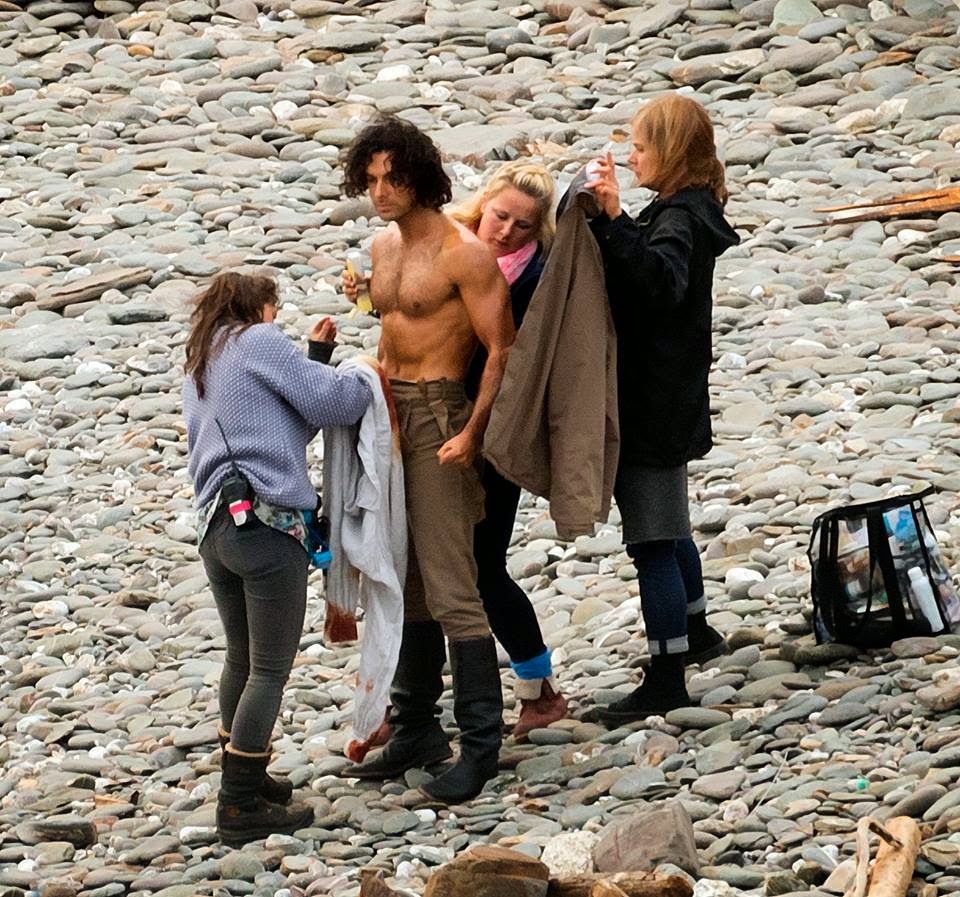
I close by sharing some great images of Aidan Turner as Ross Poldark on the set of the new Poldark adaptation. Turner has signed a five year contract with the BBC, which bodes well for the filming of all twelve Poldark novels. Filming of what will be the first season of the series finished last month. So far no date has been given for when the new Poldark will air next year. In the U.S., it will be broadcast as part of PBS's Masterpiece series. For updates, click here.


Above: Aidan Turner with Poldark co-director Edward Bazalgette.


Above: Preparing to shoot a scene at Dollar Cove in Cornwall.
(Photo: Tim Martindale)


Above: Aidan with (at left) Poldark executive producer Karen Thrussell.


Above and below: I particularly like these behind-the-scenes shots showing Aidan Turner in his eighteenth-century Poldark garb sitting amidst the film-making technology of the twenty-first century!


For previous Poldark-related posts, see:
Passion, Time and Tide
A "Useful Marriage" for Morwenna
Time and Remembrance in the Poldark Novels
"Hers Would Be the Perpetual Ache of Loss and Loneliness"
Demelza Takes a Chance (Part 1)
Demelza Takes a Chance (Part 2)
Captain Blamey Comes A-Calling
Rendezvous in Truro
Cornwall's – and Winston Graham's – Angry Tide
A Sea Dragon of an Emotion . . . "Causing Half the Trouble of the World, and Half the Joy"
Into the Greenwood
"I Want You to Become a Part of Me – Each to Become a Part of the Other"
Home

Recommended Resource:
A Winston Graham Reader – Ellen Moody (Ellen and Jim Have a Blog, Two, September 6, 2014).


Related Off-site Links:
Andrew Graham, Son of Author Winston, on Poldark FilmingThe David White Show (BBC Cornwall, June 10, 2014).
Aidan Turner Shoots Late-night Shipwreck Scene as Filming Continues on Poldark Remake in Cornwall – Ryan Smith (Daily Mail, July 1, 2014).
First Image: Aidan Turner In BBC One’s Poldark Reboot – Patrick Munn (TV Wise, May 8, 2014).
Anger as Poldark Begins Filming – in Wiltshire – Martin Hesp (Western Morning News, May 8, 2014).
Brooding Looks from Star Aidan Turner as Poldark Comes to Corsham – Joanne Moore (Gazette and Herald, May 6, 2014).
Poldark Filming in Corsham with Aidan TurnerWestern Daily Press (May 6, 2014).
Together Again! Aidan Turner's Ross is Reunited with Heida Reed's Elizabeth as Filming Begins for Poldark Remake – Archie Rice (Daily Mail, May 6, 2014).
BBC One Drama Poldark Begins Filming at Bristol's Bottle Yard StudiosTheBottleYard. com (April 27, 2014).
Chavenage House Gets 18th Century Makeover for Filming of BBC's Poldark – Brendan McFadden (Wilts and Gloucestershire Standard, April 23, 2014).
Poldark: Bristol is Hosting Comeback of TV's Top Bodice-RipperThe Bristol Post (April 16, 2014).
Robin Ellis: My Return to Poldark . . . the Remake – Peter Robertson (Express, April 10, 2014).
Passion, Pilchards and Why Poldark is Sexier Than Mr Darcy – Jan Moir (Daily Mail, March 31, 2014).
Eleanor Tomlinson to Star as Demelza in BBC One Drama PoldarkBBC (March 31, 2014).
Unveiled: Eleanor Tomlinson, Poldark's New Demelza – Ben Ellery and Peter Robertson (Daily Mail, March 29, 2014).
Poldark Finds Its DemelzaScreen Terrier (March 28, 2014).
Some Fans of Poldark Not Happy With Choice of Aidan Turner for Starring RoleCornish Guardian (March 15, 2014).
Poldark Role for Hobbit Star Aidan Turner Press Association via Yahoo! TV (February 28, 2014).
Hero Hobbit Aidan Turner Has Embarked on New Quest as Star of Poldark – Nicola Methven (The Mirror, February 28, 2014).
Poldark: Aidan Turner Has Big Shoes to Fill – Sarah Crompton (The Telegraph, February 28, 2014).
Revealed, New Star of Poldark: Irish Actor Aidan Turner to Take Role on Remake of Much Loved Costume Drama – Emma Lowe (Daily Mail, February 27, 2014).
Aidan Turner to Play Poldark in New BBC Adaptation – Ben Dowell (Radio Times, February 27, 2014).
Poldark Remake for BBC OneBBC News – Entertainment and Arts (May 9, 2013)


Saturday, September 27, 2014

A Ewe Questions Her Shepherds

.
It is my understanding that many of you are gay and even regularly, actively engage in homosexual activities, albeit clandestinely. Those of you who do this would be living a lie. Yet you welcome closet homosexual clergy living duplicitous lives at table and even permit them to consecrate the host. However, homosexuals who honestly portray their sexual orientation you do not welcome. Why are you threatened welcoming to the table people who have the courage to present themselves authentically but are not threatened welcoming to the table people whose lives are a tangled web of lies and hypocrisy?

– Excerpted from "Some Thoughts on the Upcoming Synod on the Family"
Questions from a Ewe
September 27, 2014


See also the previous Wild Reed posts:
Gay Men in the Vatican Are Giving the Rest of Us A Bad Name
Homosexuality and the Priesthood
Officially Homophobic, Intensely Homoerotic
A Fact That Should Be Neither Surprising Nor Derogatory
Vatican Stance on Gay Priests Signals Urgent Need for Renewal and Reform
Keeping All the Queens Under One Roof
Oh, Give It a Rest, Papa!
What the Vatican Can Learn from the X-Men

Related Off-site Links:
Love, Marriage and the Vatican: Americans' Attitudes about Marriage and the Catholic Church – Paul Herrnson and Kathleen Weldon (The Huffington Post, September 29, 2014).
Next Month's Extraordinary Synod on the Family in Rome is "Dangerously Homogenous" – John O'Loughlin Kennedy (The Irish Times, September 23, 2014).
How LGBT-Friendly Are the Appointees to the Synod on Marriage and Family? – Francis DeBernardo (Bondings 2.0, September 11, 2014).
The Makeup of Synod of Bishops on the Family is Disappointing – Thomas Reese (National Catholic Reporter, September 10, 2014).


Friday, September 26, 2014

Thursday, September 25, 2014

Louis Crompton on the "Theological Assault" of the Ulpianic-Thomistic Conception of Natural Law (Part II)

Continuing with The Wild Reed's exploration of natural-law theory, I present this evening a second excerpt from Louis Crompton's authoritative work Homosexuality and Civilization. (For the first excerpt, click here.)

The sharing of this excerpt is timely given the recent news that John C. Nienstedt, Archbishop of St. Paul-Minneapolis, has forced the resignation of Jamie Moore, a local parish music director, after it became known that Moore had entered a civil marriage with his male partner. In attempting to defend his actions, Nienstedt, who, among other things, is facing calls for his own resignation over his handling of clergy sex abuse complaints, insists that he is simply upholding the teaching of the church on marriage, which for the clerical leadership of the church are the same as the teaching on sexuality. After all, this leadership doesn't actually have a sexual theology, i.e., a way of taking about the gift of human sexuality that acknowledges and honors its intrinsic diversity. Rather, it has a very narrow theology (and thus teaching) on marriage based, as Crompton correctly identifies, on the Ulpianic-Thomistic understanding of natural law. Members of the church's clerical leadership would have us believe that they and they alone are the sole interpreters and guardians of this understanding and the theology and teachings that stem from it. Furthermore, these teachings are declared to have come from Christ himself. Accordingly, they are said to be eternal and thus unchangeable. Such ignorance and hubris!

As Crompton (and others) have clearly documented, teachings based on this interpretation of so-called natural law have in fact evolved and changed. For example, Crompton notes below that "the fathers of the church and medieval theologians [once] fiercely condemned usury (that is, any charging of interest) as a mortal sin, employing the same rhetoric used against homosexuality." Yet now, as we all know, the Vatican has its own interest-charging bank! Nienstedt and his ilk would do well to reflect upon Crompton's words: "Far from being an immutable, unchanging, and eternal standard, natural-law philosophy has accommodated itself to the prejudices of particular ages, often lending them a factitious air of philosophical respectability."


The other route by which Aquinas arrives at his category of "unnatural sins" is philosophical rather than zoological. It derives from Aristotle's doctrine of "final causes," that is, those ends or purposes for the sake of which things or activities exist. According to this view, as food exists for the preservation of the individual, so sex exists for the preservation of the races. Thus, sex must always serve its proper "natural" end, and all non-procreative sexual acts are "unnatural."

Aquinas, in addition, endorses Augustine's opinion that homosexuality is the "worst" of sexual sins. To make his point perfectly clear, Aquinas poses a question: are not rape and adultery worse than unnatural acts, since they harm other persons, while consensual sins against nature do not? The answer is unequivocal: the four non-procreative forms of sex are worse, since – though not harmful to others – they are sins directly against God himself as the creator of nature. According to this logic, rape, which may at least lead to pregnancy, becomes a less serious sin than masturbation. And what of contraception? Would marital intercourse using artificial birth control be an unnatural act? Aquinas does not raise the question in Summa, but earlier he so classified it in his commentary on the Sentences of Peter Lombard. By this reasoning, conjugal sex with contraception must be ranked as an unnatural sin only one degree less serious than homosexual behavior.

Moreover, as [theologian Charles] Curran has pointed out, natural-law theory is not "a monolithic philosophical system agreed upon body of ethical content existing from the beginning of time." The concept of natural law is exceedingly ambiguous and has been given radically different interpretations at different times by different thinkers. Behaviors as diverse as shaving the beard, using anesthesia in childbirth, and flying have on occasion been labeled unnatural. To take one example: in the seventh circle of his "Inferno" Dante dramatizes the punishment of men guilty of "violence against nature," or, as he alternatively puts it, "the "sins of Sodom and Cahors." Readers familiar with Sodom's lurid reputation may well wonder what took place in the Provencal city of Cahors. The fact is that Cahors was a financial center, and its unnatural sin was usury.

Dante's judgment rested on a well-established medieval doctrine. Aristotle had called usury unnatural, since money should not breed money. Drawing on the Levitical prohibition (25:36-37) against interest, the fathers of the church and medieval theologians fiercely condemned usury (that is, any charging of interest) as a mortal sin, employing the same rhetoric used against homosexuality. Thus, [Panormitanus] a fifteenth-century canonist could write: "Whenever humans sin against nature, whether in sexual intercourse, worshiping idols, or any other unnatural act, the church may always exercise its jurisdiction. [So some have held] that the church could prosecute usurers and not thieves and robbers, because usurers violate nature by making money grow which would not increase naturally." Catholic theologians did not seriously challenge the church's traditional view of usury until the eighteenth century; and the canon law making the charging of interest a mortal sin was not dropped until 1917. Throughout history people have branded a multitude of behaviors as "unnatural." This has sometimes meant no more than that they disliked them on whatever grounds, serious or trivial. Far from being an immutable, unchanging, and eternal standard, natural-law philosophy has accommodated itself to the prejudices of particular ages, often lending them a factitious air of philosophical respectability.


For more on natural law at The Wild Reed see:
Louis Crompton on the "Theological Assault" of the Ulpianic-Thomistic Conception of Natural Law (Part I)
Aquinas and Homosexuality
Daniel Helminiak on the Vatican's Natural Law Mistake
Nathanial Frank on the "Natural Law" Argument Against Same-Sex Marriage
Homosexuality is Not Unnatural
Rediscovering What Has Been Written on Our Hearts from the Very Beginning
Dialoguing with the Archbishop on Natural Law
Spirituality and the Gay Experience
Joan Timmerman and the "Wisdom of the Body"
Good News on the Road to Emmaus
Relationship: The Crucial Factor in Sexual Morality
Liberated to Be Together
The Blood-Soaked Thread

See also The Wild Reed series, “Perspectives on Natural Law,” featuring the insights of:
Herbert McCabe, OP
Judith Web Kay
Daniel Helminiak
Garry Wills
Gregory Baum
William C. McDonough

Related Off-site Links:
Archbishop Nienstedt, Firing of Gay Catholic Employees, and Upholding Teachings of the Church: Critical Reflection – William D. Lindsey (Bilgrimage, September 25, 2014).
In Minnesota and Montana Dismissals, Hypocrisy Abounds – Bob Shine (Bondings 2.0, September 25, 2014).
"I Thought I Could Be A Gay Jesuit Priest. I Can’t Believe How Wrong I Was" – Ben Brenkert (The Washington Post, September 17, 2014).
Jesuit Leaves Church After Firings – Nicholas Sciarappa (National Catholic Reporter, September 22, 2014).
Homosexual Relationships: Another Look – Bill Hunt (The Progressive Catholic Voice, September 8, 2012).

Image: Detail of "Two Men Kissing" (Bacio fra due uomini) by Bartolomeo Cesi (c. 1600).