Wednesday, December 26, 2018

Christmas in America, 2018


"Holy Family" by Kelly Latimore.


Jakelin Caal died at age 7, on the Feast of the Immaculate Conception.

Felipe Alonzo Gomez died at age 8 on Christmas Eve.

Both were in the custody of the US Border Patrol.

This is how the Infant Jesus is coming to us today, whether we like it or not: as the migrant child. And we are neither welcoming Jesus, nor caring for Jesus.

And how sad that so many people are blaming the parents for the deaths of these poor children! Their parents were fleeing to a safer country precisely to protect their sons and daughters. You might as well blame Mary and Joseph for bringing Jesus to Egypt (Matthew 2:13-22).

"I was a stranger and you did not welcome me" (Mt. 25).

James Martin, SJ
via Facebook
December 26, 2018


[A] second Guatemalan child, an 8 year old boy, [has] died in U.S. Border Patrol custody after being held for more than a week while seeking asylum. This tragedy was not an accident, but the result of systematic set of policies attacking the humanity of our neighbors to the south.

There's no reason this child seeking asylum should have been detained since December 18th except this: Trump is enacting an extrajudicial policy of maximizing trauma and violence as a deterrent to refugee seekers, while ignoring U.S. and international law.

A 38 year old statute clearly states people seeking asylum can apply in a timely manner no matter where they cross, which Trump's Supreme Court just failed to overturn 5-4 with Ruth Ginsberg casting the deciding vote from her hospital bed.

These assaults on human dignity are the result of the rise of white supremacist ideology embodied by Trump, which blames immigrants for our economic crisis instead of greedy corporations.

After failing to secure funding for the wall he promised Mexico would pay for, Trump has shut down the federal government costing us more than $1 Billion per day. The stock market Trump loves to brag about is having it's worst December since the great depression, and Trump seems more erratic with every day that passes.

If it's not clear yet, it should be: This right wing movement will stop at nothing to advance its hateful agenda.

As we enter 2019, we are entering a new chapter in American history with more at stake than ever. We must choose unity over division, clarity over confusion, and courage over despair.

– Nick Espinosa
via Facebook
December 26, 2018


– Andy Marlette (The Pensacola News Journal)


Related Off-site Links:
Guatemalan Boy, 8, Dies at Border While in Government Custody, Second to Die This Month – Lindsay Schnell (USA Today, December 25, 2018).
Who Killed Jakelin Caal Maquín at the US Border? – Greg Grandin and Elizabeth Oglesby (The Nation, December 17, 2018).
A Migrant Girl Dies at the Border. She Was No Terrorist, Mr. President – The Editorial Board (Chicago Sun Times, December 16, 2018).
At Christmas, Remember That Jesus Was a Refugee – Jay Parini (CNN, December 22, 2018).
At Christmas Time, Why Aren’t We Protecting Contemporary Holy Families? – Jim McDermott (America, December 21, 2018).

UPDATES: Another Child Dies: Homeland Security Secretary Kirstjen Nielsen Blames the Family and "Open Borders" – Igor Derysh (Salon, December 30, 2018).
"Absolutely Disgusting": In First Comment on Deaths of Two Young Kids in US Custody, Trump Falsely Blames Democrats and Child's Father – Jake Johnson (Common Dreams, December 30, 2018).

See also the previous Wild Reed posts:
A Prayer for Asylum Seekers Being Tear-Gassed at the Border
Opposing the Trump Administration's Inhumane Treatment of Immigrant Families
Something to Think About – November 27, 2018
"What We're Seeing Here Is a Tipping Point"No Room for Them
Something to Think About – December 25, 2016
2000+ Take to the Streets of Minneapolis to Express Solidarity with Immigrants and Refugees
Something to Think About – December 25, 2012


Monday, December 24, 2018

Guidelines for the Advent of a Universal Mysticism (Part 8)


The Wild Reed’s 2018 Advent series focusing on eight guidelines for interreligious understanding and the recognition and facilitation of a universal approach to mysticism, concludes today. As has been noted previously, these guidelines were developed by Thomas Keating and members of the Snowmass Conference. They are excerpted from Wayne Teasdale’s 1999 book, The Mystic Heart: Discovering a Universal Spirituality in the World’s Religions.

Along with many other people, I trust that the coming (or advent) of this universal spirituality is something that the Divine is calling humanity to embrace and embody. May it be so!

(Note: To start at the beginning of this series, click here).


The Eighth Guideline

Guideline eight turns to the issue of spiritual practice, emphasizing its utter importance in the mystical journey. Yet it also recognizes that spiritual practice alone will not achieve the transformation we desire. It is deeper than simply a matter of our own efforts at inner and outer change, regardless of how noble and heroic these are. Our transformation is based, rather, on the depth and quality of our relationship with Ultimate Reality. It is this relationship that determines our elevation into higher awareness, compassionate being, and loving presence. The eighth guideline says: Disciplined practice is essential to the spiritual life; yet spiritual attainment is not the result of one’s own efforts, but the result of the experience of oneness (unity) with Ultimate Reality.

In other words, what transform us is not what we do but our integration with what is. What we do in the way of our spiritual effort, our habits of prayer,* meditation, compassion, and love are all important; but the cause of change is the inner mystical process of union with the source. That, and that alone, is what brings about inner change and carries us into the everlasting roots of our expanded identity in the divine.

________________________


* Prayer is communion with Ultimate Reality, whether it is regarded as personal, communal, or both. Prayer is an essential activity found in every culture and every time. It defines human nature in its highest sense, in its efforts at spiritual attainment, and inner change of heart, mind, and behavior. It is the fundamental and perennial method of scaling the heights and probing the depths of the real.


See also the previous Wild Reed posts:
Guidelines for the Advent of a Universal Mysticism: An Introduction
Guidelines for the Advent of a Universal Mysticism (Part 1)
Guidelines for the Advent of a Universal Mysticism (Part 2)
Guidelines for the Advent of a Universal Mysticism (Part 3)
Guidelines for the Advent of a Universal Mysticism (Part 4)
Guidelines for the Advent of a Universal Mysticism (Part 5)
Guidelines for the Advent of a Universal Mysticism (Part 6)
Guidelines for the Advent of a Universal Mysticism (Part 7)
Something Extraordinary . . . Again
In Search of a Global Ethic
The Ground Zero Papal Prayer Service . . . and a Reminder of the Spirituality That Transcends What All the Religions Claim to Represent
A Return to the Spirit
Beltane and the Reclaiming of Spirit
New Horizons: Reflections on A Passage to India
Advent: A “ChristoPagan” Perspective
An Advent Prayer
Advent: The Season of Blessed Paradox
Active Waiting: A Radical Attitude Toward Life
No Other Time, No Other Place
Advent: Renewing Our Connection with the Sacred
Celebrating the Coming of the Sun and the Son
Christmastide Approaches

Opening image:The Prayer Tree” by Michael Bayly. Each of the posts in this series is accompanied by one or two images of what I've come to call the Prayer Tree, that special oak tree by Minnehaha Creek, close to my home in south Minneapolis. This tree and its location serve as a sacred place for me; for as its name suggests, I go there to pray, meditate, and reflect deeply. Also, as my friend McAuley recently pointed out, it serves as a beautiful representation of the axis mundi – the cosmic axis, the center of the world. Often symbolized by a tree, the axis mundi, as both a celestial and geographic pillar, serves as a point of connection between sky (heaven) and earth, the higher and lower realms of consciousness, and the four compass directions. As a representation of the axis mundi, and thus a rich symbol of groundedness, connection, and unity, the "Prayer Tree" seems a very appropriate image for The Wild Reed's 2018 Advent series on universal mysticism.


Sunday, December 23, 2018

Forbidden Lover


The mid to late-1980s saw a number of, shall we say, mature female vocalists teaming up to sing with younger artists.

Perhaps the most celebrated of these collaborations (and certainly the most successful chart-wise) was Dusty Springfield and the Pet Shop Boys with "What Have I Done to Deserve This?" (1987). But there were a number of others: Aretha Franklin and Eurythmics ("Sister Are Doing It for Themselves," 1985), Shirley Bassey and Yello ("The Rhythm Divine," 1987), and the one that perhaps started it all, Sandi Shaw and the Smiths' "Hand in Glove" (1984).

Another similar collaboration took place in 1987 when celebrated "song stylist" Nancy Wilson recorded "Forbidden Lover" with Carl Anderson. It was the title track of her then latest album, one which, according to AllMusic.com, was an "attempt to contemporize her sound, with arrangements that recall Luther Vandross and the Earth, Wind & Fire horn section." Wilson, however "gets lost on most of these recordings."

One notable exception is "Forbidden Lover." True, the song when released as a single didn't chart, but it does display the phenomenal vocal abilities of both Wilson and Anderson to great effect.

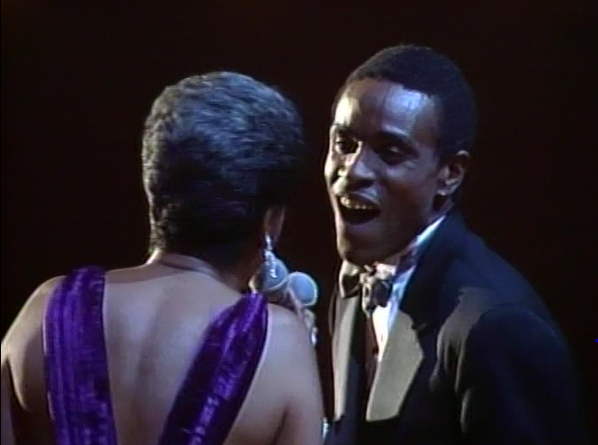
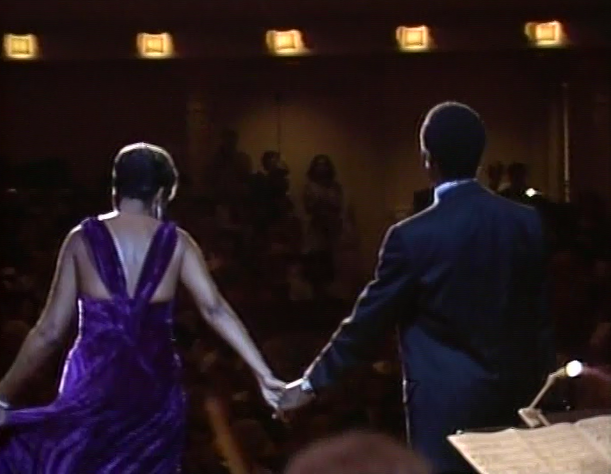
Given the recent passing of Nancy Wilson, and the fact that the late great Carl Anderson is my favorite male vocalist, I thought I'd share today the official video for "Forbidden Lover." Also, when Wilson performed at Carnegie Hall for the 1987 JVC Jazz Festival, Carl appeared on stage with her to sing both "Forbidden Lover" and "First Time On a Ferris Wheel." (Many of the images that accompany this post are from that memorable appearance of Nancy and Carl together.)


I'm overwhelmed by your love
It makes me question my love
What can I do to make it real good for you?
If you ask me for the world I'll give it to you

You make me crazy for love
You're all that I'm dreaming of
I see you everywhere
I want you to be there
I'm in your spell

Tell me how much will it take
For you to give me your love?
You say me want me to be there
But how long must I wait?
I give you good love
To make you feel brand new
Now it's all up to you
Tell me, what can we do?
Such a forbidden love that's shared by two
This world will talk about me and you
Just say you will
I want you to be my forbidden lover

So we talk and we talk about love
Then we give in, we make love
How can a love so wrong turn out to be so strong?
When you say there's just no use holding on

So we toss and we turn over love
Should we wait or give in to love?
Is it stop or go?
Should I take it fast or slow?
Forbidden lover


For more of Carl Anderson at The Wild Reed, see:
Revisiting a Groovy Jesus (and a Dysfunctional Theology)
Carl Anderson
Carl Anderson: "One of the Most Enjoyable Male Vocalists of His Era"
With Love Inside
Acts of Love . . . Carl's and Mine
The Carl Anderson Appreciation Group


Saturday, December 22, 2018

Guidelines for the Advent of a Universal Mysticism (Part 7)


The Wild Reed’s 2018 Advent series focuses on eight guidelines for interreligious understanding and the recognition and facilitation of a universal approach to mysticism. These guidelines were developed by Thomas Keating and members of the Snowmass Conference. They are excerpted from Wayne Teasdale’s 1999 book, The Mystic Heart: Discovering a Universal Spirituality in the World’s Religions.

Along with many other people, I trust that the coming (or advent) of this universal spirituality is something that the Divine is calling humanity to embrace and embody. (Note: To start at the beginning of this series, click here.)


The Seventh Guideline

The chief characteristic of the age we live in is our willingness to explore other ways of looking at life. . . . We are beginning to feel comfortable [exploring aspects of] other traditions, particularly alternative prayer forms, meditation, and yoga. We are hungry for the divine; we are striving for a breakthrough. Sooner or later, it will happen. If a person is really trying, and is devoting time for prayer or meditation each day – preferably twice a day – then, sooner or later, a breakthrough will occur.

One of the great problems of the contemporary world is the sense of isolation people feel – from the ultimate mystery, nature, other people, and our fellow creatures. This feeling of separation is a relative perspective growing out of a cultural milieu of human autonomy from the source and from one another. Such a perspective is, in the end, an illusion. The seventh guideline, and a further basis for interreligious conversation and cooperation, recognizes this danger of isolation and separation: As long as the human condition is experienced as separate from Ultimate Reality, it is subject to ignorance, illusion, weakness, and suffering.

When our life is divided against itself, it is out of touch with the way things really are: each person as part of a vast community of consciousness that embraces the totality. Bede Griffiths often said that sin is separation, referring to the false posture of autonomy so many people assume in their lives. Autonomy is illusion, and the paramount ignorance of our time. It has justified so much destructive behavior, in government, business, education, health care, and within families. But if we understand that we are intimately connected with the totality, and with all others, then our attitudes, habits, words, and actions will be measured, always seeking harmony.


NEXT: The Eighth Guideline


See also the previous Wild Reed posts:
Guidelines for the Advent of a Universal Mysticism: An Introduction
Guidelines for the Advent of a Universal Mysticism (Part 1)
Guidelines for the Advent of a Universal Mysticism (Part 2)
Guidelines for the Advent of a Universal Mysticism (Part 3)
Guidelines for the Advent of a Universal Mysticism (Part 4)
Guidelines for the Advent of a Universal Mysticism (Part 5)
Guidelines for the Advent of a Universal Mysticism (Part 6)
Something Extraordinary . . . Again
In Search of a Global Ethic
The Ground Zero Papal Prayer Service . . . and a Reminder of the Spirituality That Transcends What All the Religions Claim to Represent
A Return to the Spirit
Beltane and the Reclaiming of Spirit
New Horizons: Reflections on A Passage to India
Advent: A “ChristoPagan” Perspective
An Advent Prayer
Advent: The Season of Blessed Paradox
Active Waiting: A Radical Attitude Toward Life
No Other Time, No Other Place
Advent: Renewing Our Connection with the Sacred
Celebrating the Coming of the Sun and the Son
Christmastide Approaches

Images: My friend Mahad at the “Prayer Tree” (Michael Bayly, 8/12/18). Each of the posts in this series is accompanied by one or two images of what I've come to call the Prayer Tree, that special oak tree by Minnehaha Creek, close to my home in south Minneapolis. This tree and its location serve as a sacred place for me; for as its name suggests, I go there to pray, meditate, and reflect deeply. Also, as my friend McAuley recently pointed out, it serves as a beautiful representation of the axis mundi – the cosmic axis, the center of the world. Often symbolized by a tree, the axis mundi, as both a celestial and geographic pillar, serves as a point of connection between sky (heaven) and earth, the higher and lower realms of consciousness, and the four compass directions. As a representation of the axis mundi, and thus a rich symbol of groundedness, connection, and unity, the Prayer Tree seems a very appropriate image for The Wild Reed's 2018 Advent series on universal mysticism.


Friday, December 21, 2018

Brigit Anna McNeill on the Meaning of Winter Solstice Time


In marking this year's winter solstice I share a beautiful and insightful reflection by Brigit Anna McNeill. The artwork that accompanies this post is by Anders Røkkum.

We are approaching the threshold of winter.

Life is being drawn into the earth, painlessly descending down into the very heart of herself.

And we as natural human animals are being called to do the same, the pull to descend into our bodies, into sleep, darkness and the depths of our own inner caves is continually tugging at our marrow.

But many find the descent into their own body a scary thing indeed, fearing the unmet emotions and past events that they have stored in the dark caves inside themselves, not wanting to face what they have so carefully and unkindly avoided.

This winter solstice time is no longer celebrated as it once was, with the understanding that this period of descent into our own darkness was so necessary in order to find our light. That true freedom comes from accepting with forgiveness and love what we have been through and vanquishing the hold it has on us, bringing the golden treasure back from the cave of our darker depths.

This is a time of rest and deep reflection, a time to wipe the slate clean as it were and clear out the old so you can walk into spring feeling ready to grow and skip without a dusty mountain on your back and chains around your ankles tied to the caves in your soul.

A time for the medicine of story, of fire, of nourishment and love.

A period of reconnecting, relearning and reclaiming of what this time means brings winter back to a time of kindness, love, rebirth, peace and unburdening instead of a time of dread, fear, depression and avoidance.

This modern culture teaches avoidance at a max at this time; alcohol, lights, shopping, overworking, over spending, bad food and consumerism.

And yet the natural tug to go inwards, as nearly all creatures are doing, is strong and people are left feeling as if there is something wrong with them, that winter is cruel and leaves them feeling abandoned and afraid. Whereas in actual fact, winter is so kind. Yes, she points us in her quiet soft way towards our inner self, towards the darkness and potential death of what we were, but this journey, if held with care, is essential.

She is like a strong teacher that asks you to awaken your inner loving elder or therapist, holding yourself with awareness of forgiveness and allowing yourself to grieve, to cry, rage, laugh, and face what we need to face in order to be freed from the jagged bonds we wrapped around our hearts, in order to reach a place of healing and light without going into overwhelm.

Winter takes away the distractions, the noise and presents us with the perfect time to rest and withdraw into a womb like love, bringing fire and light to our hearth.


Related Off-site Link:
Winter Solstice 2018 Coincides With Both a Full Moon and Meteor Shower – Trevor Nace (Forbes, December 18, 2018).

See also the previous Wild Reed posts:
Winter's Return
Celebrating the Coming of the Sun and the Son
A Winter Reflection
Reclaiming the "Hour of God"
Winter Beauty
Our Quiet Time
Winter . . Within and Beyond
Christmastide Approaches

Image: Anders Røkkum.


Thursday, December 20, 2018

Guidelines for the Advent of a Universal Mysticism (Part 6)


The Wild Reed’s 2018 Advent series focuses on eight guidelines for interreligious understanding and the recognition and facilitation of a universal approach to mysticism. These guidelines were developed by Thomas Keating and members of the Snowmass Conference. They are excerpted from Wayne Teasdale’s 1999 book, The Mystic Heart: Discovering a Universal Spirituality in the World’s Religions.

Along with many other people, I trust that the coming (or advent) of this universal spirituality is something that the Divine is calling humanity to embrace and embody. (Note: To start at the beginning of this series, click here.)


The Sixth Guideline

Everything is an avenue leading to the experience of Ultimate Reality. The divine communicates itself in all things. That there are infinite ways to encounter the source is the essential truth of the sixth guideline: Ultimate Reality may be experienced not only through religious practices but also through nature, art, human relationships, and service to others.

The ultimate can be experienced in virtually anything. There is no place, no activity that restricts the divine. It is everywhere.


NEXT: The Seventh Guideline


See also the previous Wild Reed posts:
Guidelines for the Advent of a Universal Mysticism: An Introduction
Guidelines for the Advent of a Universal Mysticism (Part 1)
Guidelines for the Advent of a Universal Mysticism (Part 2)
Guidelines for the Advent of a Universal Mysticism (Part 3)
Guidelines for the Advent of a Universal Mysticism (Part 4)
Guidelines for the Advent of a Universal Mysticism (Part 5)
Something Extraordinary . . . Again
In Search of a Global Ethic
The Ground Zero Papal Prayer Service . . . and a Reminder of the Spirituality That Transcends What All the Religions Claim to Represent
A Return to the Spirit
Beltane and the Reclaiming of Spirit
New Horizons: Reflections on A Passage to India
Advent: A “ChristoPagan” Perspective
An Advent Prayer
Advent: The Season of Blessed Paradox
Active Waiting: A Radical Attitude Toward Life
No Other Time, No Other Place
Advent: Renewing Our Connection with the Sacred
Celebrating the Coming of the Sun and the Son
Christmastide Approaches

Images: My friend Mahad at “The Prayer Tree” (Michael Bayly, 8/12/18). Each of the posts in this series is accompanied by one or two images of what I've come to call the Prayer Tree, that special oak tree by Minnehaha Creek, close to my home in south Minneapolis. This tree and its location serve as a sacred place for me; for as its name suggests, I go there to pray, meditate, and reflect deeply. Also, as my friend McAuley recently pointed out, it serves as a beautiful representation of the axis mundi – the cosmic axis, the center of the world. Often symbolized by a tree, the axis mundi, as both a celestial and geographic pillar, serves as a point of connection between sky (heaven) and earth, the higher and lower realms of consciousness, and the four compass directions. As a representation of the axis mundi, and thus a rich symbol of groundedness, connection, and unity, the Prayer Tree seems a very appropriate image for The Wild Reed's 2018 Advent series on universal mysticism.


Wednesday, December 19, 2018

Photo of the Day


Image: Michael J. Bayly.

See also the previous Wild Reed posts:
Winter's Return
Winter . . Within and Beyond
Winter Beauty


Tuesday, December 18, 2018

Guidelines for the Advent of a Universal Mysticism (Part 5)


The Wild Reed’s 2018 Advent series focuses on eight guidelines for interreligious understanding and the recognition and facilitation of a universal approach to mysticism. These guidelines were developed by Thomas Keating and members of the Snowmass Conference. They are excerpted from Wayne Teasdale’s 1999 book, The Mystic Heart: Discovering a Universal Spirituality in the World’s Religions.

Along with many other people, I trust that the coming (or advent) of this universal spirituality is something that the Divine is calling humanity to embrace and embody. (Note: To start at the beginning of this series, click here.)


The Fifth Guideline

We are all mystics by virtue of our birth. We are meant for something more. All the religions inform us of this truth, and many forms of spirituality are ways for each one of us to nurture the awakening and steady growth of our inner realm of connection with the source. Guideline five addresses this point: The potential for human wholeness – or in other frames of reference, enlightenment, salvation, transformation, blessedness, nirvana – is present in every human person.

We have – indeed, we are – this potential for unlimited being because this mystical dimension is part of what makes us human. Realizing our potential for wholeness, for the divine inner core of our nature, is the goal of life. We are beings in transit to this wholeness. That is precisely why we are here.

This world is a launching pad! We are sometimes restless because we are made for a permanent fulfillment. The character Auntie Mame reflects this insight when she says to her wide-eyed nephew: “Life is a banquet, but most suckers are starving!” The mystical life is the banquet. Anything short of this is just a cheese sandwich.


NEXT: The Sixth Guideline


See also the previous Wild Reed posts:
Guidelines for the Advent of a Universal Mysticism: An Introduction
Guidelines for the Advent of a Universal Mysticism (Part 1)
Guidelines for the Advent of a Universal Mysticism (Part 2)
Guidelines for the Advent of a Universal Mysticism (Part 3)
Guidelines for the Advent of a Universal Mysticism (Part 4)
Something Extraordinary . . . Again
In Search of a Global Ethic
The Ground Zero Papal Prayer Service . . . and a Reminder of the Spirituality That Transcends What All the Religions Claim to Represent
A Return to the Spirit
Beltane and the Reclaiming of Spirit
New Horizons: Reflections on A Passage to India
Advent: A “ChristoPagan” Perspective
An Advent Prayer
Advent: The Season of Blessed Paradox
Active Waiting: A Radical Attitude Toward Life
No Other Time, No Other Place
Advent: Renewing Our Connection with the Sacred
Celebrating the Coming of the Sun and the Son
Christmastide Approaches

Opening image:The Prayer Tree” by Michael Bayly. Each of the posts in this series is accompanied by one or two images of what I've come to call the Prayer Tree, that special oak tree by Minnehaha Creek, close to my home in south Minneapolis. This tree and its location serve as a sacred place for me; for as its name suggests, I go there to pray, meditate, and reflect deeply. Also, as my friend McAuley recently pointed out, it serves as a beautiful representation of the axis mundi – the cosmic axis, the center of the world. Often symbolized by a tree, the axis mundi, as both a celestial and geographic pillar, serves as a point of connection between sky (heaven) and earth, the higher and lower realms of consciousness, and the four compass directions. As a representation of the axis mundi, and thus a rich symbol of groundedness, connection, and unity, the "Prayer Tree" seems a very appropriate image for The Wild Reed's 2018 Advent series on universal mysticism.


Monday, December 17, 2018

Thoughts on the Disease of Addiction


I’ve mentioned a few times in previous posts that I have a friend who is struggling with addiction to illegal drugs, mainly heroin and meth. In attempting to be a supportive presence, I’ve found myself struggling to understand how I can be the best and truest friend I can be for him. Discerning such knowledge is not always easy.

I dare say my experience is familiar to many reading this. After all, substance abuse and addiction impact millions of individuals and families across the U.S. It’s a problem that is often referred to as the “opioid epidemic,” and a grim indication of just how serious it has become is that drug overdoses are now the leading cause of death of Americans under 50. I don’t want my friend to die; I don’t want him to be part of that frightening and tragic statistic. At the same time I know I can’t “fix” him or even really “help” him.

What I’m beginning to understand is that I can't really do anything. Rather, I can be there for him in ways that encourage and support his own efforts to do two things: 1) trust and get in touch with his whole and authentic self, a self that is deeper than his addiction yet obscured by this insidious disease; and 2) find, participate in, and persevere with what is known as “evidence-based treatment” for the disease of addiction.

I’m sharing all of this as I want to do my bit in somehow acknowledging and addressing the issue of addiction. Specifically, I’ve decided to launch a new series at The Wild Reed, one whereby I’ll be sharing some of the writings on addiction and its treatment that I’ve found to be helpful as I’ve accompanied my friend through his ongoing struggle.

I begin this new series tonight with an excerpt from David Sheff’s 2013 book, Clean: Overcoming Addiction and Ending America’s Greatest Tragedy. Sheff is also the author of Beautiful Boy, a memoir of his efforts to accompany his son through his addiction. Sheff’s memoir, along with the one penned by his son, form the basis of the recent film Beautiful Boy.

This first excerpt is a concise and insightful articulation of the foundations of Clean: Addiction is a preventable, treatable disease, not a moral failing. As with other illnesses, the approaches most likely to work are based on science – not on faith, tradition, contrition, or wishful thinking.

_________________________


The main problems with America’s addiction-treatment system stem from its roots in the archaic notion that addiction is a choice, not a disease. One common symptom of the disease of addiction is relapse. Kicking an addict out of treatment for relapsing is like kicking a cancer patient out of treatment when a tumor metastasizes.

How are diseases treated? Many addicts describe programs in which “therapies” included group sessions during which patients were encouraged to denounce and rebuke one another – the goal was to break them. The philosophy behind such “treatments” is that addicts are undisciplined and morally bankrupt, so they have to be punished. In many treatment facilities, patients are lambasted, criticized, and berated. They’re told they aren’t going “with the program” and scolded for their bad attitude or arrogance. In the Congressional Quarterly, former congressman Patrick Kennedy, who’s been open about his addictions, summed up the problem with sad, hard-won eloquence: “I’ve made a very close personal analysis of treatment centers. I’ve gone to the best in the country myself . . . It’s all based upon . . . treating your weakness instead of your strengths.” I’ve never heard of any disease that responds to censure, blame, or denial of treatment.

Over the course of centuries, medicine has evolved from a disorganized and dangerous realm dominated by guesswork, received wisdom, faith, and fear into a comparatively reliable and effective means of dealing with a wide array of illnesses. It’s now grounded in evidence-based approaches – also known as evidence-based treatment (EBT) or evidence-based programs (EBP) – ones developed by doctors and researchers and proven effective in clinical trials. EBT is the paradigm that defines treatment in Clean. People choose proven treatments, not shots in the dark.

The current addiction-treatment system is based on shots in the dark., at least most of the time. There’s a standard model used for other illnesses. A patient sees a doctor and explains his complaint. A history is taken, and that’s followed by a physical examination. There are ancillary tests if needed, diagnosis, treatment, and then follow-up care. Bur patients with drug problems are rarely examined at all by a medical professional. If they are, the physical comes after they’ve been diagnosed, often by people without any credentials whatsoever, based solely on the addict’s behavior and their own descriptions of their drug use. Or they aren’t really diagnosed at all; everyone who walks in the door is presumed to be a drug addict, as if there’s only one form of the disease, and the addict is sent to generic rehab, as if there’s one form of treatment.

If you’re looking for treatments supported by evidence, the system is fraught with challenges, because, compared to other illnesses, there’s still not enough empirical evidence to offer a clear course forward. Many questions about addiction and treatment simply haven’t been answered categorically yet, and there’s active debate over the most basic assumptions about treatment – whether inpatient or outpatient programs are more effective, for example; what’s appropriate for adolescents and adults; whether (and when) medication should be part of treatment; how long treatment should last; which therapy models work and which don’t. It’s further complicated by the fact that most addiction treatments (indeed, most treatments for psychiatric problems in general) involve therapy, but there are limitless varieties of therapy. The evidence that supports or discredits each method is often inconsistent. Also, proven treatments may be poorly administered. Addiction medicine isn’t an exact science, and it’s still a relatively new one.


Related Off-site Links:
Amid the Opioid Epidemic, White Means Victim, Black Means Addict – Brian Broome (The Guardian, April 28, 2018).
If Addiction Is a Disease, Why Is Relapsing a Crime? – The Editorial Board (The New York Times, May 29, 2018).

See also the previous Wild Reed posts:
“Wholeness Is Never Lost, It Is Only Forgotten”
Changes
Interfaith Chaplaincy: Meeting People Where They're At
A Longing and a Prayer

Image: Richard Vyse.


Sunday, December 16, 2018

Guidelines for the Advent of a Universal Mysticism (Part 4)


The Wild Reed’s 2018 Advent series focuses on eight guidelines for interreligious understanding and the recognition and facilitation of a universal approach to mysticism. These guidelines were developed by Thomas Keating and members of the Snowmass Conference. They are excerpted from Wayne Teasdale’s 1999 book, The Mystic Heart: Discovering a Universal Spirituality in the World’s Religions.

Along with many other people, I trust that the coming (or advent) of this universal spirituality is something that the Divine is calling humanity to embrace and embody. (Note: To start at the beginning of this series, click here.)


The Fourth Guideline

If we would actualize our innate potential for infinite life and development, we need to follow the path of faith, regardless of our tradition. All paths traverse some expression of faith’s compelling power to lead us into actualization of our spiritual potential. The fourth guideline defines the nature of this experience of faith: Faith is opening, accepting, and responding to Ultimate Reality. Faith in this sense precedes every belief system.

Faith is essentially the quality of openness, eagerness, and expectation we see in children and other enlightened souls. It is a basic attitude of trust in the ultimate mystery behind existence; it is a gesture and stand of pure openness. This attitude of trust precedes a system of belief or a tradition. It is a universal experience and requirement for the higher life; without it, the spiritual journey is impossible. In a certain sense, faith is also a willingness to relinquish control to the source. It is a capacity to trust the mystery of the ultimate.


NEXT: The Fifth Guideline


See also the previous Wild Reed posts:
Guidelines for the Advent of a Universal Mysticism: An Introduction
Guidelines for the Advent of a Universal Mysticism (Part 1)
Guidelines for the Advent of a Universal Mysticism (Part 2)
Guidelines for the Advent of a Universal Mysticism (Part 3)
Something Extraordinary . . . Again
In Search of a Global Ethic
The Ground Zero Papal Prayer Service . . . and a Reminder of the Spirituality That Transcends What All the Religions Claim to Represent
A Return to the Spirit
Beltane and the Reclaiming of Spirit
New Horizons: Reflections on A Passage to India
Advent: A “ChristoPagan” Perspective
An Advent Prayer
Advent: The Season of Blessed Paradox
Active Waiting: A Radical Attitude Toward Life
No Other Time, No Other Place
Advent: Renewing Our Connection with the Sacred
Celebrating the Coming of the Sun and the Son
Christmastide Approaches

Opening image:The Prayer Tree” by Michael Bayly. Each of the posts in this series is accompanied by one or two images of what I've come to call the Prayer Tree, that special oak tree by Minnehaha Creek, close to my home in south Minneapolis. This tree and its location serve as a sacred place for me; for as its name suggests, I go there to pray, meditate, and reflect deeply. Also, as my friend McAuley recently pointed out, it serves as a beautiful representation of the axis mundi – the cosmic axis, the center of the world. Often symbolized by a tree, the axis mundi, as both a celestial and geographic pillar, serves as a point of connection between sky (heaven) and earth, the higher and lower realms of consciousness, and the four compass directions. As a representation of the axis mundi, and thus a rich symbol of groundedness, connection, and unity, the "Prayer Tree" seems a very appropriate image for The Wild Reed's 2018 Advent series on universal mysticism.


Saturday, December 15, 2018

Another First for Black Panther


When it was released earlier this year, Black Panther was the first film of the Marvel cinematic universe to place a black superhero front and centre. It's also one of only a very few films to feature a black director (Ryan Coogler) and a majority black cast (including Chadwick Boseman, Michael B Jordan, Angela Bassett, Daniel Kaluuya, Lupita Nyong’o, Danai Gurira, and Forest Whitaker). In addition, it explores questions and issues about race and identity to a depth never before attempted by a film in the "superhero" genre.

Film critic Kenneth Turan sums it up well: “A superhero movie whose characters have integrity and dramatic heft, laced with socially conscious commentary as well as wicked laughs, Black Panther is the model of what an involving popular entertainment ought to be but hardly ever is.”

For all of these reasons and more, I don't think it's not an exaggeration to say that Black Panther represents an important cultural moment.

It's a moment that continues with the news that Black Panther has garnered yet another accolade: the first superhero movie to be nominated for best picture in the drama category at the Golden Globes.

Following is how Cole Delbyck of The Huffington Post, reports this news.

The history-making Black Panther just made history again.

The Ryan Coogler-directed film has become the first superhero movie to be nominated for best picture in the drama category at the Golden Globes. A slew of stars, including the film’s own Danai Gurira, announced on Thursday [12/6/18] the nominations for the 76th annual ceremony to be held in January in Beverly Hills, California.

The film, which became the highest-grossing solo superhero film to date, earning $1.3 billion worldwide, was also nominated for best original song for Kendrick Lamar’s “All The Stars” featuring SZA, and best original score for Ludwig Göransson’s work on the film.

. . . The cast of the Marvel movie recently awarded the first recipient of The Black Panther Scholarship, which funds a full grant to Loyola Marymount University worth $250,000.

“We know that if we want to live in a world that looks more like Wakanda, the first step is you invest in women and girls,” Gurira said at The Hollywood Reporter’s 2018 Women in Entertainment event.


Above: Danai Gurira (left) as Okoye, head of the Dora Milaje, the all-female special forces of Wakanda, which serve as bodyguards to the king of Wakanda.


Above: Chadwick Boseman as T'Challa/Black Panther, King of Wakanda, in Ryan Coogler's Black Panther (2018).


Above: Black Panther (Chadwick Boseman, left) battles Erik "Killmonger" Stevens (Michael B. Jordan) for the throne of Wakanda.


Above: Arriving at the United Nations, King T'Challa of Wakanda (Chadwick Boseman) is flanked by two of his most trusted friends and allies, Okoye (Danai Gurira, left) and Nakia (Lupita Nyong'o).


If you've seen Black Panther then you're probably aware of the first of three mid-credits scenes in which King T'Challa addresses the United Nations. Then again, you may have left the theater before this rather crucial scene! If so, then you definitely need to read what's next. . . .

In his interview with director Ryan Coogler about this particular scene, John Boone of ET notes the following.

The ending of Black Panther marks a new beginning, as T'Challa (played by Chadwick Boseman) chooses to reveal Wakanda's true identity as a technologically advanced, Afrofuturistic country and establish outposts around the world, starting in Oakland. The two end-credits scenes tease what the future holds for Wakanda and the Marvel Cinematic Universe at large.

[In the first mid-credits scene] King T'Challa arrives in Vienna, Austria, alongside Okoye (Danai Gurira) and Nakia (Lupita Nyong'o) to formally announce to the United Nations that, "For the first time in our history, we will be sharing knowledge and resources with the rest of the world."

Until this point, the rest of the world knew Wakanda as a third world country, prompting the question, "With all due respect, what do farmers have to offer the rest of the world?" T'Challa and CIA operative Everett Ross (Martin Freeman), who is watching from the crowd, lock eyes and share a knowing smile.

"When people say, 'This film is a political movie,' well, yeah. Black Panther is a politician," director Ryan Coogler explained to ET. "It's the first MCU film about a politician, so it should be the most political one. And if this character has to make a governmental address, what kind of stuff would he say?"

In T'Challa's speech, he speaks about that fact that there is more that connects us all than separates us. "The foolish build barriers," he asserts, "while the wise build bridges." Considering how culturally and politically relevant the entire movie is to this moment, this stinger feels like it is sending a message to the people in the audience – and maybe even someone in the White House.


Above: Chadwick Boseman on the set of Black Panther with executive producer Nate Moore (left) and director Ryan Coogler.


Above and below: Chadwick Boseman (left) on the set of a photo shoot to promote Black Panther.


Related Off-site Links:
Golden Globe Nominations: Black Panther Scores Historic Top Nod – Jacob Oller (Syfy, December 6, 2018).
Black Panther Breaks Through at Golden Globes, with an Eye on Oscars – Brian Lowry (CNN, December 6, 2018).
2018 Belonged to Black Panther. And It Could Change Marvel’s Future – Alex Abad-Santos (Vox, December 11, 2018).
Superhero Movies Are Taking Over the Oscars, and That’s Good News for Everyone – David Ehrlich (Indie Wire, December 11, 2018).
Angela Bassett Thinks Black Panther "Has the Oscar" – Adam Barnhardt (ComicBook.com, December 11, 2018).
Black Panther Is On the Hunt for a Best Picture Oscar, No Matter What Happens with the "Popular Film" Prize – Glenn Whipp (The Los Angeles Times, August 23, 2018).

UPDATE: Golden Globes 2019: Black Panther Fails to Acquire Any Gold – Josh Weiss (Syfy Wire, January 6, 2019).


See also the previous Wild Reed posts:
The Important Cultural Moment That Is Black Panther
Celebrating Black Panther – Then and Now
"Avengers Assemble!"
Jason Johnson on Stan Lee's Revolutionary Legacy