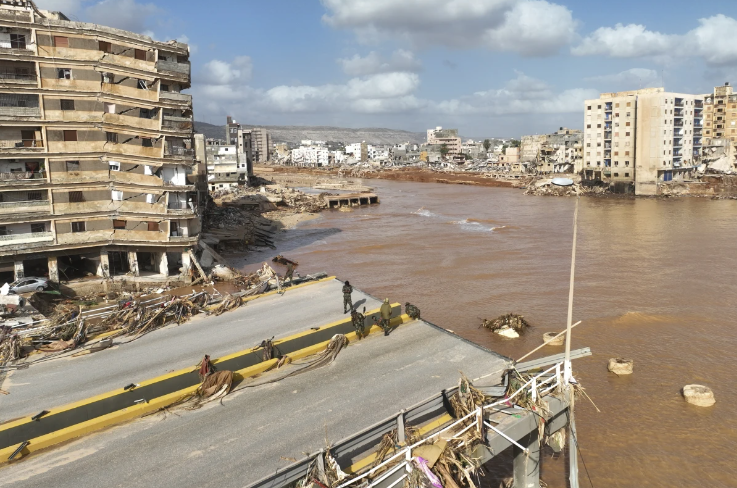
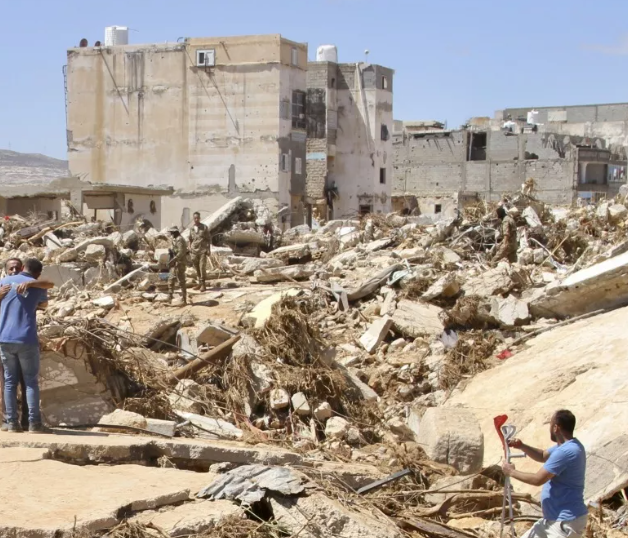
Like many people, I've been deeply saddened by the news and images coming out of the north African countries of Morocco and Libya. Each has been recently devastated by natural disasters. In Morocco, it was a powerful earthquake (above); in Libya, a massive flood (right).
International aid groups have mobilized in Morocco, where a 6.8 magnitude earthquake has killed 2,681 and injured more than 2,500, and Libya, where thousands are reported dead and more than 10,000 still missing from flooding.
In the wake of such devastation it’s easy to feel despairing and powerless, but there are things we can do to make a difference. For instance, a while back I committed to giving monthly to both Doctor’s Without Borders and UNICEF. I gave an additional donation this evening to UNICEF for their work in both Morocco and Libya.
Perhaps you too are already helping in some way. If not, I invite you to consider donating as you are able to one or more of the following humanitarian organizations. Thanks!
Following (with added images and links) is a September 9 message from UNICEF about the situation in Morocco.
The search for survivors continues in Morocco following a magnitude-6.8 earthquake, the most powerful quake to hit the area in more than a century. Families in several cities in Morocco rushed out of their homes and into the streets after a powerful earthquake struck at 11:11 p.m. on Sept. 8, 2023. A 4.9 magnitude aftershock followed 19 minutes later; several more have been reported.
Buildings collapsed, leaving nearly 3,000 people dead and more than 5,500 injured. The urgent search for survivors continues.
The epicenter of the magnitude-6.8 quake was in the High Atlas Mountains about 45 miles southwest of the city of Marrakech.
Many Moroccan children and their families are trapped under the rubble of their homes. According to the Ministry of Education, 530 schools and 55 boarding schools have been damaged. Damage to parts of Marrakech’s Medina, a UNESCO World Heritage Site, has also been reported. Hospitals in the city are receiving an influx of injured people, where authorities have called on residents to donate blood.
More than 380,000 people live within 30 miles of the epicenter. Rescuers are struggling to reach remote mountainous villages over roads blocked by debris.
António Guterres, United Nations Secretary-General, issued a statement saying the United Nations is ready to assist the Government of Morocco in its efforts to aid the impacted population.
The United Nations is in constant communication with the authorities to support assessment and response to the situation. Consultations are ongoing in order to further identify areas where the UN and its partners can provide support in the coming hours and days.
In an earthquake and other emergencies, children are always among the most vulnerable. Children and families displaced by the Morocco earthquake will need shelter, safe water, medical care, protection and psychosocial support. Morocco earthquake survivors will need help to rebuild their lives.
Whenever and wherever emergencies strike, UNICEF puts children first. Your donation helps UNICEF stay at the ready to provide emergency support for children and their families. Please donate today.
Morocco is a country I’ve long wanted to visit, in part because of the stunning architecture of many of its historic buildings, including mosques, riads (traditional townhouses with a courtyard), tombs, and palaces – all beautifully adorned with colorful tiling and intricate plasterwork. Sadly, many of these building have been damaged or even lost completely because of the recent earthquake.
I close by sharing some images of the unique beauty of Morocco that I’ve collected over the years. I share these images in a spirit of love and healing for the people of Morocco.
Opening image: A man walks through rubble in an alleyway in the earthquake-damaged old city in Marrakech on September 9, 2023. (Photo: UNICEF/UNI433684/Senna/AFP)
Throughout most of his adult life Lumumba resisted and spoke out against colonialism. It was a defiant stance, one that led to his murder during the coup orchestrated by his political opponents within Congo as well as a number of players outside the country, including Belgium (Congo’s former colonial ruler) and the U.S.
The CIA initially planned to assassinate Lumumba, with one potential plot involving poisoning his toothpaste. What actually eventuated was Lumumba’s arrest in December of 1960 and his torture and execution by firing squad on January 17, 1961. Soldiers from the former ruling Belgian authorities later dug up his body, dismembered it and dissolved it in sulphuric acid, grinding what was left to powder and scattering it. The only known remains of Lumumba, comprising a tooth, were returned to his family and buried last year in the mausoleum built in his honor in Congo’s capital, Kinshasa.
“Lumumba lived and died fighting for the liberation of African people from the shackles of colonial powers,” notesGauri Lankes News. “His legacy lives in the struggle of African nations against neo-imperialism.”
In commemorating the life of Patrice Lumumba on the anniversary of the start of the coup that would take his life, I share an article by Mose Apelblat published earlier today in The Brussels Times. The focus of Apelblat’s article is Belgian sociologist and historian Ludo De Witte’s search for truth and justice in Lumumba’s assassination. It’s a lengthy but essential read.
____________________
Truth and Justice in the
Assassination of Patrice Lumumba
By Mose Apelblat
The Brussels Times
September 14, 2023
Belgian expert Ludo de Witte has written two books about Belgium’s colonial past. Ahead of a new book by journalist Stuart A. Reid (The Lumumba Plot: The Secrete History of the CIA and a Cold War Assassination), he says that he still sticks to his conclusion that Belgium was primarily responsible for Lumumba’s death.
When the Belgian Congo gained independence in 1960, 35 years-old Patrice Lumumba became the country’s first prime minister, only to be assassinated shortly afterwards in a plot with Belgian involvement, while Congo descended into chaos despite the presence of United Nations peacekeeping forces.
In a book published in 1999 by Belgian sociologist and historian Ludo De Witte [right], the author concluded that Belgium was primarily responsible for Lumumba’s death. The book resulted in the establishment of a parliamentary commission of inquiry to determine the exact circumstances of the assassination of Lumumba and the possible involvement of Belgian politicians.
“Belgium’s responsibility is beyond any doubt,” he told The Brussels Times in an interview about Reid’s book, due to be published in October. De Witte is an expert on Belgium’s colonial past and worked six years on his book on Congo.
Tragic series of events
“The problem with all reports and books, including my own book [left], is that they don’t look into the whole picture and don’t include all actors”, says de Witte, referring to Belgium, the U.S., the United Nations, the Soviet Union, and local Congolese actors. But he still sticks to his main conclusion and lists a number of compromising facts in the tragic series of events that led to Lumumba’s’ death.
When chaos erupted in Congo, Joseph-Désiré Mobutu Sese Seko, the army colonel who later would become the despotic ruler of Congo, stepped in and took power with his troops. He placed Lumumba under house arrest in his residence, guarded by Congelese and UN troops. Lumumba managed to flee by hiding in a car, but was captured on 1 December 1960 and imprisoned again.
On 17 January 1961, Lumumba was brought by Mobutu’s soldiers to the breakaway region Katanga, which was ruled by Moïse Tshombe, urged to do so by the Belgian Minister of African Affairs. Allegedly it was because it was feared that Lumumba could be freed by his supporters. In practice it was a death sentence.
Belgian secret agents organized his transfer from prison. He was flown on a Belgian Sabena plane to “custody” in Katanga. Belgian officers reported how he was treated there and even participated in the torture of him. They were ordered to shoot him if there was any attempt to free him. They organized the firing squad.
Within five hours after the arrival of Lumumba and two of his collaborators, they were brought to an open spot in the savanna and executed.
This does not absolve the US and the UN from their responsibility, De Witte says. They also played an important role in undermining Lumumba. The US planned already in mid-August 1960 to assassinate him. But the only plan which actually was carried out and led to his death was the Belgian plan.
In August 1960, finding no help from the West and the United Nations to end the Katangese secession, which was organised by Belgian officials and military, Lumumba asked the Soviet Union for support. The Soviet Union sent trucks and airplanes. In the atmosphere of the Cold War in the ’60s, this was enough to regard Lumumba as a dangerous Communist.
Belgium’s colonial interests
But De Witte does not agree with the common perception that the assassination of Lumumba should be understood in the context of the Cold War. “The role of the Soviet Union has been blown up beyond any proportion,” he says. “Four of the five resolutions in the UN Security Council were accepted by the Soviet Union. It abstained on voting on the fifth resolution which was taken after the assassination.”
All odds seemed against Lumumba. “He was not naïve but he miscalculated the support he could get from African-Asian non-aligned countries,” De Witte says.
“I was happy to have finished the book but the work didn’t finish since then,” he added. In 2021, he published another book on Belgium’s colonial past, this time on Burundi. He found a similar colonial pattern in Congo and Burundi with Belgium trying to preserve its interests. In both countries, the elected prime ministers were murdered in connection with independence.
Patrice Lumumba was murdered shortly after Congo had become independent. Lous Rwagasore, a member of a royal family in Burundi, who had been elected to prime minister with an overwhelming majority, was murdered on 13 October 1961 with the consent of the Belgian governor. Burundi would gain independence the following year.
[Belgium’s] King Baudouin played a disastrous role in both countries, according to De Witte. Brought up in conservative Catholic milieu and under the influence of his father Leopold III, who had been forced to abdicate from the throne, the King detested both prime ministers. But in Burundi, the perpetrators were quickly caught, brought to justice and sentenced to death or long prison sentences.
UN’s failed responsibility
As regards UN’s role, De Witte replied that it is difficult to fully explain it. “The Congo crisis and the deployment of UN peace keeping troops (the “Blue Helmets”) was United Nations’ first real test and it failed miserably.”
The legitimate Congolese government pleaded for help from the United Nations, headed by Swedish Secretary-General Dag Hammarskjöld. Following a UN Security Council resolution, UN peacekeeping troops under the command of another Swede, Major General Carl von Horn, were sent to Congo.
De Witte blames the Swedish general for being directly responsible for the capture of Lumumba by soldiers answering to Mobutu. Lumumba had sought refuge at the encampment of Ghanaian UN troops. They were commanded by British officers but 100% pro-Lumumba. The troops were told by von Horn that they under no circumstances were allowed to take Lumumba into protective custody.
When Hammarskjold was asked about it at the UN Security Council he lied blatantly, according to De Witte. “He wanted to destroy Lumumba politically and didn’t realize that handing him over to his enemies meant a certain death sentence.” Hammarskjöld was surrounded by four aides, three of which were former US secret service agents.
Hammarskjöld died in a September 1961 in a plane crash on his way to talks with Tshombe. He was posthumously awarded the Nobel Peace Prize and is considered a hero in Sweden. “I don’t think that Hammarskjöld changed his opinion about Lumumba even after he was murdered,” De Witte says.
No justice served
The official Belgian report from 2002 urged the readers to regard what happened in Congo in light of the Cold War in the ’60s, “with different standards, ethics and norms.” But this is a ridiculous excuse, De Witte says.
“Assassinations and war crimes were forbidden and criminalized already then. The report did ascribe moral responsibility to the Belgian government but there were no legal consequences. In fact, the report did not adhere to the Parliament’s directive to assess the personal responsibility of those involved in the plot.”
“The conclusions in the report as regards Lumumba’s family were disgraceful,” he continues. Instead of recommending paying compensation to the family, given Belgium’s responsibility, the government proposed to establish a fund in Lumumba’s memory for support to the democratic development of Congo. The family would manage the fund. But the fund was never established.
In 2011, the family turned to the courts and sued the Belgian government for not honouring the decision. They also wanted to bring the suspected perpetrators to justice and named twelve persons. The case was admitted because the assassination of Lumumba was considered a war crime according to Belgian penal law. There is no prescription of such crimes when Belgians are involved.
A judge was appointed and he is still working on the case. By now only one of the suspects is still alive. Asked in 2020 about the slow pace, the federal prosecutor referred to the lack of staff. The inevitable conclusion is that there is no interest in finalizing the investigation and bringing the case to a closure.
The aftermath
If there is no trial, how can there be accountability? De Witte mentions two alternatives. The case could be brought to an international court, for example the International Criminal Court (ICC) in the Hague which tries individuals charged with war crimes. Another option could be a citizen-based public tribunal to raise awareness about the assassination and contribute to some form of accountability.
Meanwhile, some change is happening, albeit slowly. In 2018, the Patrice Lumumba Square was inaugurated in Brussels, on the corner of the Porte de Namur, next to the Matongé district, the heart of the city’s Congolese diaspora.
In the summer of 2020, the death of George Floyd in the US and the subsequent Black Lives Matter protests spread to Belgium and led to a clamour of calls for the country to remove its colonial-era statues and monuments – and do more to recognise its culpability towards Lumumba.
And then, there was the gold-capped tooth. It was all that was left of the remains of Lumumba that had been taken and kept for years as a trophy by a Belgian police officer who had not been involved in the execution of Lumumba but been ordered to dispose of his body after he had been killed.
The tooth was handed over to Lumumba’s family at a ceremony in the Egmont Palace in Brussels in June 2022. Prime Minister Alexander de Croo said that Belgium recognised its “moral responsibility” for Lumumba’s killing. “This is a painful and disagreeable truth, but must be spoken. A man was murdered for his political convictions, his words, his ideals.”
The plane crash where Dag Hammarskjöld and fifteen others on board died in 1961, is still unsolved. The first investigations concluded that the most likely cause of the crash was pilot error. The UN investigation, which was renewed in 2015, mentioned the probable existence of communication interceptions which could have enabled an attack against Hammarskjöld's plane.
The crash is still a national trauma in Sweden. The UN investigation, which was conducted by Tanzanian lawyer Mohamed Chande Othman, was again extended in December 2022 at the request of Sweden.
A member of the Swedish parliament, Christian-Democrat Gudrun Brunegård, recently filed a proposal to establish a “truth commission” to examine Sweden’s political considerations in 1961-62 and analyze documents that still are classified as secret. However, her proposal was rejected by the foreign affairs committee of the Swedish parliament.
– Mose Apelblat The Brussels Times
September 14, 2023
Above: A portrait of Patrice Lumumba by Ian Matchett. In writing about Lumumba in 2001, Colin Legum, a journalist, author, and notable anti-Apartheid activist, said: “I had got to know Lumumba reasonably well. . . . I found him gentle, and advanced in his social ideas, formed by his Christian beliefs and admiration for social democratic ideas. . . . Under different circumstances he could have been an impressive leader and saved the Congo from its terrible fate under the likes of the kleptomanic Mobutu.”
Well, look at you! All aglow in the light of a new day. . . . And today IS a new beginning for you, my friend. I hope and pray that that’s how you also choose to see it and live it – today and every day.
____________________
Great Spirit
Thank you for this new day
and the new start it brings me.
Thank you for the beauty, light, and possibilities
that this and every new beginning holds for me
Thank you for this chance to begin again.
As I move forward into the new day before me,
guide me in knowing what to hold on to
and what to let go of so that
I may not just survive but thrive.
As I cross the threshold upon which I stand,
may I choose to become, in big ways and in small,
a living embodiment of your transforming power.
May I know transformation in my life.
Give me strength and compassion for the journey ahead.
Show me the light within myself and others.
Help me recognize the good that is available everywhere.
May I be both a receiver and giver of love and healing.
Lead me in your ways of trust and generosity,
so that I may know for myself –
and cultivate for others – life in abundance.
Center me in a constant awareness of your presence
so that I may know and embody
your peace, wisdom, and courage.
Peace between Ukraine and Russia will not automatically result from “exhaustion” or a “stalemate”: Things don’t work that way. President Joe Biden is surely correct in believing that only negotiations can end the war. However, initiating them is complicated. Back-channel talks are already being held between various political participants of the conflict. None of the combatants will admit that, however. President Vladimir Putin of Russia and President Volodymyr Zelenskyy of Ukraine have staked their reputations on winning this war, not securing a tie, and certainly not by admitting military collapse. It is a mistake to assume that their interests, and that of their governments, are identical with those of civil society and the citizenry.
. . . Black-and-white presentations of the conflict by mass media have contributed to the mess. Russia has undoubtedly turned into a neo-fascist state. For all his charisma, Zelenskyy is no saint. Western media have been irresponsible in essentially ignoring the repression of dissidents, squandering of resources, disarray among military leaders, and rank corruption that characterize his illiberal regime. Ukraine is currently under martial law. Its president’s statement that elections planned for 2024 might be suspended unless allies extend “help,” to the tune of $5 billion, amounts to an extortion that plays on loyalty. On both sides, critics feel threatened, innovative proposals are dismissed, compromise is made more difficult, and the cause of peace is being hindered.
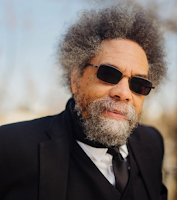
Cornel West – author, scholar, and Professor of Philosophy and Christian Practice at Union Theological Seminary – announced in June that he was seeking the Green Party’s nomination for President of the United States in their primaries. (Earlier in June West had said he was running for president as a People’s Party candidate.)
As a third-party candidate, West is being accused by some on the left as being a “spoiler” candidate, one who will take votes away from Joe Biden and thus help secure a win for Donald Trump in November 2024. It’s a long-standing accusation leveled at third-party candidates, and one Meagan Day addressed back in 2017 when Democrats were accusing Green Party candidate Jill Stein of “stealing” votes from Hillary Clinton in the 2016 presidential election, thereby helping elect Trump. Day’s response to this charge remains as important tody as it did in 2017.
The fixation on the third-party vote is a decoy. Worse, it’s a fundamental miscalculation, especially for Democrats, who have a slightly better chance than Republicans of activating [the] dormant electorate [i.e., the roughly 40 percent of eligible American adults who declined to vote at all in the 2016 presidential election]. Or at least they could if they were willing to make material concessions to poor people of color at the expense of the donor class.
“Trump’s victory margin smaller than total Stein votes in key swing states,” carped a headline at The Hill in 2016, one of dozens or hundreds like it. But where are the headlines that read, “Trump’s margin of victory dwarfed by the number of poor non-voters in key swing states”? That’s the conversation we need to be having. Not which weight tipped the scale, but why the scale only holds half the weights to begin with.
More recently, Lucas Guzman addressed voting third-party in a counterpoint he wrote last October for The Daily Texan. Guzman writes in part:
Many people claim voting for third-party candidates is just as worthless as not voting at all, but this couldn’t be farther from the truth. In state-level races such as California or Alabama, two states known for their partisan views, the leading party isn’t likely to change anytime soon. However, your dissenting vote will allow you to support a candidate that fairly represents your views, and can even serve as an opposing voice holding the leading party accountable. Voting for third party candidates could also force competitive races to have an even greater focus on policy in general, leading to more open conversations.
West, of course, wants to do more than facilitate “more open conversation,” as important as this is.
“I am running for truth and justice and as a candidate for president of the United States in the Green Party,” West says on his campaign’s official website. “I want to reintroduce America to the best of itself – the dignity, courage, and creativity of precious everyday people. Join our movement for priceless poor and working people of all colors here and abroad.”
“The Democratic party is beyond redemption”
About a week ago, Cornel West appeared on The Hill’s Rising podcast and talked with hosts Briahna Joy Gray and Robby Soave about his third party presidential run.
I should say that I don’t care for how Rising often promotes it’s various segments, with tabloid-looking and -sounding headlines. That being said, these segments’ actual content is generally always insightful and worthwhile. Case in point: the following interview with Cornel West. . . . Now, even though at this stage I remain 100% supportive of Democratic presidential candidate Marianne Williamson, whose platform very much overlaps with West’s, I found Rising’s interview well worth watching as it elicits some very powerful and inspiring observations from Dr. West on the dismal state of the Democratic party and the political, economic and moral state of the U.S.
The Democratic party has no fundamental intention of speaking to the needs of poor people or working people. They are dominated by their corporate wing; they’re dominated by the militarists when it comes to foreign policy; and [progressives like] Bernie and AOC and others are, in a certain sense, window dressing at worst, and, at best, people to appeal to every four years. But the Democratic party is beyond redemption at this point when it comes to seriously speaking to the needs of poor and working people.
I think we’ve reached such a low point that . . . we [need to] go for broke and try in fact to reshape our political system. [Yet things like] rank choice voting and proportional representation [which] would be possible things . . . the Democratic party has no interest in whatsoever. It’s clear that Biden and company have no serious interest in trying to scale back on the militarism abroad; they have no serious interest in trying to make poor and working people a priority. . . . And part of the paradox here is that the neo-fascism that’s escalating in predicated on the rottenness of the system in which the Democratic party facilitates that frustration and desperation because it can’t present an alternative [to the current status quo of the GOP’s neo-fascism and it own neoliberalism]. And if the system – if America – is unable to present an alternative to the Democratic party’s [neoliberalism] then we’re going fascist. We just need to acknowledge that. We’re going to go sooner or later. . . . So we’ve got to have some kind of break [from the status quo] or at least raise our voice and [speak to] the truth about our condition.
– Cornel West August 29, 2023
A “legitimate and sensible alternative” . . . but not the only one
Thanks to my friend William D. Lindsay, I recently became aware of an insightful article about Cornel West and his candidacy by Wendell Griffen, Pastor at New Millennium Church in Little Rock, Arkansas. Following is an excerpt from Griffen’s August 29 piece, "We Should Not Disregard or Disrespect Cornel West’s Candidacy for President of the United States."
Why shouldn’t [we] treat Cornel West as a legitimate and sensible alternative to any of the other people who are announced candidates for the highest elective office in the United States? Whether you agree with West or not, why should you refuse to consider his candidacy as a prophetic and politically sensible alternative to any of the other candidates?
Why not weigh his values, vision, and commitment to democracy, inclusion, justice, peace, and global well-being alongside what the other candidates believe? Isn’t that essential for sound decision-making?
I’ve heard people – including those I deeply respect – say that West’s candidacy benefits Donald Trump. They admit that West has taught, written, lectured, advocated, and agitated for decades about matters and issues they care about.
They have a more favorable view of West than Joe Biden. However, these serious-minded people say that West’s Green Party candidacy will benefit Donald Trump by siphoning likely Democratic voters from Biden in the November 2024 presidential election.
I find that viewpoint unsound.
Biden’s approval rating among Black, Latino, Asian, Indigenous, women, the LGBTQ+ community, elderly, and working-class voters has been lukewarm, at best, for most of his presidency. Cornel West is not responsible for Biden’s low approval rating among likely Democratic voters.
It is fanciful to think that those voters will vote for Biden in large numbers if West is not on their ballot as the Green Party presidential candidate in 2024. A convenient fanciful notion is – wait for it – fanciful, no matter how much we might enjoy it. The fact that it is convenient, or even desirable, does not make the notion credible, let alone persuasive.
Voters who hold lukewarm views about Biden’s presidency have several options. Some will vote for him anyway. Others might vote for a third-party candidate (such as Cornel West) with whom they more strongly agree. Some voters might decide to “stay home.”
People concerned about Cornel West’s Green Party campaign for the U.S. presidency do not think that disgruntled and lukewarm Democratic voters are likely to vote for Donald Trump, or for any of the other politicians currently campaigning to be chosen as the Republican Party nominee in 2024. They fear that Trump’s right-wing base of white religious nationalists, neofascist imperialists, military adventurists, and free market capitalists will vote Trump back into power unless disgruntled and lukewarm Democratic voters re-elect Joe Biden and Vice President Kamala Harris.
But if Joe Biden cannot persuade voters that he deserves their votes, no one should blame Cornel West. Instead, we should admit that those voters are free to vote for a presidential candidate whose record squares with their views and values.
They owe Biden no political fealty and are not required to serve the interests of the neoliberal capitalists who run the Democratic Party, whether West runs for president or not. Their voting preferences should be based on their realities, their histories, and their hopes.
A major critique I have of Wendell Griffen’s article on Cornel West is that towards the end of it he incorrectly writes that, “West should not be blamed because the Democratic and Republican Parties have offered no comparable candidates.”
I wonder: is it because Williamson’s a woman that she’s ignored?
Is it because she openly integrates spiritual and moral themes into her politics?
Or is it because the type of spirituality she emphasizes and embodies is often (and erroneously) labeled and dismissed as “New Age” that she’s routinely invisibilized?
I don’t have the answers, but the fact that these questions are present in the midst of Williamson’s genuinely progressive and refreshingly hope-filled presidential campaign is both disappointing and frustrating.
My friend David Weiss had the same critique, and I’ll close this post by sharing what he recently wrote on my Facebook page.
I had the *same* reaction in reading Wendell Griffen’s piece. Very appreciative of his amplifying Cornel West’s core and compelling vision, but caught off guard by the quick pivot to suggest he was the *only* candidate with such a transformative vision. Although West’s and Williamson’s visions (and temperaments) are not identical, they BOTH present a searing critique of a Democratic party establishment that seems satisfied to be “not-Republican,” rather than socially transformative. That party satisfaction with a merely mediocre vision of social well-being is perhaps the single biggest threat to our democracy, because it will invite the disenchanted and disempowered to simply stay home (or vote Green) because neither major party makes a credible claim to their vote.
Opening image: Philosopher Dr. Cornel West speaks onstage during the “Black America Since MLK: And Still I Rise” panel discussion at the PBS portion of the 2016 Television Critics Association Summer Tour at the Beverly Hilton Hotel on July 29, 2016, in Beverly Hills, California. (Photo: Frederick M. Brown/Getty Images)
You don’t need to give me reasons
I understand
Some things are best kept secret
And you’ve done all you can
I want no recompense
Just as much as you can give of yourself
If that makes sense
Go on, tell me that you love me
Show me you dare
We may not venture out in public
At least I know you care
It can’t be guaranteed
Just give me what you can of yourself
That’s all I need
No one will know who you are
I think it’s possible
Only to love
You play such silly games
But if everyone knew about us
I’d feel no shame
The bad news [for Donald Trump] keeps coming in his manifold legal battles, because courts evidently deal in facts, not lies, feints, boasts or fantastical bunkum. . . . The week’s legal rulings come as a hallowed capstone on an already perfect record wherein Trump has lost on every key issue, civil or criminal, in every major legal fight, starting with his over 60 failed court challenges to his election loss; none found any evidence of substantial fraud, though some managed to get his attorneys disbarred. In their wake, of course, more than 1,000 rioters from January 6 have been charged, and over 480 have been convicted – including former Proud Boys leader Enrique Tarrio, who on Tuesday got 22 years in prison, the longest sentence yet. Trump’s multiple failures reveal the chasm between the paranoid bombast and inane excuses his “sycophant Keystone attorneys” serve to the rabid likes of Fox or Newsmax, and the actual (not alternative) facts required to win in a court of law. His fate looks still bleaker now that he’ll be facing juries of ordinary Americans who largely follow the laws he’s brazenly flouted – any of whom, if they’d committed a fraction of his crimes, would “already be eating meat loaf and creamed corn.” In short: “Lock him up.”
If you feel lost, disappointed, hesitant, or weak, return to yourself, to who you are, here and now. And when you get there, you will discover yourself, like a lotus flower in full bloom, even in a muddy pond, beautiful and strong.
I established The Wild Reed in 2006 as a sign of solidarity with all who are dedicated to living lives of integrity – though, in particular, with gay people seeking to be true to both the gift of their sexuality and their Catholic faith. The Wild Reed's original by-line read, “Thoughts and reflections from a progressive, gay, Catholic perspective.” As you can see, it reads differently now. This is because my journey has, in many ways, taken me beyond, or perhaps better still, deeper into the realities that the words “progressive,” “gay,” and “Catholic” seek to describe.
Even though reeds can symbolize frailty, they may also represent the strength found in flexibility. Popular wisdom says that the green reed which bends in the wind is stronger than the mighty oak which breaks in a storm. Tall green reeds are associated with water, fertility, abundance, wealth, and rebirth. The sound of a reed pipe is often considered the voice of a soul pining for God or a lost love.
On September 24, 2012,Michael BaylyofCatholics for Marriage Equality MNwas interviewed by Suzanne Linton of Our World Today about same-sex relationships and why Catholics can vote 'no' on the proposed Minnesota anti-marriage equality amendment.
"I believe your blog to be of utmost importance for all people regardless of their orientation. . . . Thank you for your blog and the care and dedication that you give in bringing the TRUTH to everyone."– William
"Michael, if there is ever a moment in your day or in your life when you feel low and despondent and wonder whether what you are doing is anything worthwhile, think of this: thanks to your writing on the internet, a young man miles away is now willing to embrace life completely and use his talents and passions unashamedly to celebrate God and his creation. Any success I face in the future and any lives I touch would have been made possible thanks to you and your honesty and wisdom."– AB
"Since I discovered your blog I have felt so much more encouraged and inspired knowing that I'm not the only gay guy in the Catholic Church trying to balance my Faith and my sexuality. Continue being a beacon of hope and a guide to the future within our Church!"– Phillip
"Your posts about Catholic issues are always informative and well researched, and I especially appreciate your photography and the personal posts about your own experience. I'm very glad I found your blog and that I've had the chance to get to know you."– Crystal
"Thank you for taking the time to create this fantastic blog. It is so inspiring!"– George
"I cannot claim to be an expert on Catholic blogs, but from what I've seen, The Wild Reed ranks among the very best."– Kevin
"Reading your blog leaves me with the consolation of knowing that the words Catholic, gay and progressive are not mutually exclusive.."– Patrick
"I grieve for the Roman institution’s betrayal of God’s invitation to change. I fear that somewhere in the midst of this denial is a great sin that rests on the shoulders of those who lead and those who passively follow. But knowing that there are voices, voices of the prophets out there gives me hope. Please keep up the good work."– Peter
"I ran across your blog the other day looking for something else. I stopped to look at it and then bookmarked it because you have written some excellent articles that I want to read. I find your writing to be insightful and interesting and I'm looking forward to reading more of it. Keep up the good work. We really, really need sane people with a voice these days."– Jane Gael
"Michael, your site is like water in the desert."– Jayden